
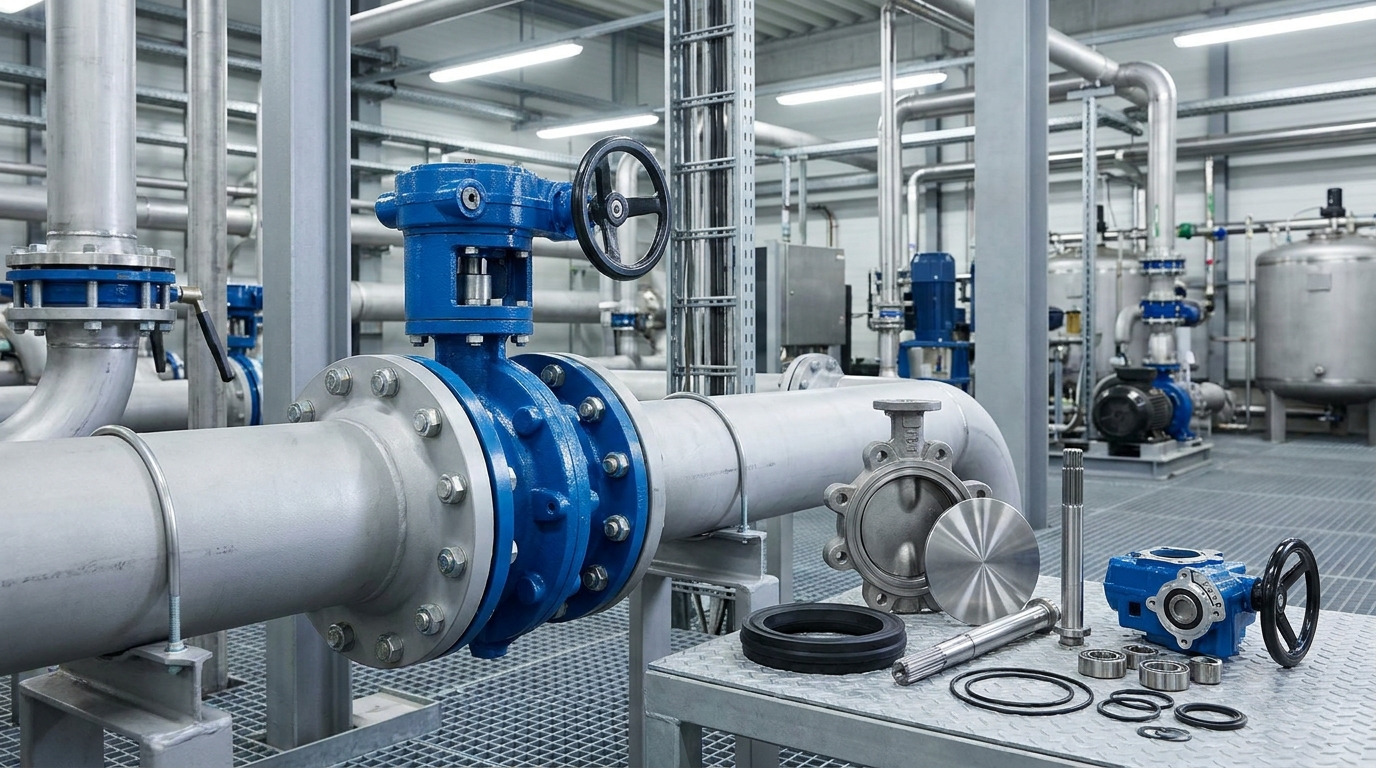
To master industrial flow control, you must learn the specific butterfly valve parts name and understand how these butterfly valve components work together to seal fluid lines. You are dealing with an unexpected pressure drop in your industrial piping system, and the line must be shut down immediately. The stress of diagnosing which internal part has failed under heavy wear can halt your entire production schedule and drive up overhead costs. To prevent these costly system disruptions, mastering the anatomy of these reliable flow control devices provides the perfect preventive solution. Choosing the right butterfly valve components ensures that your system remains safe, leak-free, and operational over millions of cycles.
Why do butterfly valve components matter in flow systems?
Butterfly valve components are vital because they work together to control fluid flow, prevent leakage, and ensure system pressure boundaries. Choosing high-performance butterfly valve components ensures that your entire processing system remains safe and runs at peak operating efficiency.
What is their primary role?
These individual parts determine how well your valve regulates, seals, and isolates the flowing media under heavy stress.
Think about it:
- The body holds pressure and connects to your pipes.
- The disc blocks or allows fluid passage.
- The stem translates external force to internal movement.
How do you choose them?
Selecting the proper material grades based on chemical compatibility and temperature limits prevents early failure of your equipment.
| Component Type | Common Materials | Primary Function |
|---|---|---|
| High Pressure | Carbon Steel, Alloys | Structural integrity under heavy load |
| Standard Use | Ductile Iron, PTFE | General fluid isolation and sealing |
You should always prioritize materials that match the chemical composition of your exact flow medium to avoid premature erosion.
Key Takeaway: Sourcing compatible material grades for each component is the ultimate safeguard against industrial leakage and unplanned shutdowns.
How do body-type butterfly valve components differ?
Body-type components differ primarily in how they connect to the surrounding piping, with wafer and lug designs serving different installation and pressure needs. Understanding the physical layout of these specific butterfly valve components helps you plan your piping system’s support structures correctly.
What is the wafer body?
The wafer style is designed to be sandwiched tightly between two pipe flanges using long stud bolts.
In other words:
- It is lightweight and highly economical.
- It does not transfer piping weight directly through the valve body.
- It requires flat face or raised face flanges for correct installation.
Why choose a lug body?
Lug bodies feature threaded bolt holes that allow you to bolt them directly to individual pipe flanges.
| Body Design | Threaded Lugs | Weight Load Support | Dead-End Service |
|---|---|---|---|
| Wafer | No | Low | No |
| Lug | Yes | High | Yes |
You should specify lug designs if your system requires downstream line maintenance while keeping the upstream side fully pressurized.
Key Takeaway: The choice between wafer and lug bodies dictates whether your line can support dead-end services or easy maintenance procedures.
Which butterfly valve components handle heavy disc wear?
The disc is the primary butterfly valve component designed to handle heavy wear by acting as the direct physical barrier against the flow stream. As the main flow closure member, the disc is subjected to constant high-velocity fluids and corrosive chemical mixtures. Selecting robust butterfly valve components ensures that your disc maintains its physical shape and seals tightly over continuous cycles.
What makes a disc durable?
High-strength alloys and protective coatings protect the disc face from cavitation and abrasive particles.
But here’s the catch:
- Thin disc profiles optimize flow coefficients and reduce turbulence.
- Polished disc edges minimize wear on the adjacent seat.
- Robust internal connections prevent stem slippage during rotation.
Which materials work best?
Selecting the right metal or polymer lining determines how long your valve disc can survive in harsh services.
| Disc Material | Best Application | Chemical Resistance | Wear Resistance |
|---|---|---|---|
| Stainless Steel | Corrosive chemicals | Outstanding | Excellent |
| Ductile Iron | Water utilities | Moderate | Good |
| Nylon Coated | Slurries and powder | High | Very High |
Stainless steel discs remain the industry B2B benchmark for general chemical services due to their resistance to pitting and oxidation.
Key Takeaway: Investing in high-grade disc materials pays off by preventing premature erosive wear and keeping your flow control precise.
Are stem-related butterfly valve components critical?
Yes, stem-related components are highly critical because they transmit the torque from the actuator to rotate the disc and control flow. The stem links the outside world to the internal mechanisms of your valve, bearing the brunt of the mechanical forces. High-quality stem design is essential among your chosen butterfly valve components to avoid mechanical failures under pressure.
How do split stems perform?
Split-stem designs utilize two separate shafts inserted into the disc to provide an unobstructed flow path.
Here is why:
- They offer higher flow coefficients.
- They reduce pressure drop across the process line.
- They require precise internal alignment during assembly.
What is a one-piece stem?
A solid, one-piece stem runs completely through the disc to offer maximum mechanical strength and rigidity.
| Stem Design | Mechanical Strength | Flow Resistance | High-Pressure Suitability |
|---|---|---|---|
| Split-Stem | Medium | Low | Low to Medium |
| One-Piece | High | High | High |
You will want a solid one-piece stem for high-torque applications where shearing is a major operating risk.
Key Takeaway: Choosing the correct stem configuration ensures that your valve can handle operating torques without risking a sudden shaft shear.
How do seat-style butterfly valve components seal tight?
Seat-style components seal tight by utilizing an interference fit between the resilient or metal seat material and the rotating disc edge. A secure seal depends on the continuous contact pressure between the valve seat and the disc boundary. Evaluating these critical butterfly valve components helps you match the elastic properties of the seat with your line’s pressure.
Why use elastomer seats?
Elastomeric seats deform under the pressure of the disc to form a perfect bubble-tight seal.
Think about it:
- EPDM excels in water treatment systems.
- Buna-N handles hydrocarbon fluids and oils.
- Viton resists high-temperature chemicals and acids.
What about polymer seats?
Polymeric materials like PTFE provide superior chemical inertness and wider temperature ranges compared to standard rubbers.
| Seat Material | Chemical Resistance | Heat Suitability | Sealing Ability |
|---|---|---|---|
| EPDM | Medium | Moderate | Bubble-Tight |
| PTFE | Outstanding | High | Tight |
| Metal | Low to Medium | Very High | Class IV/VI |
You should select PTFE seats whenever your process line handles highly aggressive acids or high-purity fluids.
Key Takeaway: Match your seat elastomer or polymer to the specific media properties to maintain a leak-free bubble-tight seal.
What actuator-driven butterfly valve components exist?
Actuator-driven components include pneumatic cylinders, electric motors, and manual gearboxes that automate or facilitate the physical rotation of the valve’s stem. Actuators allow you to transition from manual operations to fully automated, remotely controlled flow systems. Sourcing the proper actuator-driven butterfly valve components is the key to achieving modern plant automation.
Are pneumatic systems better?
Pneumatic actuators use compressed air to deliver fast, reliable quarter-turn operations in safety-critical lines.
But here’s the catch:
- They require a steady supply of clean air.
- They offer exceptionally fast cycle times.
- They fail-safe using mechanical return springs.
How do electric models compare?
Electric actuators offer high precision and easy integration with digital control systems without requiring air lines.
| Actuator Type | Operating Speed | Energy Source | Control Precision |
|---|---|---|---|
| Pneumatic | Fast | Compressed Air | Moderate |
| Electric | Moderate | Electricity | High |
| Manual Gear | Slow | Human Effort | Low |
You should specify electric actuation when precise throttling and digital feedback loops are required in your facility.
Key Takeaway: Selecting the right actuation system directly impacts your operational cycle times and integration with plant-wide control networks.
How do bearing-based butterfly valve components support rotation?
Bearing-based components support rotation by reducing friction between the rotating stem and the stationary valve body, preventing alignment issues. Bearings keep the valve stem perfectly aligned and prevent off-center forces from damaging the delicate sealing elements. These supportive butterfly valve components run quietly in the background to lower overall torque requirements.
Why do bearings reduce wear?
Lowering the frictional coefficient on the shaft prevents premature wear and prevents the stem from binding.
In other words:
- They prevent side-load forces from damaging packaging.
- They extend the life of the stem seals.
- They maintain precise disc concentricity.
Where are they located?
Heavy-duty valves place bearings both above and below the disc to distribute mechanical stress evenly.
| Bearing Position | Main Purpose | Standard Material | Lubrication Need |
|---|---|---|---|
| Upper Stem | Radial alignment | Bronze / PTFE | Low |
| Lower Journal | Thrust absorption | Stainless / PTFE | None |
You should ensure your heavy-duty valves feature dual journal bearings to handle high differential pressures.
Key Takeaway: Robust shaft bearings are essential for minimizing operating friction and maintaining long-term sealing alignment.
Why do seal-type butterfly valve components prevent leaks?
Seal-type components prevent leakage by establishing tight, pressurized barriers around the stem and body-to-flange connections. Without reliable stem seals, pressurized process fluids would escape into the atmosphere and cause environmental hazards. Selecting advanced, seal-type butterfly valve components protects your personnel and helps you comply with strict environmental regulations.
What are shaft seals?
Shaft packing or O-rings are compressed around the rotating stem to block any axial fluid migration.
Here is why:
- They seal the atmospheric boundary.
- They accommodate minor shaft deflections.
- They allow online packing adjustments.
How do O-rings fit in?
Elastomeric O-rings provide secondary sealing back-up to guarantee zero-leakage performance under varying pressures.
| Seal Type | Temperature Limit | Pressure Suitability | Wear Life |
|---|---|---|---|
| V-Ring Packing | High | High | Long |
| O-Ring | Moderate | Medium | Medium |
You must regularly check and adjust stem packing systems to prevent minor weeps from turning into costly emissions.
Key Takeaway: Reliable stem packing and O-ring configurations are your primary line of defense against hazardous atmospheric emissions.
Which butterfly valve components withstand extreme heat?
Metal-seated components and high-alloy stems are specifically designed to withstand extreme thermal conditions where elastomeric seals would melt or degrade. High-temperature applications like steam or exhaust gas require materials that do not lose their mechanical properties under extreme heat. Utilizing specialized, high-temperature butterfly valve components prevents thermal deformation from seizing your flow lines.
How do metal seats endure?
Metal-to-metal sealing interfaces rely on precise machining and flexible metal bands to seal at extreme temperatures.
Think about it:
- They survive temperatures exceeding standard rubber limits.
- They resist erosion from abrasive particles.
- They tolerate rapid thermal cycling.
What alloys are preferred?
Stellite-faced discs and Inconel seats are widely utilized to provide maximum thermal stability and hardness.
| Component Material | Heat Resistance | Oxidation Resistance | Cost Factor |
|---|---|---|---|
| Inconel | Outstanding | Excellent | High |
| Stainless Steel | High | Very Good | Moderate |
You will need high-performance alloys when dealing with superheated steam or industrial furnace exhaust systems.
Key Takeaway: Hard-faced metal alloys and specialized seat geometries are critical for maintaining tight seals at extreme operating temperatures.
How do offset-style butterfly valve components work?
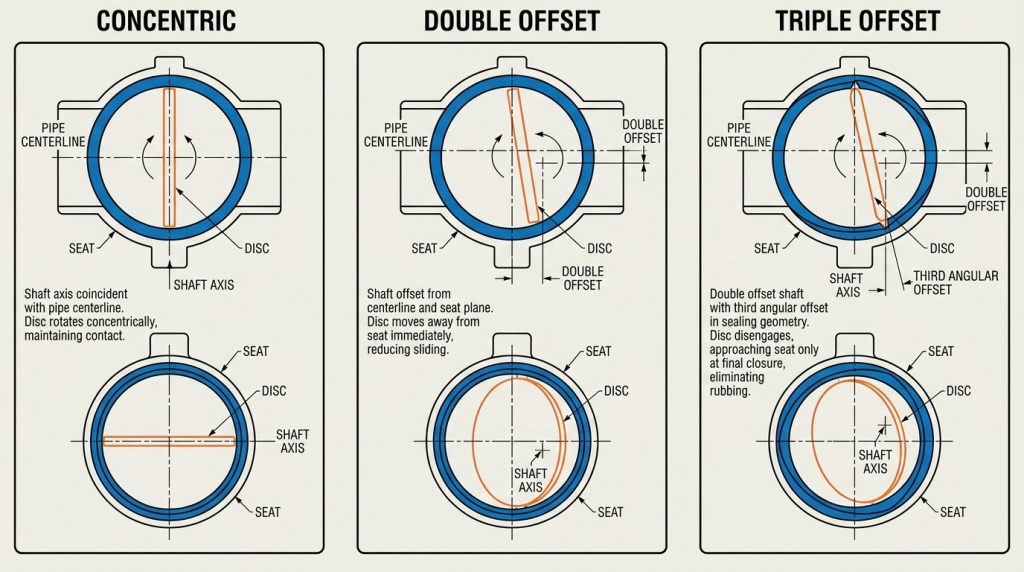
Offset-style components work by shifting the shaft axis away from the disc centerline, which minimizes seat rubbing and prolongs the service life of the valve. Concentric designs rub continuously, whereas offset configurations allow the disc to cam into the seat only at the final moment of closure. High-performance, offset-style butterfly valve components represent the pinnacle of rotary sealing technology.
What is a double offset?
Double offset designs shift the stem centerline both behind the seat and slightly to one side of the pipe centerline.
But here’s the catch:
- They break contact immediately upon opening.
- They dramatically reduce operating torque.
- They allow the use of PTFE seats.
Why select triple offset?
Triple offset designs introduce a third angular offset that creates a completely frictionless cone-in-cone sealing action.
| Offset Style | Contact Friction | Sealing Type | Seating Force |
|---|---|---|---|
| Double Offset | Low | Interference | Medium |
| Triple Offset | Zero | Torque-Seated | High |
You should always choose triple offset designs for critical isolation applications where zero-leakage is mandatory under extreme pressures.
Key Takeaway: Offset designs minimize seal friction to deliver exceptional valve life and lower the cost of automatic actuators.
How do you secure high-quality butterfly valve components?
Sourcing high-quality butterfly valve components requires partnering with a certified manufacturer who uses verified raw materials and strict testing protocols. If you are struggling with frequent valve failures or searching for highly reliable flow equipment, Ruito Flow is here to help you secure the ideal configuration. Our deep engineering expertise ensures every disc, seat, and stem stands up to the toughest processing challenges. Let us power your path to maximum efficiency; contact us today to build a leak-free tomorrow.
FAQs regarding butterfly valve components
How do I know if my seat needs to be replaced?
You will know by observing downstream leakage or a sudden drop in operating torque. When the internal seal wears out, fluid bypasses the closed disc, requiring immediate replacement of the elastomeric seal.
What’s the best material for corrosive acids?
PTFE is the best option because it offers near-universal chemical inertness. It resists corrosive attack from strong acids and maintains its structural shape over many operating cycles.
Can I use wafer-style valves for dead-end piping?
No, you cannot safely do this because wafer valves require pressure from flanges on both sides to remain securely positioned. Removing downstream piping will cause the valve to slip out under pressure.
How do I know if a double offset design is required?
You will know it is required if your system operates at medium-to-high pressures where standard concentric seats wear out too quickly. Double offset valves reduce seat friction and prolong service life.
Can I automate an existing manual butterfly valve?
Yes, you can do this by removing the manual handle and mounting an actuator onto the valve’s top flange. You must ensure the stem dimensions match standard ISO mounting patterns.