
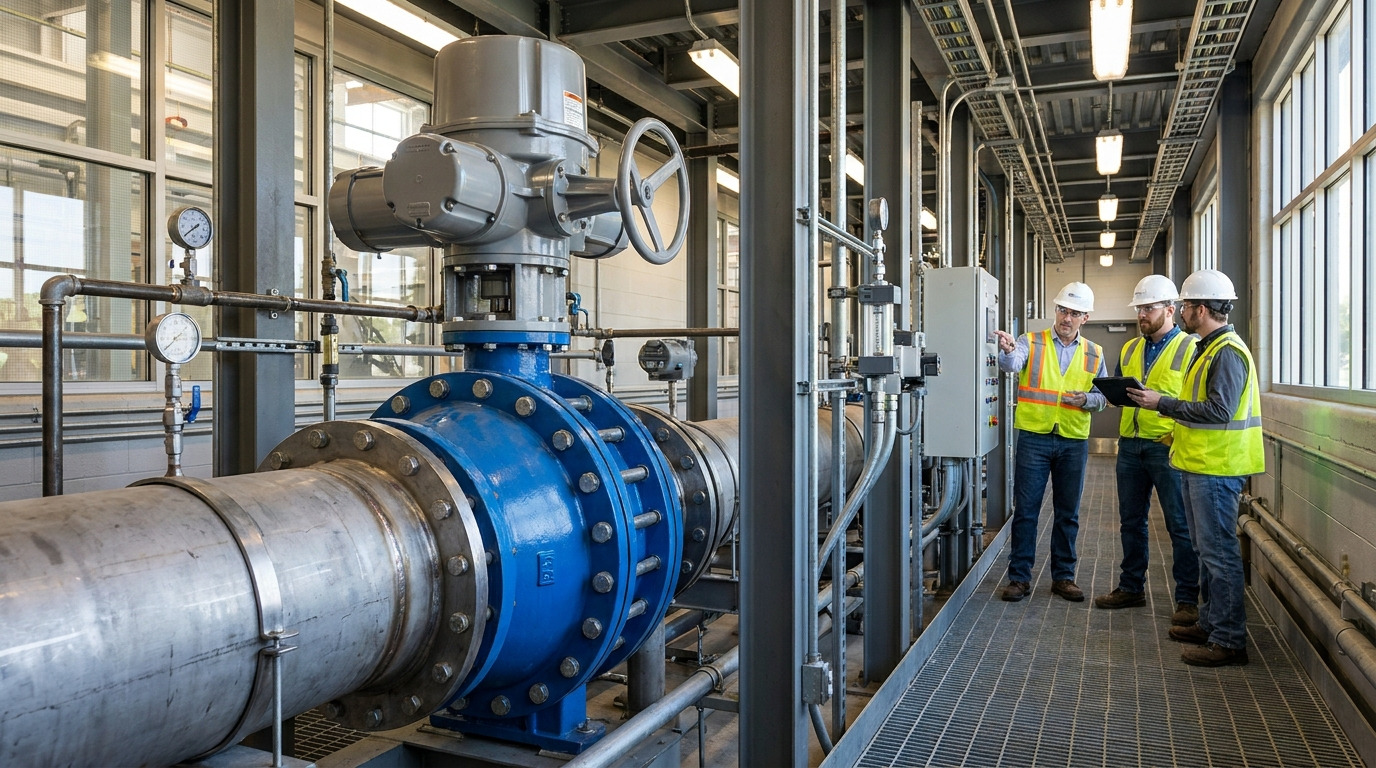
Yes, butterfly valves can be used effectively for throttling applications when you select the correct design and operational parameters for your specific fluid control needs. Imagine managing a high-pressure municipal water system where sudden surges constantly damage downstream equipment. The continuous repairs and operational downtime can cripple your budget and frustrate your engineering team. By integrating a specialized throttle butterfly valve into your pipeline, you can precisely modulate fluid flow, eliminate destructive surges, and protect your critical infrastructure with a reliable, cost-effective solution.
How Does a Throttle Butterfly Valve Work?
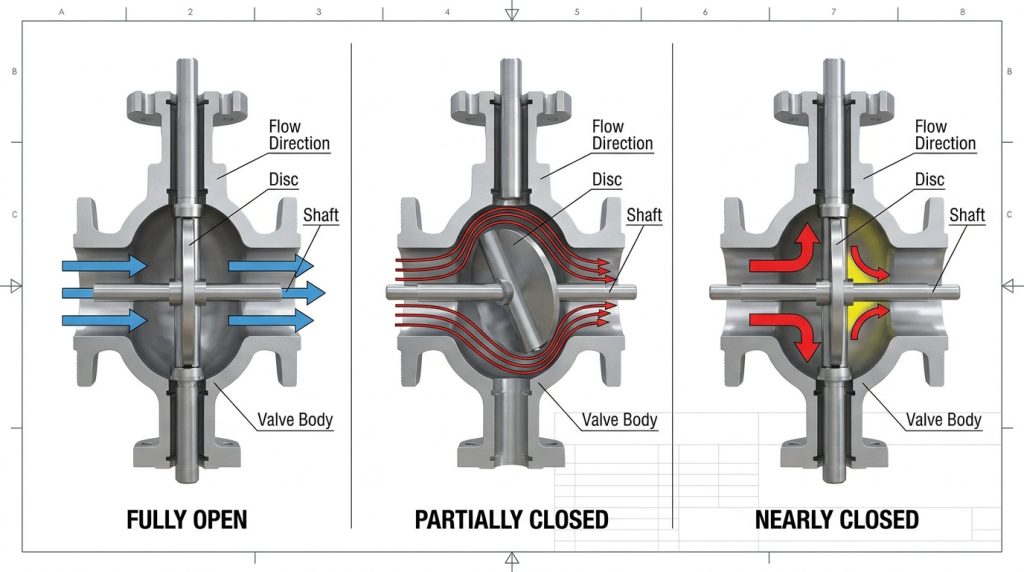
A throttle butterfly valve works by rotating a central disc on a shaft to partially obstruct the fluid path, creating a controlled pressure drop that regulates the flow rate. To achieve this, a throttle butterfly valve uses precise actuator mechanisms that hold the disc at specific angles against the fluid pressure.
What Is the Core Mechanism?
Here’s the deal: standard valves simply turn flow on or off, but a throttling mechanism requires sustained intermediate positioning. When the disc is fully open, resistance is minimal.
- The shaft connects the disc to an external actuator.
- The disc angle determines the exact flow coefficient.
- Resilient seats provide tight shut-off when fully closed.
How Do Angles Affect Flow?
As the disc rotates toward the closed position, the restricted opening creates a deliberate pressure drop. You can achieve different flow rates by locking the handle or setting the automated actuator to specific degrees of rotation.
Key Takeaway: Understanding the relationship between disc angle and flow reduction is essential for accurate system calibration.
| Position | Flow Characteristic | Resistance Level |
|---|---|---|
| Fully Open | Maximum Flow | Minimum |
| 45 Degrees | Moderate Flow | Medium |
| 15 Degrees | Restricted Flow | High |
This table demonstrates how incrementally closing the disc steadily increases fluid resistance.
What Makes a Throttle Butterfly Valve Effective?
A throttle butterfly valve is effective because its streamlined disc design offers minimal pressure loss when open and highly predictable flow modulation when partially closed. Selecting the right throttle butterfly valve ensures that your system maintains stable pressure without excessive wear on the internal components.
Why Is Design Crucial?
You might be wondering: can any standard valve handle flow regulation? The short answer is no, because standard valves often suffer from vibration and seat wear when left partially open.
- Specialized disc profiles reduce turbulence.
- Reinforced shafts prevent deflection under high pressure.
- Advanced seat materials resist erosion from high-velocity fluids.
How Does Automation Play a Role?
Modern facilities often connect these valves to SCADA systems for remote operation. This allows your team to make real-time adjustments based on pressure transducers and level sensors.
Key Takeaway: Combining a robust mechanical design with smart actuators significantly enhances flow regulation accuracy.
| Component | Function in Throttling | Wear Resistance |
|---|---|---|
| Disc | Modulates fluid volume | High |
| Shaft | Translates actuator torque | High |
| Seat | Prevents internal leakage | Moderate |
The data above shows that upgrading critical components directly impacts the longevity of the valve in demanding conditions.
Is a Zero Offset Throttle Butterfly Valve Suitable?
A zero offset throttle butterfly valve is generally not suitable for demanding throttling tasks because the disc constantly rubs against the seat, leading to rapid wear and significant flow restrictions. If you use a basic throttle butterfly valve in high-velocity pipelines, you risk premature failure and inconsistent control.
What Are the Limitations?
The truth is: zero offset designs are built for simple on/off isolation, not for holding intermediate positions under stress. Constant friction degrades the rubber seat over time.
- Friction occurs throughout the entire 90-degree stroke.
- High velocities can deform the resilient seat.
- They struggle to maintain stable flow at high pressure drops.
When Should You Avoid Them?
If your application requires fine flow control or operates continuously in a partially open state, avoid this design. The resulting pressure drops can disrupt downstream processes and trigger cavitation.
Key Takeaway: Reserve zero offset valves for low-pressure isolation and seek more advanced geometries for true flow modulation.
| Valve Type | Throttling Capability | Seat Wear Rate |
|---|---|---|
| Zero Offset | Poor | High |
| Double Offset | Excellent | Low |
| Triple Offset | Superior | Minimal |
This comparison clearly illustrates why zero offset designs fall short in continuous flow regulation scenarios.
How Does a Double Eccentric Throttle Butterfly Valve Perform?
A double eccentric throttle butterfly valve performs exceptionally well because its offset shaft design moves the disc away from the seat immediately upon opening, eliminating friction and wear. Upgrading to a double eccentric throttle butterfly valve extends the lifespan of your equipment and provides precise flow regulation.
Why Is the Offset Important?
Ready for the good part? By offsetting the stem from the centerline of the disc and the valve body, the disc only contacts the seat during the last few degrees of closure.
- Friction is dramatically reduced, extending seat life.
- Operating torque is lowered, requiring smaller actuators.
- The design allows for tighter shut-off at higher pressures.
Can It Handle High Velocities?
Yes, the robust construction prevents the disc from fluttering when subjected to high-velocity fluid streams. This stability is crucial when managing critical municipal or industrial water networks.
Key Takeaway: The double eccentric design is the industry standard for reliable and long-lasting flow modulation.
| Feature | Zero Offset | Double Eccentric |
|---|---|---|
| Shaft Position | Center | Double Offset |
| Friction Zone | 100% of stroke | Last 10% of stroke |
| Torque Required | High | Moderate |
These metrics reveal how mechanical offsets fundamentally improve both durability and operational efficiency.
What Role Does Cavitation Play for a Throttle Butterfly Valve?
Cavitation poses a severe threat to a throttle butterfly valve because the high fluid velocities passing through a partially closed disc can cause localized pressure drops that form destructive vapor bubbles. If you ignore the risk of cavitation, your throttle butterfly valve will suffer from rapid material erosion and heavy vibration.
How Do Vapor Bubbles Form?
This is where it gets interesting: when fluid squeezes past the restricted valve opening, its velocity spikes and its pressure plummets below the vapor pressure.
- Vapor bubbles form in the low-pressure zone.
- As pressure recovers downstream, the bubbles collapse violently.
- The implosions generate shockwaves that pit the metal surfaces.
How Can You Prevent Damage?
You must calculate the cavitation index for your specific system parameters before finalizing your valve selection. Sometimes, using two valves in series or changing the pipe diameter can mitigate the pressure drop.
Key Takeaway: Proactive system design and careful pressure management are essential to prevent cavitation-induced failure.
| Condition | Velocity | Cavitation Risk |
|---|---|---|
| Fully Open | Low | Minimal |
| 50% Closed | Moderate | Moderate |
| 15% Closed | Extremely High | Severe |
This table highlights the direct correlation between extreme flow restriction and the likelihood of destructive cavitation.
Are Plunger Valves Better Than a Throttle Butterfly Valve?
Plunger valves often provide better linear control and cavitation resistance than a standard throttle butterfly valve, making them ideal for extreme pressure drop applications. While a throttle butterfly valve is cost-effective for general use, plunger valves deliver superior precision in highly demanding environments.
What Makes Plunger Valves Unique?
But here’s the kicker… plunger valves feature an internal sliding cylinder that controls the flow area coaxially, maintaining a perfectly symmetrical flow path.
- The symmetrical flow reduces turbulence and vibration.
- Specialized anti-cavitation trims can be easily integrated.
- They offer near-perfect linear flow characteristics.
When Should You Switch?
If your system demands continuous throttling at very high differential pressures, a plunger valve is the superior engineering choice. They are especially popular in large-scale water transmission lines where failure is not an option.
Key Takeaway: Evaluate your maximum pressure drop; if it exceeds the safe limits of a butterfly design, transition to a plunger valve.
| Valve Design | Flow Path | Cavitation Resistance |
|---|---|---|
| Butterfly | Obstructed by disc | Moderate |
| Plunger | Symmetrical/Coaxial | Excellent |
| Gate | Linear | Poor |
The comparison proves that internal geometry dictates a valve’s ability to handle severe throttling duties safely.
How Does Sizing Impact a Throttle Butterfly Valve?
Proper sizing ensures that a throttle butterfly valve operates within its optimal opening angle, usually between 30 and 70 degrees, to provide stable and predictable control. An oversized throttle butterfly valve will operate too close to the closed position, causing erratic flow and increasing the risk of mechanical damage.
Why Is Oversizing Dangerous?
Let’s dig deeper: many engineers mistakenly match the valve size to the pipe diameter without calculating the actual flow coefficient (Cv) required.
- An oversized valve loses control accuracy.
- It operates at a nearly closed angle, increasing flow velocity.
- This setup rapidly accelerates seat wear and cavitation risks.
How Do You Calculate the Right Size?
You must use system flow data, pressure drops, and specific gravity to calculate the required Cv, then select a valve that achieves this Cv at a mid-range opening angle.
Key Takeaway: Accurate mathematical sizing is far more critical than simply matching flange dimensions.
| Valve Size | Operating Angle | Control Stability |
|---|---|---|
| Undersized | >80 Degrees | Poor (Restricted) |
| Correct | 30 – 70 Degrees | Excellent |
| Oversized | <20 Degrees | Poor (Erratic) |
This sizing matrix demonstrates that mid-range operation is the sweet spot for maintaining fluid stability.
What Are Key Criteria to Select a Throttle Butterfly Valve?
The key criteria to select a throttle butterfly valve include operating pressure, maximum fluid velocity, temperature, and media compatibility to ensure long-term reliability. By thoroughly analyzing these parameters, you can configure a throttle butterfly valve that perfectly matches your specific industrial application.
How Do Materials Affect Performance?
Picture this: using a standard cast iron body in a highly corrosive marine environment will lead to catastrophic failure within months.
- Stainless steel discs resist corrosion and pitting.
- Ductile iron bodies provide high tensile strength.
- PTFE or high-grade EPDM seats ensure chemical compatibility.
Why Does the Actuator Matter?
The actuator must deliver sufficient torque to hold the disc steady against the dynamic forces of the moving fluid. Electric or pneumatic actuators with positioners are mandatory for precise automated throttling.
Key Takeaway: A successful installation requires matching the valve body materials and actuator strength to the environmental realities.
| Media Type | Recommended Disc Material | Recommended Seat |
|---|---|---|
| Clean Water | Ductile Iron | EPDM |
| Corrosive Fluid | 316 Stainless Steel | PTFE |
| Abrasive Slurry | Hardened Steel | Metal |
Selecting the appropriate material combination is the first line of defense against premature wear and system downtime.
How Can You Maintain a Throttle Butterfly Valve System?
You maintain a throttle butterfly valve system by conducting regular visual inspections, monitoring actuator performance, and scheduling routine seal replacements before failure occurs. A well-maintained throttle butterfly valve will reward you with decades of uninterrupted service and optimal flow control.
What Should You Inspect?
Here’s the secret: preventative maintenance saves thousands in emergency repair costs and lost production time. You should establish a strict inspection schedule.
- Check the valve stem for signs of leakage or corrosion.
- Verify the actuator calibration and response times.
- Listen for unusual vibrations or cavitation noise during operation.
How Easy Is Part Replacement?
Modern high-performance valves are designed for inline maintenance, meaning you can replace seals and packing without removing the entire valve body from the pipe.
Key Takeaway: Consistent maintenance routines directly translate into higher system reliability and lower total cost of ownership.
| Maintenance Task | Frequency | Impact on Lifespan |
|---|---|---|
| Visual Leak Check | Monthly | High |
| Actuator Calibration | Annually | Critical |
| Seat Replacement | 3-5 Years | Vital |
Adhering to this basic maintenance schedule dramatically reduces the likelihood of sudden mechanical failures.
Can Upgrading a Throttle Butterfly Valve Enhance Efficiency?
Upgrading a throttle butterfly valve to a newer, high-performance model drastically enhances efficiency by reducing pressure drops, lowering energy consumption, and improving control precision. When you replace an outdated throttle butterfly valve with a modern double eccentric design, your entire pumping system works less to achieve better results.
How Does It Save Energy?
Think about it: pumps consume massive amounts of electricity pushing fluid against unnecessary resistance caused by poorly designed valves.
- Streamlined discs improve the overall flow coefficient.
- Lower operating torque requires less energy from electric actuators.
- Tighter control loops prevent costly fluid waste.
What Is the Financial Impact?
While high-performance valves carry a higher initial purchase price, the reduction in energy bills and maintenance costs typically results in a rapid return on investment.
Key Takeaway: View your valve upgrades not as an expense, but as a strategic investment in long-term operational efficiency.
| System Component | Old Valve Impact | Upgraded Valve Impact |
|---|---|---|
| Pump Energy Use | High | Minimized |
| Maintenance Costs | Frequent | Rare |
| Control Accuracy | Variable | Pinpoint |
These operational upgrades prove that modernizing your fluid control hardware yields immediate and measurable financial benefits.
How Can the Right Valves Transform Operations?
Selecting the proper flow control equipment ultimately transforms your operations by eliminating unexpected downtime, safeguarding your infrastructure against hydraulic shock, and optimizing your energy consumption. When you move away from temporary fixes and invest in engineered precision, you establish a resilient pipeline system capable of handling the most demanding industrial challenges. We believe that world-class engineering should deliver uncompromising reliability, which is why we build fluid control systems that operators can trust implicitly. If you are ready to modernize your pipeline and protect your assets, contact us today to discuss your custom specifications.
FAQ
Q1: Can I use a standard zero offset valve for throttling?
No, you should not use them for continuous throttling. Constant friction against the rubber seat during intermediate positioning causes rapid wear and leads to premature leakage.
Q2: What’s the best way to prevent cavitation damage?
The best way is to correctly size the valve and limit the pressure drop across it. Operating the valve within the optimal 30 to 70-degree angle keeps fluid velocities in check.
Q3: How do I know if my valve is oversized?
If your valve is oversized, you will notice that it only opens a few degrees to achieve the desired flow rate. This restricted angle causes erratic control and unstable system pressure.
Q4: Can I automate my existing manual throttling valves?
Yes, most industrial valves feature a standardized mounting pad. You can easily remove the handwheel and install an electric or pneumatic actuator with a digital positioner.
Q5: What’s the best alternative if butterfly valves fail my pressure requirements?
Plunger control valves are the best alternative for extreme applications. Their internal symmetrical design handles massive pressure drops smoothly without succumbing to severe cavitation.