
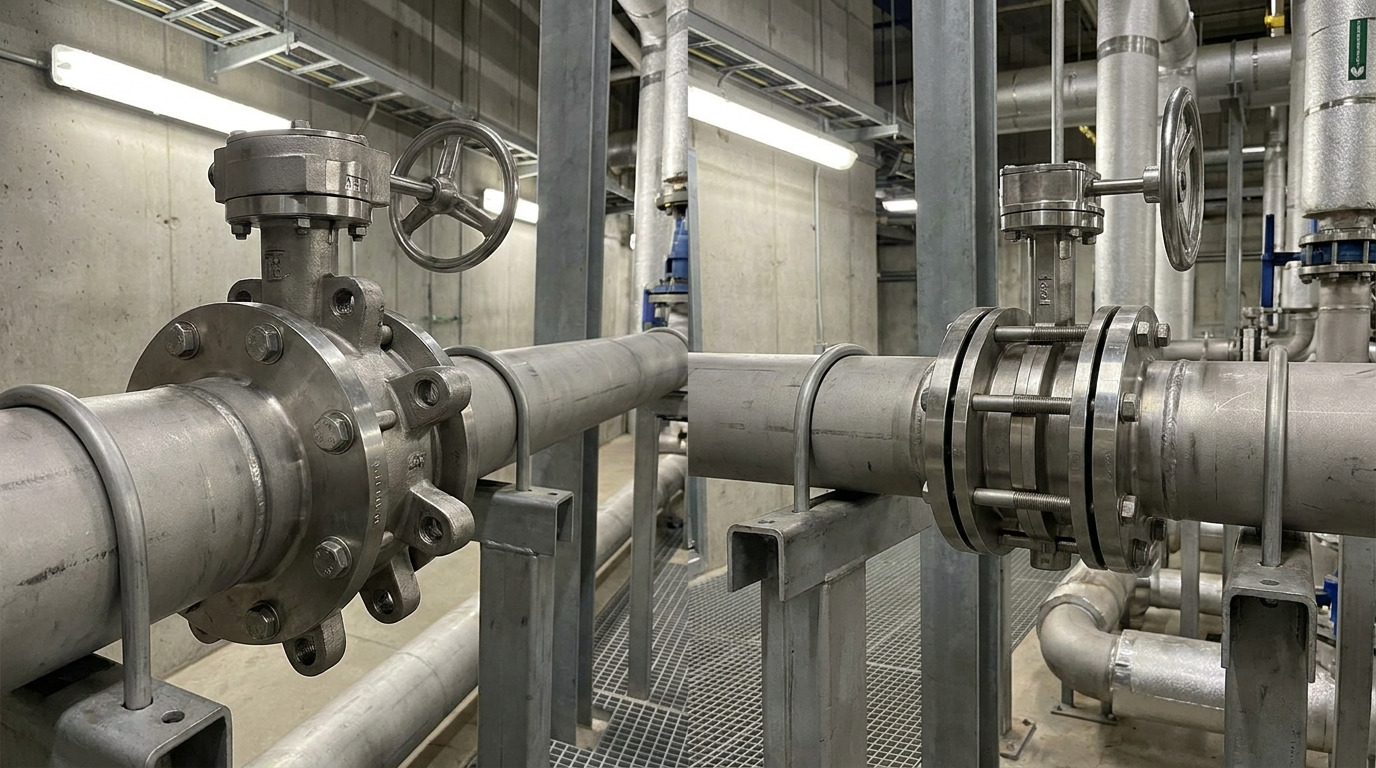
Facing a critical pipeline installation, many engineers struggle with an unexpected challenge. You choose the wrong valve body style for a high-pressure system, and suddenly you are looking at leaks, extended downtime, or a complete system shutdown. Selecting the right component prevents these catastrophic failures. Understanding the fundamental difference between a lugged vs wafer butterfly valve will save you significant time and resources during your next project.
What is a lugged vs wafer butterfly valve exactly?
A lugged vs wafer butterfly valve is primarily differentiated by its outer body design and how it connects to surrounding pipe flanges. A wafer valve is a simple, ring-like structure clamped tightly between two flanges using long bolts that span the entire valve body. In contrast, a lug valve features protruding metal lugs with threaded holes around its perimeter, allowing individual bolts to secure each side of the valve independently.
How their designs influence basic functionality?
The structural variance directly impacts how these valves handle pipeline stress. Here’s the deal: the wafer design relies entirely on the compressive force of the surrounding flanges to stay in place. If you disconnect one side of the piping, the wafer valve falls out. The lug design, however, remains bolted to the opposite flange even when one side is completely removed.
- Wafer valves utilize long through-bolts to compress the valve between flanges.
- Lug valves use threaded inserts, allowing direct bolting from either side.
- Wafer styles are strictly for inline use, whereas lug styles offer more versatility.
Why do these structural differences matter for your plant?
Understanding this distinction is vital for planning system upgrades. You might be wondering, why does this structural trait matter? It dictates whether you can perform maintenance on a downstream section without depressurizing and draining the entire upstream pipeline. Knowing this helps you schedule maintenance windows much more efficiently.
Key Takeaway: The physical casing of the valve—whether it has threaded lugs or a simple clamped ring—determines its structural independence within a piping network, directly impacting your maintenance flexibility.
| Feature | Lug Design | Wafer Design |
|---|---|---|
| Body Structure | Protruding threaded lugs | Simple ring structure |
| Mounting Method | Bolted directly to each flange | Clamped between flanges |
| Structural Independence | High | Low |
The table above illustrates the foundational structural variations between the two valve types.
How does the mounting mechanism differ between lugged vs wafer butterfly valve?
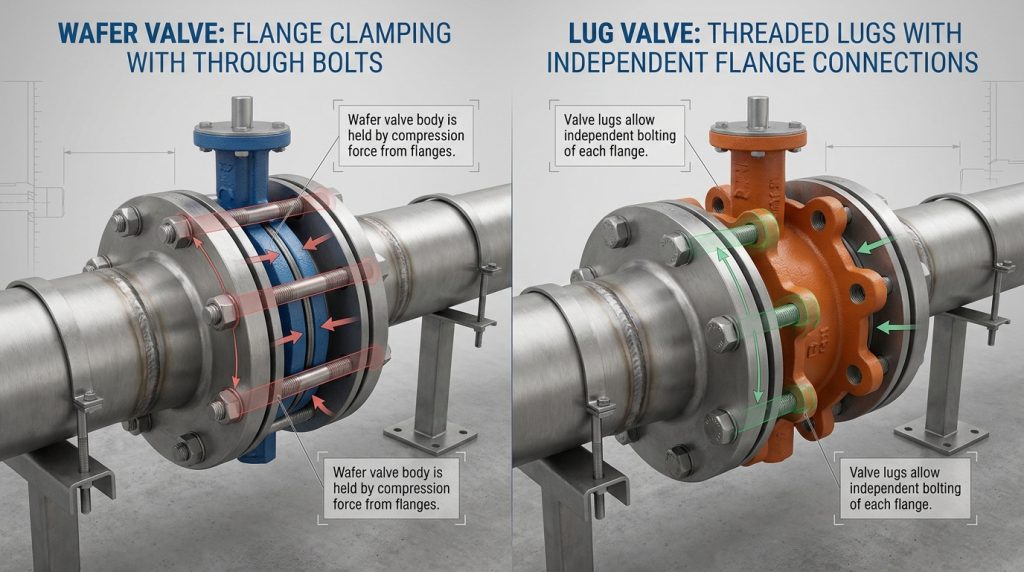
The mounting mechanism for a lugged vs wafer butterfly valve differs fundamentally in bolt application and load distribution. Wafer valves require a single set of long nuts and bolts to clamp the valve between the flanges, transferring the pipe’s tension across the valve body. Lug valves require two separate sets of shorter cap screws, connecting each flange directly to the valve’s threaded lugs.
What are the specific installation procedures?
Installing these valves requires distinct approaches. Listen to this: a wafer valve demands careful alignment of both pipe ends simultaneously before tightening the long through-bolts. This can be tricky in tight spaces. Conversely, a lug valve allows you to secure the valve to one flange first, making it easier to align the remaining pipe section.
- Wafer valves need simultaneous flange alignment.
- Lug valves can be mounted to a single side temporarily.
- Wafer installations are faster if alignment is already perfect.
How does this affect structural integrity?
The bolting method heavily influences the joint’s strength. What’s the real story? Lug valves distribute pipeline stress directly into the heavy valve body through the threaded holes, making them robust against line vibrations. Wafer valves rely on the stretching force of the long bolts, which can sometimes relax under severe temperature fluctuations.
Key Takeaway: The lug valve’s independent bolting system provides superior structural stability and easier alignment in complex piping arrangements compared to the wafer valve’s clamping method.
| Mounting Aspect | Lug Valve | Wafer Valve |
|---|---|---|
| Bolt Type Used | Short cap screws | Long through-bolts |
| Alignment Difficulty | Lower | Higher |
| Stress Distribution | Through valve body | Through clamping bolts |
This bolting comparison highlights the practical installation differences you will encounter on the job site.
Which applications are best for a lugged vs wafer butterfly valve?
Selecting between a lugged vs wafer butterfly valve heavily depends on the specific industrial application and operational requirements. Wafer valves excel in general HVAC, water treatment, and lightweight industrial processes where the valve acts purely as an inline shut-off. Lug valves are essential for critical chemical processing, heavy manufacturing, and systems requiring frequent downstream equipment removal.
When should you specify a wafer design?
Certain environments naturally favor the wafer configuration. Ready for the good part? Whenever space is at a premium and the piping system is permanent, the wafer valve is your ideal candidate. They fit seamlessly into compact skids and standard water distribution lines where you rarely need to dismantle the piping architecture.
- Ideal for standard HVAC cooling water loops.
- Perfect for compact OEM equipment skids.
- Suited for low-pressure municipal water lines.
Where does the lug design become mandatory?
Specific scenarios make lug valves the only safe option. It gets better: in facilities handling aggressive chemicals or requiring regular pump replacements, the lug valve’s ability to act as a secure boundary is indispensable. You use them when structural integrity during partial system disassembly is a non-negotiable safety requirement.
Key Takeaway: Match the valve type to your system’s operational rhythm; use wafer for static, continuous lines, and lug for dynamic systems needing frequent modular maintenance.
| Application Criteria | Lug Recommendation | Wafer Recommendation |
|---|---|---|
| HVAC Systems | Secondary option | Primary choice |
| End-of-line Service | Required | Not permitted |
| Frequent Maintenance | Highly recommended | Not suitable |
Application matching ensures you do not over-engineer or under-equip your fluid control system.
What are the key maintenance differences for a lugged vs wafer butterfly valve?
Maintenance protocols for a lugged vs wafer butterfly valve showcase the most significant practical divide between the two styles. With a lug valve, you can safely remove downstream piping for cleaning or pump replacement while holding full pressure on the upstream side. A wafer valve strictly prohibits this; you must drain and depressurize the entire pipe section on both sides before loosening any bolts.
How do maintenance downtimes compare?
The downtime associated with servicing these valves varies drastically. Here’s the kicker: because a wafer valve requires full system depressurization, a simple repair can shut down your entire plant floor. Lug valves isolate the maintenance zone, keeping the rest of your facility fully operational and saving thousands in lost production.
- Wafer valves require full line drainage.
- Lug valves allow isolated equipment servicing.
- Downtime is significantly longer for wafer installations.
What are the safety implications during repairs?
Worker safety must guide your valve selection. Truth be told, unbolting a wafer valve without properly verifying zero pressure can lead to dangerous fluid blowouts. Lug valves provide a bolted, secure physical barrier that protects maintenance personnel working on the open end of the pipe.
Key Takeaway: If your facility relies on continuous uptime and localized maintenance, the lug valve provides a safer and far more efficient isolation method.
| Maintenance Factor | Lug Valve | Wafer Valve |
|---|---|---|
| Line Drainage Required | One side only | Both sides |
| Plant Uptime Impact | Minimal | Significant |
| Worker Safety Margin | High during disassembly | Requires strict lockout |
Understanding these maintenance parameters helps plant managers accurately calculate long-term operational costs.
How do pressure limitations compare in a lugged vs wafer butterfly valve?
Pressure handling capabilities of a lugged vs wafer butterfly valve generally fall within similar ranges for standard inline use, but differ dramatically under specific stress conditions. Both styles easily manage standard 150 PSI to 300 PSI applications. However, when used as an end-of-line mechanism, a lug valve’s pressure rating usually drops, whereas a wafer valve cannot handle any pressure without a downstream flange.
How does inline pressure affect the valve body?
Inline performance is generally consistent across both designs. You read that right: when securely bolted between two flanges, the wafer valve matches the lug valve in pressure retention. The continuous compression from the long bolts effectively seals the elastomer liner against the pipe faces, handling moderate surges effortlessly.
- Both handle standard Class 150 pressures inline.
- Wafer clamping force relies on bolt tension.
- Lug threads offer strong resistance to line vibration.
What happens during pressure spikes?
System anomalies reveal the structural limits of the designs. This is where it gets interesting… During severe water hammer or pressure spikes, the threaded lugs of the lug valve absorb the shock directly into the metal casing. Wafer valves, relying on the stretching limit of the through-bolts, are slightly more susceptible to microscopic shifts that can cause temporary leaks.
Key Takeaway: While both perform admirably under stable inline pressures, the lug valve’s threaded body provides a superior mechanical defense against sudden, violent pressure fluctuations.
| Pressure Condition | Lug Valve Rating | Wafer Valve Rating |
|---|---|---|
| Standard Inline | Full rated pressure | Full rated pressure |
| Dead-End Service | Derated (e.g., 75-150 PSI) | Not applicable |
| Surge Resistance | Excellent | Good |
Reviewing these pressure profiles ensures your chosen valve can withstand your system’s worst-case scenarios.
Why choose a lugged vs wafer butterfly valve for dead-end service?
Using a lugged vs wafer butterfly valve for dead-end service is not a matter of preference; it is an engineering mandate. Dead-end service occurs when a valve is installed at the end of a pipe, or when the downstream pipe is completely removed. Lug valves are specifically engineered to hold this pressure independently, whereas a wafer valve has no mechanism to stay attached to a single flange.
What makes the lug valve capable of dead-end use?
The design mechanics make all the difference here. Let me explain: the lug valve uses bolts that pass through the pipe flange and thread directly into the valve body. This creates a secure, structural termination point. The valve itself becomes the end-cap for the pipeline, safely holding back the fluid.
- Bolts secure the valve to the active flange.
- The valve body acts as a solid physical barrier.
- It requires specific derated pressure calculations.
Why is the wafer valve prohibited here?
Attempting to use a wafer valve in this manner is extremely dangerous. Think about it: without a second flange to provide clamping force, there is absolutely nothing holding a wafer valve to the pipe. Turning on the pressure would instantly blow the valve off the line, resulting in catastrophic failure and severe safety hazards.
Key Takeaway: You must specify a lug-style valve whenever there is any possibility that the valve will need to act as the final boundary in a pressurized piping system.
| Service Type | Lug Valve Suitability | Wafer Valve Suitability |
|---|---|---|
| Mid-line Isolation | Excellent | Excellent |
| Dead-End Service | Approved (with derating) | Strictly Prohibited |
| Pump Isolation | Highly Recommended | Poor |
This distinction is perhaps the most critical safety rule when designing industrial fluid control networks.
How does space and weight influence the choice of a lugged vs wafer butterfly valve?
Space constraints and weight restrictions often dictate whether you use a lugged vs wafer butterfly valve. Wafer valves are intentionally designed to be minimalist, utilizing a slim ring body that strips away all excess metal. Lug valves require a much heavier body casting to accommodate the thick, threaded protrusions, adding significant weight and bulk to the piping assembly.
How do these valves fit into tight spaces?
Physical dimensions play a huge role in skid design. Check this out: when engineering a compact offshore platform or a mobile water purification unit, every millimeter counts. The wafer valve slips into narrow gaps between pipes seamlessly. The bulky lugs on the alternative design often interfere with adjacent pipes or structural supports in cramped environments.
- Wafer profiles are exceptionally narrow.
- Lug bodies require wider clearance for bolt access.
- Wafer valves fit better in complex pipe manifolds.
What is the impact on structural pipe supports?
Weight heavily influences overall system engineering. As a matter of fact, installing multiple lug valves on a suspended pipe run requires heavier, more expensive structural hangers to support the added metal. Wafer valves keep the overall weight of the piping network down, reducing structural load and saving money on support hardware.
Key Takeaway: If minimizing weight and maximizing spatial efficiency are your primary engineering goals, the wafer valve is the vastly superior choice.
| Design Metric | Lug Valve | Wafer Valve |
|---|---|---|
| Overall Weight | Heavy | Lightweight |
| Space Required | Moderate | Minimal |
| Support Needed | Robust pipe hangers | Standard pipe hangers |
Weight and dimension considerations directly impact the cost and complexity of your supporting infrastructure.
What are the cost differences between a lugged vs wafer butterfly valve?
Evaluating the financial impact of a lugged vs wafer butterfly valve requires looking beyond the initial purchase price. Generally, wafer valves are cheaper to manufacture because they use significantly less raw material and require less complex machining. Lug valves have a higher upfront cost due to the heavy casting and precise threading required for the lugs.
How do initial purchasing costs compare?
The upfront capital expenditure favors the simpler design. Let’s dive in: when outfitting a large commercial HVAC project with hundreds of valves, choosing the wafer style can slash your procurement budget drastically. The reduced metal content and simplified manufacturing process make the wafer valve an incredibly cost-effective solution for bulk installations.
- Wafer valves require less raw metal casting.
- Lug valves demand extensive CNC thread machining.
- Bulk purchases amplify the wafer valve’s savings.
What about long-term ownership costs?
The total cost of ownership tells a different story. But wait, there’s more: while lug valves cost more initially, their ability to facilitate modular maintenance without draining the entire system saves massive amounts of labor and downtime money over a twenty-year lifespan. A single averted plant shutdown often pays for the price difference of the lug valve.
Key Takeaway: Choose wafer valves for immediate budget savings on static systems, but invest in lug valves to minimize long-term maintenance costs in dynamic industrial environments.
| Cost Factor | Lug Valve | Wafer Valve |
|---|---|---|
| Initial Purchase Price | Higher | Lower |
| Maintenance Labor Cost | Lower | Higher |
| Total Cost of Ownership | Varies by application | Excellent for static lines |
Cost analysis must balance upfront procurement limits with anticipated maintenance labor over the valve’s lifecycle.
How do you replace or upgrade a lugged vs wafer butterfly valve?
The procedure to replace or upgrade a lugged vs wafer butterfly valve requires careful planning based on the structural differences. Upgrading a wafer valve means shutting down a larger section of the facility to remove the clamping tension safely. Replacing a lug valve allows for surgical, localized upgrades without disrupting the broader manufacturing process.
What steps are required for a wafer replacement?
Wafer replacement is a highly involved mechanical process. Make no mistake: you must drain the line completely, loosen all the long through-bolts evenly, and carefully pry the flanges apart. Because the valve relies on flange tension, removing it often requires pipe spreaders to create enough clearance to slide the old valve out and the new one in.
- Ensure zero pressure on both sides.
- Use flange spreaders to release tension.
- Align the new valve precisely before bolting.
How is lug valve replacement easier?
Lug valves offer a more straightforward swap. Here is the best part: if you need to upgrade the valve, you can unbolt one side of the piping, leave the valve attached to the upstream flange holding pressure, and prep the new piping. When ready, a brief shutdown allows you to swap the valve body quickly using standard hand tools.
Key Takeaway: The independent bolting architecture of the lug valve streamlines the upgrade process, making retrofits and replacements significantly faster and less disruptive to plant operations.
| Replacement Task | Lug Valve | Wafer Valve |
|---|---|---|
| Flange Spreaders Needed | Rarely | Almost always |
| Alignment Difficulty | Simple | Complex |
| Disruption Level | Low | High |
Understanding these replacement mechanics helps maintenance teams prepare the correct tools and schedule appropriate shutdown windows.
Which fluid types dictate the selection of a lugged vs wafer butterfly valve?
The specific media flowing through your pipes rarely dictates whether you use a lugged vs wafer butterfly valve, as both bodies can be fitted with identical discs and liners. However, the operational hazards associated with specific fluids heavily influence the choice. Hazardous chemicals demand the secure isolation provided by a lug valve, while benign fluids like chilled water perfectly suit the wafer design.
How do hazardous fluids impact the choice?
Dangerous media require strict safety boundaries. Consider this: if you are pumping concentrated sulfuric acid, you cannot risk a blowout during maintenance. The lug valve ensures that even if a technician mistakenly removes a downstream pipe, the valve remains securely bolted to the pressurized side, preventing a lethal chemical spill.
- Lug valves secure hazardous chemical lines safely.
- Wafer valves are risky for toxic fluid maintenance.
- Elastomer liners are identical for both body styles.
What about non-hazardous applications?
Benign fluids allow for more economical choices. On the flip side, if you are moving filtered cooling water or low-pressure air, the consequences of a minor leak during maintenance are negligible. In these safe applications, the lightweight, cost-effective wafer valve is the logical, practical choice without compromising facility safety.
Key Takeaway: Base your valve body selection on the danger level of the fluid; prioritize the structural security of lug valves for toxic media, and leverage the economy of wafer valves for harmless fluids.
| Fluid Risk Level | Recommended Valve Type | Primary Reason |
|---|---|---|
| High (Acids, Toxins) | Lug Valve | Secure mechanical isolation |
| Medium (Hot Water) | Lug Valve | Prevents thermal burns |
| Low (Chilled Water) | Wafer Valve | Cost and space efficiency |
Aligning valve body type with fluid risk ensures maximum safety compliance across your industrial facility.
Making Your Final Decision
Choosing between a lugged and wafer valve ultimately comes down to balancing your initial budget with your long-term maintenance strategy. Wafer valves provide unbeatable cost savings, a lightweight profile, and simple inline performance for static systems like HVAC or municipal water. Lug valves demand a higher upfront investment but deliver critical safety advantages, dead-end service capabilities, and isolated maintenance options that keep industrial plants running smoothly.
By analyzing your specific pipeline requirements—such as fluid hazards, spatial constraints, and maintenance frequency—you can confidently specify the correct component. If your facility requires robust fluid control solutions, contact us today to discover how we can optimize your piping architecture. Ruitoflow is committed to engineering reliable, high-performance flow control systems that protect your personnel and maximize your operational efficiency.
FAQ
Q1: Can I use a wafer butterfly valve at the end of a pipe?
No, you cannot. Wafer valves rely on the clamping force between two flanges to stay in place; without a downstream flange, line pressure will forcefully eject the valve.
Q2: What’s the best valve style for frequent pipeline maintenance?
The lug butterfly valve is the best choice. Its threaded inserts allow you to remove downstream piping while keeping the upstream side securely pressurized and sealed.
Q3: How do I know if I need a lug or wafer valve for my HVAC system?
If your HVAC system is a permanent, closed-loop setup with tight space constraints, a wafer valve is ideal. If you anticipate frequent pump replacements or rerouting, select a lug valve.
Q4: Can I upgrade a wafer valve to a lug valve later?
Yes, you can. Because both valves fit between standard pipe flanges, you can replace a wafer valve with a lug valve of the same size, provided you purchase the correct shorter bolt sets.
Q5: What’s the best way to handle hazardous chemical lines?
A lug butterfly valve is the safest option. It provides a secure, mechanically bolted barrier that prevents dangerous blowouts if a technician accidentally disconnects the wrong side of the piping.