
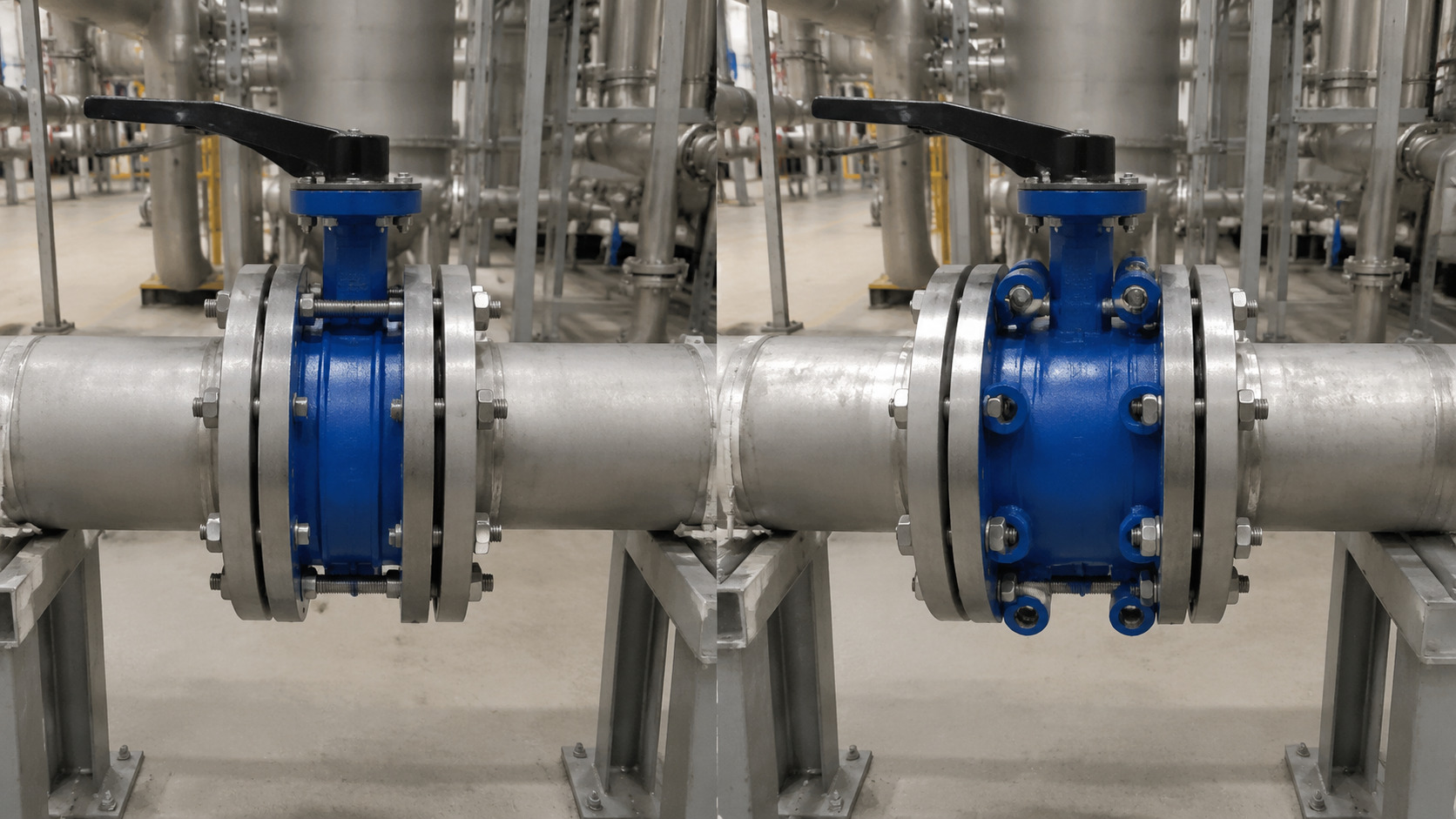
A wafer valve sits between two flanges with shared through-bolts, while a lug valve has threaded body lugs that accept separate bolts from either side. Choosing badly can turn a routine shutdown into a piping disassembly job, raise installation cost, or leave a line unsuitable for dead-end duty. This guide resolves the wafer vs lug type butterfly valve decision through design, sealing, maintenance, service conditions, and purchasing checks so you can specify a dependable connection without guesswork.
How Does Wafer vs Lug Type Butterfly Valve Design Differ?
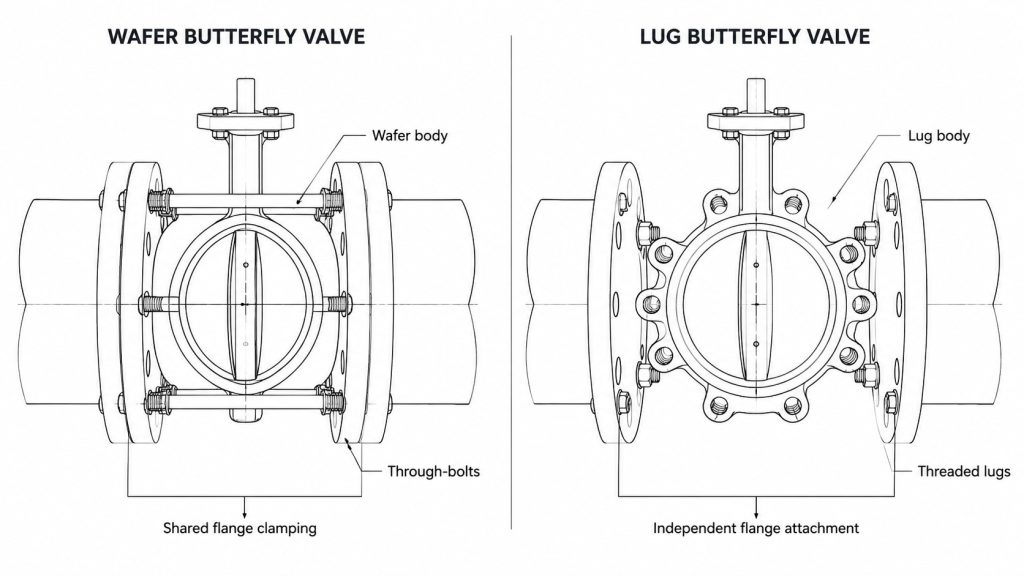
The wafer vs lug type butterfly valve design differs mainly in how each body connects with mating flanges. A wafer body relies on long bolts spanning both flanges, while a lug body uses threaded inserts around its perimeter for two independent bolt sets.
Why Does Body Geometry Change Field Performance?
Here’s the practical point: body geometry controls load paths, alignment, removal access, and possible dead-end use. You should verify flange drilling and body dimensions against your piping standard before releasing a purchase order.
- Wafer bodies remain compact and relatively light.
- Lug bodies provide individual attachment on each flange face.
- Both designs retain a disc within the flow path.
| Design point | Wafer style | Lug style |
|---|---|---|
| Body feature | Centering holes | Threaded lugs |
| Bolting | Shared through-bolts | Separate bolt sets |
| Typical strength | Lower body mass | Greater attachment rigidity |
This comparison shows why similar-looking valves can behave differently during maintenance.
Key Takeaway: match connection geometry with your flange pattern and shutdown plan before comparing price.
What Makes a Wafer Butterfly Valve Work?
A wafer butterfly valve works by clamping its narrow body between two pipe flanges, and the wafer vs lug type butterfly valve choice does not change quarter-turn disc operation. Long studs or bolts pass around the body and draw both flanges against its sealing faces.
Where Does a Wafer Body Offer Clear Value?
What does that mean for you? A wafer body suits compact lines where low mass, economical procurement, and straightforward installation carry more value than single-side pipe removal. Correct centering protects seat contact and reduces uneven disc interference.
- Use matched flange standards and pressure classes.
- Center the body before tightening bolts in a cross pattern.
- Confirm disc clearance inside both adjacent pipes.
| Selection factor | Typical wafer benefit | Check before use |
|---|---|---|
| Space | Short face-to-face layout | Tool access around bolts |
| Weight | Lower handling load | Pipe support condition |
| Cost | Fewer body features | Lifecycle service needs |
The pattern favors simple, accessible installations with planned isolation elsewhere.
Key Takeaway: choose wafer construction when compactness and project cost outweigh independent flange attachment.
How Does a Lug Butterfly Valve Support Maintenance?
A lug butterfly valve supports maintenance through separate flange bolts on each side, making the wafer vs lug type butterfly valve decision closely tied to outage planning. One piping side may be removed while the valve remains attached to the other when its rating permits that service.
Can You Isolate One Side Without Disturbing the Other?
Here’s where planning pays off: lugged construction can simplify coil, pump, or downstream spool removal during a controlled shutdown. Your team must still confirm dead-end pressure ratings because manufacturers may derate that operating mode.
- Separate bolts prevent reliance on one continuous fastener set.
- Threaded lugs give technicians access from either side.
- Body strength and seat design govern allowable isolation duty.
| Maintenance task | Wafer style | Lug style |
|---|---|---|
| Remove downstream spool | Valve loses shared clamping | Valve may remain attached |
| Replace one flange gasket | Both sides disturbed | One side can be accessed |
| Dead-end isolation | Usually unsuitable | Possible when rated |
This table links connection choice directly with outage scope rather than valve operation alone.
Key Takeaway: specify lug construction when single-side access can shorten planned maintenance and protect production time.
Which Connection Handles Dead-End Service Better?
A properly rated lug valve handles dead-end service better, while the wafer vs lug type butterfly valve comparison places most wafer designs outside that duty. Dead-end service means closed-valve pressure acts from one side after downstream piping has been removed.
What Must You Confirm Before Using a Lug Valve This Way?
The catch is simple: a lugged appearance does not automatically grant full-pressure end-of-line capability. Ask for the allowable dead-end pressure, flow direction, seat leakage class, and bolt requirements in writing.
- Check any pressure derating against maximum differential pressure.
- Verify body, seat, shaft, and retainer suitability.
- Provide safe restraint and lockout procedures for exposed piping.
| Verification item | Required evidence | Risk if missed |
|---|---|---|
| Dead-end rating | Manufacturer datasheet | Body or seat failure |
| Flow direction | Drawing or marking | Reduced sealing ability |
| Test acceptance | API 598 or EN 12266-1 data | Unclear leakage performance |
These checks separate a rated isolation point from a risky field assumption.
Key Takeaway: never approve dead-end duty from body style alone; require documented pressure and leakage performance.
How Do Installation Methods and Fasteners Compare?
In a wafer vs lug type butterfly valve comparison, wafer installation uses shared long fasteners while lug installation uses shorter bolts threaded into each body side. Both styles need clean flange faces, correct alignment, suitable bolt grade, and controlled tightening.
Which Installation Errors Cause Early Leakage?
This is where small details matter: uneven tightening can distort a resilient seat, shift the disc, or create a leak path. Before full torque, cycle the disc carefully and confirm it does not strike a pipe bore or flange liner.
- Leave enough flange gap to protect the seat during insertion.
- Tighten in a cross sequence through several torque passes.
- Avoid adding gaskets unless valve instructions call for them.
| Installation point | Wafer style | Lug style |
|---|---|---|
| Fastener layout | Studs span both flanges | Bolts enter threaded lugs |
| Centering | Requires careful positioning | Lugs aid alignment |
| Side removal | Shared joint opens | Independent joint possible |
The comparison highlights alignment and fastener control as primary leak-prevention measures.
Key Takeaway: follow approved drawings and torque guidance instead of treating either body as a generic flange spacer.
Which Design Fits Your Pressure and Temperature Range?
Neither design wins every pressure or temperature case; the wafer vs lug type butterfly valve choice must follow a stated rating for body, seat, disc, stem, and end connection. Connection style alone cannot compensate for an unsuitable elastomer or weak pressure class.
How Should You Read Service Ratings?
Now for the part buyers often miss: catalogue limits may describe different materials rather than one complete valve assembly. Compare normal and upset pressure, full temperature range, vacuum conditions, differential pressure, and cycling frequency with a confirmed configuration.
- EPDM commonly serves water and many HVAC duties.
- NBR often suits oils within its stated limits.
- PTFE offers broad chemical resistance with design-specific limits.
| Service input | Supplier response needed | Engineering purpose |
|---|---|---|
| Maximum pressure | Rated class and test basis | Body and seat integrity |
| Temperature range | Material-specific limit | Seal life and torque |
| Differential pressure | Closing torque data | Actuator sizing |
This data set turns a body-style preference into a verifiable service selection.
Key Takeaway: approve a complete material-and-rating combination rather than a connection label by itself.
How Do Weight, Space, and Cost Affect Selection?
Wafer construction usually reduces weight, envelope size, and initial price, while the wafer vs lug type butterfly valve cost balance may favor lug bodies where downtime carries a high financial penalty. Purchase price gives only one part of lifecycle cost.
What Should Your Cost Review Include?
Here’s the business angle: a heavier lug valve may save labor if technicians often remove adjacent equipment. You should compare supports, fasteners, actuator access, maintenance hours, spare strategy, and expected service life across one operating period.
- Count installation labor and lifting requirements.
- Estimate lost production during planned isolation.
- Include replacement seats, bolts, and inspection work.
| Cost element | Wafer tendency | Lug tendency |
|---|---|---|
| Initial purchase | Lower | Higher |
| Structural weight | Lower | Higher |
| Maintenance flexibility | Limited | Greater |
This summary shows why lowest purchase price may not produce lowest operating cost.
Key Takeaway: calculate lifecycle value around your actual outage pattern and available maintenance access.
Where Does Each Connection Perform Best?
Wafer bodies perform well in compact utility lines, while lug bodies fit systems needing stronger attachment or one-side maintenance; the wafer vs lug type butterfly valve decision still depends on media and duty. Water, HVAC, chemical, marine, and process plants can use either style with proper materials.
Can Application Type Decide the Body Style Alone?
Short answer: no: an industry label cannot replace line-specific data. A cooling-water loop may favor wafer economy, while a chemical skid may need lug access, yet pressure, corrosion, solids, cleaning practice, and shutdown philosophy remain decisive.
- Utility headers often reward compact wafer bodies.
- Equipment isolation may justify lugged connections.
- Corrosive service demands compatible wetted materials.
| Application need | Likely preference | Reason |
|---|---|---|
| Dense HVAC plantroom | Wafer | Compact installation |
| Removable process skid | Lug | Independent side access |
| General water distribution | Either | Duty and budget decide |
The table provides a starting point rather than a substitute for engineering review.
Key Takeaway: use application context to narrow options, then validate every line condition before selection.
What Materials and Seats Match Your Media?
Material compatibility decides sealing life in any wafer vs lug type butterfly valve, regardless of body connection. You need compatible body, disc, shaft, seat, coating, and fasteners for fluid chemistry, temperature, solids, cleaning agents, and external atmosphere.
How Can You Prevent a Material Mismatch?
The smart move starts with data: give suppliers fluid concentration, temperature swings, particle size, velocity, and cleaning method rather than a broad media name. A seat that seals clean water may swell in hydrocarbons or wear rapidly in abrasive slurry.
- Compare elastomer resistance with full chemical composition.
- Check galvanic pairs in seawater or wet outdoor service.
- Ask whether coating covers every exposed body surface.
| Material option | Common strength | Limitation to verify |
|---|---|---|
| EPDM seat | Water and weather resistance | Oil compatibility |
| NBR seat | Many oil services | Heat and ozone limits |
| PTFE seat | Chemical resistance | Torque and mechanical design |
This matrix shows that media compatibility reaches beyond a single seat name.
Key Takeaway: document every wetted material and confirm compatibility against worst-case operating conditions.
How Can You Specify the Right Valve With Confidence?
You can specify the right wafer vs lug type butterfly valve by issuing a complete datasheet and requiring traceable compliance evidence. Define service conditions, connection standard, size, pressure class, materials, actuator duty, leakage acceptance, testing, documentation, and delivery scope.
What Should a Purchase Specification Contain?
Ready for a cleaner RFQ? Give each bidder the same technical schedule so quotations remain comparable and exceptions become visible. Request a dimensional drawing, material certificates, pressure-test records, coating data, actuator sizing, and spare-parts list before approval.
- State flange standard and drilling pattern.
- Define maximum differential pressure and flow direction.
- List inspection, certification, marking, and packing needs.
| Specification block | Minimum entry | Review output |
|---|---|---|
| Process data | Fluid, pressure, temperature | Material and rating check |
| Mechanical data | DN, flange, face-to-face | Fit confirmation |
| Quality data | Tests and certificates | Traceable acceptance |
This checklist converts operating needs into measurable supplier commitments.
Key Takeaway: a complete RFQ prevents hidden assumptions and gives your team a defensible basis for technical bid evaluation.
Choose the Connection That Protects Your Project
Wafer valves bring compact, economical clamping, while lug valves bring independent flange attachment and possible dead-end capability when rated. You now have a practical method for comparing construction, installation, maintenance, service limits, materials, and documentation; contact us today for application review and a matched valve proposal. We believe dependable flow control begins with honest engineering choices that keep people, processes, and infrastructure working safely.
FAQ
Can I replace a wafer valve with a lug valve directly?
Sometimes. Confirm face-to-face dimensions, flange drilling, pressure class, disc clearance, actuator space, and bolt engagement before replacement because body envelopes and fastener lengths may differ.
What’s the best valve style for dead-end service?
A rated lug valve is usually the better choice. Its separate bolt sets can retain attachment on one flange, though you must verify allowable dead-end pressure and flow direction.
How do I know if a wafer valve suits my pipeline?
Check line conditions and maintenance plans. A wafer valve fits many compact, bidirectional utility systems where both flanges remain installed and separate isolation supports maintenance.
Can I use the same seat material for water and oil?
Usually not. EPDM often suits water while NBR commonly suits many oils, but temperature, additives, concentration, and manufacturer compatibility data decide the correct material.
What’s the best information to send with my RFQ?
A complete operating schedule works best. Include media, size, pressure, temperature, flange standard, materials, actuator type, leakage class, testing, certificates, quantity, and delivery date.