
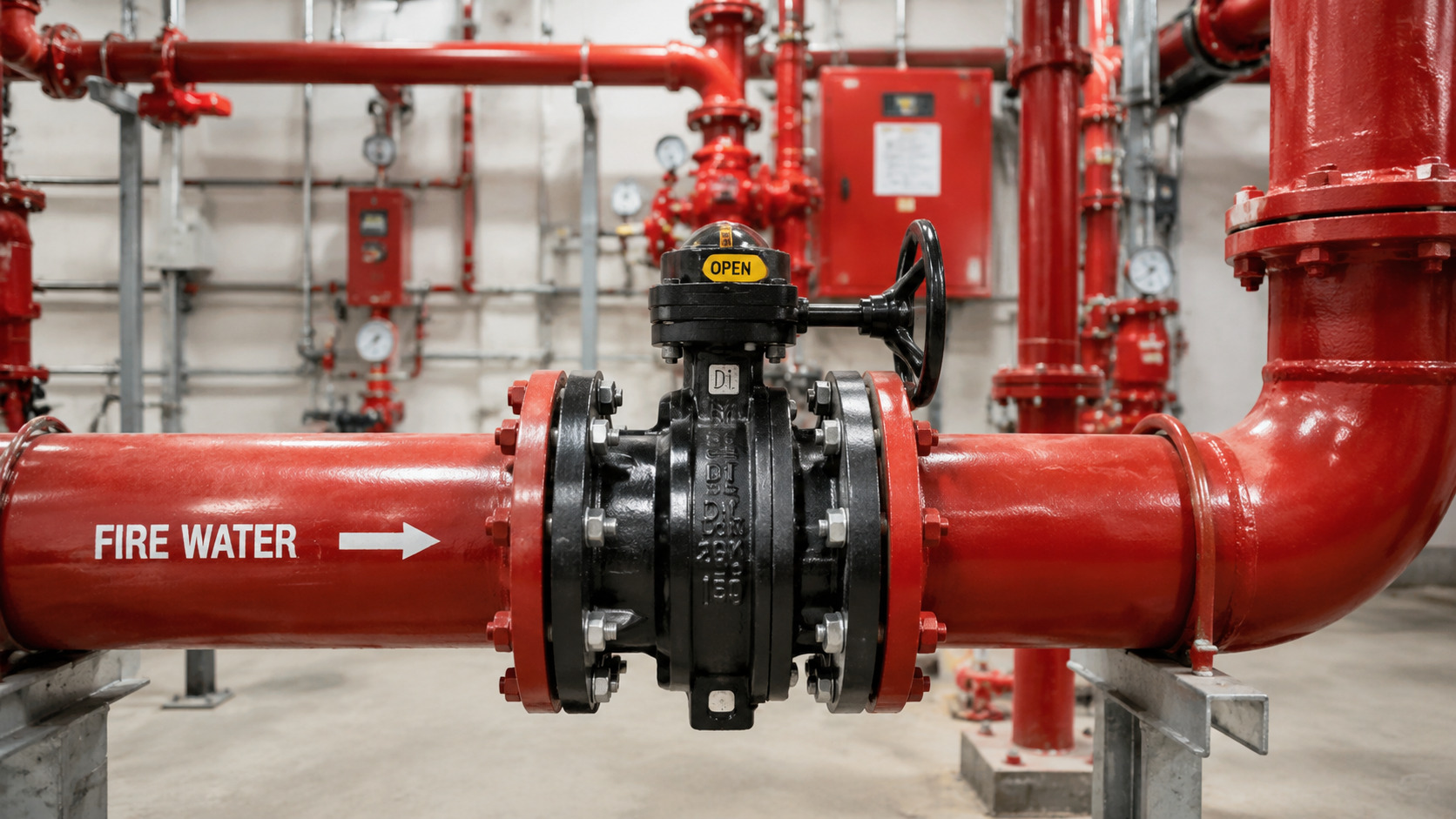
A butterfly valve in a fire fighting system is a quarter-turn valve that isolates or regulates water flowing toward sprinklers, hydrants, and other fire-protection equipment. A valve that leaks, closes too slowly, or lacks suitable approval can delay commissioning and compromise emergency water delivery. Properly specified butterfly valve fire fighting equipment solves these problems through fast operation, compact dimensions, visible position indication, and dependable sealing.
Why Are Valves Necessary in Fire Fighting Systems?
Valves matter because a butterfly valve fire fighting network must route pressurized water while allowing safe isolation for testing, repairs, and emergencies. Without dependable control points, one damaged branch could interrupt protection across a much larger area.
Where Do Valves Support System Control?
Fire-protection valves divide a network into manageable zones. Here’s the practical point: each valve gives you control over a defined section without draining an entire building or industrial site.
- Isolate sprinkler floors during maintenance
- Direct water toward hydrants or monitors
- Separate pumps, tanks, and alarm assemblies
- Support inspection and flow-testing procedures
How Does Valve Reliability Affect Fire Readiness?
Valve condition directly affects available flow, pressure, and response time. A seized disc, damaged seat, or incorrect position can restrict water before it reaches an active discharge point.
| Valve duty | Operational value | Risk if neglected |
|---|---|---|
| Isolation | Separates one pipeline zone | Wider system shutdown |
| Regulation | Controls flow during testing | Unstable test readings |
| Position monitoring | Reports open or closed status | Undetected valve closure |
| Emergency control | Stops damaged pipework | Uncontrolled water loss |
This comparison shows why valve supervision belongs in every readiness plan.
Key Takeaway: You can limit shutdown areas and protect emergency water delivery through correctly placed, monitored valves.
What Is a Butterfly Valve in a Fire Fighting System?
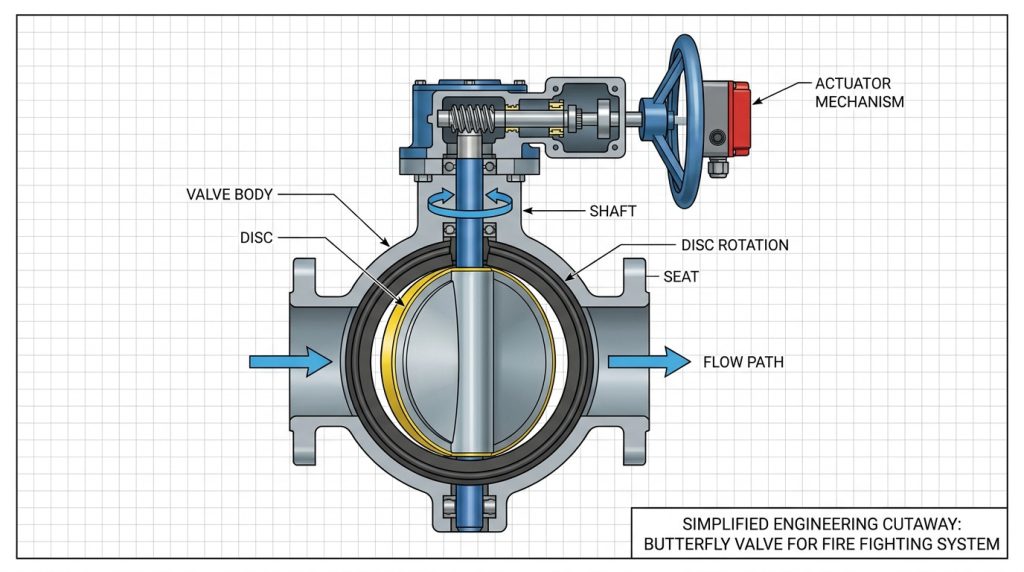
A butterfly valve fire fighting unit uses a circular disc mounted on a shaft inside a compact body. Turning its handle, gearbox, or actuator through 90 degrees moves it between open and closed positions.
Which Components Perform Each Function?
Several parts work together during every operating cycle. What does that mean for you? Component compatibility deserves as much attention as valve size.
- Body connects with surrounding pipework
- Disc opens or blocks the flow path
- Seat creates a shutoff seal
- Shaft transfers operating torque
- Gearbox or actuator controls movement
- Supervisory switch reports valve position
How Does Its Design Compare With Other Valves?
Butterfly valves weigh less and occupy less space than many gate valves of equal nominal size. Their disc remains in the flow path when open, so hydraulic calculations should include published resistance data.
| Design factor | Butterfly valve | Gate valve |
|---|---|---|
| Operating movement | Quarter-turn | Multi-turn |
| Installation space | Compact | Taller |
| Position visibility | Easy with indicator | Depends on stem design |
| Large-diameter cost | Usually lower | Usually higher |
This comparison helps you balance space, operating speed, and hydraulic performance.
Key Takeaway: A butterfly valve suits projects that need rapid isolation, compact installation, and clear position feedback.
How Does a Butterfly Valve Control Fire-Water Flow?
A butterfly valve fire fighting installation controls water through disc rotation. A parallel disc leaves most of the flow path open while a perpendicular disc presses against its seat and stops flow.
What Happens During Opening and Closing?
Operating torque travels from a handle or actuator through the shaft into the disc. This is where it gets practical: smooth movement depends on correct alignment, clean water, and suitable actuator torque.
- At 0 degrees, the valve normally sits closed
- Between positions, the disc restricts flow
- Near 90 degrees, the valve reaches full opening
- A gearbox supports controlled movement on larger sizes
A correctly selected check valve may also prevent reverse flow elsewhere in a pump or supply arrangement.
Why Do Pressure and Velocity Matter?
High differential pressure increases operating torque and seat loading. Excessive velocity may also produce vibration or accelerated wear around the disc.
| Operating condition | Likely effect | Design response |
|---|---|---|
| High pressure difference | Higher torque | Recheck gearbox or actuator |
| High velocity | Disc vibration | Review valve size and location |
| Debris in water | Seat damage | Flush pipework before service |
| Frequent cycling | Faster wear | Select a suitable seat compound |
These relationships explain why nominal diameter alone cannot define a safe selection.
Key Takeaway: You should match valve torque, materials, and flow data with real operating conditions.
Why Are Butterfly Valves Used in Fire Protection?
A butterfly valve fire fighting design is widely used because it combines quick shutoff, low weight, and economical large-diameter construction. Its short face-to-face dimension also helps in crowded riser rooms and mechanical spaces.
Which Project Benefits Matter Most?
Butterfly valves reduce handling and installation demands compared with many heavier alternatives. Here’s the payoff: those physical savings can simplify supports, access, and future servicing.
- A 90-degree operating stroke supports fast isolation
- Compact bodies fit narrow pipe corridors
- Low weight reduces lifting requirements
- Gear operators provide clear position indication
- Actuators support remote control where permitted
When May Another Valve Type Fit Better?
A gate valve may suit specifications that demand an unobstructed full-bore passage. A ball valve may serve smaller lines or duties needing a different sealing arrangement.
| Project priority | Likely option | Selection note |
|---|---|---|
| Compact large-bore isolation | Butterfly valve | Check flow resistance |
| Clear full-bore passage | Gate valve | Allow extra height |
| Small-line tight shutoff | Ball valve | Check bore and approval |
| Backflow prevention | Check valve | Verify orientation |
This quick comparison narrows your options before detailed engineering begins.
Key Takeaway: Butterfly valves offer strong value where space, operating speed, and large pipe sizes shape project decisions.
Which Butterfly Valve Types Fit Fire Fighting Systems?
A butterfly valve fire fighting specification may call for wafer, lug, flanged, or grooved-end construction. Connection style should match pipe layout, maintenance strategy, pressure rating, and local approval conditions.
How Do Connection Styles Differ?
Each body pattern changes installation access and flange support. You might be wondering which one suits your project: start with pipe standard and required maintenance isolation.
- Wafer bodies sit between mating flanges
- Lug bodies use threaded inserts around the body
- Double-flanged bodies provide rigid connections
- Grooved ends support rapid coupling installation
- Concentric designs suit many water services
Which Type Matches Common Installations?
Indoor sprinkler systems often favor compact grooved or wafer arrangements. Large municipal or industrial mains may require flanged bodies for added structural support.
| Valve type | Typical setting | Main benefit |
|---|---|---|
| Wafer | Plant-room piping | Low weight and short body |
| Lug | Serviceable branches | One-side pipe removal |
| Flanged | Large outdoor mains | Strong pipe connection |
| Grooved | Sprinkler networks | Fast coupling assembly |
The correct connection reduces installation complications and unplanned adapters.
Key Takeaway: Choose body style after confirming pipe ends, pressure class, maintenance access, and approval requirements.
Which Standards Apply to Fire Fighting Butterfly Valves?
A butterfly valve fire fighting project may reference UL listings, FM approvals, AWWA C504, NFPA requirements, EN 593, API 609, or regional rules. Applicable documents depend on system jurisdiction, valve duty, and authority-having-jurisdiction acceptance.
What Should Procurement Documents Specify?
Avoid requesting a “certified valve” without naming the required approval. Here’s the catch: a general manufacturing certificate does not replace product-specific fire-service acceptance.
- Product listing or approval number
- Design and test standard
- Pressure and temperature rating
- Face-to-face and flange dimensions
- Seat leakage requirement
- Supervisory-switch arrangement
- Material and coating certificates
How Can You Confirm Compliance?
Compare every submitted document with purchase specifications before production. Approval scope must cover the ordered size, pressure class, connection, operator, and intended service.
| Document | What to verify | Procurement purpose |
|---|---|---|
| Product approval | Model and size range | Fire-service acceptance |
| Datasheet | Pressure and materials | Technical conformity |
| Test report | Shell and seat results | Performance evidence |
| Drawing | Dimensions and interfaces | Installation fit |
| Material record | Body, disc, and seat | Traceability |
This document set gives your review team a defensible approval trail.
Key Takeaway: Name every required standard and verify that supporting documents cover the exact ordered configuration.
What Problems Affect Fire Fighting Butterfly Valves?
A butterfly valve fire fighting unit can develop leakage, corrosion, difficult operation, faulty supervision, or coating damage. Most failures trace back to unsuitable materials, debris, poor alignment, excessive torque, or weak inspection routines.
What Warning Signs Should You Watch?
Routine inspection can reveal problems before they affect emergency duty. Watch what happens next: a minor operating change often signals developing seat or shaft damage.
- Rising gearbox effort may indicate scale or misalignment
- Seat leakage may point toward debris or wear
- External rust may signal coating failure
- Incorrect switch status may hide valve movement
- Vibration may indicate excessive velocity
Which Corrective Action Fits Each Fault?
Technicians should identify root cause before replacing parts. Repeated seat damage may reflect pipe stress or dirty water rather than a defective seat.
| Symptom | Probable cause | Practical response |
|---|---|---|
| Internal leakage | Debris or worn seat | Flush and inspect seat |
| Hard operation | Scale or undersized gear | Clean and verify torque |
| External corrosion | Damaged coating | Repair coating and inspect body |
| False position signal | Switch misalignment | Reset and function-test |
| Recurrent vibration | High velocity | Review hydraulic conditions |
This pattern-based review prevents repeated repairs that never address root cause.
Key Takeaway: Early warning signs help you correct mechanical or hydraulic faults before fire-water availability declines.
How Do You Select the Right Butterfly Valve?
The right butterfly valve fire fighting model matches pipe size, design pressure, water quality, connection standard, operating method, and approval scope. Selection should begin with a complete duty sheet rather than a price comparison.
Which Technical Data Should You Provide?
Suppliers need actual operating data before recommending materials or actuators. Here’s what moves a quotation forward: send one clear specification package.
- Nominal diameter and pipe schedule
- Working and test pressure
- Maximum water temperature
- Flange or groove standard
- Required listing or approval
- Indoor or outdoor environment
- Manual, electric, or pneumatic operation
- Position-switch requirements
How Can You Compare Supplier Proposals?
Place technical differences beside commercial terms during bid review. A lower quote may exclude switches, mating flanges, testing records, or corrosion protection.
| Review item | Acceptable evidence | Common omission |
|---|---|---|
| Pressure rating | Marked datasheet | Vague working range |
| Materials | Bill of materials | Unnamed seat compound |
| Approval | Verifiable certificate | Logo without scope |
| Testing | Recorded test procedure | Generic quality statement |
| Dimensions | Approved drawing | Missing flange details |
This matrix helps your team compare equivalent supply scopes.
Key Takeaway: A complete duty sheet gives you accurate pricing and reduces specification gaps during approval.
Where Are Butterfly Valves Installed in Fire Systems?
A butterfly valve fire fighting network commonly places these valves around risers, pumps, sectional branches, storage tanks, hydrant mains, and sprinkler control assemblies. Their compact form works well wherever frequent isolation and visible status indication are needed.
Which Applications Benefit From Their Compact Design?
Location determines connection type, coating, supervision, and access needs. Ready for the practical examples? Common placements include:
- Commercial-building sprinkler risers
- Warehouse sectional control stations
- Fire-pump suction or discharge arrangements
- Municipal hydrant distribution mains
- Industrial deluge-system branches
- Tank inlet and outlet pipework
How Should Location Affect Specification?
Outdoor valves need stronger protection against weather and corrosion. Indoor supervised valves may require tamper switches connected with a fire alarm control system.
| Installation area | Main concern | Specification response |
|---|---|---|
| Pump room | Pressure and access | Rated valve with gear operator |
| Sprinkler riser | Position monitoring | Supervisory switch |
| Buried main | Corrosion and access | Suitable coating and valve box |
| Industrial site | Aggressive atmosphere | Compatible body and disc materials |
| Outdoor hydrant line | Weather exposure | Protected operator and coating |
This location review turns a general valve schedule into an application-specific specification.
Key Takeaway: Match construction and accessories with each valve’s environment, access, and monitoring duty.
How Should Butterfly Valves Be Installed?
A butterfly valve fire fighting unit should be installed with aligned pipework, clean sealing faces, correct fasteners, and enough disc clearance. Poor installation can damage a new seat before commissioning even begins.
What Should Installers Check Before Assembly?
Pipework must remain supported without forcing flanges into position through valve bolts. This small detail matters: flange misalignment creates uneven seat compression and operating torque.
- Confirm valve tag and flow-service location
- Inspect body, disc, seat, and coating
- Flush debris from adjoining pipework
- Check flange faces and bolt patterns
- Verify disc clearance inside pipe ends
- Follow specified bolt-tightening sequence
Which Commissioning Checks Confirm Correct Work?
Operate the valve through its full travel before pressurization where procedures permit. After pressure testing, check leakage, position indication, gearbox stops, and supervisory signals.
| Commissioning check | Expected result | Record required |
|---|---|---|
| Full-stroke operation | Smooth movement | Functional checklist |
| Seat test | Leakage within specified limit | Pressure-test report |
| Switch test | Correct alarm status | Cause-and-effect record |
| Visual inspection | No coating or body damage | Inspection release |
| Tag verification | Matches valve schedule | Commissioning dossier |
These checks create a clear handover record for operators and inspectors.
Key Takeaway: Careful alignment, clean assembly, and recorded functional tests protect both valve life and project acceptance.
How Should Fire Fighting Butterfly Valves Be Maintained?
A butterfly valve fire fighting maintenance plan should include visual checks, position verification, controlled exercising, leakage inspection, and supervisory-signal testing. Frequencies must follow site procedures, governing rules, and manufacturer guidance.
What Belongs in a Routine Inspection?
Maintenance teams need consistent records rather than informal observations. Here’s a useful rhythm: inspect visible condition regularly and schedule functional work under an approved impairment procedure.
- Confirm valve remains in its normal position
- Check seals, body, gearbox, and fasteners
- Look for corrosion or coating damage
- Test tamper or supervisory switches
- Record unusual torque, noise, or leakage
- Restore and document normal service status
How Can Maintenance Records Reduce Risk?
Trend data reveals recurring faults across valve models, buildings, or water conditions. Rising operating effort across several inspections may justify cleaning or planned component replacement.
| Record field | Why it helps | Follow-up trigger |
|---|---|---|
| Valve position | Confirms readiness | Unexpected closure |
| Operating torque | Tracks mechanical change | Rising effort |
| Leakage condition | Tracks seat health | Visible seepage |
| Signal result | Confirms supervision | Failed indication |
| Coating condition | Tracks corrosion | Exposed base metal |
This history supports planned work before faults become emergency impairments.
Key Takeaway: Consistent inspection records help you identify deterioration early and plan repairs around system availability.
Ready to Specify a Safer Fire-Water Valve Package?
You now know how butterfly valves operate, where they fit, which standards and connections require review, what common faults look like, and how installation and maintenance protect system readiness. RUITO can support valve selection, material review, technical drawings, testing documentation, and project-specific configurations.
Reliable fire-water control begins with clear specifications and traceable manufacturing. For a technical review of your valve schedule or procurement package, contact us today—our position is simple: every supplied valve should support predictable performance when your system faces its hardest test.
Frequently Asked Questions
Can I use any butterfly valve in a fire fighting system?
No. The valve must match system pressure, pipe connection, monitoring requirements, and approval rules set for your project. A general-purpose industrial model may lack suitable product acceptance or supervisory accessories.
What’s the best connection type for sprinkler pipework?
Grooved or wafer connections often suit compact sprinkler installations. Your best option depends on pipe standard, available space, pressure rating, dismantling needs, and local acceptance requirements.
How do I know if a valve has the correct approval?
Check its product certificate against model number, size, pressure class, connection, and operator. Approval marks shown on marketing material alone do not confirm that every configuration falls within certificate scope.
Can I throttle fire-water flow with a butterfly valve?
Sometimes, but only where system design and valve documentation permit that duty. Many fire-protection butterfly valves primarily serve isolation, while prolonged partial opening may increase turbulence and seat wear.
How do I know if a butterfly valve needs maintenance?
Hard operation, leakage, corrosion, abnormal noise, damaged coating, or incorrect position signals indicate that inspection is due. Keep the affected zone under an approved impairment process until testing confirms normal operation.