
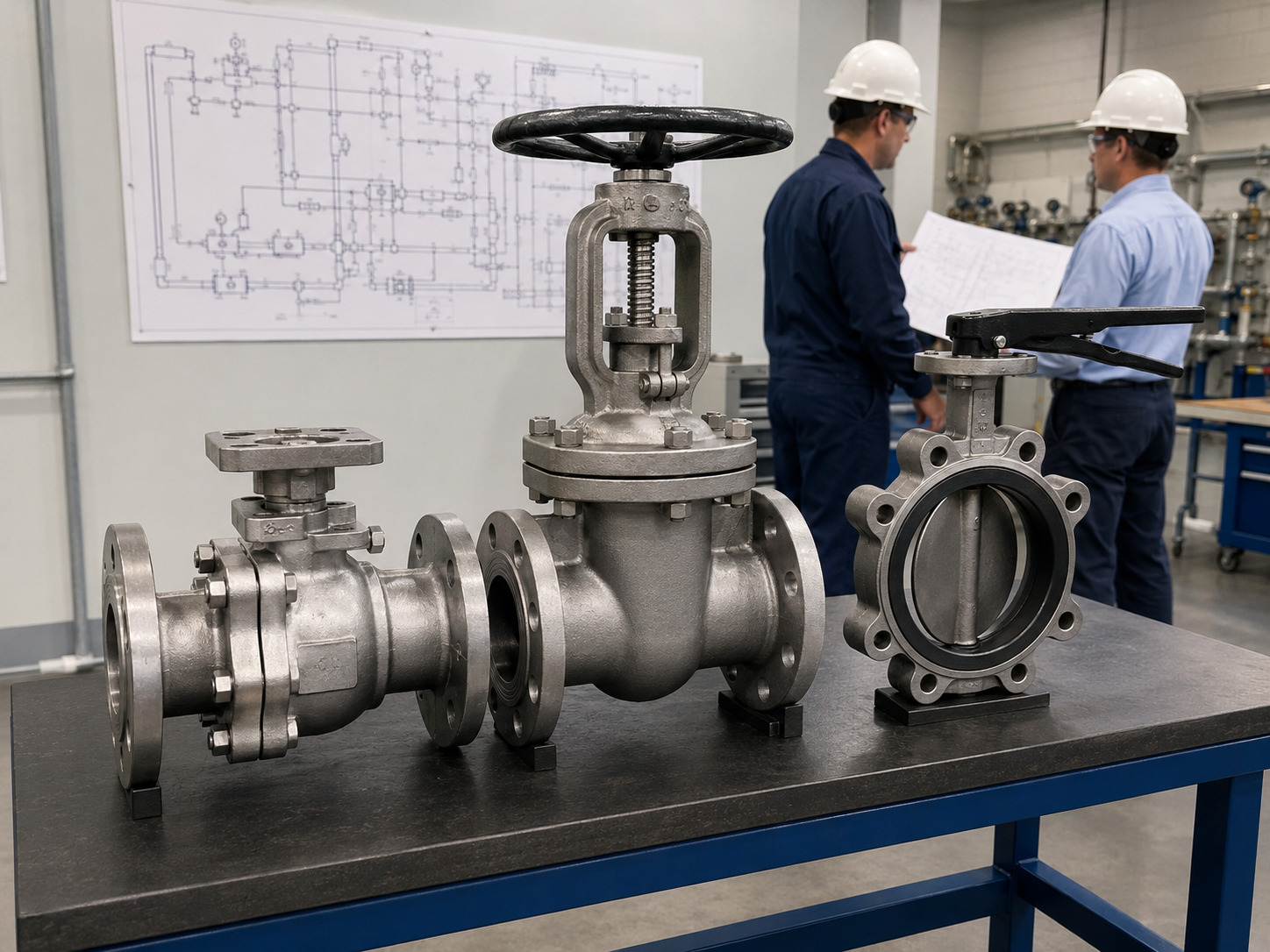
In the ball valve vs gate valve vs butterfly valve decision, choose a ball valve for fast, tight isolation; a gate valve for an unobstructed bore with infrequent operation; and a butterfly valve for compact, economical isolation or control in larger lines. That rule is only a starting point. Pressure, temperature, media, shutoff requirement, flow range, actuation, and installation geometry can all change the answer.
The costliest mistake is to select the family and treat its rating, seat, bore, and actuator as details. Select the family by duty, then verify the configuration against the real operating envelope. RUITO’s industrial valve portfolio includes all three families, but they solve different problems.
The short answer: match the valve to the duty
Ball valves usually lead for rapid isolation, gate valves for a clear full-bore flow path, and butterfly valves for large-diameter economy and compact installation. The table below shows the practical starting point before materials and ratings are checked.
| Decision factor | Ball valve | Gate valve | Butterfly valve |
|---|---|---|---|
| Closure motion | Quarter-turn ball | Multi-turn linear gate | Quarter-turn disc |
| Best starting duty | Fast, tight isolation | Infrequent full-open/full-close isolation | Large-line isolation or moderate control |
| Fully open flow path | Full-port can be unobstructed; reduced-port is restricted | Usually unobstructed in a full-bore design | Disc and shaft remain in the flow |
| Throttling | Standard isolation designs are poor choices; control-ball trims are separate configurations | Not recommended | Possible when correctly sized and actuated |
| Operation speed | Fast | Slow | Fast, or deliberately slowed with gearing/actuation |
| Installation envelope | Compact stem height; body becomes heavy at large sizes | Requires stem and bonnet headroom | Short face-to-face and relatively low weight |
| Typical strength | Shutoff, gas service, automation | Low obstruction, pigging, buried or infrequent isolation | Large diameters, frequent operation, space and weight limits |
| Main selection risk | Wrong seat, bore, cavity, or torque basis | Partial-open wear, slow cycling, stem clearance | Wrong seat/offset, disc clearance, surge, or control sizing |
The most important conclusion is that no family wins every row. Use the table to create a shortlist, not to approve a valve.
How the three valve designs change performance
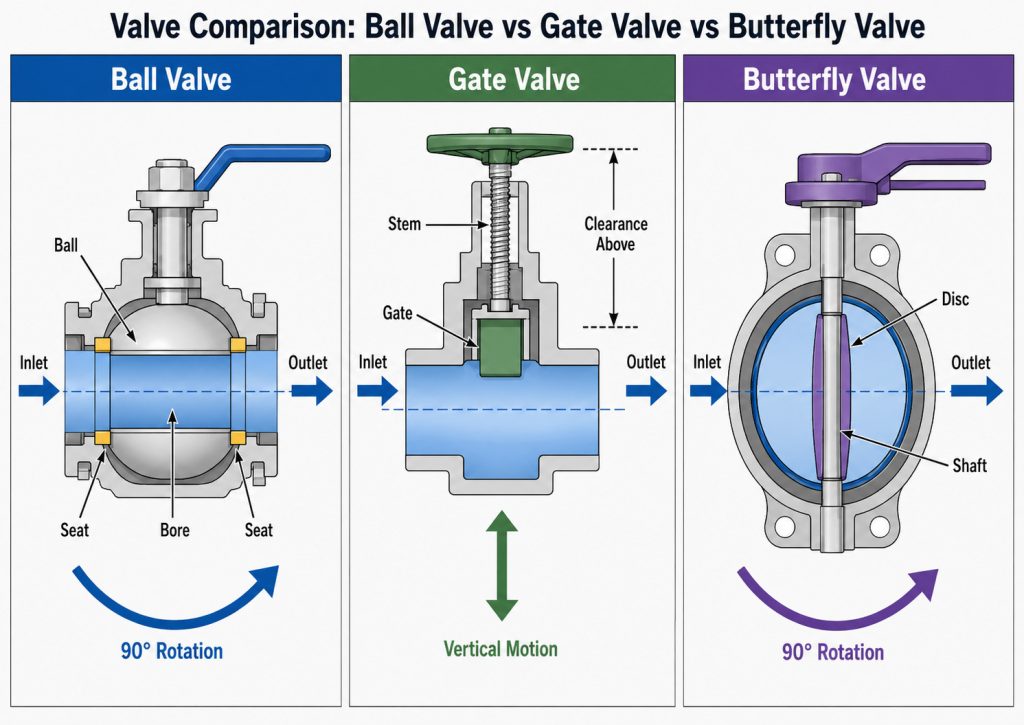
The closure element determines the flow path, operating motion, torque behavior, and maintenance access. Those differences explain most of the tradeoffs in service.
Ball valves prioritize fast, positive isolation
A ball valve rotates a bored sphere through 90 degrees. With a compatible soft seat and clean media, it can provide tight, fast manual or automated isolation.
Port and mounting design matter. A full-port ball can preserve a near-straight, piggable path, while a reduced port increases velocity and pressure loss. Trunnion mounting controls ball loading and torque as size and differential pressure rise. Our published ball valve configurations include full and reduced bore, floating and trunnion, and soft and metal seating.
Gate valves prioritize a clear open bore
A gate valve raises a wedge, slab, or knife out of the flow path. When fully open, the line can have little internal obstruction, which suits mainline isolation, low-pressure-loss service, and applications that require a piggable path.
The tradeoff is motion. A multi-turn gate needs more time and stem travel than a quarter-turn valve. Keep it fully open or closed because flow across a partly open gate can cause vibration, erosion, and seat damage. The published RUITO gate valve range covers resilient-seated, metal-seated, knife, and flanged configurations.
Butterfly valves prioritize size and installation efficiency
A butterfly valve rotates a disc inside the pipe. Its short body and comparatively low mass make it attractive as diameter increases, especially in water, wastewater, HVAC, marine, and utility systems where space, support loads, and actuator cost matter.
Because the disc remains in the flow, a butterfly valve does not provide the clear bore of a full-port ball or gate. It can serve isolation or modulating duty when its Cv, seat, offset design, and actuator fit the operating range. Our butterfly valve range lists wafer, lug, and flanged bodies; concentric, double-eccentric, and triple-eccentric structures; and resilient, PTFE, and metal seating.
Isolation, throttling, and pressure loss need separate checks
Shutoff, flow control, and open-valve pressure loss are different requirements, so one feature should not stand in for all three. A valve that isolates well may control poorly, and a valve with a high fully open Cv may still be unsuitable for the required leakage or cycling duty.
Shutoff depends on the seat and operating envelope
Do not approve leakage performance from the family name. A soft-seated ball can isolate tightly in compatible clean service, but heat, abrasion, solids, and chemicals can damage its seat. A resilient-seated gate may give tight water-service shutoff, while a metal-seated gate can permit leakage. Resilient concentric and metal-seated triple-offset butterfly valves also have different limits.
Specify the shutoff direction, maximum differential pressure, test medium, seat material, and required leakage acceptance. “Zero leakage,” “bubble-tight,” or a named leakage class means little unless the test method and conditions are defined.
Throttling requires stable authority across the flow range
A gate valve is not a control valve: partial opening exposes its gate and seats to concentrated velocity. A standard ball valve is also a poor default for continuous throttling because small rotation can create a large flow change at the seat. A characterized or segmented ball is a different configuration and must be sized as one.
A butterfly valve can modulate, but it still needs a calculated Cv at the expected positions. Check minimum, normal, and maximum flow; upstream and downstream pressure; available pressure drop; media density; vapor pressure for liquids; and actuator resolution. If normal operation holds the disc close to shutoff or almost fully open, the valve may have weak control authority even though its line size matches the pipe.
Compare Cv and system pressure drop, not labels
A full-port ball valve and a fully open gate valve generally offer the least obstruction. A reduced-port ball can lose that advantage, while a butterfly valve introduces some resistance because its disc and shaft remain in the stream.
For a real comparison, request Cv or Kv data for the exact size and configuration. Calculate the pressure drop at the design flows, then check velocity and pump or compressor margin. Pipe size alone does not prove hydraulic suitability.
Where each valve is the practical first choice
The practical first choice comes from the service task, not from a universal ranking. These scenarios show where each family normally starts the evaluation.
Choose a ball valve when you need:
- Fast on-off isolation or emergency closure.
- Tight shutoff in clean liquid or gas service with a compatible seat.
- Frequent automation with a compact quarter-turn actuator.
- A full-port, piggable path in an available ball-valve size and rating.
Choose a gate valve when you need:
- Infrequent isolation with the valve normally fully open or closed.
- An unobstructed bore for pigging or low flow resistance.
- Buried water-main service with an appropriate resilient-seated design.
- A purpose-built knife gate for media containing fibers, sludge, or suspended solids.
Choose a butterfly valve when you need:
- A compact, lighter valve for a medium- or large-diameter line.
- Lower installed weight and shorter face-to-face dimensions.
- Frequent quarter-turn operation or a properly sized modulating duty.
- A practical isolation solution for water, wastewater, HVAC, or utility service.
Hazardous media, fire-safe requirements, abrasive solids, extreme temperature, or severe differential pressure may require a specialized design or a different valve type.
Four conditions can overturn the obvious choice
The apparent winner can change after you check configuration, installation, transient response, and maintenance.
Configuration can reverse a simple comparison
“Ball valve” does not tell you full or reduced port, floating or trunnion, soft or metal seat, one-, two-, or three-piece body, or cavity relief method. “Gate valve” does not identify resilient or metal seating, wedge or knife geometry, rising or non-rising stem, or bonnet design. “Butterfly valve” does not identify concentric or offset geometry, body connection, seat type, or rated shutoff direction.
Compare complete configurations at the same size, pressure class, temperature, material, leakage requirement, and actuator scope.
Installation geometry goes beyond face-to-face length
A gate valve needs vertical stem, bonnet, and removal clearance. A butterfly disc must open without hitting a liner, nearby fitting, or narrow flange bore. A ball valve needs handle or actuator space and, at large sizes, adequate support.
Also check dead-end service, flow direction, seat access, and whether one side stays pressurized during maintenance. A lug body may support a plan that a wafer body cannot, but only within its stated dead-end rating.
Fast closure is not automatically safer
Ball and butterfly valves close quickly, which helps emergency isolation but may create hydraulic transients in liquid lines. A slower gate still needs a closure-curve review.
For large water lines, define closing time and actuator speed. Review pump inertia, check-valve behavior, pipe length, velocity, elevation, and surge protection. A gearbox or controlled actuator can slow a quarter-turn valve where the process allows it.
Use a five-step valve selection workflow
A reliable selection defines the duty, establishes the operating envelope, shortlists the family, chooses the configuration, and verifies performance.
- Define the duty. State whether the valve provides isolation, emergency shutdown, modulation, bypass, drain, or maintenance separation. Add the normal position, cycling frequency, required stroke time, fail position, and pigging requirement.
- Establish the operating envelope. Record media composition and phase, solids or fibers, minimum and maximum temperature, design and operating pressure, maximum shutoff differential, flow range, and any surge or vacuum condition.
- Shortlist the valve family. Use the comparison table to eliminate families that conflict with the required flow path, throttling duty, operation speed, size, weight, or maintenance access.
- Select the configuration. Define port, seat, body style, stem or offset design, materials, end connection, pressure class, actuator, and required accessories. Check chemical compatibility at temperature, not at ambient conditions alone.
- Verify the exact assembly. Review Cv/Kv, pressure-temperature rating, shutoff direction and leakage, operating torque or thrust, actuator margin, dimensions, weight, disc or stem clearance, and testing documents before approval.
This is the key two-pass decision: the task selects the family; the operating envelope approves or rejects the configuration.
Specification checks before you issue an RFQ
A usable RFQ gives the manufacturer enough information to confirm hydraulic, mechanical, material, and documentation requirements. Include the following items rather than sending only valve type, size, and quantity:
- Process fluid, concentration, solids content, and any cleaning or flushing media.
- Minimum, normal, and maximum temperature and pressure, including surge or vacuum.
- Line size, pipe schedule or bore, flange or end standard, and face-to-face requirement.
- Minimum, normal, and maximum flow, allowable pressure drop, and required Cv/Kv.
- Isolation or control duty, cycling frequency, closure time, fail position, and power supply.
- Seat and body materials, corrosion allowance, fire-safe or emissions requirements where applicable.
- Required leakage acceptance, test standard, test direction, and pressure.
- Actuator torque or thrust basis, safety factor, manual override, and position feedback.
- Material certificates, dimensional report, shell and seat test records, coating report, and drawing approval requirements.
RUITO’s published QA workflow includes heat-number material records, dimensional checks, shell and seat tests, and documents matched to valve identification. Put the document package in the RFQ so it becomes part of the technical and commercial scope.
Choose the valve family, then verify the configuration
Ball valves are strong candidates for fast, tight isolation; gate valves for infrequent isolation with an unobstructed bore; and butterfly valves for compact, economical service in larger lines. The exact seat, port, body, rating, materials, actuator, leakage requirement, and system dynamics decide the final configuration.
If you are comparing alternatives for a live project, send the service conditions and required documents to RUITO’s engineering team. We can review the operating envelope and return a configuration-level recommendation for your RFQ.
Frequently asked questions
Which valve is best for high-pressure service?
There is no universal high-pressure winner. Ball and gate valves are common starting points, but approval depends on the pressure-temperature rating, body and seat, materials, size, shutoff differential, and project specification.
Can a butterfly valve replace a ball valve?
Yes, when its pressure-temperature rating, leakage, materials, control range, and speed meet the service. It may be more practical in a large line with space or weight limits. A ball may remain preferable for a full-port path, clean-gas isolation, or a tighter shutoff requirement.
Which valve gives the lowest pressure drop?
A full-port ball valve or fully open full-bore gate valve usually provides the least obstruction. A butterfly valve retains a disc and shaft in the flow, while a reduced-port ball adds a deliberate restriction. Compare certified Cv/Kv values for the exact proposed valves instead of relying on the family name.
When should none of these three valves be selected?
Choose another valve type when the duty requires precise low-flow control, automatic backflow prevention, pressure relief, or a specialized hygienic or slurry function that these configurations cannot provide. Start with the required function; do not force a familiar valve family into an unsuitable duty.