
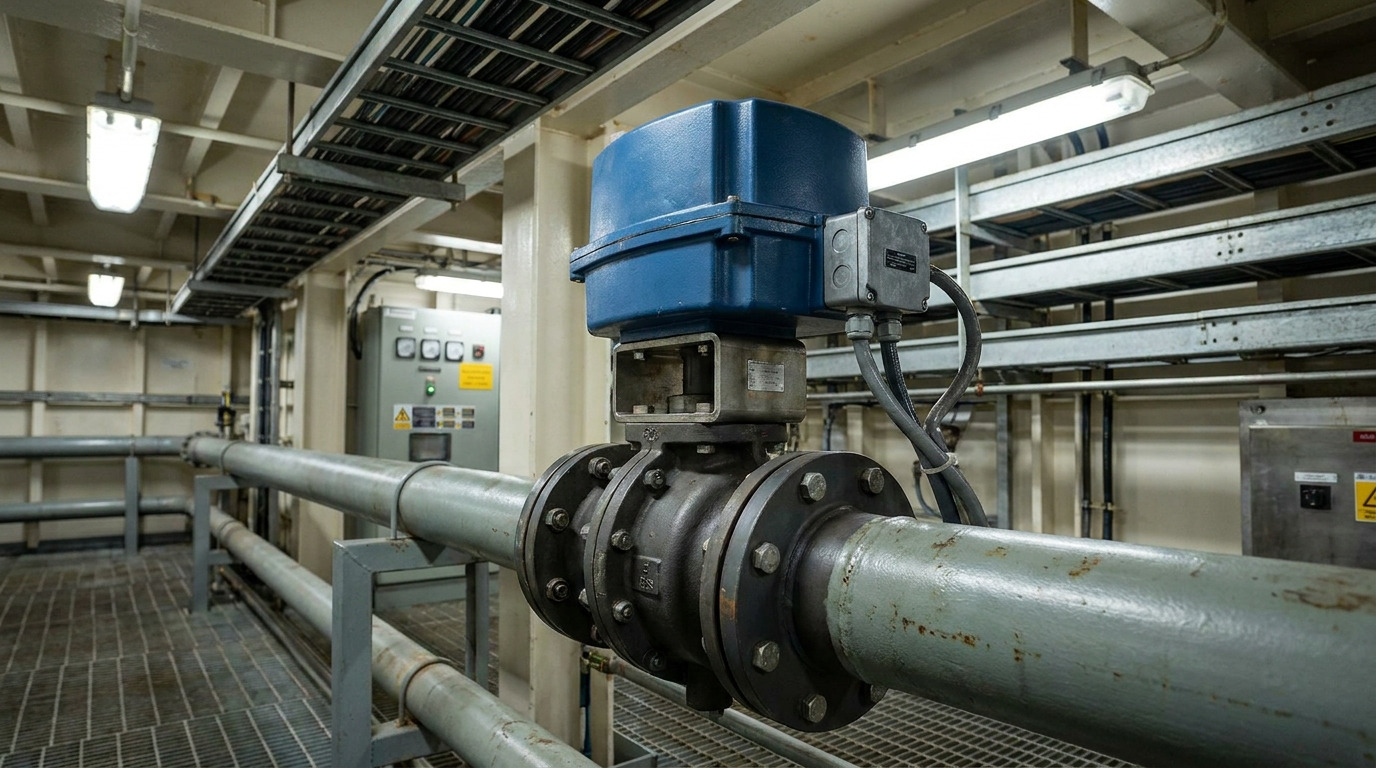
Selecting an explosion-proof marine electric butterfly valve means proving that the hazardous-area actuator, valve, materials, controls, and approval documents all match the same service condition. On a tanker, offshore module, or hazardous engine-room line, a generic “marine grade” valve with an “Ex option” is not enough. The practical solution is to qualify the assembly in layers and close every interface before issuing the purchase order.
This guide turns that qualification into an RFQ and document-review process. It applies to automated isolation or regulation in marine fluid systems handling seawater, fuel, oily water, chemicals, or general utilities where the actuator sits in a classified area.
Prove four requirements before comparing suppliers
A compliant assembly must satisfy four separate requirements: process performance, hazardous-area suitability, marine environmental suitability, and project approval. Treating any one certificate as proof of all four creates a serious specification gap.
An explosion-proof marine electric butterfly valve is a quarter-turn valve assembly that combines a hazardous-area-certified electric actuator with a valve and material system suitable for the stated marine service. “Explosion-proof” normally describes an ignition-protection method for the electrical equipment; it does not mean that the valve can withstand an external blast.
Typical duties include remote isolation or regulation on fuel, cargo, oily-water, seawater, and utility lines aboard ships or offshore facilities. The Ex requirement is driven by the actuator’s installed location and area classification, so a valve used at sea does not automatically need an explosion-protected actuator.
The following matrix shows what each layer must prove and what it does not prove.
| Qualification layer | What must match | Evidence to request | What it does not prove |
|---|---|---|---|
| Valve duty | Medium, pressure, temperature, flow function, shutoff class, end connection | Valve datasheet, drawing, material schedule, pressure and leakage test procedure | Electrical suitability in a hazardous area |
| Hazardous-area protection | Jurisdiction, zone or division, gas/dust group, temperature class, equipment protection level or category, ambient range | Certificate for the exact actuator model, marking drawing, nameplate image, special conditions of use | Saltwater compatibility or marine class acceptance |
| Marine environment | External salt exposure, humidity, vibration, enclosure ingress protection, corrosion system, cable-entry arrangement | Environmental rating, coating specification, material list, marine approval where required | Correct valve torque or process compatibility |
| Project approval | Flag, class society, owner specification, applicable valve and electrical standards | Type approval or project approval, inspection and test plan, manufacturer data record | Suitability outside the certificate scope |
The key decision is simple: the delivered model, its nameplate, and its certificates must describe the same configuration. A certificate for a product family, an actuator option, or a different ambient range should be treated as a clarification item until the supplier proves coverage.
Match the actuator certificate to the hazardous area
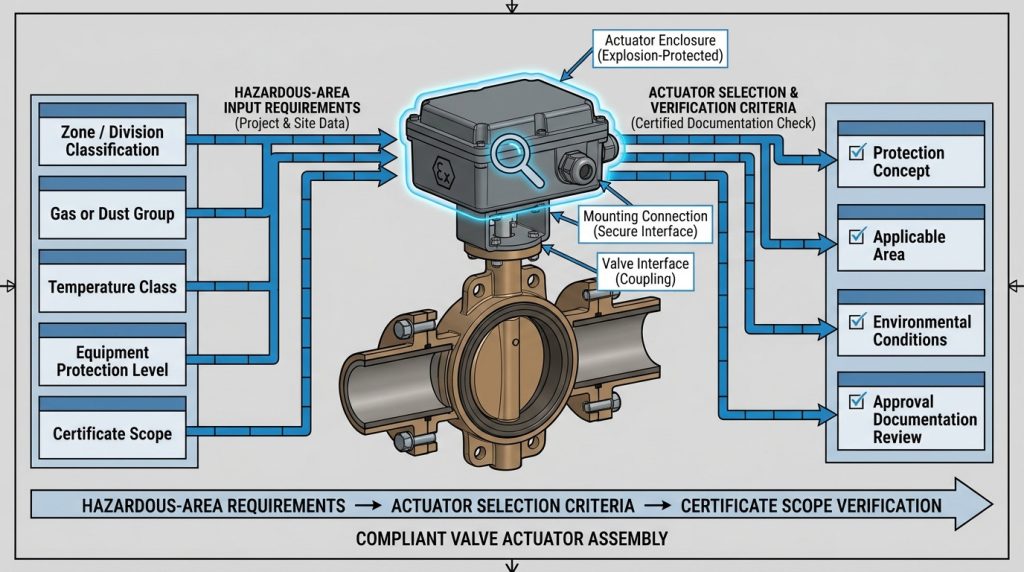
The actuator marking must match the project’s hazardous-area classification field by field. Start with the area-classification drawing and electrical equipment schedule; do not start with a supplier’s preferred actuator.
Verify the certification regime and scope
State whether the project requires IECEx, ATEX, a North American Class/Division or Zone listing, or another national scheme. IECEx does not automatically replace every national approval, and ATEX serves a different jurisdictional purpose. For IECEx equipment, check the certificate number and current status in the official controlled system; the IECEx certificate guidance explains that an online certificate marked “Current” is the master validity record.
Next, compare the certificate’s manufacturer, model code, protection concept, gas or dust group, temperature class, equipment protection level, and ambient range with the purchase description. Read the schedule of limitations or special conditions as carefully as the front page. Those conditions may control the permitted cable gland, mounting arrangement, fasteners, temperature, or maintenance method.
Reject vague certificate language
Phrases such as “explosion-proof available,” “ATEX compatible,” or “Ex rating customizable” are not approval evidence. Ask for the exact certificate before technical bid approval, then require the actuator nameplate and model code to appear on the final document index. If the actuator is assembled with a gearbox, local control station, heater, positioner, or external junction box, confirm whether each electrical item has the required protection and whether the combination stays within the certificate scope.
Separate explosion protection from marine protection
Explosion protection and marine protection solve different hazards and must be verified independently. A high IP rating may help with water and dust ingress, but it does not establish that the actuator is suitable for an explosive atmosphere.
The IEC 60529 product page defines the IP Code as enclosure protection against ingress. Ex certification addresses ignition protection under a different standards framework. Therefore, “IP68” and “explosion-proof” are not interchangeable statements, and neither one alone proves resistance to salt spray, condensation, vibration, or galvanic corrosion.
Marine class approval also needs a model-level check. If a project calls for DNV type approval, for example, verify the exact product and approval status in the DNV Approval Finder or request the class-issued controlled copy. Then compare its product designation, limitations, standards, and validity with the offered assembly. Apply the same discipline to other class societies or owner approval lists.
Size the valve and actuator as one assembly
The actuator must be sized from the valve’s worst credible operating torque, not from nominal pipe size or a free-running shop test. The calculation should show the torque source, operating condition, required factor, actuator output, and mechanical interface.
Build the valve duty point first
Provide maximum differential pressure in both directions, not only the line pressure class. Add the medium, temperature range, solids or fouling tendency, seat material, operating frequency, required stroke time, and whether the valve performs isolation or modulation. A valve that closes cleanly in water at ambient temperature may need substantially different torque in cold service, after long static periods, or with deposits at the seat.
RUITO’s industrial butterfly valve range lists DN25–DN3000, PN10–PN25, wafer, lug, and flanged connections, with body choices including ductile iron, carbon steel, stainless steel, and duplex. Disc options include coated ductile iron, SS304/316, aluminum bronze, and duplex; seat options include EPDM, NBR, PTFE, FKM, and metal. These are platform options, not proof that every combination carries the same marine or hazardous-area approval.
Review the complete torque chain
Request seating/unseating torque, dynamic torque where relevant, and the basis for any fouling or service factor. Compare those values with the actuator’s guaranteed output across the specified voltage, frequency, ambient temperature, duty cycle, and stroke time. Also confirm the ISO mounting interface, adapter, drive key, stem dimensions, mechanical stops, and manual override.
The final check is functional: the assembled unit must open, close, stop, indicate position, and reach the required shutoff under the agreed acceptance condition. A large nameplate torque value does not compensate for an unverified stem adapter, incorrect travel stops, or a control module outside its temperature range.
Select materials for the medium and the atmosphere
Material selection must cover both the wetted process and the external marine atmosphere. “Stainless steel” or “marine coating” is too broad for a purchase specification.
Use this division to prevent hidden material substitutions.
| Component or exposure | Data to provide | Selection check |
|---|---|---|
| Body, disc, shaft, seat | Exact medium, concentration, temperature, velocity, solids, cleaning chemicals | Chemical compatibility, erosion, pitting, crevice and galvanic corrosion |
| External body and bracket | Deck, splash zone, enclosed machinery space, insulation, washdown | Coating system, surface preparation, dry-film thickness, drainage and crevice control |
| Fasteners and stem hardware | Adjacent alloys, salt exposure, maintenance access | Galvanic couple, galling risk, protective treatment and replacement grade |
| Actuator enclosure and entries | Humidity, condensation, spray, immersion risk, ambient temperature | Enclosure material, IP rating, approved glands, breathers/drains if permitted, anti-condensation provision |
For offshore valve service conditions, separate internal seawater exposure from external salt spray. A coated ductile-iron body may be suitable for one duty, while an aluminum-bronze or duplex disc and a different stem/fastener system may be needed for another. Seat choice must also follow the medium: EPDM, NBR, PTFE, FKM, and metal seats have different chemical, temperature, abrasion, and shutoff limits.
Record every selected grade in the bill of materials and drawing. Do not accept “SS,” “bronze,” or “rubber” without the precise grade or compound, and do not let the actuator bracket, couplings, fasteners, or cable glands disappear from the corrosion review.
Specify controls, duty cycle, and power-loss behavior
The control specification must state what the valve does during normal commands, faults, and loss of power. An electric actuator does not become fail-safe merely because it is explosion-protected.
For on-off service, define open/close commands, end-position feedback, local/remote selection, torque and limit-switch action, ESD interface, and permitted stroke time. For modulating service, add the command and feedback signals, positioning accuracy, deadband, duty cycle, starts per hour, communication protocol, and required behavior after signal loss.
State the safe position explicitly: fail closed, fail open, or fail in place. A conventional motor-driven actuator commonly stays in its last position when power disappears unless it has a certified spring-return, stored-energy, or backup-power arrangement. If a safe-state function is required, specify the available energy source, required closing time, number of operations, test method, and whether the complete safety function needs SIL or class review.
Installation details belong in the same review. Confirm supply voltage and frequency, cable-entry thread, certified glands and stopping plugs, earthing points, space for terminal access, heater supply, local controls, manual override, and the orientation permitted by the manufacturer. These details often determine whether a certified actuator remains compliant after installation.
Define the acceptance test and document package
The purchase order should define evidence for the valve, actuator, and assembled unit before shipment. A generic quality certificate cannot substitute for serial- or batch-linked records.
The minimum package should be agreed during technical bid evaluation, not after manufacturing.
| Document or test | Minimum acceptance content |
|---|---|
| Approved datasheet and GA drawing | Tag, size, rating, face-to-face, flange standard, materials, weight, orientation, actuator model and interface |
| Hazardous-area file | Current certificate, schedule/annexes, marking drawing, nameplate image, declaration required by the project jurisdiction |
| Marine approval file | Exact type or project approval, limitations, and class/owner references when specified |
| Material file | Traceable material certificates for specified pressure-containing and wetted parts; coating records where required |
| Valve tests | Shell and seat leakage results to the purchase standard, test pressure, duration, medium, acceptance criterion and traceability ID |
| Assembly functional test | Open/close and local/remote operation, limit and torque switch action, position feedback, modulating travel if applicable, stroke time and current draw if specified |
| Installation file | Wiring diagram, terminal plan, IOM manual, certified gland requirements, spare-parts list and preservation instructions |
RUITO’s manufacturing and quality controls document hydrostatic or pneumatic testing to the specified valve standard, key-dimensional checks, batch traceability, drawings, material certificates, pressure-test reports, and IOM manuals. For an explosion-proof marine electric assembly, add the actuator-specific hazardous-area file, approval cross-check, and functional acceptance records to that valve documentation baseline.
Where project risk justifies it, add witness or hold points for nameplate verification, document review, pressure/leakage testing, and functional testing. The inspection and test plan should identify who witnesses, what instrument calibration is required, and what happens if the offered model changes after approval.
Send an RFQ that prevents hidden assumptions
A complete RFQ gives the supplier enough information to select one defensible assembly without guessing. Use a single tag-level datasheet and attach the area-classification and control documents.
Include at least the following inputs:
- Process: medium and concentration, design and operating pressure/temperature, maximum differential pressure, flow or Cv requirement, solids, corrosion allowance, and cleaning conditions.
- Valve: tag, quantity, DN/NPS, pressure class, wafer/lug/flanged body, flange and face-to-face standards, flow direction, isolation or modulating duty, shutoff requirement, materials, and coating system.
- Actuator: hazardous-area classification, required certification regime, ambient range, IP rating, voltage/frequency, control mode, duty cycle, stroke time, torque basis, feedback, communication, manual override, and fail action.
- Marine and approval: vessel or platform, installation location, class society, flag or owner requirements, vibration or environmental tests, and controlled approval-list references.
- Quality and delivery: document register, material certification level, test standards, witness points, nameplate language, spares, preservation, packing, delivery schedule, and deviation-list format.
Require suppliers to return a completed datasheet, not only a quotation. Each deviation should identify the affected tag, proposed alternative, technical effect, certificate effect, and commercial impact. Silence must not be treated as compliance.
Make the approval evidence match the delivered assembly
The right valve is not the one with the longest feature list; it is the one whose process duty, actuator marking, marine protection, torque calculation, materials, controls, and documents all agree. Freeze those interfaces before purchase, verify certificates against the exact model, and make functional and document acceptance part of the order.
RUITO can review your valve duty, materials, mounting interface, testing requirements, and document register against a tag-level RFQ. Send the area classification, process conditions, control philosophy, and approval requirements through our project contact page to receive a configuration and clarification list for technical review.
Frequently Asked Questions
Is an IP68 actuator automatically explosion-proof?
No. IP68 describes enclosure ingress protection under specified conditions; it does not certify ignition protection for a hazardous atmosphere. Require a separate Ex certificate and marking that match the classified area.
Does the certificate cover the actuator or the whole valve?
It depends on the certificate scope. An electrical Ex certificate often covers the exact actuator or certified component, while the valve assembly may also require marine type approval, project approval, or additional assessment. Check the model description and limitations rather than assuming the entire package is covered.
What happens to the valve when electrical power fails?
It normally remains in its last position unless the selected actuator package includes a defined stored-energy or backup-power function. Specify the required safe position, closing time, available energy, and acceptance test in the RFQ.
Can one material specification cover seawater and deck exposure?
Not reliably. Wetted parts must resist the process medium, while external parts must withstand salt spray, condensation, washdown, and galvanic couples. Review the body, disc, shaft, seat, fasteners, bracket, actuator enclosure, and cable entries separately.