
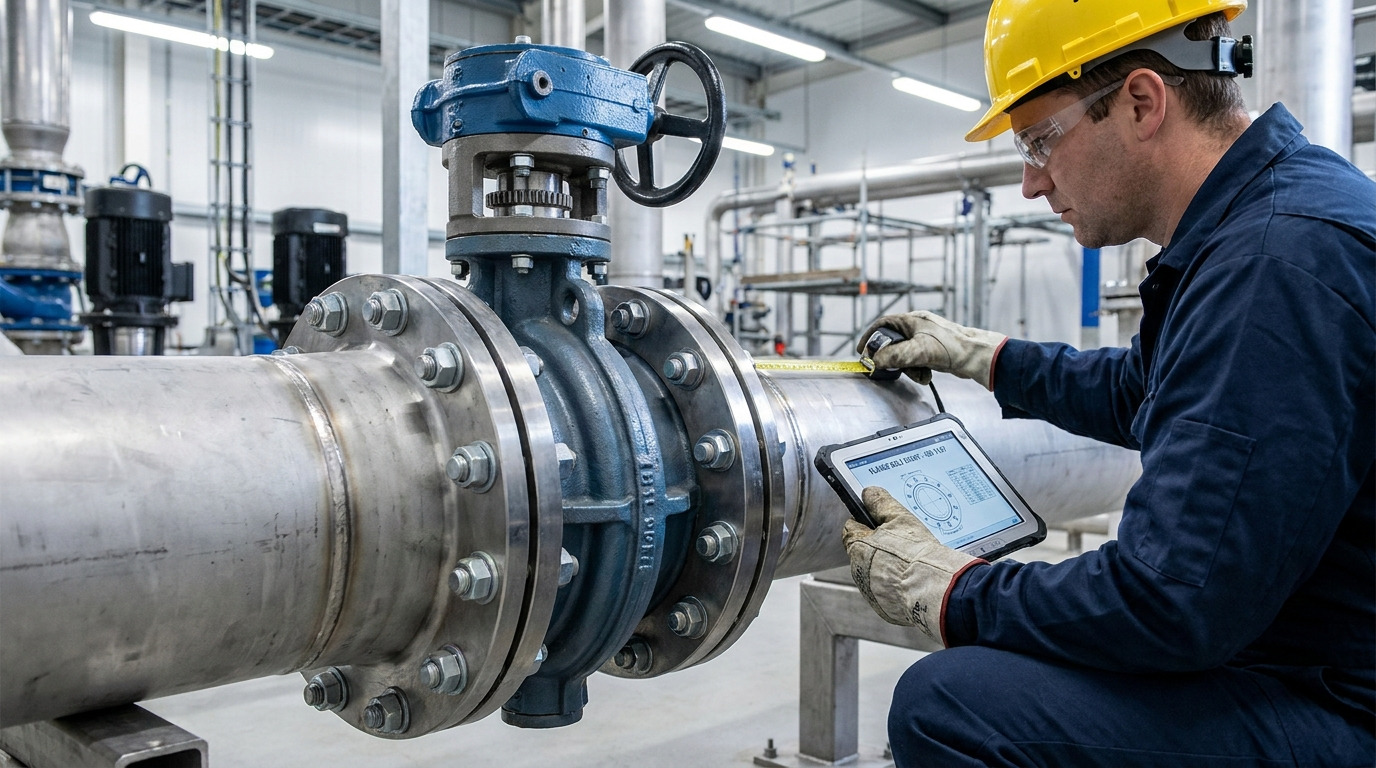
Installing industrial piping systems can feel incredibly frustrating when flange connections do not align properly. You spend hours guessing the right bolt dimensions, leading to delayed projects and unsafe connections. The solution is straightforward: using a reliable 300 butterfly valve bolt chart ensures you get the precise measurements for every installation. By referencing accurate specifications, you eliminate guesswork and build a secure, leak-proof system every single time.
What Is a 300 Butterfly Valve Bolt Chart?
A 300 butterfly valve bolt chart is a reference table that specifies the exact fastener dimensions required for Class 300 flanges. This tool dictates the diameter, length, and number of bolts needed for proper alignment. Using this guide ensures your piping connections meet industrial safety standards.
How Does the Chart Organize Data?
The data is categorized by nominal pipe size and pressure rating. This makes it simple to cross-reference your specific valve dimensions.
Here is the deal:
- Lists the number of holes per flange.
- Provides the diameter of each fastener.
- Specifies the exact length required for secure threading.
Why Are Bolt Dimensions Specific?
Fastener dimensions are specific to handle the elevated pressures of a Class 300 system. Incorrect sizes lead to structural weaknesses and potential leaks.
Key Takeaway: Always match your fastener size exactly to the chart to guarantee system integrity.
| Pipe Size (NPS) | Number of Bolts | Bolt Diameter |
|---|---|---|
| 2 inch | 8 | 5/8 inch |
| 4 inch | 8 | 3/4 inch |
| 6 inch | 12 | 3/4 inch |
The table above illustrates how bolt quantities increase as pipe diameters expand to maintain pressure distribution.
Why Use a 300 Butterfly Valve Bolt Chart?
You use a 300 butterfly valve bolt chart to guarantee that your piping components can safely withstand the designated system pressure. Without these exact measurements, you risk catastrophic joint failure during operation. It serves as your primary safety check during assembly.
Can It Prevent Costly Leaks?
Yes, matching the correct fasteners prevents uneven gasket compression. Proper compression is what keeps the fluid contained.
You might be wondering:
- Reduces maintenance downtime.
- Prevents fugitive emissions.
- Saves money on replacement gaskets.
Does It Speed Up Installation?
Having the correct measurements on hand drastically cuts down assembly time. Your crew will not waste time testing different fastener lengths.
Key Takeaway: Exact specifications streamline your workflow and reduce labor costs significantly.
| Benefit Category | Impact Level | Primary Reason |
|---|---|---|
| Safety | High | Prevents blowout |
| Efficiency | High | Speeds up assembly |
| Cost | Medium | Reduces wasted parts |
This matrix shows that safety and efficiency are the most significant benefits of using standardized measurements.
How to Read a 300 Butterfly Valve Bolt Chart?
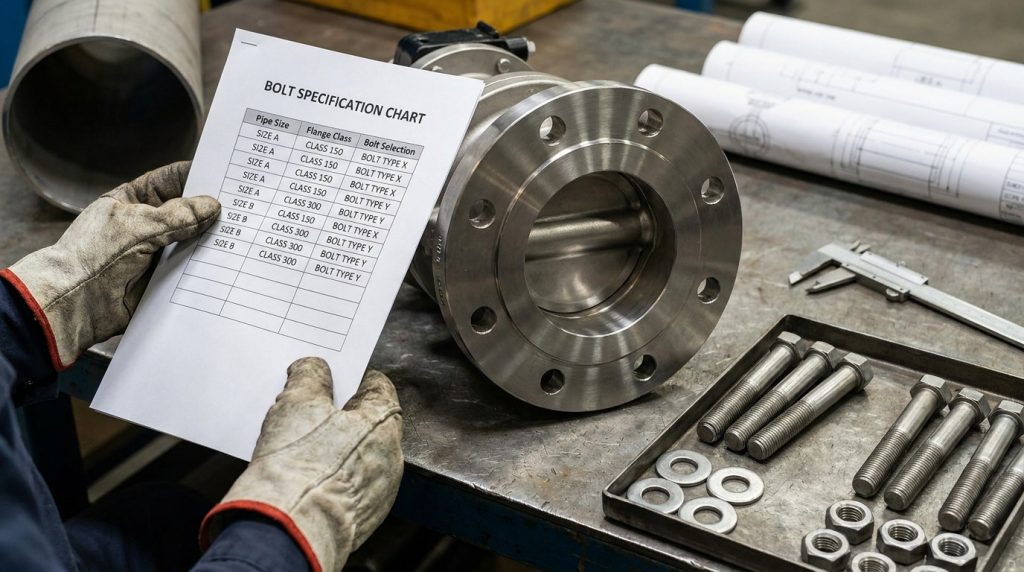
Reading a 300 butterfly valve bolt chart involves locating your pipe size on the left axis and moving across the row to find the matching fastener details. It provides a straightforward grid layout for rapid information retrieval. You just need to know your valve’s nominal size.
What Does NPS Mean?
NPS stands for Nominal Pipe Size, which is the standard North American designation for pipe diameters. It determines which row you look at.
What’s the real story?
- NPS is not the exact outer diameter.
- It relates directly to the flange bore.
- It is the starting point for all chart lookups.
How to Identify Bolt Length?
The length column specifies the distance from the underside of the head to the tip of the threads. You must account for the thickness of the valve body and two flanges.
Key Takeaway: Reading the length column correctly ensures you have enough thread engagement for the nuts.
| NPS Size | Flange Thickness | Minimum Bolt Length |
|---|---|---|
| 3 inch | 1.12 inch | 3.50 inch |
| 5 inch | 1.38 inch | 4.25 inch |
| 8 inch | 1.62 inch | 5.00 inch |
The data confirms that thicker flanges directly necessitate longer fasteners to achieve secure mechanical joints.
Where to Find a 300 Butterfly Valve Bolt Chart?
You can easily locate a 300 butterfly valve bolt chart in manufacturer catalogs, engineering handbooks, or specific ASME standard documents. Most reputable valve suppliers publish these guides directly on their technical resource pages. They are widely accessible for any field technician.
Are Online Charts Reliable?
Most digital charts provided by certified manufacturers are highly accurate and updated regularly. You should always verify the source before ordering parts.
Ready for the good part?
- Check for ASME B16.5 compliance.
- Verify the publisher is a recognized manufacturer.
- Cross-reference with your specific valve manual.
Should I Keep a Printed Copy?
Keeping a laminated physical copy on the job site is a smart operational practice. Digital devices fail or lose battery in harsh field environments.
Key Takeaway: Having a physical reference saves time when internet access is unavailable on the job site.
| Source Type | Accessibility | Reliability |
|---|---|---|
| Manufacturer Website | High | Very High |
| Engineering Handbook | Medium | Very High |
| Random Forum | High | Low |
This comparison highlights why you should only trust documentation from direct manufacturers or engineering organizations.
Does a 300 Butterfly Valve Bolt Chart Help?
A 300 butterfly valve bolt chart absolutely helps by eliminating the trial-and-error process of industrial piping assembly. It gives you the exact blueprint for a structurally sound connection. This directly translates to safer, faster, and more compliant installations.
How Does It Impact Safety?
Safety is severely compromised if fasteners are too short or too weak. The chart ensures you meet the required tensile strength.
This is where it gets interesting:
- Maintains structural integrity under load.
- Prevents sudden pressure releases.
- Protects personnel from hazardous fluid leaks.
Does It Assist in Purchasing?
Procurement teams rely heavily on these tables to order the correct hardware quantities. It prevents ordering mistakes that stall projects.
Key Takeaway: Using precise data for procurement keeps your project budget tight and on schedule.
| Procurement Issue | Without Chart | With Chart |
|---|---|---|
| Ordering Accuracy | Low | 100% Accurate |
| Project Delays | Frequent | Rare |
| Waste | High | Minimal |
This tracking table demonstrates how proper documentation transforms procurement from a guessing game into a precise operation.
Who Needs a 300 Butterfly Valve Bolt Chart?
Anyone involved in piping construction needs a 300 butterfly valve bolt chart, including pipefitters, field engineers, and procurement managers. It is a fundamental tool for anyone responsible for joining flanged systems. Without it, these professionals cannot perform their jobs correctly.
Why Do Pipefitters Rely on It?
Pipefitters use the data daily to prep materials before they climb up the scaffolding. It tells them exactly what tools and hardware to carry.
Here is the kicker:
- Pre-assembly planning becomes effortless.
- Reduces trips back to the tool crib.
- Ensures the correct wrench sizes are used.
How Do Engineers Apply It?
Design engineers reference these dimensions when modeling piping systems in CAD software. The clearance required for bolts affects the entire skid layout.
Key Takeaway: Every discipline in the piping industry relies on this standardized data to maintain consistency across the project lifecycle.
| Professional Role | Primary Use | Frequency of Use |
|---|---|---|
| Pipefitter | Physical assembly | Daily |
| CAD Engineer | Spatial planning | Weekly |
| Buyer | Hardware ordering | Per Project |
The usage breakdown shows that the chart is a universal language spoken across all phases of industrial construction.
Can a 300 Butterfly Valve Bolt Chart Fail?
A 300 butterfly valve bolt chart will not fail, but human error in reading or applying the data can lead to serious connection failures. The standard itself is mathematically proven, but applying data from the wrong pressure class is a common mistake. You must ensure you are looking at the exact right page.
What Happens If You Read It Wrong?
Misreading the dimensions usually results in buying fasteners that are too short to hold a nut. This forces a complete halt in construction.
Want to know a secret?
- Always double-check the pressure class header.
- Verify you are not reading the metric side by accident.
- Confirm the flange type matches the valve type.
Does Material Matter?
The table gives dimensions, but you must also select the correct steel grade for your specific fluid and temperature. A correct size in the wrong metal will still fail.
Key Takeaway: Accurate reading must be paired with correct metallurgical selection to guarantee a safe connection.
| Error Type | Consequence | Prevention Method |
|---|---|---|
| Wrong Class | Leaks | Check header |
| Wrong Unit | Won’t fit | Verify inch/mm |
| Wrong Grade | Corrosion | Check specs |
This failure analysis table proves that careful attention to detail is required even when using standardized reference materials.
When to Check a 300 Butterfly Valve Bolt Chart?
You should check a 300 butterfly valve bolt chart during the initial material takeoff phase and right before physical assembly begins. Verifying the data early prevents supply chain bottlenecks. Checking it again on-site ensures the right parts actually made it to your hands.
Should You Check Before Bidding?
Estimators need this data to accurately price the hardware costs for massive piping jobs. High-tensile fasteners are expensive and must be budgeted accurately.
Here is the deal:
- Accurate bids win more contracts.
- Prevents budget overruns on hardware.
- Allows for precise weight calculations for shipping.
Is It Needed During Maintenance?
Maintenance crews use the data to prepare replacement parts before shutting down a live line. You want the new hardware staged and ready immediately.
Key Takeaway: Frequent verification at every project stage ensures smooth transitions from planning to active maintenance.
| Project Phase | Reason to Check | Priority Level |
|---|---|---|
| Estimating | Cost calculation | High |
| Procurement | Ordering parts | Critical |
| Maintenance | Prep work | High |
This timeline confirms that hardware specifications are critical path items throughout the entire lifespan of a piping system.
What Sizes Fit a 300 Butterfly Valve Bolt Chart?
A standard 300 butterfly valve bolt chart covers nominal pipe sizes ranging from 2 inches all the way up to 24 inches or larger. The fastener diameter and quantity scale proportionally as the pipe size increases. You will find that smaller sizes might use 8 fasteners, while larger sizes require 24 or more.
Do Dimensions Change Drastically?
Yes, the physical mass of the hardware increases significantly to hold back the force in larger pipes. A 24-inch valve requires massive, heavy-duty studs.
What’s the real story?
- Small valves use standard hand tools.
- Large valves require hydraulic torque wrenches.
- Flange thickness grows rapidly with size.
Are Lug and Wafer Types Different?
Lug style valves require cap screws that thread directly into the body, changing the required fastener length. Wafer styles use long studs that pass completely through.
Key Takeaway: You must know your specific valve body style to select the correct length column on the reference page.
| Valve Style | Fastener Type | Installation Method |
|---|---|---|
| Wafer | Long Studs | Clamped between flanges |
| Lug | Cap Screws | Threaded into valve |
| Flanged | Standard Bolts | Bolted to ends |
This design breakdown highlights how valve geometry directly changes the mechanical requirements for secure installation.
How to Apply a 300 Butterfly Valve Bolt Chart?
You apply a 300 butterfly valve bolt chart by cross-referencing your pipe size, purchasing the specified hardware, and installing them using a star-pattern tightening sequence. Having the right parts is only half the battle; proper installation technique finishes the job. You must apply even torque across all fasteners.
What Is a Star Pattern?
Tightening fasteners in a star pattern means you tighten one nut, then move to the one directly across from it. This prevents the gasket from pinching on one side.
Ready for the good part?
- Start by hand-tightening all nuts.
- Use a torque wrench for final passes.
- Never tighten in a simple circle.
How Much Torque Is Needed?
The reference data provides the dimensions, but you must consult your gasket manufacturer for the exact torque values. The bolts simply provide the clamping force needed.
Key Takeaway: Combining accurate hardware sizing with professional tightening techniques guarantees a permanent, leak-free seal.
| Step | Action | Tool Required |
|---|---|---|
| 1 | Align flanges | Alignment pins |
| 2 | Insert bolts | Hands |
| 3 | Star tighten | Torque wrench |
This final procedural checklist proves that correct hardware must be paired with methodical mechanical practices for success.
Properly managing industrial piping installations requires precision, verified data, and reliable equipment. Relying on accurate measurement standards ensures your facility runs safely and efficiently without unexpected downtime. We provide the expertise and high-quality components required to keep your systems operating flawlessly. If you need professional guidance on your next project, contact us today to find the perfect solutions for your industrial requirements.
FAQ
Q1: Can I use Class 150 hardware on a Class 300 flange?
No, you cannot mix pressure class hardware. Class 300 flanges are thicker and require longer, higher-tensile strength fasteners to safely manage the increased internal pressure.
Q2: What’s the best way to determine my valve’s size?
Look at the identification tag riveted to the valve body. This tag permanently displays the Nominal Pipe Size (NPS) and pressure class, which you need before consulting the dimension tables.
Q3: How do I know if I need a stud or a standard machine bolt?
It depends entirely on your valve’s body design. Wafer style valves require long continuous threaded studs, while lug style valves typically utilize shorter cap screws that thread directly into the lugs.
Q4: Can I reuse old fasteners when replacing a valve?
It is highly discouraged to reuse old fastening hardware. Used bolts have often been stretched past their yield point and may fail catastrophically under new torque loads.
Q5: What’s the best material for these fasteners?
Carbon steel like ASTM A193 Grade B7 is the most standard choice for typical industrial environments. However, highly corrosive or extreme temperature applications dictate the use of specific stainless steel or exotic alloys.