
Choose a lug type double eccentric butterfly valve by checking its offset geometry, flange fit, seat rating and operating torque against your actual service. A replacement can match nominal size yet foul the pipe bore or lose its seat rating in reverse flow. Compare offers against a controlled drawing and duty sheet.
1. What defines a lug type double eccentric butterfly valve?
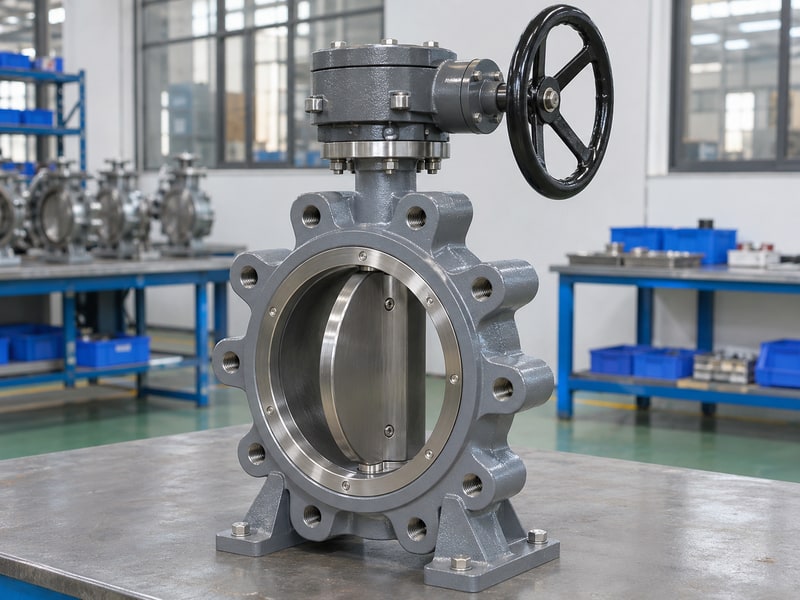
A lug type double eccentric butterfly valve combines a lug connection with two offsets in its operating geometry. The connection describes how the body attaches to pipe flanges. The offsets describe the relationship between shaft, disc and sealing plane. Confirm both on the drawing; photographs can hide the offsets.
Check the connection independently
A typical threaded lug body accepts separate bolts from each mating flange. Hole pattern, thread form, effective engagement and body thickness govern the connection. Some lug arrangements use through holes, so ask for the exact fastening detail before ordering hardware.
- Match flange drilling and facing.
- Confirm thread specification and bolt length.
Keep the product families separate
RUITO's documented lug butterfly valve range and double eccentric double flanged range have different approved configurations. Their size, pressure and application limits cannot be combined into a new catalogue product. For a lug body with double eccentric geometry, request written configuration confirmation before treating it as an available standard item.
| Description | Evidence to request |
|---|---|
| Lug connection | Fastening and flange drawing |
| Double eccentric geometry | Controlled section drawing |
| Available configuration | Written technical offer |
Key takeaway: Freeze the body style and offset geometry as separate purchase requirements.
2. How does a lug type double eccentric butterfly valve work?
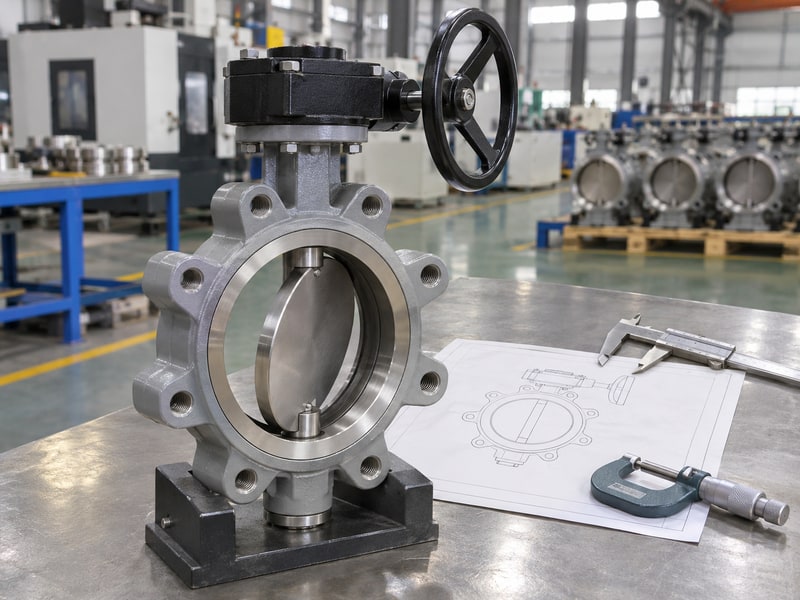
A lug type double eccentric butterfly valve uses an offset shaft arrangement that gives the disc a cam-like movement near its seat. One offset places the shaft behind the sealing plane. Another moves its axis away from the bore centreline. Their dimensions and the seat profile determine how the disc approaches and leaves the seal.
Read the section drawing
Check the drawing before comparing torque claims. A general front view may hide both offsets. Ask the supplier to show the shaft axis, bore centreline and sealing plane in views that make their relationships clear. A position indicator on the gearbox confirms operator position, rather than proving the geometry inside the valve.
- Identify both offsets on controlled views.
- Check the disc-to-shaft attachment.
Ask how contact changes during travel
Cam action can reduce rubbing after the disc moves away from its closing position. It does not establish a universal service life, fixed torque reduction or identical behaviour at every angle. Review operating cycles, solids and differential pressure before accepting a wear comparison.
| Drawing feature | Review question |
|---|---|
| Shaft position | Are both offsets shown? |
| Seat profile | Where does contact occur? |
| Travel limit | What defines full closure? |
Key takeaway: Compare geometry and duty conditions before accepting a low-torque claim.
3. How does a lug type double eccentric butterfly valve seal?
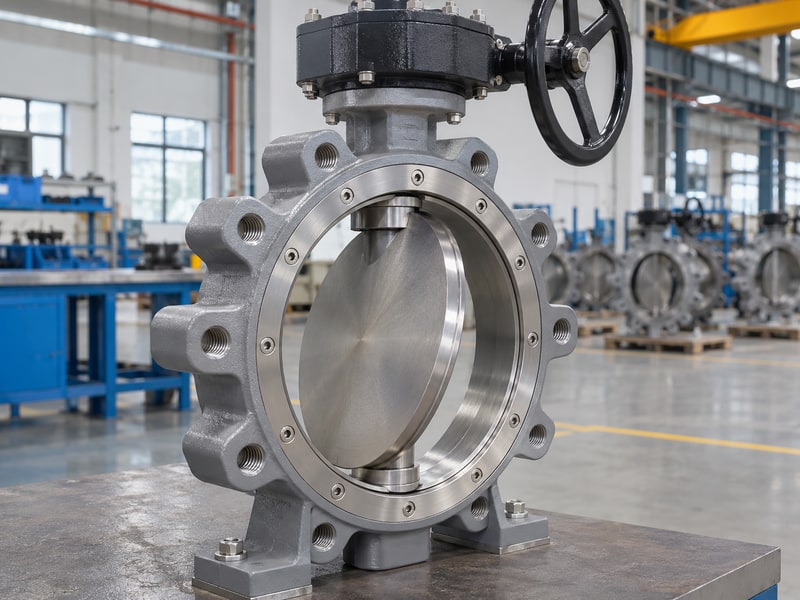
A lug type double eccentric butterfly valve seals through its specified disc and seat assembly, with contact and pressure assistance depending on the design. Body connection alone does not determine leakage performance. The seat material, retention method, closing position and pressure direction all need their own review.
Match every wetted component
A stainless steel body does not settle chemical compatibility. List the disc, shaft, seat, packing, bearings and other wetted parts. Evaluate the complete fluid composition, concentration, temperature and cleaning cycle. PTFE seats and fully lined valves also have different wetted surfaces; a seat material name does not describe a continuous corrosion barrier.
- Identify the exact seat compound or grade.
- Check packing and auxiliary seals separately.
Define leakage in testable terms
Specify the contracted test standard, such as ISO 5208 for metallic valve pressure testing where applicable, along with medium, temperature, differential pressure, direction and acceptance criterion. A soft-seat result under one procedure cannot become a promise of zero leakage in every operating condition. Metal seats may have an agreed allowable leakage rate. Ask what changes after maintenance, thermal cycling or replacement of the seal assembly.
| Selection point | Required detail |
|---|---|
| Compatibility | Complete wetted bill of materials |
| Tightness | Test conditions and leakage criterion |
| Maintenance | Seat replacement procedure |
Key takeaway: Approve the seal assembly and its test conditions together.
4. Where can a lug type double eccentric butterfly valve fit?
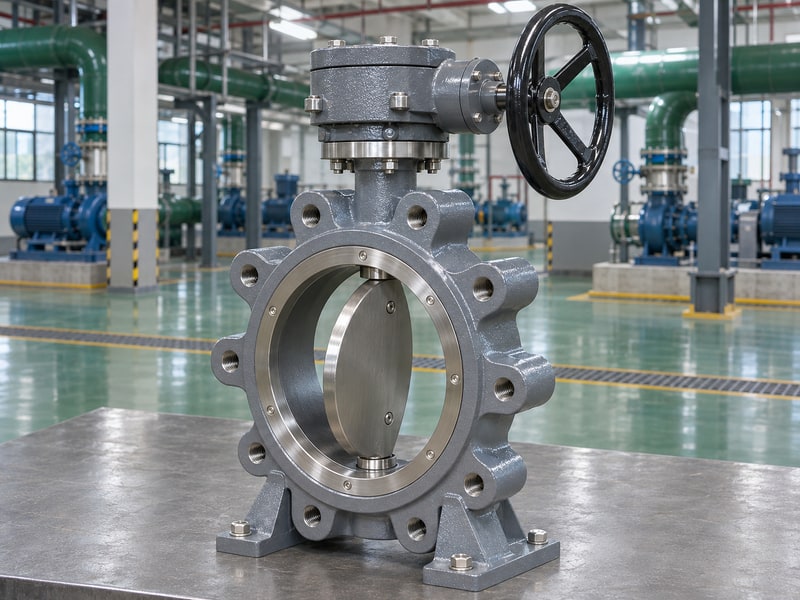
A lug type double eccentric butterfly valve can fit services for which its complete configuration has been approved. Water, oil, air and chemical applications require different material and verification decisions. A broad industry label on a product page cannot replace a duty-specific review of fluid, pressure, temperature and operating frequency.
Describe the fluid beyond its name
For cooling water, record glycol concentration, treatment chemicals and possible solids. For oil, include additives and cold-start viscosity. Gas service needs its own suitability and leakage evidence. A water-service configuration does not automatically qualify for natural gas, oxygen, hydrogen or other special gas duties.
- Record normal and upset conditions.
- Include cleaning and standby conditions.
Separate isolation from control duty
An isolation valve normally spends most of its time open or closed. A valve held partly open needs a flow and dynamic-load review. Check expected throttling duration, noise, cavitation risk and actuator stability. In a pump station, closing time and system transients also matter; a static pressure test does not validate water-hammer performance.
| Duty | Information beyond nominal size |
|---|---|
| Isolation | Maximum closing differential pressure |
| Throttling | Flow range and permitted operating angles |
| Pump service | Closing time and transient assessment |
Key takeaway: Describe the operating task before selecting the valve family.
5. What rates a lug type double eccentric butterfly valve?
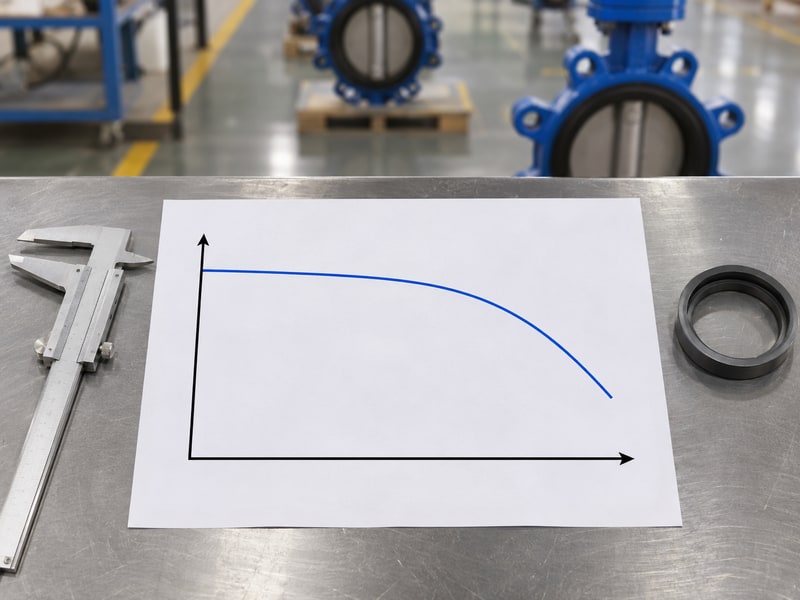
A lug type double eccentric butterfly valve takes its usable rating from the lowest applicable limit across body, seat, packing, connection and service conditions. A PN or Class designation does not provide one working pressure at every temperature. Forward, reverse and end-of-line limits may also differ.
Read the correct pressure-temperature curve
Use a curve tied to the quoted size, body material, seat and packing combination. Read pressure and temperature at the same operating point. Do not combine the largest pressure from one configuration with the hottest temperature from another. The accompanying graph illustrates the idea of derating only; it contains no product rating data.
- Check pressure units and reference temperature.
- Include maximum closing differential pressure.
Keep test pressure out of operating limits
Shell-test and closure-test pressures are inspection conditions. They are not alternative working ratings. The same distinction applies when comparing a lug valve with a flanged butterfly valve. Flange construction and test pressure do not independently prove a suitable seat rating, corrosion allowance or high-temperature capability.
| Value | What it describes |
|---|---|
| Working rating | Permitted service at stated temperature |
| Closing differential | Pressure across the closed disc |
| Test pressure | A defined inspection condition |
Key takeaway: Require one rating statement for the complete offered configuration.
6. How do you size a lug type double eccentric butterfly valve?
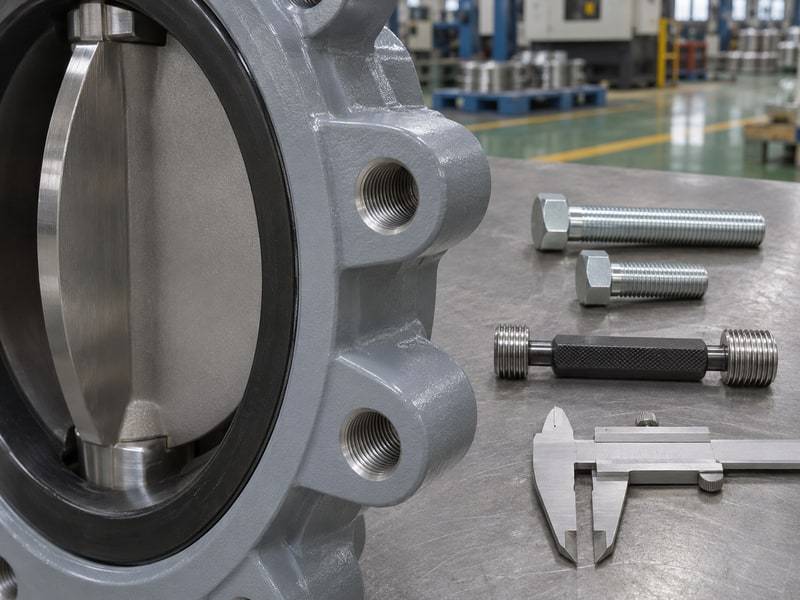
A lug type double eccentric butterfly valve needs hydraulic, mechanical and actuator sizing. Pipe size helps establish a starting connection, while flow, allowable pressure loss and operating differential establish performance requirements. The same nominal bore can have different disc obstruction, flow coefficients and torque requirements across designs.
Calculate against the real operating range
Supply minimum, normal and maximum flow with fluid properties and available pressure. For liquids, ask for the relevant Kv or Cv data at the proposed operating angles. Review viscosity corrections where needed. Gas sizing requires appropriate compressible-flow calculations; a water coefficient alone does not establish gas performance.
- Check the maximum and minimum operating cases.
- Include piping restrictions near the valve.
Size the operator from a torque envelope
Ask for breakaway, running and seating torque under the governing conditions. Include packing friction, service ageing and the agreed sizing allowance. Pneumatic output must be checked at minimum available air pressure. Electric and manual operators also need suitable output, travel stops and shaft-load limits; mounting-pad compatibility does not prove torque adequacy.
| Input | Review output |
|---|---|
| Flow and fluid properties | Hydraulic selection |
| Differential pressure | Disc and operating loads |
| Available drive supply | Operator output throughout travel |
Key takeaway: Obtain a documented flow selection and torque calculation before approving the actuator.
7. How do you fit a lug type double eccentric butterfly valve?
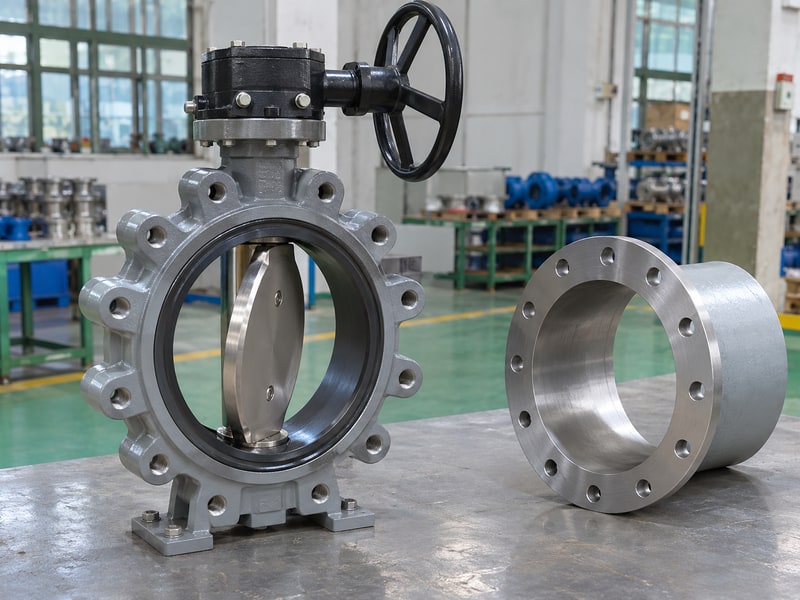
A lug type double eccentric butterfly valve fits correctly when its face-to-face length, flange pattern, bore clearance and fastening details match the pipework. A replacement should be checked against measured site dimensions and the approved valve drawing before the shutdown begins.
Check the disc sweep and flange bore
The disc may project beyond the body when open. Check clearance against pipe bore, flange neck, liner and any adjacent component. Compare the actual face-to-face dimension rather than assuming every compact valve uses the same series. A wafer butterfly valve drawing cannot be reused as a lug installation drawing without a dimensional review.
- Check gasket requirements in the supplied IOM.
- Keep pipe loads off the valve body.
Verify bolts before tightening
A bolt that bottoms in a blind threaded lug can appear tight without clamping the flange properly. Calculate length from flange thickness, washers, gasket arrangement and required engagement. Follow the manufacturer's tightening sequence and torque. Do not pull misaligned pipework together with the valve bolts or add an unapproved gasket to solve a fit problem.
| Installation check | Acceptance evidence |
|---|---|
| Disc sweep | Bore and clearance comparison |
| Bolt length | Approved engagement calculation |
| Pipe alignment | Supported, unloaded mating faces |
Key takeaway: Resolve interference and fastening questions before the valve reaches site.
8. Can a lug type double eccentric butterfly valve dead-end?
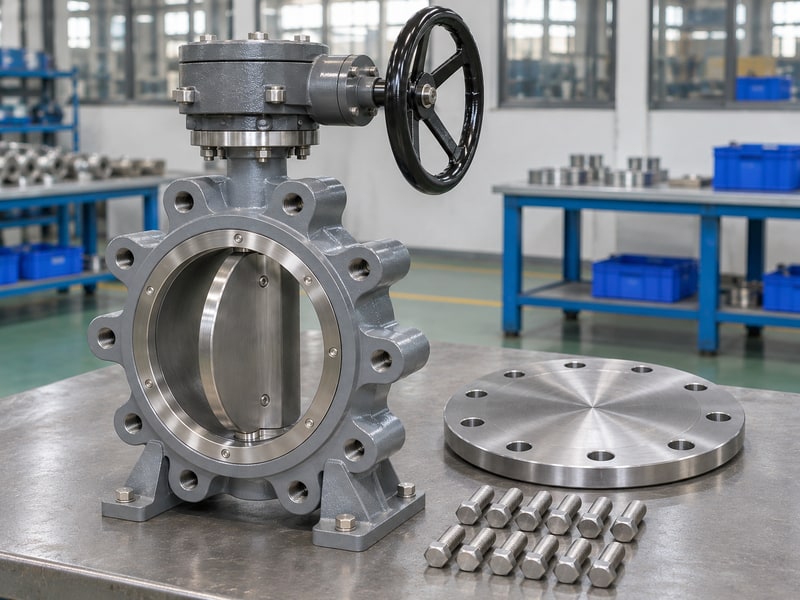
A lug type double eccentric butterfly valve can serve end-of-line duty only when the manufacturer approves that precise configuration and pressure direction. Threaded lugs alone do not establish the capability. Removing a downstream spool changes the restraint and pressure-boundary arrangement, including loads on lugs, fasteners and seat-retaining components.
Ask for the separate end-of-line rating
Obtain the permitted differential pressure, temperature, size range, installation direction and any downstream support requirement. Check whether the seat retainer remains secure with one mating flange removed. A standard two-flange pressure test does not reproduce every end-of-line condition. Request evidence tied to the offered construction rather than another valve from the same family.
- Identify the side that may be removed.
- Confirm the remaining flange and bolts.
Plan personnel isolation separately
Maintenance isolation requires the site's approved procedure, including energy isolation and verification of a safe state. A closed butterfly valve is not automatically a positive isolation barrier for personnel entry or line breaking. The loose blind flange pictured here is an inspection prop, not proof of an approved operating arrangement.
| Condition | Written confirmation needed |
|---|---|
| One flange removed | Approved construction and direction |
| Pressure retained | Separate end-of-line rating |
| Maintenance access | Site isolation procedure |
Key takeaway: Treat end-of-line service as an additional approval requirement.
9. How do you test a lug type double eccentric butterfly valve?
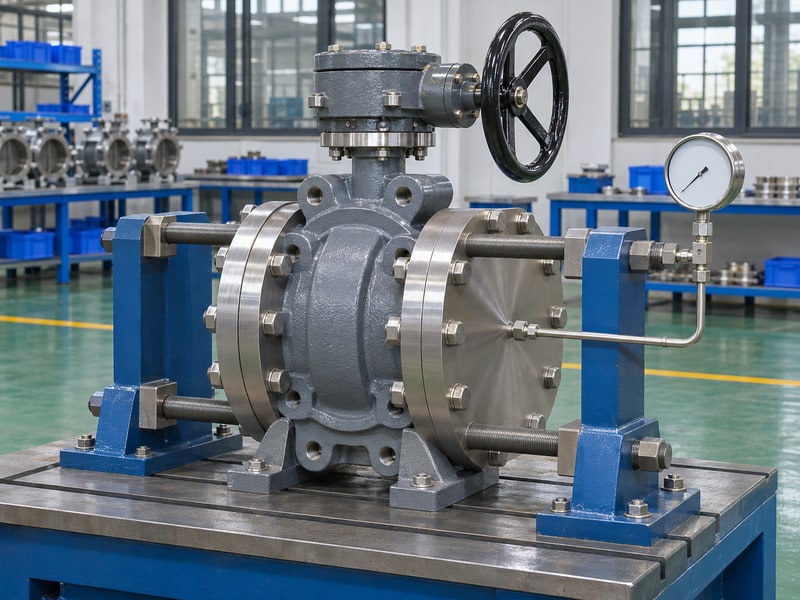
A lug type double eccentric butterfly valve should be tested against an agreed inspection plan for its exact materials, size and duty. Shell strength, seat tightness, operating function and directional performance are separate checks. Each result should identify the valve, procedure, pressure, duration and acceptance criterion.
Link records to the supplied unit
Ask for traceability from product identification to material batches, assembly records and pressure reports. Where the project requires reverse closure or end-of-line verification, include those conditions explicitly. Additional gas leakage, thermal cycling or coating checks depend on the service and contract; they cannot be inferred from a routine water test.
- Review calibrated instrument records.
- Match report revisions to the purchase order.
Check movement after assembly
Verify travel, indication and the approved stop settings with the final operator installed. Investigate unexpected torque or leakage instead of increasing actuator force to hide it. An illustrative test-rig photograph cannot establish that a pressure test occurred, so acceptance should rely on signed records and any agreed witness points.
| Inspection | Record to retain |
|---|---|
| Pressure boundary | Identified shell-test report |
| Seat performance | Directional closure results |
| Operation | Travel, indication and torque checks |
Key takeaway: Accept traceable test records rather than generic inspection photographs.
10. How do you buy a lug type double eccentric butterfly valve?
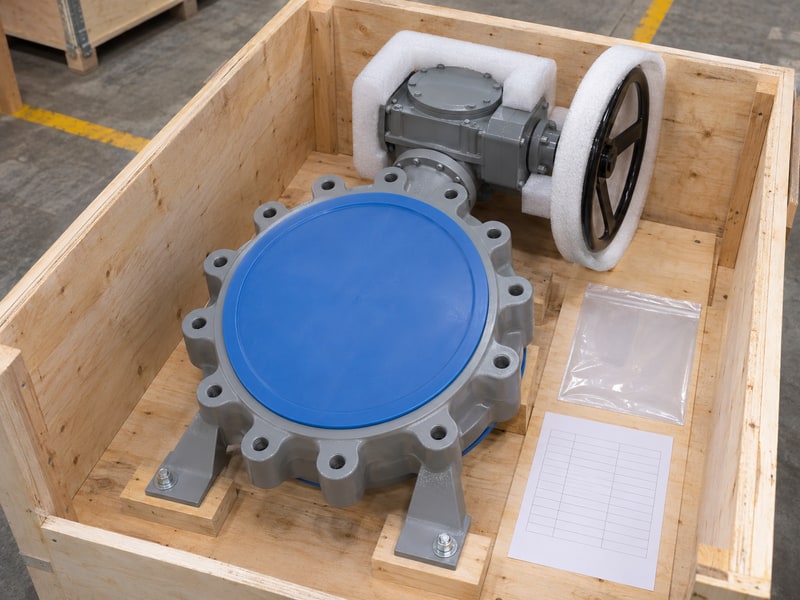
A lug type double eccentric butterfly valve should be purchased against a frozen technical scope, with deviations resolved before manufacturing. Put the fluid, operating cases, connection, materials, rating, operator and inspection requirements into one enquiry package. A low unit price is difficult to compare when these items differ between offers.
Close the technical exceptions
Request a line-by-line response and a controlled general arrangement drawing. Identify required spares, seat replacement access, packing adjustment and the final documentation package. For a new configuration, agree the sample and validation stages before releasing a batch. RUITO's engineering review can confirm whether an established product or a separately reviewed configuration matches the enquiry.
- Approve drawings and the wetted materials list.
- Record all accepted deviations in the order.
Define delivery by a verifiable milestone
Separate factory readiness from international transport and customs. Agree preservation, flange protection, packing support and document release. Use the valve guides and resources when preparing your enquiry, then submit the actual service conditions for a project-specific response.
| Purchase stage | Release condition |
|---|---|
| Technical approval | Drawing and deviations accepted |
| Factory release | Required inspection records complete |
| Shipment | Protected product and agreed documents |
Key takeaway: Keep the approved configuration attached to every order and inspection record. Send your duty sheet and mating-flange drawing when you contact us for configuration review.
Frequently asked questions
Q1. Can I identify double eccentric geometry from a product photo?
No. A photo can show body style and external features, but it may conceal both offsets. Use a controlled section drawing to confirm shaft, bore and sealing-plane relationships.
Q2. Can I reuse the bolts from my old wafer valve?
Only after checking them. Threaded lugs can need separate bolt lengths and engagement from the two sides. Verify the new valve's fastening drawing before installation.
Q3. How do I know if reverse-flow shutoff is allowed?
Ask for the reverse differential-pressure rating and its test basis. A bidirectional flow arrow or generic catalogue description does not replace that statement.
Q4. What's the best seat for my cooling-water line?
Choose from the complete fluid and temperature data. Glycol, treatment chemicals, solids and cleaning conditions can change material suitability. Approve the exact seal assembly with the supplier.
Q5. Can I order this as a standard RUITO configuration?
Obtain written confirmation. The documented concentric lug and double eccentric double flanged ranges have separate limits. A combined lug and double eccentric requirement needs its own configuration review.