
You can avoid costly chemical valve mistakes by selecting the resilient seated butterfly valve for chemicals against the complete fluid composition, concentration, temperature, cleaning duty and wetted materials. A valve may pass a water pressure test yet contain a seat, backing or shaft seal that has never been reviewed for the process liquid. Start with a complete exposure schedule, then require a configuration specific materials and validation response before comparing commercial offers.
1. Which resilient seated butterfly valve for chemicals fits?
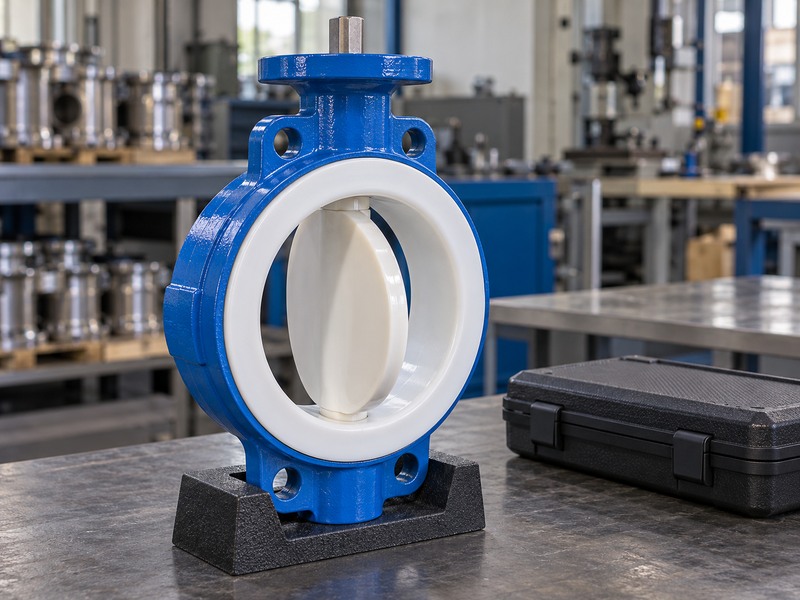
The resilient seated butterfly valve for chemicals is one whose complete construction has demonstrated compatibility with your defined chemical duty. There is no useful universal brand ranking without that duty. A supplier should explain the proposed materials, the evidence supporting them and any operating or installation conditions that remain unresolved.
What should “best” mean in your specification?
Define acceptance through containment, shutoff, operability and maintainability under the agreed conditions. The least expensive compatible construction may suit one service, while another requires a continuous fluoropolymer lining and additional validation. A chemical plant location alone does not tell the supplier which construction to select.
Separate ordinary water services from process chemical lines, and give each valve a service identification. If several liquids pass through the same valve, the approved construction must account for the full sequence, including residues and cleaning. Approval for one liquid cannot settle compatibility with the next.
- Define the actual service before requesting alternatives.
- Identify every wetted and potentially exposed material.
- Require a written statement of limits and exceptions.
| Selection claim | Evidence needed |
|---|---|
| Compatible seat | Exact compound and exposure conditions |
| Chemical isolation | Complete wetted materials and lining design |
| Suitable assembly | Pressure, function and application validation |
Compare suppliers against these acceptance requirements rather than an unsupported ranking.
2. What chemistry must the valve supplier receive?
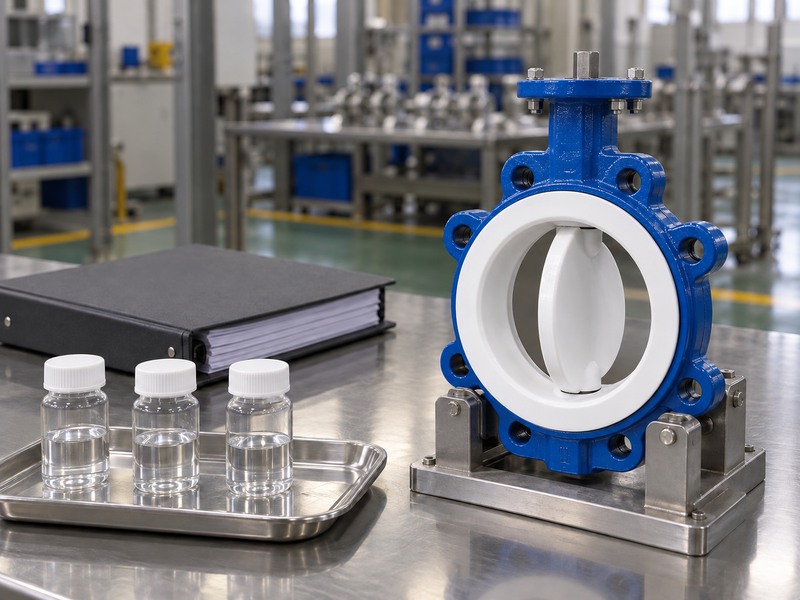
Selecting the resilient seated butterfly valve for chemicals starts with a complete chemical description, including concentration, contaminants and exposure changes. A trade name or a statement such as “dilute acid” leaves too much uncertainty. Provide the formulation or an agreed confidential description that the materials reviewer can use.
Which operating states belong in the exposure schedule?
List normal operation, startup, shutdown, cleaning, flushing and any credible concentration changes. State whether concentration is expressed by mass or volume. Include temperature for each exposure, rather than providing one maximum temperature without identifying the liquid present at that condition.
Cleaning solutions can introduce a different chemical family or a hotter exposure than the process liquid. Residues may remain in the valve between stages. Ask the process owner to identify relevant mixtures and abnormal conditions; the supplier should state which ones the proposed valve covers and which need further evaluation.
- Include additives, impurities and suspended solids.
- State contact duration and operating frequency.
- Identify possible vacuum or low absolute pressure.
| Duty information | Why the reviewer needs it |
|---|---|
| Full composition | Evaluate each material against actual exposure |
| Concentration basis | Avoid comparing unlike percentage values |
| Cleaning sequence | Assess additional liquids and temperatures |
Keep the approved exposure schedule with the valve specification so later process changes can be checked against it.
3. How should EPDM, NBR and fluoropolymers be compared?
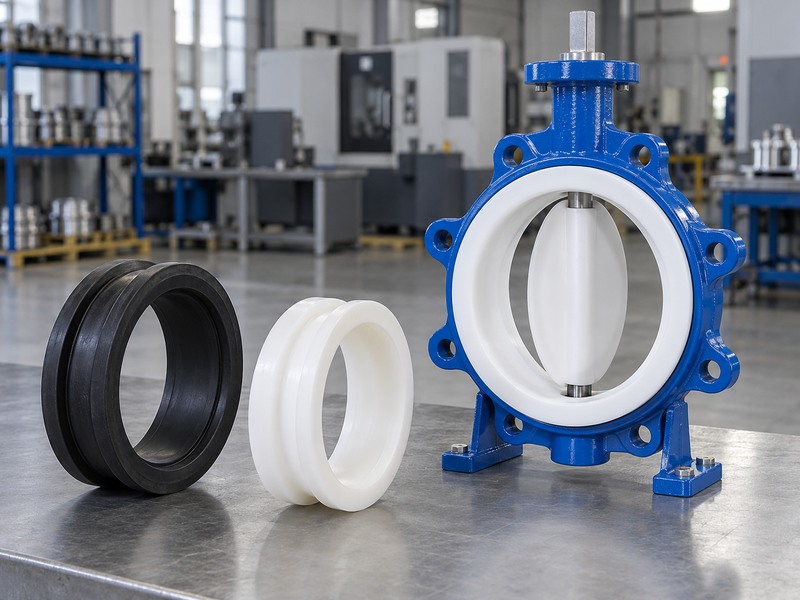
The resilient seated butterfly valve for chemicals uses materials selected for the actual exposure, so EPDM, NBR, PTFE and PFA require different assessments. EPDM and NBR are elastomers with compound dependent behavior. PTFE and PFA are fluoropolymers; PTFE is not an elastomer.
Why does the complete sealing arrangement matter?
A polymer name does not describe fillers, formulation, mechanical support or all sealing interfaces. RUITO controls its water EPDM and oil or clean gas NBR arrangements separately. Neither inherits arbitrary acid, alkali, solvent or oxidizer suitability from the family name, and a compatibility chart entry cannot identify the full supplied assembly.
A dedicated PTFE lined butterfly valve has its own lining, backing and shaft seals. Those parts must be reviewed together. If the selected design relies on an elastomer behind a fluoropolymer layer, ask how permeation, temperature and pressure conditions affect that backing and the external sealing system.
- Request exact controlled material identifications.
- Distinguish resin data from complete valve evidence.
- Obtain written approval for material alternatives.
| Material description | Review needed |
|---|---|
| EPDM or NBR seat | Compound compatibility and mechanical duty |
| PTFE lining | Continuous coverage, backing and shaft seals |
| PFA lining | Actual covered surfaces and resin specification |
Choose a construction from its documented exposure limits and design evidence.
4. Which chemical limits apply to RUITO lined valves?
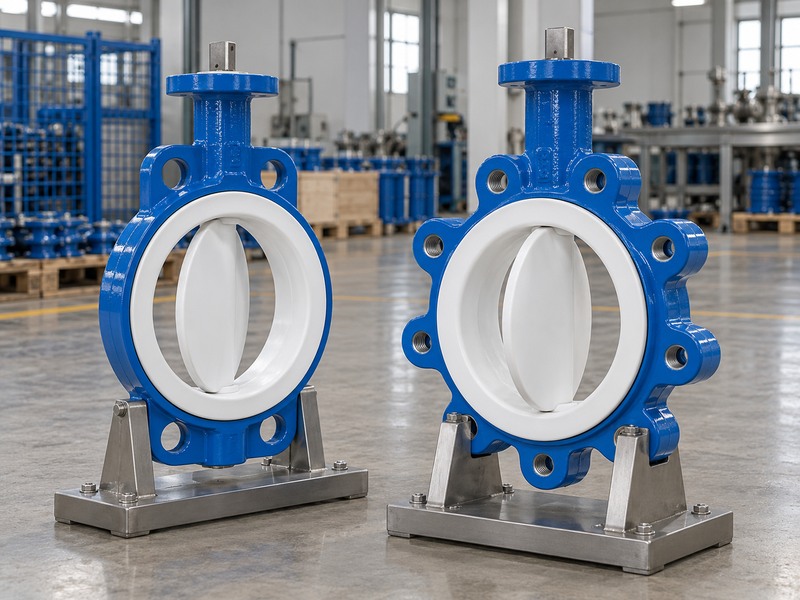
For RUITO, the resilient seated butterfly valve for chemicals may require dedicated PTFE or PFA lined configurations within the following defined chemical boundaries. These are separate configurations, with concentrations stated by mass. Each selection still needs confirmation of the simultaneous fluid, temperature, pressure and size conditions.
How should the listed envelopes be read?
The lined families have a PN10 designation, while the chemical-service pressure limits below are lower. NaOH, HCl and H2SO4 each use an independent approved configuration. For these three liquids, PTFE versions cover DN25–300 and PFA versions cover DN25–200. For NaClO, both PTFE and PFA versions are limited to DN25–150.
| Aqueous liquid, mass concentration | Temperature | Working pressure |
|---|---|---|
| NaOH, 10–30% | 20–60°C | ≤6 barg |
| HCl, 1–20% | 5–50°C | ≤6 barg |
| H2SO4, 1–30% | 5–50°C | ≤6 barg |
| NaClO, 0.5–5% | 5–35°C | ≤4 barg |
These boundaries do not establish suitability for concentrated acids, mixed acids or hot oxidizing liquids. Independent maximum values cannot be combined into a new operating point. For NaClO, review available chlorine, pH, backing and shaft seals; the customer’s system design must address decomposition gas and required venting or pressure relief.
- Identify the exact chemical configuration in the order.
- Confirm additives and impurities separately.
- Request the applicable pressure-temperature assessment.
5. Which wetted surfaces and lining details need review?
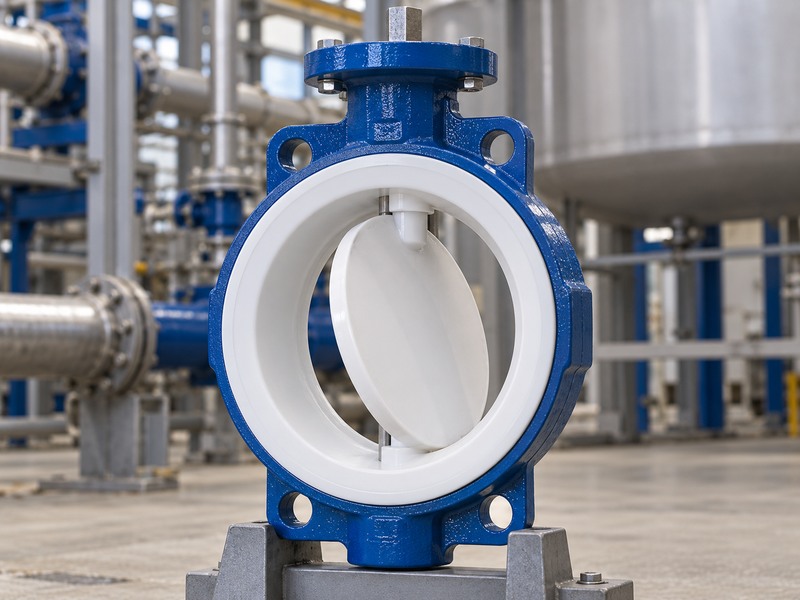
The resilient seated butterfly valve for chemicals accounts for every wetted surface, including the disc covering, body lining, shaft interfaces and flange sealing area. Review a controlled section drawing and parts list together. A quoted body material does not describe the chemical barrier between that body and the process liquid.
What should a lining description specify?
RUITO’s PTFE lined construction has a continuous wetted PTFE lining and covered disc, with a design thickness of 2–5 mm. Its PFA lined construction uses PFA on both the wetted body lining and disc covering, with a design thickness of 3–5 mm and local minimum values defined by drawing. Resin, backing and shaft seals remain separately controlled.
A PFA covered disc combined with a PTFE seat is a mixed material configuration. Identify each part rather than calling the whole valve fully PFA lined. Request the local thickness criteria and inspection procedure applicable to the selected design; the broad design range cannot replace those acceptance requirements.
- Trace the continuous process contact surfaces.
- Identify exposed metals and secondary seals.
- Confirm the approved resin and component revisions.
| Surface or part | Document to review |
|---|---|
| Body and disc | Section drawing and material identification |
| Flange sealing area | Face detail and installation procedure |
| Shaft interface | Seal arrangement and compatibility assessment |
Close any uncertainty about chemical contact before approving the materials list.
6. How do pressure, temperature and cycling change selection?
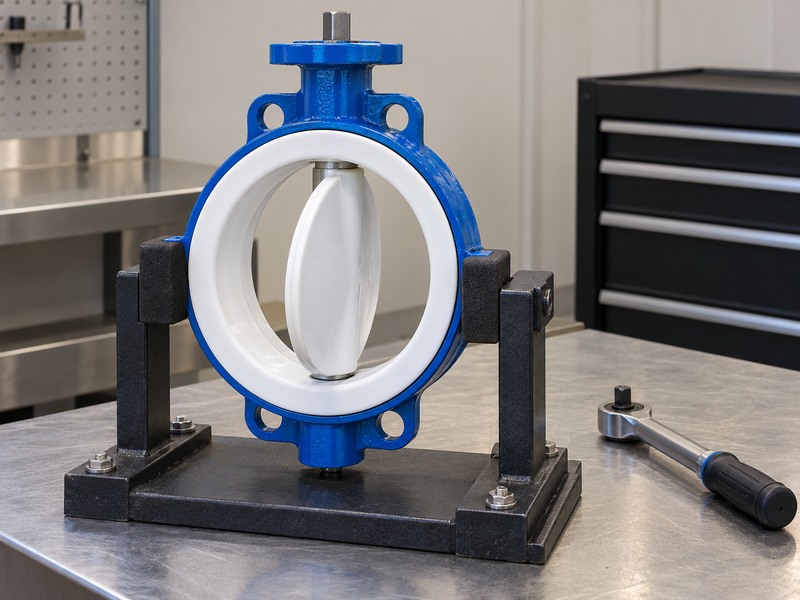
The resilient seated butterfly valve for chemicals must operate within a confirmed combination of pressure, temperature and exposure, including relevant cycles. An allowable ambient pressure cannot be transferred to the highest temperature without checking derating. The backing, lining retention and shaft seals can constrain the complete valve.
Which conditions need explicit confirmation?
RUITO’s PTFE/PFA lined family design range is −10–150°C, subject to lining, backing and temperature derating. That family design description does not extend the narrower chemical service limits listed above. Request confirmation for the actual process point and every cleaning or shutdown exposure.
State the maximum closing differential and the minimum absolute pressure, including suction or draining conditions. Positive pressure qualification cannot establish unlimited vacuum suitability. Where temperature changes or repeated operation are relevant, agree the representative validation conditions and the acceptance checks after cycling.
- Provide concurrent pressure and temperature cases.
- Include heating, cooling and depressurization sequences.
- Assess the actual operating and closing frequency.
| Condition | Review question |
|---|---|
| Highest temperature | Which fluid and pressure occur together? |
| Lowest absolute pressure | Is lining retention validated? |
| Repeated cycling | Which seals and interfaces need rechecking? |
Use the lowest applicable limit from the complete configuration and the approved chemical duty.
7. Which installation checks protect the chemical barrier?
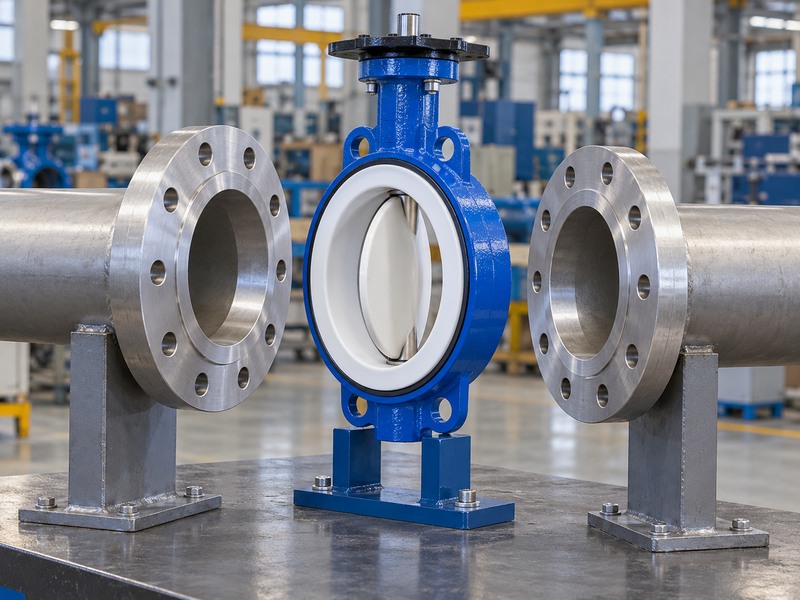
The resilient seated butterfly valve for chemicals still requires correct flange fit, bolt loading, support and handling to preserve the chemical barrier. Review installation instructions before selecting mating components. Excessive compression or an incompatible flange face can damage a lining that passed its factory inspection.
How should the connection arrangement be checked?
For a wafer butterfly valve arrangement, confirm disc clearance against the actual flange and pipe bore. Identify the required sealing face, fastener pattern and tightening method from the approved lined valve instructions. Do not add gaskets by habit when the supplied sealing arrangement requires a different assembly.
A lug butterfly valve arrangement needs its own thread engagement and connection review. Lug construction alone does not establish chemical end isolation capability. Confirm any required end service condition for the exact lined configuration, together with pipe loads, maintenance access and the operator envelope.
- Keep protective covers on until assembly preparation.
- Prevent debris from entering sealing interfaces.
- Use the approved tightening and support procedure.
| Installation feature | Check before assembly |
|---|---|
| Mating flange | Face, bore and lining contact geometry |
| Fasteners | Approved sequence, loading and engagement |
| Support and handling | Pipe loads, access and protected sealing faces |
Record the installation conditions needed for commissioning and later fault investigation.
8. What do immersion and complete valve tests prove?
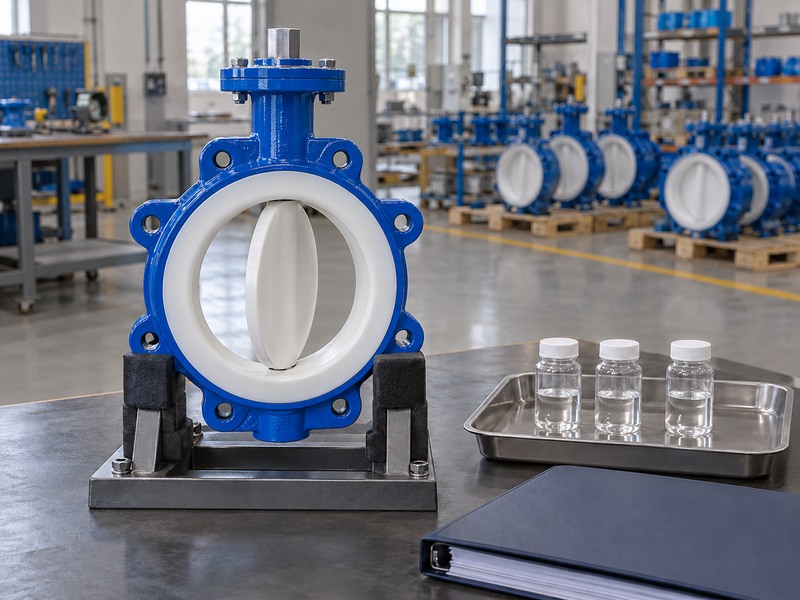
Validation of the resilient seated butterfly valve for chemicals needs both material evidence and appropriate complete valve testing. Immersion testing examines how a defined material responds to a particular liquid under stated conditions. It cannot by itself prove lining retention, shaft sealing, torque or shutoff performance in the assembled valve.
Which records should the test plan distinguish?
Define the material samples, liquid composition, temperature, exposure duration and evaluation criteria before immersion work. Relate the results to the actual controlled material and intended exposure. If the process liquid changes, assess whether the existing evidence remains applicable rather than reusing a favorable chart entry.
The primary standard ISO 5208 addresses pressure testing of industrial metallic valves. RUITO uses a selected pressure procedure alongside lining integrity and other configuration specific checks. Hydrostatic acceptance does not prove chemical compatibility; thickness, pinhole, flange face, functional and applicable thermal or negative pressure validation answer different questions.
- Link resin and backing batches to the valve records.
- Set pinhole inspection conditions by material and thickness.
- Identify which tests are routine and which are qualification.
| Evidence | What it can establish |
|---|---|
| Material exposure test | Material response to defined chemical conditions |
| Lining inspection | Thickness, continuity and surface acceptance |
| Complete valve test | Defined pressure, sealing and operating performance |
Require each report to identify the tested configuration and its limits.
9. What documents should close the chemical review?
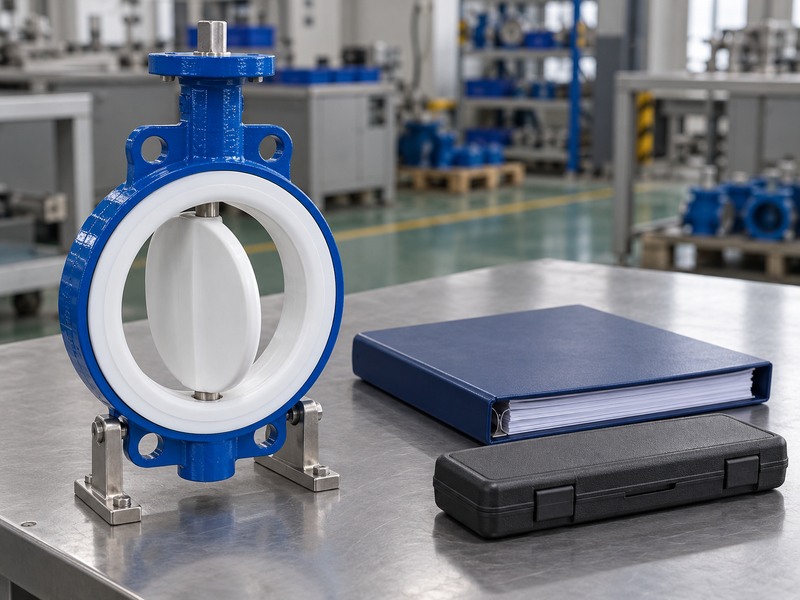
The resilient seated butterfly valve for chemicals needs an approved chemical duty sheet, configuration specific materials list, drawing and validation plan before purchase. Assign reviewers for process conditions, materials, mechanical fit and acceptance evidence. Leave unresolved assumptions visible until the responsible person approves them.
How should changes be controlled after approval?
Keep the fluid specification, lining and seal identities, operating limits and approved drawing revisions together. The supplier should state exceptions and identify any further samples or testing required. Require written review before changing the resin, backing, shaft seals or other parts that affect chemical containment.
| Review package | Required content |
|---|---|
| Process duty | Chemistry, concentration and exposure schedule |
| Valve definition | Wetted materials, drawings and operating limits |
| Acceptance evidence | Inspection plan, reports and traceability |
After commissioning, review changes in cleaning liquid, concentration, temperature, operating frequency or pressure conditions against that package. Replacement parts must match the approved assembly or pass a documented change review.
For a chemical configuration review, contact us with the full composition, concentration basis, pressure-temperature cases, cleaning sequence and pipe connection details. Ask for a written compatibility response that identifies the proposed lining, backing, shaft seals, applicable limits and remaining validation work.
10. What do chemical valve buyers ask before approval?
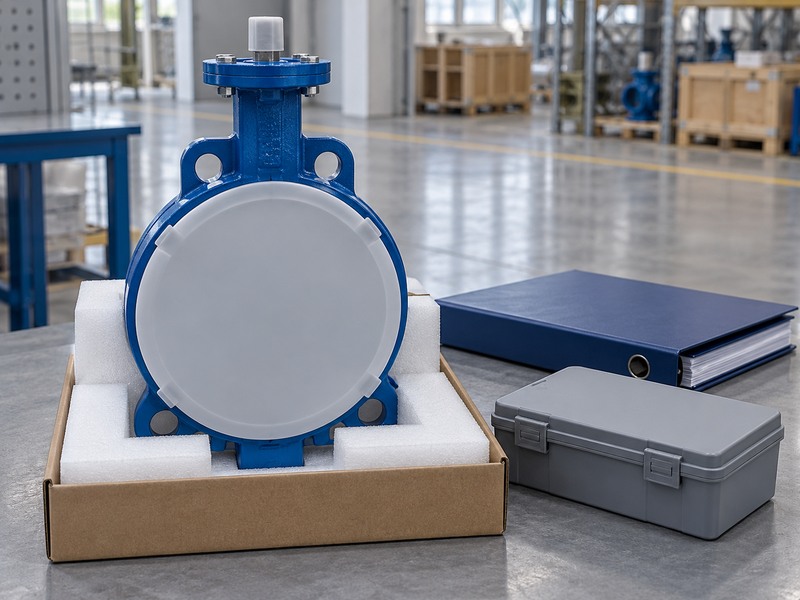
Chemical valve buyers ask how to identify the resilient seated butterfly valve for chemicals, verify compatibility and approve later exposure changes. Answers must refer to the offered assembly and exposure schedule, because a favorable result for one polymer or liquid does not approve every chemical service.
Q1. Can I select a valve from the chemical name alone?
No. Provide concentration, temperature, impurities, cleaning liquids and operating conditions so the supplier can review every relevant material and exposure.
Q2. What are the best resilient-seated butterfly valves for chemical applications?
There is no universal choice. The exact compound or lining construction must suit the complete duty, with evidence for the intended exposure.
Q3. Can I call a PTFE lined valve elastomer seated?
PTFE is not an elastomer. Describe the actual lining and sealing construction, including any elastomer backing or secondary seals listed in its materials.
Q4. Does a successful water pressure test prove compatibility?
No. It establishes performance under its specified test conditions. Chemical exposure, permeation and lining behavior need their own applicable evidence.
Q5. How do I know whether a new cleaning liquid is acceptable?
Submit the revised exposure schedule for review before use. Check concentration, temperature, residues and contact duration against the complete supplied valve configuration.