
How to Choose a Supervisory Butterfly Valve Without Mistakes
Choose a supervisory butterfly valve when the proposed location, mechanical duty, hydraulic review, approval scope, and required position supervision all support that exact assembly. A compact valve can fit a drawing while leaving its operator inaccessible or its use at that location unresolved. Review the position before committing to a valve type, especially when replacing an existing control valve.
1. When does a supervisory butterfly valve fit the location?
A supervisory butterfly valve fits a location when it meets the valve duty and the requirements attached to that particular position in the system. Identify the pipe segment, equipment relationship, required normal position, and service before comparing catalogues. The same nominal pipe size can appear at locations with different selection constraints.

Record whether the valve isolates a distribution section, forms part of a specified equipment arrangement, or replaces an existing approved item. Ask the responsible designer to identify the governing project documents and unresolved conditions. A product listing is one input to this decision; it does not by itself approve every location.
Define the position before comparing products
Prepare a short location record with the valve tag, surrounding equipment, available envelope, and required service. Link it to the current drawing and specification revision. Give the supplier these inputs so its response addresses a real position rather than a generic request for a supervised valve.
- Identify the upstream and downstream equipment or service boundaries.
- State the required isolation and supervision functions separately.
- Mark positions needing a specialist design decision before selection.
| Location input | Decision it supports |
|---|---|
| System function | Whether the valve type is suitable for that duty |
| Equipment relationship | Which additional restrictions need review |
| Layout and access | Whether the complete assembly can be accommodated |
| Adopted requirements | Who must accept the proposed selection |
An incomplete location record should lead to a design clarification before a purchase decision.
2. How does it compare with an OS&Y gate valve?
Compare a supervisory butterfly valve with an OS&Y gate valve by reviewing their actual construction, operating envelope, hydraulic data, and permitted application. The butterfly valve rotates a disc within its body. An OS&Y gate valve has an external stem-and-yoke arrangement, with a different movement and position-indication mechanism.

RUITO’s gate valve range provides structural context for a comparison, but the proposed fire-service product still needs its own model-specific evidence. Compare the open and closed envelopes on the actual drawings. Avoid assuming that an external stem, a handwheel, or a fitted switch makes two complete valve arrangements interchangeable.
Compare the consequence of each construction
An OS&Y arrangement requires review of its rising-stem clearance and any applicable supervisory device. A geared butterfly arrangement requires review of its disc envelope, operator access, and permitted sensing mechanism. Use each manufacturer’s hydraulic information instead of assuming equal flow resistance from nominal size or a broad “full bore” description.
- Compare the complete open and closed dimensions of both candidates.
- Request hydraulic evidence for the actual size and operating condition.
- Review each valve’s approved application and supervision arrangement.
| Comparison item | Butterfly candidate | OS&Y candidate |
|---|---|---|
| Moving element | Rotating disc and shaft | Gate and stem mechanism |
| External envelope | Operator, enclosure, and service access | Stem travel, yoke, and service access |
| Hydraulic basis | Exact model data | Exact model data |
| Supervision | Permitted disc/shaft-related mechanism | Permitted stem-related mechanism |
Retain an alternative when it resolves a documented location constraint that the other candidate cannot satisfy.
3. Can the complete valve fit the available space?
Check the complete supervisory butterfly valve envelope against the available space, including the handwheel, gear, switch enclosure, and access around them. Body length alone gives an incomplete picture. Nearby walls, insulation, supports, instruments, and other operators can conflict with a valve that appears compact on a pipe schedule.
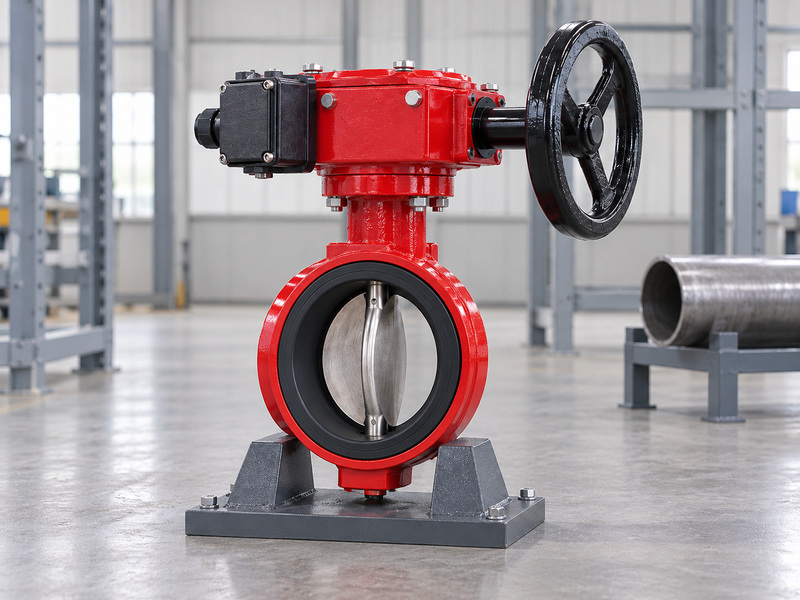
Request a general arrangement drawing for the offered assembly in its intended orientation. Compare it with the coordinated project model or measured replacement envelope, using the applicable approved method. Identify any layout assumptions before a supplier treats the available space as confirmed.
Distinguish disc movement from operator movement
The disc’s rotary movement does not establish how far a geared handwheel must turn. Obtain the operator’s own information for its travel, operating requirements, and permitted orientation. A description such as quarter-turn refers to the valve’s disc movement and should not become an instruction about handwheel rotation.
- Include the complete operator and enclosure in the layout review.
- Check the space required for authorized access and removal.
- Record orientation or access conditions attached to the offered assembly.
| Envelope check | Information to compare | Possible conflict |
|---|---|---|
| Axial space | Valve and mating connection dimensions | Existing pipe arrangement |
| Operator space | Handwheel and gear outline | Wall, support, or adjacent valve |
| Enclosure space | Entry and access requirements | Cable route or structural obstruction |
| Replacement route | Complete item dimensions | Door, hatch, or removal path |
An orientation change needs review against the manufacturer’s instructions before it becomes the solution to a clash.
4. Will authorized personnel be able to maintain it?
A supervisory butterfly valve is a suitable location choice only when the project can provide the access its inspection, operation, and maintenance requirements need. Review access with the operating team before finalizing the layout. A valve can be physically installed while still being difficult to identify, reach, or remove under an authorized work plan.

Include the viewing position for local indication, access to the operator and enclosure, and the route for handling replacement parts. Use the exact instructions and project access requirements. Do not infer a universal clearance or maintenance interval from a photograph of another installation.
Review the tasks the layout must accommodate
Ask the responsible project team to identify foreseeable inspection and replacement tasks and the associated access needs. Consider whether removable panels, adjacent equipment, or structural supports affect those tasks. Keep fire-system valve movement and any disturbance of supervision within qualified personnel’s authorization and the project’s applicable controls.
- Confirm that the asset and local indicator can be identified from the intended access point.
- Check the space required by the documented service arrangement.
- Include a workable route for the complete replacement item where required.
| Access task | Layout question |
|---|---|
| Identification | Can personnel locate the correct asset? |
| Local observation | Is the intended indication visible? |
| Authorized service | Can the relevant enclosure and operator be accessed? |
| Replacement | Can the permitted item be supported and removed? |
Refer unresolved service access to the layout designer before approving the valve position.
5. Which connection and disc-clearance checks apply?
Select the supervisory butterfly valve connection from the actual mating pipe and the permitted assembly requirements, then verify disc clearance through its documented travel. Nominal size does not settle pipe outside diameter, flange bore, groove profile, or adjacent fitting clearance. Ask for the connection details that apply to the exact offered body.
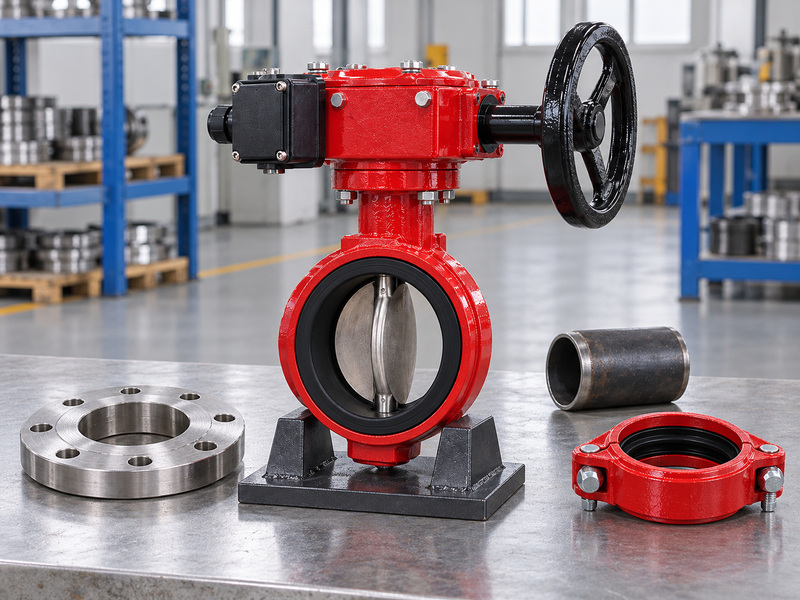
For a grooved end butterfly valve, review the valve ends with the specified pipe, coupling, and gasket. For a wafer butterfly valve, review its companion flanges and the available internal clearance. These product categories describe connections; they do not establish approval of every supervised configuration.
Check the internal envelope as well as the pipe ends
Request the manufacturer’s disc-opening envelope and compare it with nearby pipe, liners, reducers, and other components. Include the intended assembly orientation and any connection restrictions in the review. An external fit check can miss interference inside the flow passage, particularly in a replacement with limited records.
- Confirm actual mating dimensions and component identities.
- Compare the disc envelope with the adjacent internal geometry.
- Record any special connection or end-service conditions.
| Connection detail | Evidence needed | Acceptance question |
|---|---|---|
| Grooved assembly | Valve, pipe, coupling, and gasket requirements | Do these parts form a permitted connection? |
| Companion flange | Bore and mating dimensions | Can the disc move without interference? |
| Adjacent fitting | Internal profile and location | Does it conflict with the travel envelope? |
Keep a connection uncertainty open until the actual mating arrangement has been reviewed.
6. What hydraulic data should support the choice?
Support the supervisory butterfly valve choice with manufacturer hydraulic data for the exact model, size, and stated operating condition. Give the project hydraulic designer the applicable document revision and any conditions attached to the data. A position-supervision function does not establish flow capacity or pressure loss.
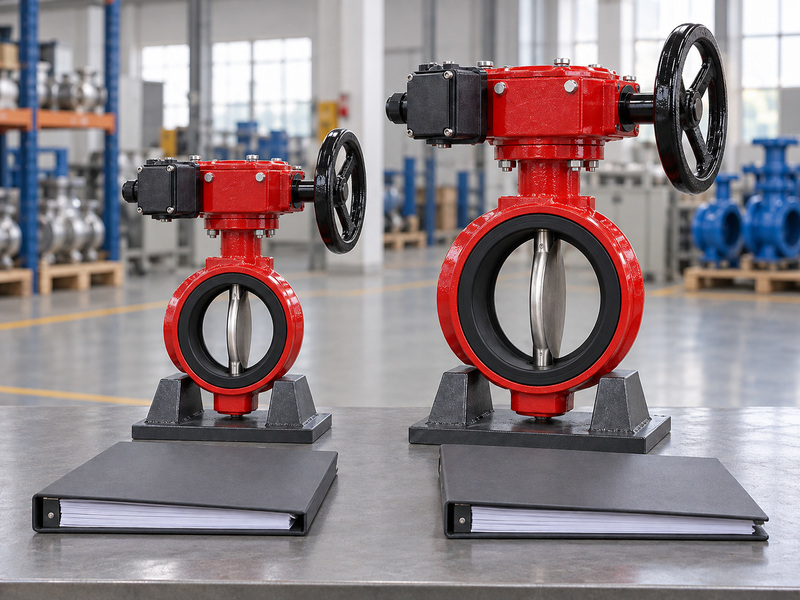
For example, the Series 705 product publication provides equivalent-pipe-length information and flow coefficients for that series, with a specified fully open water condition for the coefficient table. Those data belong to that product and its stated basis. Obtain the corresponding evidence for the proposed valve instead of transferring another manufacturer’s values.
Keep the hydraulic basis with the selected configuration
Ask the responsible designer to review the required flow cases, available pressure, and the intended valve position using the appropriate calculation basis. A coefficient for a fully open valve cannot establish performance at another opening. If the duty calls for throttling or regulation, request a separate suitability review rather than treating a supervised isolation valve as a control valve by default.
- Identify the exact model, size, document revision, and data conditions.
- Preserve the manufacturer’s opening and fluid basis with the submitted data.
- Refer different operating positions or duties for a specific review.
| Hydraulic input | Check before using it |
|---|---|
| Flow coefficient | Model, size, opening, and stated fluid conditions |
| Equivalent length | Product identity and applicable calculation basis |
| Required flow cases | Responsible designer’s accepted project inputs |
| Different operating duty | Separate manufacturer suitability response |
The selection record should identify the data the hydraulic designer accepted for that valve position.
7. Can you choose it for fire-pump suction piping?
Do not select a supervisory butterfly valve for fire-pump suction piping without a specific review of the adopted pump requirements and the exact equipment arrangement. Valve type and location require their own decision there. A compact body or a fire-service product listing cannot establish that a proposed substitution is acceptable at the pump suction.

NFPA’s description of NFPA 20 identifies it as the standard for stationary fire-pump selection and installation. The project’s adopted edition and local requirements must govern the review. Obtain a decision from the responsible fire-pump designer using those requirements and the applicable pump and valve instructions.
Treat the suction position as a separate design decision
The Armstrong end-suction pump instructions illustrate an OS&Y suction gate valve separately from butterfly valves elsewhere in a suggested arrangement. The document labels those drawings as informational. Use the current instructions for the actual pump and obtain project approval; the illustration does not establish a universal installation layout or separation distance.
- Identify whether the proposed valve is on suction, discharge, or a separate branch.
- Submit the precise location and surrounding arrangement for specialist review.
- Retain the accepted valve type and location decision before procurement.
| Pump-related position | Procurement action |
|---|---|
| Suction piping | Obtain a specific permitted-type and location review |
| Discharge arrangement | Review its separate equipment and adopted-rule requirements |
| Other pump-associated branch | Confirm that branch’s actual duty and permitted configuration |
Suspend a proposed substitution when the pump-related location decision remains unresolved.
8. Which ratings and environmental limits govern selection?
Apply the ratings and environmental limits of the exact supervisory butterfly valve, its operator, and its supervision components together. Review simultaneous fluid pressure and temperature, closing duty, materials, and external exposure. The body rating alone cannot establish suitability for every condition affecting the assembled valve.
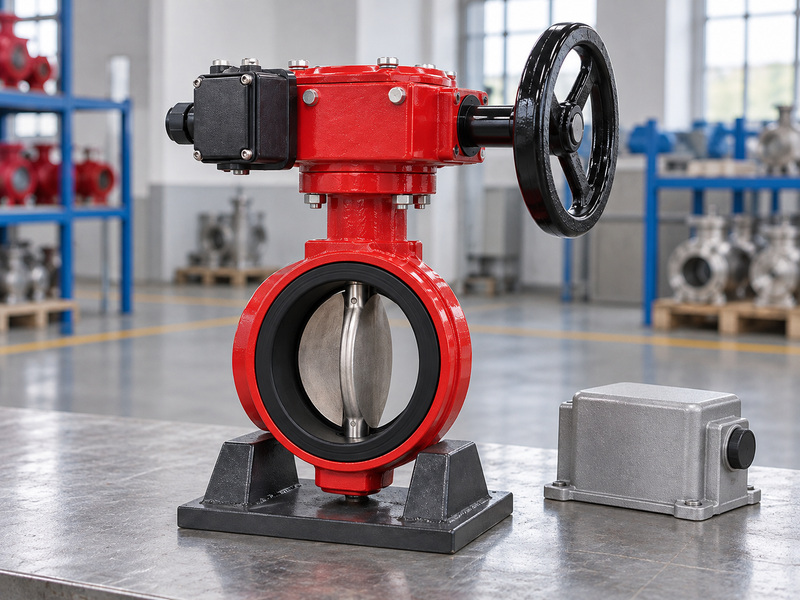
For a flanged butterfly valve, distinguish the connection designation from the complete valve’s permitted operating envelope. Apply the same discipline to the enclosure and its entries. A broad weatherproof description cannot settle every outdoor, wet, corrosive, freezing, or hazardous-area condition.
Match product evidence with the actual exposure
Ask the supplier to identify the applicable rating documents, materials, enclosure conditions, and required product approvals for the proposed assembly. Have the project reviewer check the stated coverage against the intended service and location. Keep special exposures and destination-market requirements explicit rather than inferring them from another product’s certificate.
- State fluid conditions and external environmental exposure separately.
- Obtain the permitted assembly ratings and relevant conditions of use.
- Confirm any required fire-service approval for the actual configuration.
| Selection boundary | Information that must match |
|---|---|
| Fluid service | Medium, pressure, temperature, and materials |
| Mechanical duty | Closing differential, direction, and operator basis |
| External exposure | Enclosure, entries, coating, and documented restrictions |
| Product approval | Covered model, size, rating, and accessory combination |
Resolve the most restrictive applicable limit before the product enters the approved equipment schedule.
9. Does the supervision target match the intended service?
The supervisory butterfly valve mechanism must support the physical normal position required at its selected location. Define that position in the service schedule and compare it with the exact assembly instructions. A contact designation or a panel point name cannot make an incompatible sensing arrangement suitable for the service.

The Series 705 publication cited above limits that product’s supervision to the fully open position. Other documented arrangements require their own evidence. Do not transfer a normal-position capability from one valve family to another or assume a supervised-closed requirement can be met by changing an electrical label.
Match physical service with the monitored condition
Ask the designer to connect the valve tag, service, normal position, permitted sensing target, and required monitoring input in the selection record. Keep local mechanical indication, contact condition, input state, and displayed event distinct. A normal supervisory indication does not prove available water, flow, an unobstructed passage, or seat sealing.
- Identify the normal physical position required by the service.
- Obtain the exact manufacturer’s support for that supervision arrangement.
- Assign the input and event-definition review to the qualified project team.
| Record | Question to resolve |
|---|---|
| Service schedule | What physical normal position is required? |
| Mechanism instructions | Can this assembly supervise that position? |
| Monitoring definition | How will the selected input represent the condition? |
| Selection decision | Have the relevant reviewers accepted the relationship? |
A mismatch between service position and supported supervision should return the selection to design review.
10. What should you settle before selecting the valve?
Settle the location, permitted valve type, mechanical envelope, hydraulic basis, product evidence, and supervision target before selecting a supervisory butterfly valve. The remaining questions should lead to an accepted design choice rather than assumptions passed into purchasing.

Q1. Can I replace an OS&Y valve with a supervised butterfly valve?
Only after the responsible designer accepts the replacement for that exact location. Compare the adopted requirements, mechanical envelope, hydraulic data, connection, approval scope, and normal-position supervision. A shared nominal size does not establish interchangeability.
Q2. Does a compact body mean the complete assembly will fit?
No. Include the gear, handwheel, switch enclosure, entries, and required access in the review. Use the actual assembly drawing and the coordinated layout, including any removal route required by the project.
Q3. Can I use one valve family’s hydraulic coefficient for another?
No. Request data for the exact proposed model and size with its stated fluid and opening conditions. Have the responsible hydraulic designer accept the appropriate basis for the project calculation.
Q4. Can I select it near a fire pump from its listing alone?
No. The valve’s location in the pump arrangement needs a separate review under the adopted requirements and actual manufacturer instructions. Retain the accepted type and location decision before placing the order.
Q5. What should I send RUITO for a location-based review?
Send the valve tag, service, surrounding arrangement, connection details, available space, fluid conditions, hydraulic-document requirements, and intended normal position. RUITO can review the valve requirement and document scope; the specific supervisory configuration and applicable approval evidence need confirmation for the proposal.
For that review, contact us with the current layout and the unresolved selection questions. Request a written response identifying the proposed configuration, supporting documents, and decisions that remain with the project designer.