
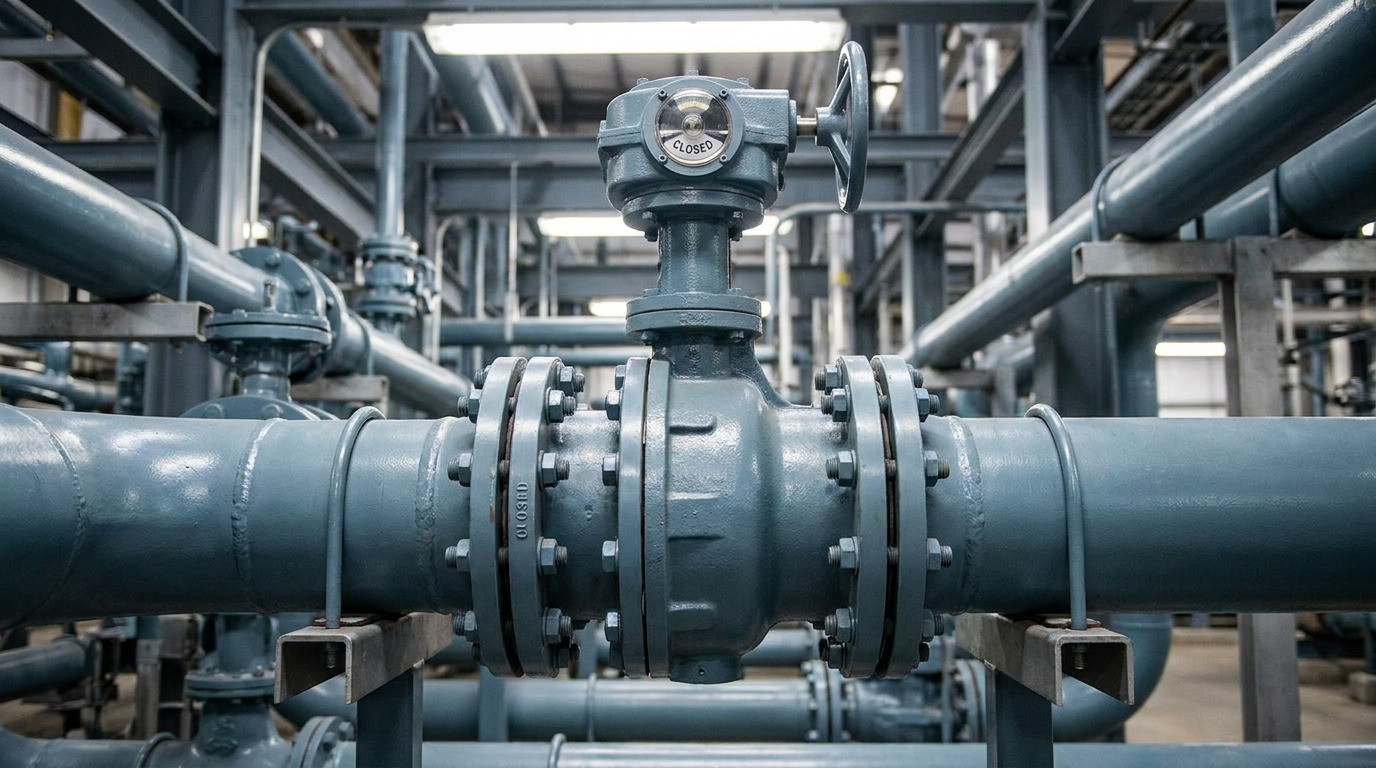
Use a butterfly shut off valve when you need compact, fast quarter-turn isolation in a pipe where the media, pressure differential, temperature, and leakage requirement fit the seat and disc design. A butterfly shut off valve is especially useful in larger water, HVAC, utility, and process lines where space, weight, and actuation speed matter more than having a full-bore flow path.
If you are comparing valve types for an isolation point, start with the service conditions rather than the valve name. An industrial butterfly valve can be a very efficient shutoff choice, but it becomes the wrong choice when solids, abrasion, high temperature, or strict leakage criteria exceed what the selected seat and body style can handle.
A typical case is a plant operator replacing a heavy gate valve on a DN300 cooling-water header. The real question is not “Can a butterfly valve shut off?” but “Will this disc, seat, flange style, and actuator still close tightly under the actual pressure differential?” That is the decision frame this article follows.
What a Butterfly Shut Off Valve Really Does
A butterfly shut off valve stops flow by rotating a disc across the pipe bore, usually through a 90-degree quarter turn. In the closed position, the disc presses against a resilient or metal seat; in the open position, the disc turns parallel to the flow but still remains inside the pipe.
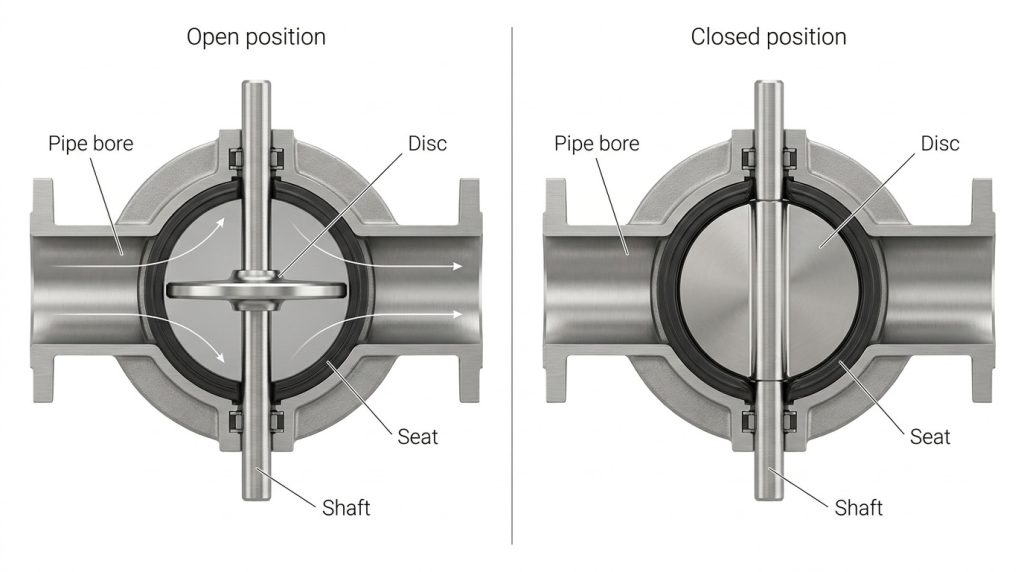
This simple movement is why butterfly valves are compact and quick to operate. It is also why you must check flow loss, seat wear, and shutoff pressure carefully instead of treating every butterfly valve as a universal isolation valve.
What changes when the disc closes?
The disc creates shutoff by loading the seat around the valve bore. For soft-seated designs, the seal often depends on elastomer or polymer compression, so media compatibility and temperature are central to sealing life.
In higher-performance designs, such as double-offset or triple-offset valves, the disc movement reduces rubbing against the seat during travel. That matters when you need tighter shutoff, higher cycle life, or metal seating for hotter service.
Why does the disc matter when fully open?
The disc remains in the flow path even when the valve is fully open, so a butterfly valve does not behave like a full-bore gate valve. The effect may be acceptable in many large utility lines, but it can matter in pump discharge lines, low-pressure systems, or lines where every pressure-loss margin counts.
You should therefore treat the valve as both an isolation device and a flow obstruction. If the system is already pressure-limited, confirm the valve Cv, pressure drop, and opening angle on the manufacturer’s data sheet.
When a Butterfly Shut Off Valve Fits Best
A butterfly shut off valve fits best when the fluid is compatible with the seat, the line size benefits from compact construction, and the valve is expected to open or close quickly. It is usually strongest in clean liquid, water, cooling, HVAC, air, gas, and many general process services.
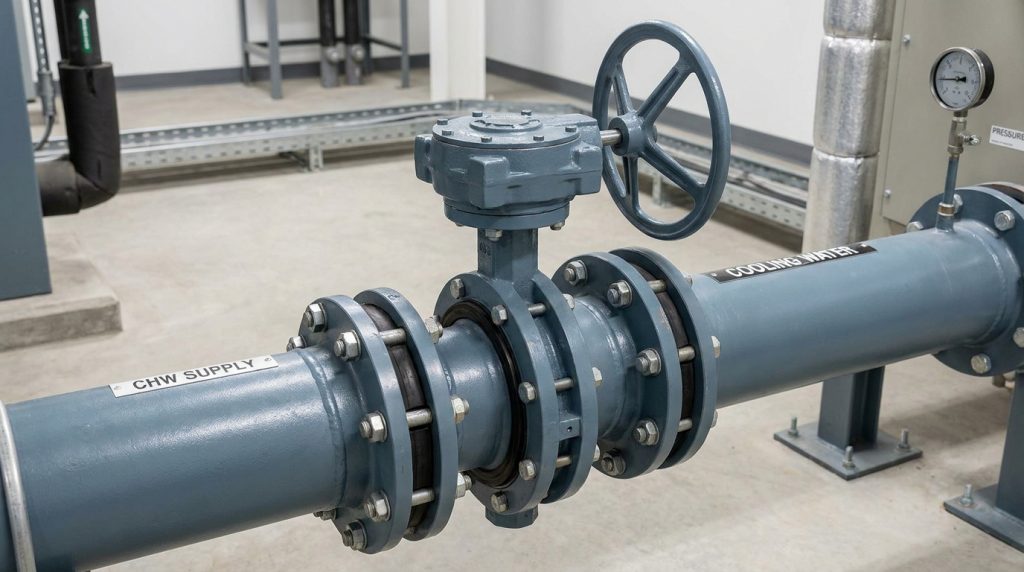
For water-sector butterfly valves, AWWA C504-23 covers rubber-seated butterfly valves from 3 in. through 72 in. for raw water, potable water, wastewater, and reclaimed water within pH 6–12 and 33–125°F (0.6–52°C). AWWA C516-21 covers large-diameter rubber-seated butterfly valves from 78 in. and larger, so the standard path changes when the valve becomes very large.
Is clean liquid the easiest service?
Yes, clean liquid is usually the easiest shutoff service for a resilient-seated butterfly valve. The seat can seal evenly because grit, scale, and stringy material are less likely to score the disc edge or become trapped at the sealing line.
For water and wastewater treatment lines, the distinction between clear water, screened wastewater, sludge, and chemical dosing is important. A butterfly valve may be suitable for isolation in one part of the plant and unsuitable in another part where solids or abrasive particles dominate.
Can it throttle as well as isolate?
It can throttle in many services, but shutoff and throttling are not the same duty. A valve that performs well as an on-off isolation valve may suffer seat wear, noise, vibration, or unstable control if it is left partly open under high pressure drop.
For light balancing or occasional flow adjustment, a butterfly valve can work well. For continuous modulation, ask for the flow characteristic, actuator duty, expected opening range, and allowable pressure drop before using the same valve as both a control device and a shutoff device.
Butterfly Valve vs Gate Valve vs Plug Valve
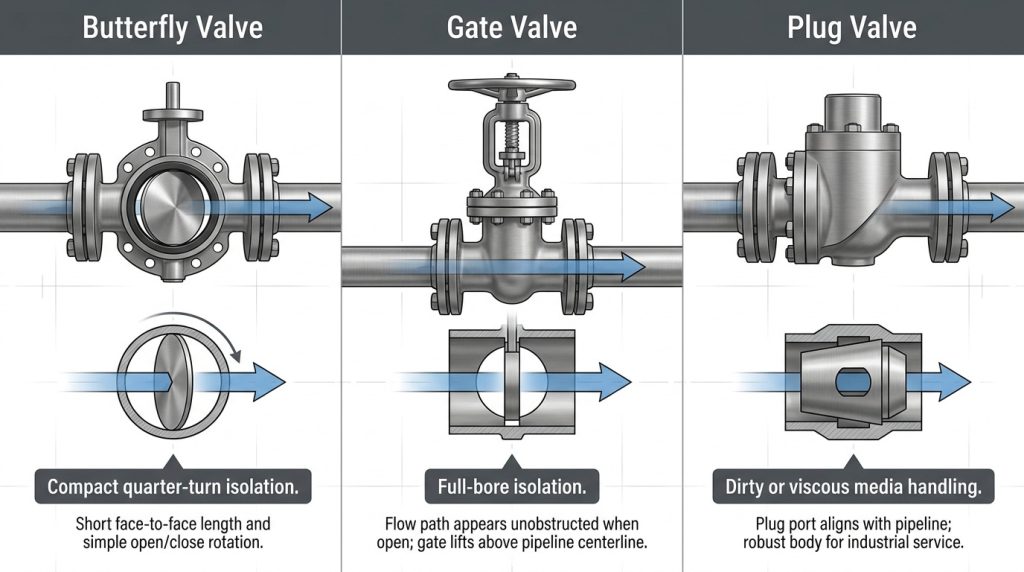
Choose the valve type by the failure mode you are trying to avoid, not by habit. Butterfly valves solve space, weight, and operating-speed problems; gate valves solve full-bore isolation problems; plug valves often solve dirty or slurry-service problems.
The table below gives a practical first screen before you move into exact sizing, material selection, or actuator torque.
| Decision point | Butterfly shut off valve | Gate valve or plug valve may fit better |
|---|---|---|
| Operating motion | Quarter-turn, normally 90 degrees from open to closed | Gate valve if slow multi-turn operation is preferred |
| Flow path | Disc remains in the bore, so pressure drop must be checked | Gate valve when a near full-bore path is important |
| Space and weight | Compact face-to-face, useful in large sizes | Gate valve if vertical space and weight are not limiting |
| Dirty or viscous media | Works only if solids will not damage or pack around the seat | Plug valve for slurries, grit, or viscous media |
| Leakage expectation | Strong with the right seat and test condition | Metal-seated alternatives when high temperature or fire exposure drives the design |
| Standards path | API 609 or AWWA standards may apply depending on service | API 600, API 599, AWWA C509, or other valve-specific standards may apply |
The main takeaway is simple: a butterfly valve is often the most efficient shutoff option when the service is compatible, but it is not automatically the safest option for every isolation point. If the line carries abrasive solids, needs an unobstructed bore, or must seal at elevated temperature, compare the alternatives early.
Limits to Check Before You Specify One
The most important limits are seat compatibility, shutoff pressure, temperature, solids content, and required leakage test. If any one of these conditions is outside the valve design, a butterfly shut off valve can look correct on size and still fail in service.
Do not rely only on nominal pressure class. Confirm the actual maximum differential pressure across the closed disc, because actuator torque and seat loading often depend on differential pressure rather than line pressure alone.
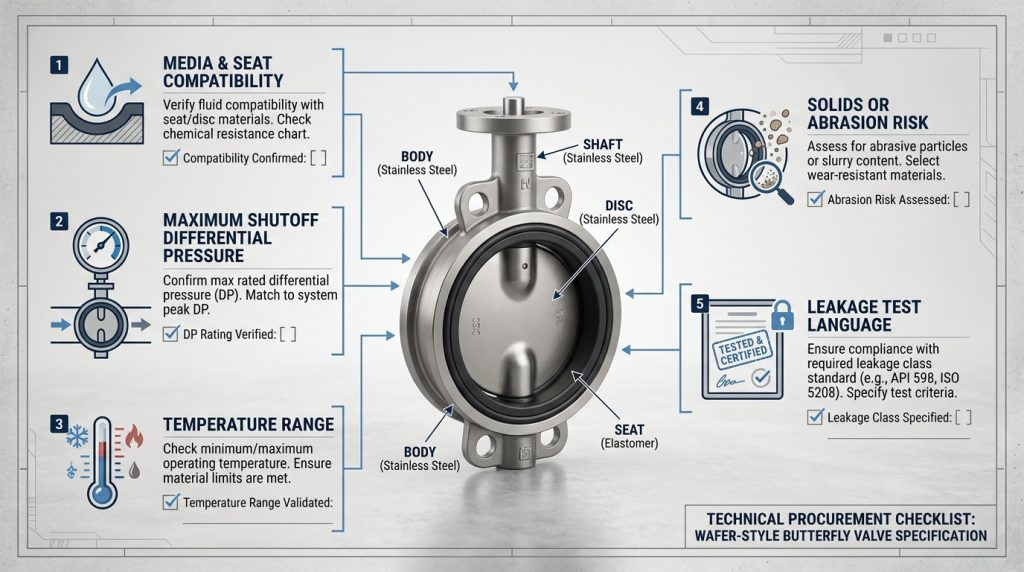
How tight does the shutoff need to be?
Define shutoff by a test standard and acceptance condition, not by a marketing phrase. API 598 11th Edition, February 2023 covers inspection and pressure testing for gate, globe, plug, ball, check, and butterfly valves; for resilient-seated shutoff, specify the required closure test and “no visible leakage” condition where applicable.
“Bubble-tight” is useful shorthand, but it is not enough for a purchase specification. You should state the test medium, test pressure, direction of test, seat type, and whether bidirectional shutoff is required.
What media can damage the seat?
Abrasive solids, scale, fibrous material, crystallizing chemicals, and incompatible solvents can damage a butterfly valve seat or prevent full closure. Even a small particle trapped at the sealing edge can create a leak path after repeated operation.
For clean water, EPDM or similar elastomer seats are common. For oils, chemicals, higher temperatures, or aggressive media, seat selection may move toward NBR, PTFE, reinforced PTFE, or metal seating, but final compatibility must be checked against the exact fluid, concentration, temperature, and cleaning procedure.
When is temperature the deciding factor?
Temperature becomes decisive when the seat material loses elasticity, swells, hardens, or creeps. A valve body may handle the pressure class, while the soft seat becomes the weak point.
For example, waterworks rubber-seated standards such as AWWA C504-23 define a 33–125°F (0.6–52°C) range for the covered water applications. Industrial butterfly valves outside that window may still be valid, but the specification must shift to the correct standard, material, seat design, and manufacturer data sheet.
Body Style and Actuation Choices
Body style and actuation decide whether the valve can be installed, isolated, removed, and operated safely in the real line. The wrong body style can create maintenance or dead-end service problems even when the disc and seat are correct.
For flanged piping, ASME B16.5 covers NPS 1/2 through NPS 24 flanges, while ASME B16.47 covers NPS 26 through NPS 60 large-diameter steel flanges. That does not choose the valve for you, but it does tell you why flange standard, bolt pattern, face-to-face dimension, and disc clearance must be confirmed before ordering.
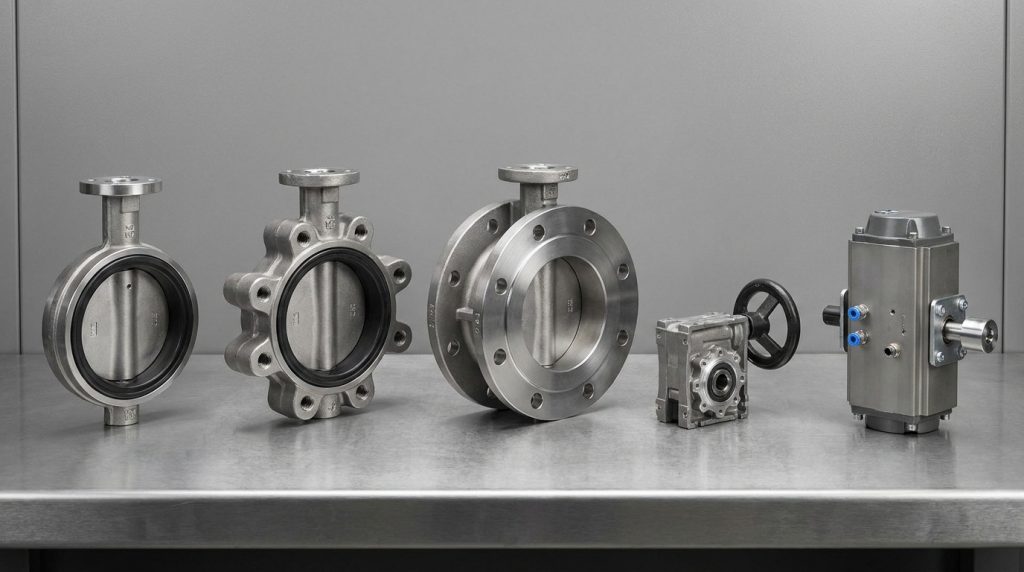
Wafer, lug, or flanged body?
Wafer butterfly valves are compact and cost-effective when the valve is clamped between two flanges and does not need independent dead-end service. Lug-style valves add threaded lugs, which may allow one side of the line to be removed depending on the valve design and pressure rating.
Flanged butterfly valves are heavier but often preferred for larger sizes, higher structural loads, or permanent installations. For any of these styles, check whether the valve is rated for dead-end service, bidirectional flow, and the actual flange standard in the pipeline.
Manual, gearbox, electric, or pneumatic?
Small valves may use a lever, but larger valves usually need a gearbox because the disc area and pressure differential increase operating torque. Automated valves require even more care because the actuator must close the valve under the worst expected differential pressure, not just under normal flow.
Fast closure can also create surge or water hammer. If the line is long, the pump is large, or the fluid velocity is high, specify controlled closing time, actuator fail position, position feedback, and manual override as part of the shutoff function.
Standards and Test Language That Matter
Standards matter because they define what the valve is, how it is built, and how it is tested, but they do not replace service review. The best specification ties the valve standard to the actual media, pressure, temperature, flange connection, leakage requirement, and operating duty.
API 609 9th Edition, April 2021 covers butterfly valves with double-flanged, lug, wafer, and butt-welding ends, including design, materials, face-to-face dimensions, pressure-temperature ratings, inspection, examination, and testing requirements. It is a common reference for industrial butterfly valves, especially where API and ASME piping practices are used.
Which standards belong in the datasheet?
The datasheet should name the design standard, flange standard, face-to-face standard, pressure test standard, and leakage acceptance condition. For waterworks projects, AWWA C504-23, AWWA C516-21, or AWWA C519-25 may be more relevant than a purely process-industry standard.
For industrial process lines, API 609, API 598, ASME B16.34, ASME B16.5, ASME B16.47, EN 593, EN 558, ISO 5752, ISO 5208, or EN 12266-1 may appear depending on region and project requirements. Do not list standards casually; each one should match a real design, dimension, testing, or compliance need.
What should you ask the supplier to confirm?
Ask the supplier to confirm the conditions that directly affect shutoff performance. At minimum, provide the media, concentration if chemical, temperature range, normal and maximum pressure, maximum shutoff differential pressure, line size, flange standard, operating frequency, actuator preference, and leakage requirement.
Also ask for the product drawing, material list, pressure-temperature rating, torque data, test standard, and seat leakage criterion. For project-specific values such as Cv, operating torque, face-to-face dimension, and actuator sizing margin, use typical ranges only for early screening and confirm the final values on the valve drawing or data sheet.
Quick Selection Checklist
Use this checklist when you need a fast decision on whether a butterfly shut off valve belongs in the line. It keeps the discussion focused on the core shutoff decision instead of drifting too early into procurement details.
- Use a butterfly valve when compact quarter-turn isolation is valuable.
- Prefer clean liquid, gas, air, HVAC, utility water, or compatible process media.
- Check pressure drop because the disc remains in the flow path.
- Confirm shutoff differential pressure, not only the pipe pressure class.
- Avoid standard soft-seat designs for abrasive slurry, heavy grit, or stringy solids.
- Match the seat to temperature, chemistry, cleaning method, and cycling duty.
- Specify leakage by standard and test condition, not by vague wording.
- Confirm wafer, lug, or flanged body based on maintenance and dead-end needs.
- Size the actuator for worst-case torque and required closing speed.
- Verify final dimensions, Cv, torque, and materials on the manufacturer’s drawing.
Key Takeaway: a butterfly shut off valve is a strong choice when compact isolation, quick operation, and acceptable pressure drop align with the media and seat design. It becomes risky when the valve is asked to solve full-bore flow, abrasive solids, high-temperature sealing, or undefined leakage requirements.
Conclusion
A butterfly shut off valve can be the right isolation choice when the line needs compact construction, fast quarter-turn operation, and a seat design that matches the media, pressure differential, temperature, and leakage requirement. This article covered where it fits, where gate or plug valves may be safer, which limits to check, and how standards and test language help you avoid vague specifications.
For your next step, prepare the media, temperature, pressure, line size, flange standard, shutoff differential pressure, and leakage expectation, then share your operating conditions so the valve type, seat material, body style, and actuator direction can be reviewed against your application.
FAQ
Can I use a butterfly shut off valve for steam?
Yes, but only with the correct high-temperature design. Standard soft-seated butterfly valves are often unsuitable for steam because the seat can harden, deform, or lose sealing force; metal-seated or high-performance designs must be checked against the pressure-temperature rating.
What’s the best butterfly valve for tight shutoff?
The best choice is the valve that meets your leakage requirement under the stated test condition. For many clean services, a resilient-seated valve can provide very tight shutoff, while high-temperature or severe service may require double-offset or triple-offset construction.
How do I know if a gate valve is better?
Choose a gate valve when you need a near full-bore flow path, very low pressure loss, or conventional on-off isolation with infrequent operation. A gate valve is usually not the better choice for frequent throttling, fast automation, or tight spaces.
Can I use a butterfly valve for slurry or dirty water?
Sometimes, but you should be cautious. Lightly screened water may be acceptable, while abrasive slurry, grit, fibrous solids, or settling media can damage the seat or prevent full closure; in those cases, plug, knife gate, or other solids-handling valves may be safer.
How do I know what actuator torque I need?
You need torque data based on valve size, seat type, maximum differential pressure, media condition, and operating temperature. Do not size the actuator only from nominal pressure class; final actuator selection should follow the valve manufacturer’s torque chart and project safety margin.