
Choosing between a ball valve and a butterfly valve ultimately comes down to your system’s pressure, space, and shutoff requirements. Imagine you are managing a critical pipeline, and a sudden leak threatens your entire production schedule. The wrong valve choice can lead to catastrophic pressure drops, severe equipment damage, and costly downtime that ruins your quarter. Fortunately, understanding the core differences between a ball valve butterfly valve ensures you install the right component for a leak-proof, highly efficient piping network.
What Are The Basics Behind A ball valve butterfly valve Selection?
The basics behind a ball valve butterfly valve selection revolve around matching the quarter-turn mechanism to your flow control needs. Every industrial system requires a reliable shutoff method, and understanding how a ball valve butterfly valve functions is the first step. Ball valves use a hollow, perforated sphere to stop flow, while butterfly valves utilize a rotating disc. You must assess your operational requirements before deciding.
Understanding The Core Mechanisms
Both valves operate with a simple 90-degree turn to open or close the line. However, their internal structures dictate how they handle fluid dynamics. Here is the deal: you need to know exactly how they interact with the media.
- Ball designs provide zero flow restriction.
- Disc designs remain constantly in the flow path.
- Both offer quick manual or automated actuation.
Why Context Matters In Piping
Your specific industrial environment dictates the right fit for your process lines. If you choose poorly, you might face premature wear or unexpected pressure issues.
Key Takeaway: Grasping the fundamental mechanical differences sets the foundation for a reliable and efficient piping system design.
| Feature | Ball Design | Butterfly Design |
|---|---|---|
| Mechanism | Rotating hollow sphere | Rotating disc |
| Flow Path | Unobstructed when open | Partially obstructed |
| Actuation | Quarter-turn | Quarter-turn |
This comparison highlights the primary operational distinctions between the two popular shutoff mechanisms.
How Do The Internal Mechanisms Of A ball valve butterfly valve Differ?
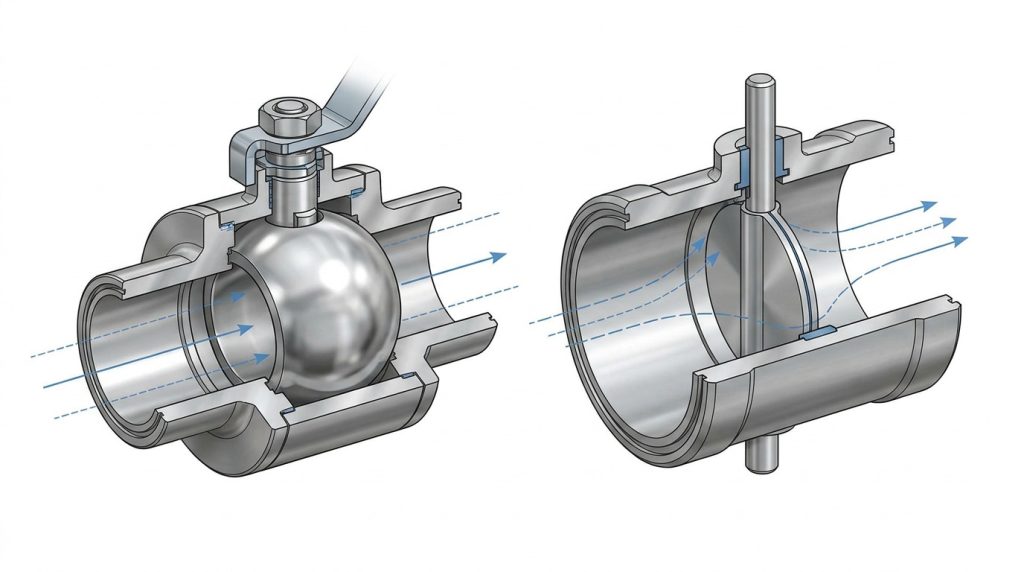
The internal mechanisms of a ball valve butterfly valve differ primarily in how the sealing element interacts with the flow path. A ball valve butterfly valve operates differently under pressure due to its unique structural components. Ball units rotate a sphere with a hole through it, whereas butterfly units pivot a thin metal disc on an axis. You will notice these mechanical traits heavily influence performance.
Delving Into Sphere Operations
The hollow sphere inside the body completely rotates out of the way when opened. This allows fluids to pass through without any turbulence or restriction. You might be wondering: why is this so critical? It prevents pressure loss in long pipelines.
- Ensures a straight-through flow.
- Minimizes turbulence and cavitation.
- Provides a tight, reliable seal under high pressure.
Exploring Disc Dynamics
The disc in the alternative design is always present within the pipeline fluid. When turned open, the fluid must split and travel around the metal plate.
Key Takeaway: The structural presence of the sealing element directly impacts the flow characteristics and pressure drop in your system.
| Component | Ball Structure | Disc Structure |
|---|---|---|
| Obstruction | Zero in open position | Always present |
| Flow Rate | Extremely high capacity | Moderate capacity |
| Turbulence | Minimal | Noticeable |
Understanding the internal obstruction levels clarifies why certain systems experience higher turbulence than others.
What Are The Main Types You Need In A ball valve butterfly valve Comparison?
The main types you need in a ball valve butterfly valve comparison include trunnion, floating, concentric, and eccentric designs. Selecting the right ball valve butterfly valve configuration depends on your specific pressure ratings and pipe dimensions. You can find floating spheres for standard lines or trunnion-mounted setups for high-pressure demands. Knowing the sub-categories helps you narrow down the perfect fit.
Categorizing By Construction
You will find that manufacturers build these devices in various housing styles to accommodate maintenance routines. Look at it this way: easy access saves immense labor costs.
- One-piece bodies for compact, economical use.
- Two-piece bodies for general industrial applications.
- Three-piece bodies for easy inline maintenance.
Differentiating By Offset
For disc-based units, the offset design determines how the seal engages with the seat. Concentric models are standard, while double or triple offsets handle harsh conditions.
Key Takeaway: Identifying the correct structural subtype ensures your hardware can withstand the specific mechanical stresses of your environment.
| Sub-type | Configuration | Best Use Case |
|---|---|---|
| Floating | Seat supported | Low to medium pressure |
| Trunnion | Top and bottom supported | High pressure and large pipes |
| Triple Offset | Advanced seating | Extreme temperatures |
Reviewing these sub-types helps engineers match the exact structural integrity to the process demands.
Where Are The Best Applications For A ball valve butterfly valve Setup?
The best applications for a ball valve butterfly valve setup range from critical gas isolation to massive municipal water treatment networks. A ball valve butterfly valve serves diverse industries, but their distinct strengths dictate their ideal locations. You should deploy spherical units where absolute zero-leakage is mandatory, such as chemical processing. Conversely, disc models thrive in large-scale cooling water systems.
Ideal Scenarios For Unrestricted Flow
When your process involves thick slurries or requires frequent pigging, you need an unobstructed path. The truth is: any interference can cause severe blockages.
- Oil and gas transmission lines.
- High-pressure steam systems.
- Corrosive chemical isolation.
Perfect Spots For Space-Saving Installations
Large diameter pipes require hardware that does not add excessive weight or bulk to the infrastructure. Disc units slip perfectly between pipe flanges without stressing the supports.
Key Takeaway: Matching the valve type to the specific fluid medium and environmental constraints is essential for long-term operational success.
| Application Area | Recommended Choice | Primary Reason |
|---|---|---|
| Gas Transmission | Sphere type | Superior high-pressure sealing |
| Water Treatment | Disc type | Cost-effective for large diameters |
| Chemical Plants | Sphere type | Chemical compatibility and tight shutoff |
Assigning the correct hardware to its optimal industrial setting drastically reduces the risk of premature failure.
What Are The Key Benefits Driving Your ball valve butterfly valve Choice?
The key benefits driving your ball valve butterfly valve choice are primarily tight shutoff capabilities, cost-effectiveness, and compact sizing. Every ball valve butterfly valve brings a unique set of advantages to your engineering project. You will appreciate the absolute leak-proof nature of spherical designs in hazardous environments. Meanwhile, the lightweight nature of disc designs offers unparalleled installation convenience.
The Superior Sealing Advantage
Spherical units excel in providing a bubble-tight seal that completely halts fluid momentum. But here’s the kicker: they maintain this seal even after thousands of cycles.
- Exceptional durability over time.
- Handles multi-directional flows effortlessly.
- Reduces the risk of fugitive emissions.
The Economic And Spatial Perks
If you manage a facility with miles of massive piping, budget and weight become critical factors. Disc units cost significantly less and require a fraction of the installation space.
Key Takeaway: Weighing upfront costs against long-term reliability and space constraints will guide you to the most beneficial investment.
| Benefit | Sphere Design | Disc Design |
|---|---|---|
| Shutoff Quality | Excellent / Bubble-tight | Good / Moderate |
| Installation Space | Requires significant room | Highly compact |
| Cost Efficiency | Higher initial investment | Very budget-friendly |
Comparing these core benefits clarifies which operational priorities should drive your final purchasing decision.
Are There Any Limitations When Using A ball valve butterfly valve System?
The limitations when using a ball valve butterfly valve system involve potential pressure drops, weight constraints, and temperature thresholds. While a ball valve butterfly valve solves many problems, you must acknowledge their inherent engineering drawbacks. Spherical units can be excessively heavy and expensive in larger sizes. Disc units, however, struggle with high-pressure sealing and introduce turbulence.
Recognizing Size And Cost Barriers
As pipeline diameters increase, the cost and weight of spherical housings skyrocket exponentially. This is where it gets interesting: the sheer mass can require reinforced pipe supports.
- Prone to trapping media in the cavity.
- Unsuitable for fine flow throttling.
- Difficult to install in extremely tight corridors.
Addressing Turbulence And Sealing Issues
The permanent presence of the disc in the flow path means you will always experience some level of pressure drop. Furthermore, standard resilient seats may degrade faster under severe conditions.
Key Takeaway: Acknowledging the physical and financial limitations of each design prevents costly engineering miscalculations during system construction.
| Limitation | Sphere Issue | Disc Issue |
|---|---|---|
| Weight / Size | Very heavy in large sizes | Generally lightweight |
| Fluid Dynamics | Cavity traps fluid | Causes continuous turbulence |
| Throttling | Poor control accuracy | Limited control range |
Outlining these drawbacks helps engineers implement necessary workarounds to maintain system integrity.
How Does Pressure Affect A ball valve butterfly valve Performance?
Pressure affects a ball valve butterfly valve performance by dictating the seating mechanism’s integrity and the torque required to operate it. High system pressures demand a robust ball valve butterfly valve capable of preventing blowout and seat deformation. You need trunnion-mounted spheres to handle extreme upstream forces safely. Standard disc models may leak if the line pressure exceeds their structural rating.
Managing High-Stress Environments
When fluid velocity and pressure peak, the internal components undergo massive stress. Now let’s dive deeper: the right seating material makes all the difference here.
- Trunnion designs distribute pressure evenly.
- Metal seats withstand extreme forces.
- Blowout-proof stems ensure operational safety.
Dealing With Pressure Drops
Because disc models obstruct the flow, high-velocity media hitting the disc creates a noticeable pressure drop. You must calculate this loss when sizing your pumps.
Key Takeaway: Accurate pressure calculations ensure your chosen hardware will seal tightly without requiring excessive force to actuate.
| Pressure Factor | Sphere Performance | Disc Performance |
|---|---|---|
| High Pressure Sealing | Highly reliable | Prone to leakage |
| Pressure Drop | Practically zero | Moderate to high |
| Operating Torque | Increases with pressure | Requires careful management |
Evaluating pressure dynamics is critical for preventing catastrophic blowouts and ensuring smooth mechanical operation.
Why Is Size A Crucial Factor In A ball valve butterfly valve Installation?
Size is a crucial factor in a ball valve butterfly valve installation because it directly impacts weight, cost, and physical space requirements. When evaluating a ball valve butterfly valve, the diameter of your pipeline dictates the feasible options. You will find that large spherical units become impractical and prohibitively expensive beyond a certain size. In contrast, disc units scale up beautifully without adding excessive bulk.
The Scaling Problem With Spheres
Manufacturing a massive, perfectly round sphere requires significant material and machining time. What is the real story? The resulting product is incredibly heavy and expensive.
- Requires heavy-duty lifting equipment for installation.
- Demands robust structural pipe supports.
- Consumes a large portion of the project budget.
The Compact Nature Of Discs
Wafer and lug style bodies are specifically designed to fit snugly between standard pipe flanges. This slim profile is a lifesaver in cramped mechanical rooms.
Key Takeaway: Strategic sizing prevents budget overruns and ensures the equipment can actually be installed within the physical confines of your facility.
| Size Aspect | Sphere Reality | Disc Reality |
|---|---|---|
| Large Diameters | Impractical / Expensive | Ideal / Economical |
| Face-to-Face Dimension | Very wide | Extremely narrow |
| Support Needed | Substantial | Minimal |
Understanding how physical dimensions scale with pipe size is vital for practical and economical pipeline design.
Which Option Wins The ball valve butterfly valve Cost Debate?
The disc option generally wins the ball valve butterfly valve cost debate, especially as pipeline diameters increase. Budget constraints frequently force the choice of a ball valve butterfly valve during large-scale procurement. You will notice that the raw material required for a spherical unit makes it inherently more expensive. However, you must also factor in the long-term maintenance and replacement costs.
Analyzing Initial Purchasing Costs
If you are outfitting a municipal water plant with dozens of massive pipelines, disc models will save you millions. Ready for the good part? They are universally recognized as the budget-friendly choice.
- Lower raw material consumption.
- Simpler manufacturing processes.
- Cheaper shipping due to lighter weight.
Calculating Total Cost Of Ownership
While spherical models cost more upfront, their exceptional durability often means fewer replacements over a twenty-year lifespan. You have to balance the initial hit with future reliability.
Key Takeaway: A comprehensive cost analysis must evaluate both the immediate purchase price and the projected lifecycle maintenance expenses.
| Cost Factor | Sphere Unit | Disc Unit |
|---|---|---|
| Initial Purchase | High | Low |
| Shipping / Handling | Expensive due to weight | Cheap |
| Long-term Value | Excellent for critical lines | Good for standard lines |
Breaking down the financial aspects ensures your procurement strategy aligns with both immediate budgets and long-term maintenance goals.
How To Make The Final Decision On Your ball valve butterfly valve Needs?
To make the final decision on your ball valve butterfly valve needs, you must carefully evaluate pressure, size, flow characteristics, and budget. You can successfully select a ball valve butterfly valve by aligning the hardware’s capabilities with your process data. You should prioritize bubble-tight sealing for dangerous chemicals, but lean towards space-saving designs for basic water transport. Thorough engineering analysis always leads to the right choice.
Reviewing Your System Parameters
Gather all your system data before looking at catalogs. It all boils down to this: exact specifications prevent catastrophic failures.
- Maximum operating pressure and temperature.
- Specific media characteristics and viscosity.
- Available physical space for installation.
Consulting With Valve Experts
Never hesitate to reach out to manufacturers who deal with these specifications daily. They can guide you toward customized solutions like triple offset or trunnion mounted units.
Key Takeaway: Systematic evaluation of your pipeline’s unique demands guarantees a safe, efficient, and cost-effective fluid control system.
| Decision Criteria | Choose Sphere When… | Choose Disc When… |
|---|---|---|
| Primary Need | Zero leakage required | Budget and space are tight |
| Media Type | Slurries or gases | Clean water or air |
| Pipe Size | Small to medium | Medium to extremely large |
A structured decision-making matrix simplifies the complex process of selecting the ideal fluid control equipment.
Choosing the ideal component for your pipeline secures the integrity of your entire operation. By thoroughly comparing pressure ratings, space constraints, and long-term costs, you ensure a safe and highly efficient industrial process. If you want to optimize your system further, contact us today so we can engineer the perfect solution for your specific application. At Ruitoflow, we build reliable industrial valves designed to keep your critical processes flowing safely without interruption.
FAQ
Q1: Can I use a ball valve for throttling applications?
It is generally not recommended to use standard designs for precise throttling. While they can partially open, doing so exposes the seats to high-velocity fluid, leading to rapid wear and eventual leakage.
Q2: What’s the best choice for very large diameter water pipes?
Butterfly designs are the absolute best choice for large water lines. They are incredibly cost-effective, require minimal face-to-face installation space, and are much lighter than alternative options.
Q3: How do I know if I need a trunnion or a floating design?
You need a trunnion design if your system operates at high pressures or uses large pipe sizes. Floating designs rely on line pressure to seal and become too difficult to operate effectively under extreme forces.
Q4: Can I install a butterfly valve in a high-pressure gas line?
It is usually unsafe to use standard disc models for high-pressure gas. Gases require bubble-tight, zero-leakage shutoff under extreme pressure, which is best handled by heavy-duty spherical designs.
Q5: What’s the best way to prevent a valve from failing?
Routine maintenance and proper initial selection are the best ways to prevent failure. Ensure the materials are chemically compatible with your media and that the unit is rated for your system’s maximum pressure.