
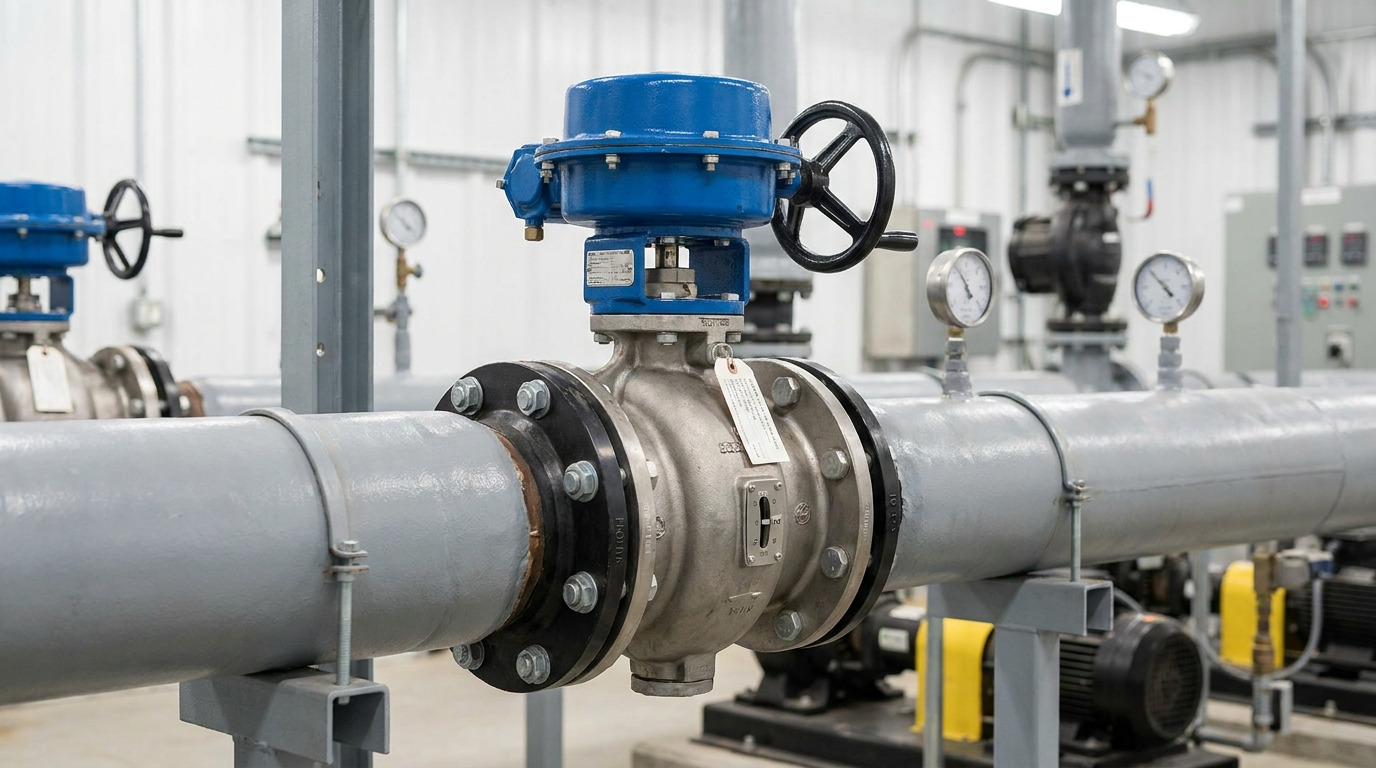
Butterfly valve Cv tells you how much water a valve can pass at a defined pressure drop. A valve that looks correctly sized by pipe diameter may still starve a heat exchanger, waste pump energy, or control erratically when its disc sits partly open. That mismatch can surface during commissioning, when schedule pressure leaves little room for new calculations or replacement hardware. This guide shows you how to interpret butterfly valve cv data, calculate a suitable value, and compare operating angles before you specify a valve.
What Does Butterfly Valve Cv Mean?
Butterfly valve Cv measures water-flow capacity in US gallons per minute at 60°F with a 1 psi pressure drop. A larger Cv passes more liquid under equal conditions, while a smaller Cv creates greater resistance. You can use butterfly valve cv to compare performance across sizes and disc positions without relying on nominal diameter alone.
Which terms should you check before using Cv?
Here’s the practical point: Cv describes hydraulic capacity, not pressure rating, leakage class, or material compatibility. Read it beside each operating condition:
- Flow rate, stated in gpm or m³/h
- Pressure drop across valve, stated in psi or bar
- Fluid specific gravity at operating temperature
- Disc angle and actuator command position
| Term | Meaning | Design use |
|---|---|---|
| Cv | US flow coefficient | Liquid sizing in US units |
| Kv | Metric flow coefficient | Liquid sizing in metric units |
| ΔP | Valve pressure drop | Energy and sizing check |
The coefficient becomes useful only after units and service conditions match.
Key Takeaway: You can compare valve capacity accurately when Cv, fluid data, pressure drop, and opening angle refer to one operating case.
How Is Butterfly Valve Cv Calculated for Liquids?
Butterfly valve Cv for a liquid comes from Cv = Q × √(SG/ΔP), where Q uses gpm, SG means specific gravity, and ΔP uses psi. For example, 500 gpm of water across a 4 psi drop requires Cv 250. This result gives you a target capacity, not an automatic valve size.
What calculation sequence prevents unit errors?
Watch what happens next: mixed units can produce a neat answer that remains physically wrong. Keep one unit system through this short sequence:
- Confirm maximum, normal, and minimum flow
- Deduct upstream pressure from downstream pressure correctly
- Use specific gravity at real service temperature
- Compare calculated Cv with manufacturer curves
| Q | SG | ΔP | Required Cv |
|---|---|---|---|
| 500 gpm | 1.0 | 4 psi | 250 |
| 500 gpm | 1.0 | 1 psi | 500 |
| 500 gpm | 1.2 | 4 psi | 274 |
Lower allowable pressure drop demands more valve capacity for equal flow.
Key Takeaway: You can create a defensible Cv target by preserving units and calculating every expected load case.
Why Does Disc Angle Change Butterfly Valve Cv?
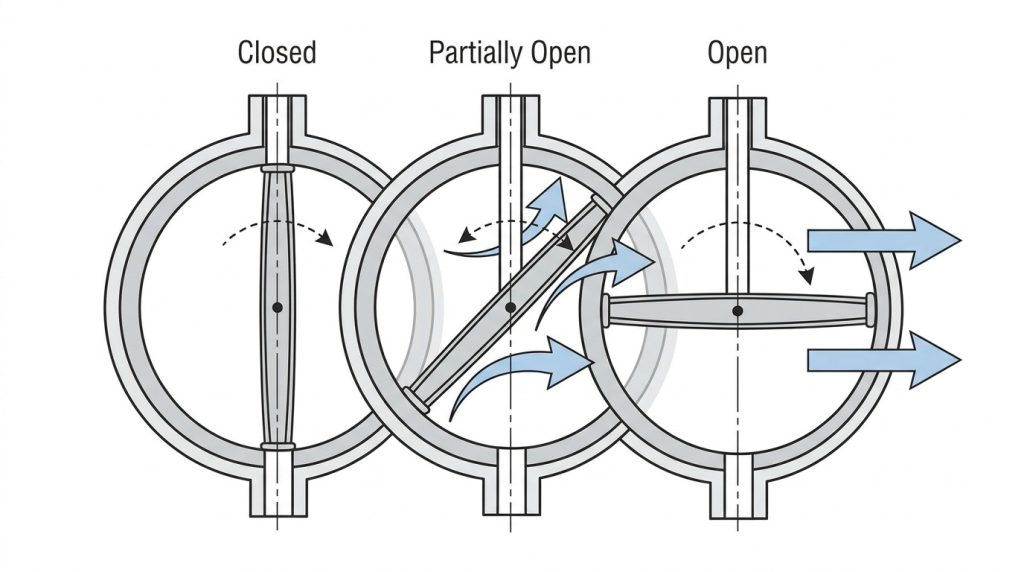
Butterfly valve Cv rises sharply as disc angle approaches fully open because exposed flow area expands nonlinearly. For butterfly valve cv selection in HVAC and district energy systems, capacity may be modest near 30 degrees yet several times higher near 70 degrees. A ten-degree actuator movement never promises a ten-percent capacity change.
How should you read an opening-angle curve?
This is where control behavior gets revealing: compare each angle as a separate operating point rather than drawing a straight line between sparse values. Focus on:
- Stable controllable range recommended for valve design
- Cv gain produced by each incremental angle change
- Velocity and noise near restricted openings
- Remaining travel available at peak demand
| Disc position | Relative capacity | Typical concern |
|---|---|---|
| 10°–20° | Very low | Erosion and unstable control |
| 30°–60° | Rising rapidly | Actuator resolution |
| 70°–90° | High | Limited control authority |
Mid-travel usually provides a more manageable balance between capacity and response.
Key Takeaway: You can avoid unstable modulation by selecting around a usable angle range rather than full-open Cv alone.
How Do Cv and Kv Differ?
Butterfly valve Cv uses US gallons per minute and psi, while Kv uses cubic metres per hour and a one-bar pressure drop. For water near standard reference conditions, Kv ≈ 0.865 Cv and Cv ≈ 1.156 Kv. Conversion lets you compare data sheets, provided every other rating uses compatible conditions.
When should you convert rather than recalculate?
Here’s the catch: conversion works for equivalent reference values, while service calculations still need actual density and pressure conditions. Use these checks:
- Identify whether a curve reports Cv or Kv
- Convert only once and retain source units
- Label converted values in project schedules
- Round after calculation, not before
| Starting value | Operation | Result |
|---|---|---|
| Cv 100 | × 0.865 | Kv 86.5 |
| Kv 100 | × 1.156 | Cv 115.6 |
| Cv 500 | × 0.865 | Kv 432.5 |
Small rounding differences rarely matter, but an unlabeled coefficient can distort sizing.
Key Takeaway: You can compare global supplier data safely when every converted value keeps a visible unit label.
How Does Pressure Drop Affect Required Cv?
Butterfly valve Cv must increase when you want more flow through a smaller permitted pressure drop. Because flow changes with the square root of ΔP, doubling flow at equal fluid density and pressure loss requires roughly double Cv. Pump head and downstream process needs set how much drop the valve may consume.
What pressure-drop checks belong in a design review?
Now consider the system boundary: a valve cannot spend pressure that a coil, filter, or distant terminal still needs. Review:
- Available differential at minimum pump head
- Peak and low-load flow cases
- Added losses from fittings and strainers
- Cavitation or flashing margin for hot liquids
| Change | Cv effect | System impact |
|---|---|---|
| Flow doubles | Cv doubles | Larger valve capacity |
| ΔP quadruples | Cv halves | Greater energy loss |
| SG increases | Cv increases | More capacity required |
A realistic pressure budget gives each component enough head without excessive pumping cost.
Key Takeaway: You can protect flow delivery and energy performance by assigning valve ΔP within a complete system pressure budget.
How Should You Select Butterfly Valve Cv by Size?
Butterfly valve Cv should be selected from required flow and pressure drop before you confirm nominal size. Water and wastewater systems often need a different butterfly valve cv for modulation, solids handling, or changing demand, though matching pipe diameter can work for isolation duty. Compare at least three operating cases against one manufacturer’s curve.
What sizing margin keeps control practical?
A better question follows: does your selected valve operate with useful travel at normal load? Check:
- Normal flow near middle control range
- Peak flow below maximum permitted angle
- Minimum flow above unstable near-closed travel
- Velocity within project limits
| Selection result | Likely behavior | Response |
|---|---|---|
| Too much Cv | Valve stays near closed | Choose smaller capacity |
| Matched Cv | Useful mid-travel control | Verify actuator |
| Too little Cv | Valve stays near open | Choose larger capacity |
Useful travel matters more than a generous full-open capacity figure.
Key Takeaway: You can gain steadier control by sizing for normal operation while verifying both demand extremes.
Why Can Oversizing Cause Poor Control?
Butterfly valve Cv becomes hard to regulate when an oversized valve delivers required flow through very small disc movements. The controller may hunt, actuator commands may reverse repeatedly, and seat regions may face concentrated velocity. A larger body can feel safer during purchasing yet perform worse after commissioning.
How can you recognize an oversized valve?
The warning signs are straightforward: trend data often shows unstable travel long before hardware fails. Look for:
- Normal operation below roughly 20% travel
- Frequent command reversals around setpoint
- Flow jumps after small position changes
- Noise or vibration near a restricted disc
| Symptom | Likely cause | Practical check |
|---|---|---|
| Hunting | Excess valve gain | Trend flow and position |
| Low travel | Excess Cv | Recheck design cases |
| Disc noise | High local velocity | Check ΔP and angle |
Several symptoms appearing together justify a fresh sizing review.
Key Takeaway: You can reduce control instability by choosing capacity that keeps normal duty away from near-closed travel.
How Do Fluid Properties Influence Butterfly Valve Cv?
Butterfly valve Cv calculations for liquids change with specific gravity, while viscosity can require correction outside ordinary water-like service. The selected butterfly valve cv in power and utility networks must also account for temperature, vapor pressure, and transient loads. Gas and steam demand compressible-flow equations rather than a liquid shortcut.
Which fluid data should reach your supplier?
The useful detail is this: a fluid name alone rarely defines sizing conditions. Provide:
- Minimum and maximum temperature
- Density or specific gravity
- Viscosity for heavy liquids
- Vapor pressure and solids content
| Fluid factor | Cv influence | Related risk |
|---|---|---|
| Higher SG | Higher required Cv | Underflow |
| High viscosity | Correction may apply | Added resistance |
| High vapor pressure | Sizing limit | Cavitation |
Reliable property data narrows uncertainty before a valve enters production.
Key Takeaway: You can prevent misleading Cv results by submitting fluid properties at actual operating conditions.
What Data Should a Butterfly Valve Cv Schedule Include?
Butterfly valve Cv schedules should record size, coefficient by angle, design flows, pressure drops, fluid properties, and actuator travel limits. A single full-open number cannot describe control performance. Procurement and commissioning teams need the same revision so that quoted hardware matches hydraulic intent.
How can you make supplier data comparable?
Here’s a clean method: normalize bids into one schedule and flag every missing field before technical approval. Include:
- Cv or Kv with units and reference basis
- Disc angles tied to each coefficient
- Valve pattern, seat, and trim
- Test standard and document revision
| Schedule field | Why it matters | Approval evidence |
|---|---|---|
| Cv by angle | Shows control range | Performance curve |
| Valve geometry | Changes capacity | Model drawing |
| Revision | Prevents mismatch | Approved data sheet |
One normalized schedule exposes differences that product names can hide.
Key Takeaway: You can compare offers fairly when every supplier answers one controlled hydraulic data set.
How Can You Verify Butterfly Valve Cv Before Purchase?
Butterfly valve Cv should be verified against project duty points, manufacturer curves, valve geometry, and actuator limits before a purchase order. Compare butterfly valve cv with full-bore gate valve data when low open-valve loss matters more than modulation. Final approval should connect hydraulic performance with materials, testing, and documentation.
Which questions should close the technical review?
Before you sign off: ask for evidence tied to the offered model, not a generic family. Confirm:
- Cv curve for exact size and construction
- Recommended throttling-angle range
- Torque data at maximum differential pressure
- Hydrostatic, seat, and traceability documents
| Review item | Required record | Decision protected |
|---|---|---|
| Hydraulic capacity | Model-specific curve | Flow delivery |
| Operating torque | Torque sheet | Actuator sizing |
| Build quality | Test certificates | Acceptance |
Model-specific records turn a catalog claim into a checkable procurement decision.
Key Takeaway: You can approve a valve with confidence when hydraulic, mechanical, and quality records describe one offered configuration.
What Should You Carry Into Your Next Valve Specification?
Cv links required flow, available pressure drop, fluid properties, disc position, and valve geometry. This article has shown you how to calculate a target, convert Cv and Kv, interpret nonlinear angle curves, spot oversizing, and structure a supplier review. For model-specific flow data and a valve matched to your duty points, contact us today with your line size, fluid, temperatures, pressures, and flow range.
Reliable fluid control starts with transparent engineering data and ends with hardware that performs as specified. We help you turn operating conditions into a documented valve selection, because every industrial system deserves predictable flow rather than guesswork.
Frequently Asked Questions
Can I size a butterfly valve from pipe diameter alone?
No, not for reliable throttling service. Pipe diameter provides a starting boundary, while flow, available pressure drop, fluid properties, and disc-angle curves determine hydraulic capacity.
What’s the best opening range for butterfly valve control?
A mid-travel range usually works best. Exact limits depend on valve geometry and manufacturer guidance, while prolonged near-closed operation can create high velocity and unstable response.
How do I know if my butterfly valve is oversized?
Check normal operating position. Persistent low travel, hunting, noise, or large flow changes after tiny actuator movements often indicate excess capacity.
Can I use Kv data when my calculation requires Cv?
Yes, after a documented conversion. Multiply Kv by about 1.156 for Cv, then verify reference conditions and preserve unit labels in project records.
What’s the best information to send for a Cv check?
Send normal, minimum, and maximum flow plus upstream and downstream pressures. Include fluid, temperature, specific gravity, pipe size, valve pattern, and expected control duty.