

A globe valve gives finer throttling control while a butterfly valve offers faster operation, lower weight, and a compact installation. Yet choosing between them becomes costly when line size hides pressure loss, unstable control, poor seat compatibility, or weak actuator sizing. This globe valve vs butterfly valve guide turns that specification problem into a practical decision based on duty, media, pressure, temperature, space, and lifecycle cost.
What Does Globe Valve vs Butterfly Valve Mean?
A globe valve vs butterfly valve comparison contrasts linear plug movement with quarter-turn disc rotation. A globe design moves a plug toward its seat, while a butterfly design rotates a thin disc inside a short body.
How does each valve regulate flow?
Globe trim changes an annular opening, giving you predictable adjustment across much of its stroke. Butterfly capacity changes with disc angle and can become highly sensitive. Here’s the practical split:
- Choose globe trim for repeatable modulation and demanding pressure-drop duty.
- Choose a butterfly disc for rapid isolation or broad flow adjustment.
Which motion matters during specification?
Linear travel suits control loops where small stem movements should change flow, while rotary travel suits compact automated packages. What’s the real story? Motion affects actuator type, response time, space, and fail position.
- Globe valve: multi-turn handwheel or linear actuator.
- Butterfly valve: lever, gear operator, or quarter-turn actuator.
Key Takeaway: You can narrow your shortlist quickly by matching valve motion with control accuracy and operating speed.
| Selection point | Globe valve | Butterfly valve |
|---|---|---|
| Motion | Linear | Quarter-turn |
| Main strength | Fine control | Compact speed |
| Typical duty | Throttling | Isolation or modulation |
This split puts actuator strategy into your early valve review.
What Is a Globe Valve and Where Does It Work Best?
A globe valve works best where globe valve vs butterfly valve selection favors precise throttling, strong shutoff, or high pressure and temperature. Flow changes as a stem-driven plug approaches or leaves its seat.
Why does globe trim support precise control?
Seat and plug geometry can shape flow response more deliberately than a rotating disc. You can select trim characteristics for a control objective. The useful part is this:
- Guided trim supports stable positioning.
- Replaceable seats and plugs simplify repair.
Where should you specify a globe design?
Globe valves suit steam, thermal oil, cooling-water bypasses, fuel systems, and regulated process lines. Here’s the catch: their tortuous path raises pumping demand, and their longer body needs more room.
- Favor globe valves for small and medium lines with demanding control.
- Screen severe service with calculated pressure drop and outlet pressure.
Key Takeaway: You gain control quality and adaptable trim, but you must budget for pressure loss, weight, and installation length.
| Best-fit factor | Globe valve response |
|---|---|
| Fine throttling | Strong |
| High differential pressure | Strong with suitable trim |
| Low energy loss | Weak |
This profile makes globe valves a control-led choice.
What Is a Butterfly Valve and Where Does It Work Best?
A globe valve vs butterfly valve decision favors a butterfly valve for compact construction, quick operation, and economical large-diameter flow control. Concentric and offset forms address progressively tougher pressure, temperature, and sealing duties.
Why is a butterfly valve so compact?
Its disc, shaft, seat, and short body need little face-to-face space. Less metal means lower weight on large utility lines. Here’s where it gets useful:
- Wafer bodies fit between mating flanges.
- Lug bodies permit some dead-end service and easier line access.
Which services suit butterfly construction?
Butterfly valves serve water treatment, HVAC, cooling water, air, gas, marine, and selected process duties. But there’s a limit: seat material, erosion, cavitation, and solids can change performance sharply.
- Soft seats suit many clean-water and HVAC duties.
- Offset metal-seated designs suit higher temperatures and tougher cycles.
Key Takeaway: You can reduce space, weight, actuation time, and capital cost when service conditions match disc and seat construction.
| Best-fit factor | Butterfly valve response |
|---|---|
| Large diameter | Strong |
| Tight spaces | Strong |
| Severe fine control | Application-dependent |
This pattern suits many high-flow utility networks.
How Do Their Working Principles Change Performance?
Their working principles change performance because globe valve vs butterfly valve designs create different flow paths and capacity curves. Plug lift and disc rotation influence controllability, torque, response speed, and pressure recovery.
How does travel affect control response?
Globe travel can change capacity gradually across a broad range. Butterfly response depends on disc angle, and an oversized valve may pass normal flow near a small opening. Keep an eye on this:
- Low-angle butterfly operation can feel overly sensitive.
- Mid-travel globe operation often provides usable control authority.
What should actuator sizing include?
Actuator sizing must cover maximum differential pressure, friction, packing load, fluid forces, and a design margin. Here’s the kicker: running torque may sit far below breakaway or closing torque.
- Use linear thrust data for globe actuators.
- Use breakaway, running, and seating torque for butterfly actuators.
Key Takeaway: You can prevent hunting and failed closure by sizing valve and actuator as one operating package.
| Operating factor | Globe valve | Butterfly valve |
|---|---|---|
| Full travel | Multiple turns or linear stroke | 90 degrees |
| Fast shutoff | Moderate | Strong |
| Actuator basis | Thrust | Torque |
This comparison supports accurate actuator data requests.
How Do Construction Differences Affect Installation?
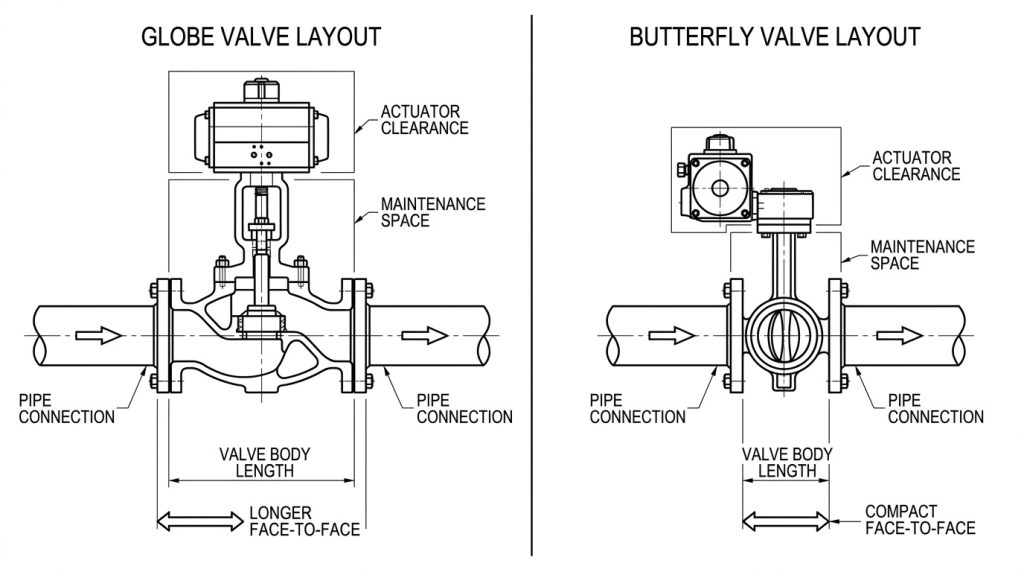
Construction affects installation because globe valve vs butterfly valve bodies differ in length, mass, orientation, and piping load. Globe bodies are longer, while butterfly discs need clearance inside adjoining pipework.
Which layout checks prevent site problems?
Check face-to-face dimensions, flange standard, bolt pattern, access, flow arrow, and removal space. You might be wondering where projects slip. Interface mismatches often appear after piping fabrication.
- Verify EN, ASME, JIS, or project-specific flange drilling.
- Allow stem, gearbox, actuator, and maintenance clearance.
How should piping support each body?
Piping should carry its own weight without forcing either body out of alignment. The key point is simple: heavy globe valves may need support, while actuated butterfly assemblies can impose side loads.
- Support heavy actuators independently where drawings require it.
- Keep sealing faces parallel and clean during assembly.
Key Takeaway: You can avoid leakage and binding by treating dimensional compatibility and piping support as procurement checks.
| Installation factor | Globe valve | Butterfly valve |
|---|---|---|
| Face-to-face length | Longer | Shorter |
| Disc clearance | Not applicable | Must be checked |
| Support demand | Often higher | Size and actuator dependent |
This review catches field delays before shipment.
Which Valve Creates Less Pressure Drop?
A globe valve vs butterfly valve comparison usually gives a fully open butterfly valve lower pressure drop than a globe valve. Globe geometry redirects flow through its seat, while an open butterfly path stays straighter.
How should you compare Cv or Kv?
Compare Cv or Kv at your selected size and opening, then calculate pressure drop with actual fluid properties. Cv uses US units, while Kv uses metric units. Here’s what matters:
- Use operating, minimum, and maximum flow cases.
- Include density, viscosity, vapor pressure, and temperature.
When can low pressure loss mislead you?
Low full-open loss can mislead you when a control valve runs partly closed. Ready for the useful test? Plot its installed characteristic and check authority, velocity, cavitation, noise, and operating angle.
- Avoid normal butterfly operation near extreme low angles.
- Check globe trim limits under maximum differential pressure.
Key Takeaway: You can balance pumping cost with stable control by comparing performance across real operating points.
| Hydraulic factor | Globe valve | Butterfly valve |
|---|---|---|
| Full-open loss | Higher | Usually lower |
| Control shaping | Broad trim options | Disc-angle dependent |
| Oversizing risk | Poor authority | Low-angle sensitivity |
This view keeps low-loss claims from weakening control.
Why Choose a Globe Valve for Throttling?
You choose a globe valve when globe valve vs butterfly valve screening puts stable throttling and controlled pressure reduction ahead of compactness. Its plug and seat meter flow in small increments, while severe-service trim can divide pressure drop.
What operating benefits support control loops?
Globe valves accept many trim profiles, leakage classes, and actuator arrangements. Positioners can correct stem movement from a control signal. Here’s why engineers care:
- Predictable response supports tighter process control.
- Replaceable trim lets you adapt capacity or materials.
What trade-offs must you accept?
You accept higher pressure loss, greater weight, slower travel, and often higher large-diameter cost. But here’s the deciding point: those penalties may be justified when unstable process conditions cost more.
- Confirm rangeability and minimum controllable flow.
- Review noise and cavitation calculations for liquid service.
Key Takeaway: You gain measured, adaptable control when process stability carries more value than minimum pressure loss.
| Globe advantage | User value |
|---|---|
| Shaped trim | Better control response |
| Replaceable internals | Service flexibility |
| Strong seating | Dependable shutoff options |
This value case fits demanding modulating service.
Why Choose a Butterfly Valve for Large Lines?
You choose a globe valve vs butterfly valve option built around a butterfly valve when large size, tight space, fast cycling, and low mass drive your project. Its short body cuts structural demand, while quarter-turn motion suits automation.
Which benefits scale with diameter?
Weight, footprint, actuator simplicity, and handling advantages grow with pipe diameter. Your crew can install a butterfly body with less lifting. Here’s the payoff:
- Compact bodies fit congested plants and prefabricated skids.
- Lower torque designs can reduce actuator size.
Which butterfly design should you select?
Select concentric soft seats for moderate duty, double-offset designs for reduced rubbing, and triple-offset metal seats for demanding conditions. What’s the catch? Strong geometry cannot compensate for wrong materials or missing torque data.
- Check wafer, lug, or flanged connection needs.
- Specify seat, disc, shaft, coating, and actuator details.
Key Takeaway: You can gain major installation and cost advantages at scale when construction matches service severity.
| Butterfly design | Typical fit |
|---|---|
| Concentric | Water and HVAC |
| Double-offset | Higher-cycle industrial duty |
| Triple-offset | High temperature or tougher sealing |
This progression aligns spending with service duty.
How Do Media and Temperature Affect Selection?
Media and temperature affect globe valve vs butterfly valve selection through corrosion, erosion, seal life, emissions, and allowable pressure. Review every wetted component, including trim, disc, shaft, seat, packing, gasket, and coating.
Which material questions should you ask?
Ask for fluid composition, concentration, temperature range, solids, cleaning chemicals, and upset conditions. Compatibility can change with concentration or temperature. Here’s a safer checklist:
- Use EPDM only with compatible water-based media.
- Screen NBR for oils and its stated temperature range.
How do pressure and temperature interact?
Allowable pressure commonly falls as temperature rises, so review its pressure-temperature chart. Now for the hidden risk: thermal cycling can relax packing, age soft seats, and change actuator demand.
- Record normal, design, and upset values on the datasheet.
- Check bidirectional sealing under maximum differential pressure.
Key Takeaway: You can extend service life by basing materials on full chemistry and temperature history, not fluid name alone.
| Service condition | Likely priority |
|---|---|
| Clean cool water | Soft-seat compatibility |
| Hot steam | Metal trim and packing |
| Corrosive fluid | Alloy and lining review |
This matrix turns media labels into focused material questions.
How Should You Compare Cost, Maintenance, and Supply?
A globe valve vs butterfly valve lifecycle comparison should include price, energy, labor, spares, downtime, documentation, and delivery risk. Butterfly valves often cost less in large sizes, while globe valves may justify added expense through stronger control.
Which maintenance tasks differ?
Globe maintenance covers packing, stem, gasket, seat, plug, and actuator calibration. Butterfly work covers seat wear, shaft seals, bearings, disc, gearbox, and actuator stops. Here’s the planning advantage:
- Keep matched trim kits for globe control duties.
- Stock compatible seats and seals for butterfly fleets.
What should a supplier document?
A supplier should provide approved drawings, material records, pressure tests, coating data, certificates, manuals, and traceable identification. Don’t miss this: clear inspection points and spare support reduce approval delays and downtime.
- Align standards, acceptance criteria, and document language.
- Confirm lead time only after materials and drawings are approved.
Key Takeaway: You can compare bids fairly by pricing performance, proof, serviceability, and schedule exposure across the full lifecycle.
| Cost area | Globe valve | Butterfly valve |
|---|---|---|
| Large-size purchase | Often higher | Often lower |
| Pumping energy | Often higher | Often lower |
| Maintenance focus | Trim and packing | Seat, shaft, and actuator |
This lens gives procurement and engineering a shared award basis.
What Should You Take Away?
Globe valves suit precise throttling, demanding pressure reduction, and adaptable trim, while butterfly valves suit compact layouts, rapid operation, and economical large-diameter service. This article has resolved how their motion, construction, hydraulics, materials, installation, maintenance, and supply documentation affect your decision.
For a specification review based on your media, pressure, temperature, flow cases, and required standards, contact us today. RUITO believes dependable flow control begins with transparent engineering evidence and ends with equipment that performs as specified.
Frequently Asked Questions
Can I use a butterfly valve for throttling?
Yes, in many suitable services. You should size it from manufacturer flow curves and keep normal operation within a stable angle range while checking cavitation, velocity, noise, seat limits, and actuator torque.
What’s the best valve for precise flow control?
A globe valve is usually the better starting point. Its plug and seat geometry offers broader control shaping, though final selection still depends on rangeability, pressure drop, media, and required leakage class.
How do I know if a butterfly valve is oversized?
It is likely oversized when normal flow occurs at a very small disc angle. Hunting, sharp flow changes, noise, weak actuator response, or poor low-demand control provide further warning signs.
Can I replace a globe valve with a butterfly valve?
Sometimes, but not as a like-for-like swap. You must recalculate capacity and pressure drop, then verify dimensions, shutoff, materials, actuator behavior, disc clearance, and control response.
What’s the best information to send a valve supplier?
A complete process datasheet is best. Include fluid chemistry, solids, flow range, normal and design pressure, temperature, differential pressure, line size, standards, leakage class, actuation, fail position, and document needs.