
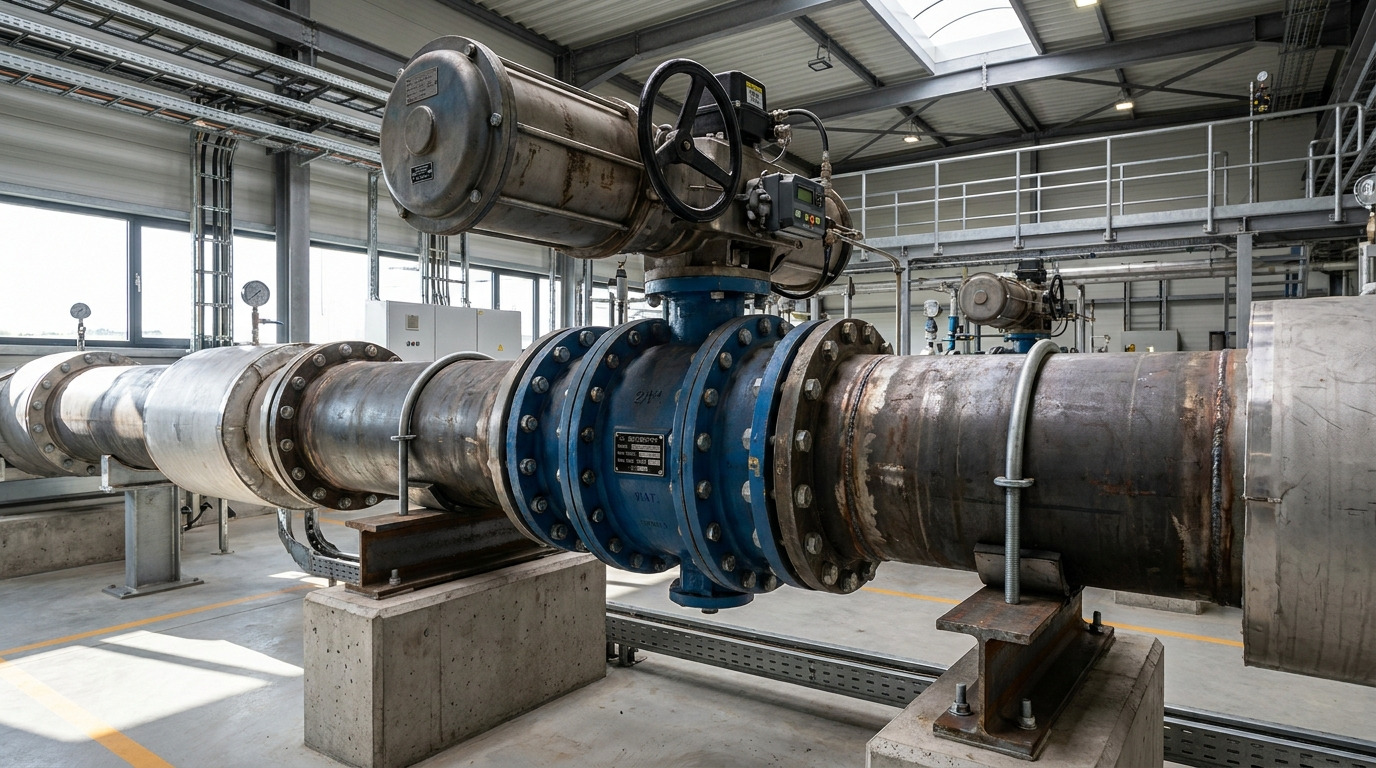
A 24-inch butterfly valve should be selected by matching duty, medium, pressure, temperature, connection, sealing, and actuation requirements. A rushed choice can leave you with unstable control, a leaking seat, or an actuator that stalls during a shutdown. For a plant engineer or buyer, one wrong assumption can delay commissioning and raise replacement costs across a large-bore line.
Consider a DN600 cooling-water header where a line-size valve must isolate flow and modulate during low demand. Poor sizing may cause hunting near closure, while an unsuitable seat can wear after repeated cycling. This guide gives you a practical route for specifying a 24 butterfly valve around real operating data, verified standards, and maintainable hardware.
What Duties Must a 24 Butterfly Valve Perform?
A 24 butterfly valve must perform a clearly defined isolation, throttling, bypass, or emergency function. Write a duty statement covering normal operation, abnormal events, and the required fail position before comparing models.
Which operating details should you record?
Here’s the practical point: Pipe diameter alone cannot describe valve duty. Record conditions that change torque, wear, response time, and sealing behavior:
- Minimum, normal, and maximum flow
- Normal and peak differential pressure
- Cycle frequency and required stroke time
- Indoor, outdoor, buried, or marine exposure
How does duty translate into a selection summary?
Use one datasheet for process, mechanical, electrical, and control inputs. This shared record prevents procurement substitutions from quietly changing valve performance.
| Duty factor | Selection effect | Buyer check |
|---|---|---|
| Isolation | Shutoff class and seat | Test certificate |
| Throttling | Cv curve and control range | Published curve |
| Emergency duty | Fail action and stroke time | Functional test |
This pattern shows why function must come before hardware.
Key Takeaway: A written duty statement gives you a defensible basis for every choice that follows.
How Do Fluid Properties Shape Valve Materials?
A 24 butterfly valve needs wetted materials that resist both chemical attack and physical wear from its process fluid. Document fluid composition, pH, solids, viscosity, chloride level, and cleaning chemicals rather than using a broad label such as “water.”
What can damage wetted components?
What changes next? Temperature may accelerate corrosion while solids abrade a disc edge and seat. Review each exposed part against these conditions:
- Body or liner contact with media
- Disc-edge erosion at partial opening
- Stem and packing chemical exposure
- Sediment buildup around a soft seat
Which material families fit common duties?
Material selection should cover body, disc, stem, seat, and fasteners as one system. Request a compatibility review whenever concentration or temperature varies during cleaning.
| Service | Common starting point | Main verification |
|---|---|---|
| Clean water | Ductile iron, EPDM | Potable approval if needed |
| Mild chemicals | Stainless trim, PTFE | Concentration and heat |
| Abrasive slurry | Hard trim or liner | Particle size and velocity |
The table narrows candidates without replacing supplier data.
Key Takeaway: You reduce early leakage when every wetted component matches actual fluid chemistry and solids loading.
Which Pressure and Temperature Ratings Fit the Service?
A 24 butterfly valve fits the service only when its rated pressure at maximum temperature exceeds operating, differential, and surge conditions. Never treat a Class or PN designation as a direct working-pressure promise across all materials and temperatures.
How should you define the design case?
Here’s the catch: Steady gauge pressure may miss pump-trip surge, static head, thermal expansion, or reverse differential pressure. Your design case should state:
- Maximum allowable working pressure at temperature
- Highest differential pressure across a closed disc
- Calculated surge pressure and duration
- Vacuum or reverse-flow conditions
What rating evidence should procurement request?
Ask for manufacturer pressure-temperature tables tied to body and seat materials. Match valve rating, flange standard, piping class, and test basis on one approved datasheet.
| Rating input | Required evidence | Common risk |
|---|---|---|
| Operating pressure | Process datasheet | Normal value used as design value |
| Maximum temperature | Rating table | Material derating missed |
| Surge pressure | Hydraulic study | Short peaks omitted |
These checks expose rating gaps before purchase.
Key Takeaway: A temperature-adjusted design case protects your line from deformation, seal damage, and unplanned shutdowns.
Should You Choose Resilient or High-Performance Design?
A 24 butterfly valve should use a resilient concentric design for compatible moderate service or an eccentric design for greater heat, pressure, cycling, or wear. Your leakage target and operating profile should drive that choice rather than initial price alone.
Where does each valve geometry work well?
Look at the operating reality: A concentric disc rubs its seat through much of each stroke, while offset geometry reduces contact near opening. Compare these service patterns:
- Concentric soft seat for water and HVAC isolation
- Double-offset design for higher cycling and pressure
- Triple-offset metal seat for heat or severe duty
- Published leakage class for every geometry
What trade-offs affect total ownership cost?
Soft-seated valves often provide tight shutoff with lower torque. Eccentric valves cost more initially, yet reduced rubbing can extend service intervals in demanding operation.
| Design | Typical strength | Check closely |
|---|---|---|
| Concentric | Simple tight shutoff | Seat compatibility |
| Double offset | Lower seat wear | Direction and seal design |
| Triple offset | Heat and severe duty | Leakage class and torque |
The comparison links geometry with service severity.
Key Takeaway: Choose the simplest design that meets every verified process limit and shutoff target.
Which Body Style Matches Installation and Isolation Needs?
A 24 butterfly valve body should match flange drilling, piping support, access limits, and any dead-end isolation requirement. Wafer, lug, and double-flanged bodies may share a bore size, yet they behave differently during installation and maintenance.
Can wafer or lug construction support your plan?
The deciding detail: A wafer body suits compact through-bolted assemblies, while a rated lug body can permit removal of downstream pipework. Confirm these items before release:
- Applicable flange standard and pressure class
- Face-to-face dimension and disc clearance
- Dead-end pressure rating and permitted direction
- Bolt length, material, and tightening procedure
When does a flanged body make sense?
A double-flanged body suits large permanent lines where alignment, structural stability, or project specifications favor a rigid connection. Pipe supports must carry line loads without using the valve as an anchor.
| Body style | Practical advantage | Limitation to verify |
|---|---|---|
| Wafer | Compact and economical | No assumed dead-end duty |
| Lug | One-side maintenance potential | Tapped-lug rating |
| Double flanged | Stable large-bore connection | Weight and space |
This summary ties body form directly to field work.
Key Takeaway: Verified drawings prevent bolt clashes, disc interference, and unsafe isolation assumptions.
Which Seat and Seal Materials Suit the Medium?
A 24 butterfly valve needs a seat and seal package screened against fluid, temperature, pressure differential, and cycle rate. Generic temperature limits are only preliminary filters because compound formulation and valve geometry change actual ratings.
How do common seat materials differ?
Here’s where cost shifts: An inexpensive elastomer becomes costly if oil, solvent, heat, or abrasion makes it swell or harden. Typical screening logic includes:
- EPDM for many water and HVAC duties
- NBR for compatible oils and air
- PTFE for broad chemical resistance
- FKM for selected hydrocarbons and higher heat
- Metal seals for hot or abrasive service
What should a seal approval record contain?
Record compound grade, media concentration, minimum and maximum temperature, differential pressure, leakage criterion, and expected cycling. Ask for written confirmation based on the offered valve design.
| Seat family | Common fit | Main caution |
|---|---|---|
| EPDM | Water-based service | Oils and hydrocarbons |
| NBR | Compatible oil service | Ozone and chemical limits |
| PTFE | Aggressive chemicals | Creep and backing design |
The matrix provides a screening path, not a universal rating.
Key Takeaway: A documented compatibility check prevents most avoidable seat failures.
How Should You Size the Actuator and Controls?
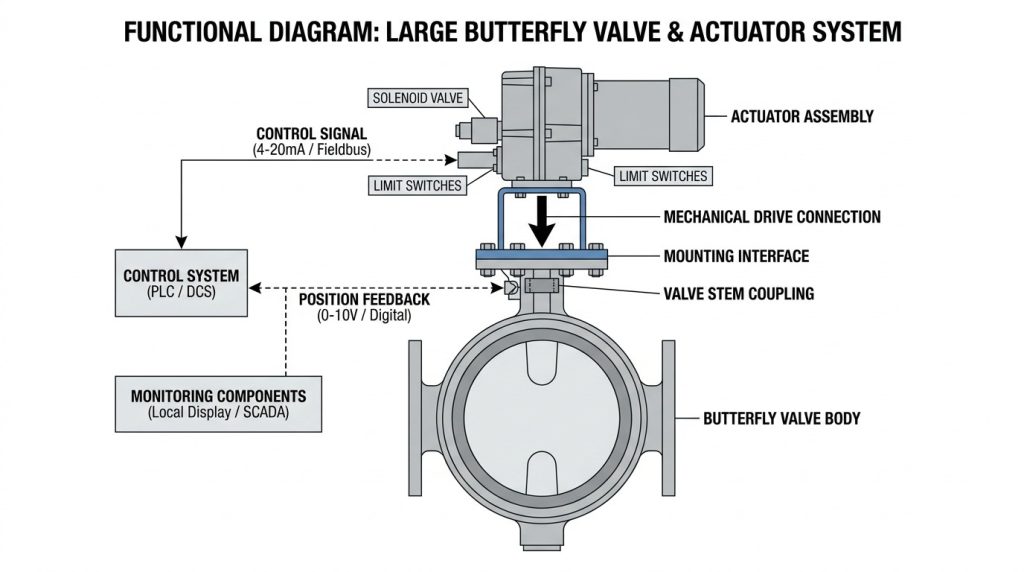
A 24 butterfly valve actuator should exceed calculated break, run, dynamic, and seating torque under the worst credible conditions. Apply a documented service factor while checking air pressure or voltage at the actuator rather than at the utility source.
Which operator suits your operating pattern?
What matters in practice? A 24-inch disc usually needs a gearbox or powered actuator because direct lever operation offers insufficient mechanical advantage. Compare:
- Manual gearbox for infrequent local operation
- Pneumatic actuator for fast cycling and fail action
- Electric actuator for remote sites with power access
- Hydraulic actuator for high force or specialized duty
Which accessories complete the control package?
Define position feedback, limit switches, solenoid voltage, positioner signal, enclosure rating, manual override, and fail-open or fail-closed action. Verify ISO 5211 mounting details and stem coupling dimensions.
| Control need | Typical device | Acceptance check |
|---|---|---|
| On-off duty | Limit switches | End-position proof |
| Modulating duty | Positioner | Stroke and response test |
| Safety action | Spring return | Loss-of-utility test |
This package view prevents interface gaps between mechanical and control teams.
Key Takeaway: Torque data and defined accessories give you reliable movement during both routine and upset conditions.
What Installation Checks Prevent Large-Valve Problems?
A 24 butterfly valve avoids field problems when technicians verify alignment, disc clearance, support, gasket practice, and bolt tightening before pressurization. Large diameter magnifies small flange errors and side loads.
What should happen before bolting begins?
Now for field execution: Inspect flange faces and clean the line before placing the valve. Your crew should also:
- Confirm flow direction where design requires it
- Open the disc slightly without striking pipework
- Center wafer bodies before staged tightening
- Support actuators independently when specified
- Follow the approved gasket and bolt procedure
How should commissioning verify the assembly?
Stroke the valve slowly and confirm free movement before applying full differential pressure. Check position indication, actuator travel stops, joint leakage, control signals, and fail action under a controlled permit.
| Installation stage | Main check | Failure prevented |
|---|---|---|
| Pre-fit | Flange and disc clearance | Mechanical interference |
| Bolting | Alignment and sequence | Seat distortion and leakage |
| Commissioning | Stroke and fail test | Control malfunction |
The sequence turns drawings into field reliability.
Key Takeaway: Controlled installation protects a sound valve from damage caused by piping stress or poor alignment.
How Can Maintenance Lower Lifecycle Cost?
A 24 butterfly valve costs less over its service life when inspection intervals follow duty severity, cycling, and failure consequences. Baseline torque, leakage, vibration, and stroke time during commissioning so later changes become visible.
Which condition signs deserve attention?
The payoff is measurable: Trend data lets you plan work before a minor seat or actuator issue stops production. Watch for:
- Rising operating torque or longer stroke time
- Seat leakage after closure
- Stem packing seepage or corrosion
- Gearbox backlash and actuator air leakage
- Noise or vibration during throttling
What belongs in a practical service plan?
Set inspection frequency from risk rather than a generic calendar. Stock critical seals and coupling parts where lead time exceeds the acceptable repair window.
| Maintenance item | Condition signal | Planned response |
|---|---|---|
| Seat and disc | Leakage trend | Inspect sealing surfaces |
| Operator | Torque or time change | Service drive train |
| Fasteners and coating | Corrosion or loosening | Repair and retorque |
These signals support condition-based maintenance.
Key Takeaway: Baseline measurements help you intervene before wear becomes downtime.
Which Tests and Supplier Records Support Approval?
A 24 butterfly valve gains project approval through traceable materials, approved drawings, pressure tests, leakage tests, and functional records tied to its serial or batch number. A catalog statement alone cannot prove conformance.
Which records should accompany the valve?
Here’s your proof point: Specify the document package in the purchase order before manufacturing begins. Request applicable items such as:
- Approved general arrangement and wiring drawings
- Material certificates and coating records
- Shell and seat test reports
- Dimensional inspection and actuator test sheets
- Installation, operation, and maintenance manual
How do you compare suppliers on equal terms?
Issue one data sheet and require a clause-by-clause deviation list. Compare offered standards, materials, ratings, testing, lead time, spares, and engineering response rather than price in isolation.
| Approval area | Evidence | Release gate |
|---|---|---|
| Design | Approved drawing and datasheet | Dimensional review |
| Materials | Traceable certificates | Document acceptance |
| Performance | Pressure and functional tests | Inspection release |
This evidence trail makes technical bids easier to compare.
Key Takeaway: Clear acceptance records protect your project from substitutions, missing tests, and commissioning disputes.
Build a Safer Large-Bore Valve Specification
You now have a practical method for defining duty, checking media and ratings, choosing geometry and seals, sizing actuation, planning installation, and verifying records. That method helps you prevent unstable control, premature leakage, interface errors, and undocumented substitutions.
At RUITO, we believe dependable flow control begins with transparent engineering choices and proof you can audit. Share your process datasheet, piping standard, and control needs when you contact us today; our team can help you shape a technically sound valve package and quotation.
Frequently Asked Questions
Can I use a 24-inch butterfly valve for throttling?
Yes, if its Cv curve and operating range match your flow cases. Avoid prolonged operation near closure when velocity, vibration, or cavitation may damage the seat and disc.
What’s the best body style for dead-end service?
A rated lug or suitable flanged design usually fits dead-end isolation. Confirm pressure rating, flow direction, bolting, and manufacturer approval for that exact arrangement.
How do I know if my actuator has enough torque?
Check a supplier torque calculation covering break, run, dynamic, and seating loads. Confirm available air pressure or voltage, fail action, and applied service factor.
Can I select a seat using temperature alone?
No, temperature alone cannot establish compatibility. Review fluid chemistry, concentration, pressure differential, abrasion, cycling, and the offered compound grade.
What’s the best proof that a valve meets my specification?
An approved, traceable document package provides the strongest proof. It should connect drawings, material records, pressure tests, leakage results, and functional checks with the supplied valve.