
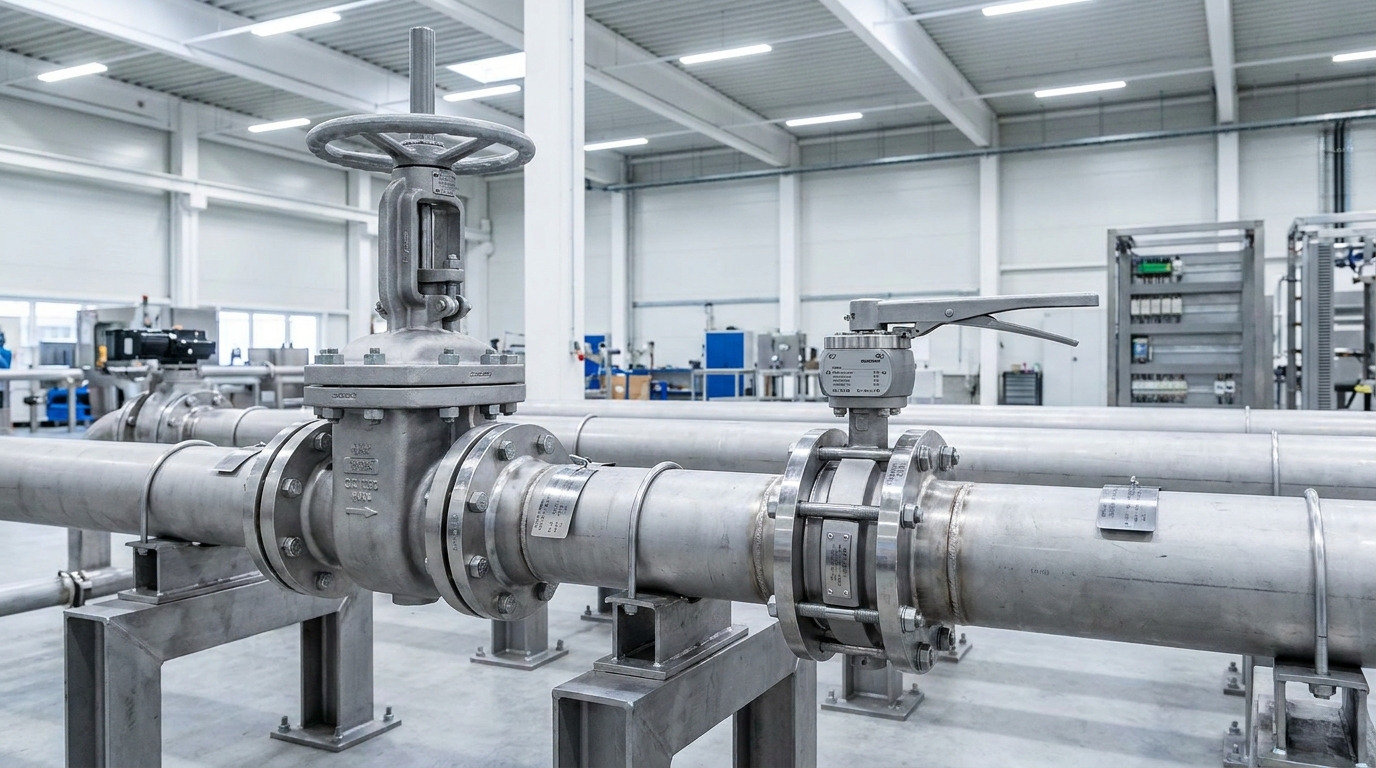
Choose a gate valve when full-bore isolation and an unobstructed flow path are decisive; choose a butterfly valve when compact size, fast actuation, large-diameter economy, or controlled throttling matters more. In a gate vs butterfly valve decision, neither valve family is universally better. The correct choice depends on the actual construction, pressure and temperature envelope, fluid, operating duty, allowable pressure loss, shutoff requirement, and installation geometry.
That distinction matters on real projects. A generic comparison may point you toward a butterfly valve for a large water line, but the choice can still fail if the seat is incompatible, the actuator cannot close against maximum differential pressure, or the disc hits the pipe lining. Likewise, a gate valve’s clear bore is valuable only when the selected model, trim, and operating method fit the service.
Use the comparison below to choose the valve family, then verify the exact configuration. RUITO’s range of industrial butterfly valve configurations shows why body style, offset design, seat, disc, and actuation must be specified rather than implied by the valve name.
Gate vs Butterfly Valve at a Glance
A gate valve is usually the stronger choice for low-loss, full-bore isolation, while a butterfly valve is usually stronger on footprint, operating speed, automation, and large-size economics.
The table gives a useful first screen, not a final specification.
| Decision factor | Gate valve | Butterfly valve |
|---|---|---|
| Motion | Multi-turn linear travel lifts or lowers a gate | Quarter-turn rotary motion turns a disc |
| Fully open flow path | Can be unobstructed in a full-bore design | Disc and shaft remain in the flow path |
| Primary duty | On-off isolation | On-off isolation or throttling when properly sized |
| Operating speed | Generally slower | Generally faster, subject to actuator settings |
| Installation envelope | More face-to-face and overhead space, especially with a rising stem | Short face-to-face dimension and lower weight |
| Pressure loss | Typically lower when fully open and full bore | Depends on disc geometry, opening angle, and valve size |
| Line cleaning | A suitable full-bore design may permit pigging or swabbing | Disc normally prevents pigging or swabbing |
| Frequent automation | Possible, but often slower and requires a multi-turn actuator | Well suited to compact quarter-turn actuators |
| Throttling | Poor choice; partial opening can damage gate and seats | Possible with verified flow data and operating limits |
| Best first fit | Transmission isolation, very low-loss lines, services requiring a clear bore | Water, HVAC, utility, and process lines where space and actuation matter |
The most important limitation is the word “typically.” A resilient-seated gate valve and a pressure-seal metal-seated gate valve do not share the same service envelope. A concentric rubber-lined butterfly valve and a triple-offset metal-seated butterfly valve should not be judged as if they were the same product.
How Design Changes the Operating Behavior
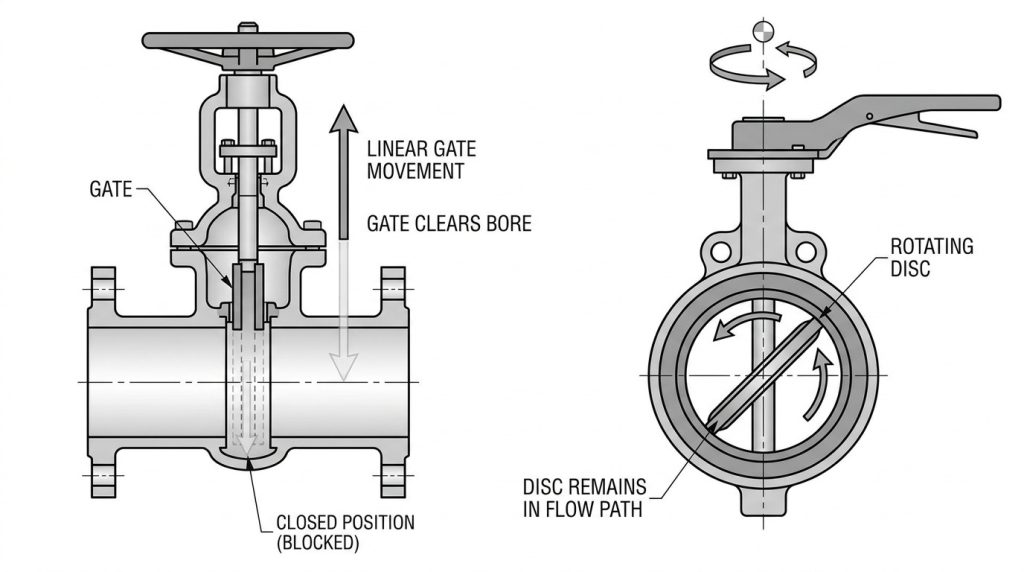
The gate leaves the bore as it opens, while the butterfly disc rotates but stays in the bore; that structural difference drives most of the practical tradeoffs.
A gate valve converts handwheel or actuator rotation into linear stem and gate movement. Wedge and parallel-slide designs serve different sealing conditions, resilient and metal seats cover different media and temperatures, and knife gates address fibrous or solids-bearing service. Rising-stem designs provide visible position but need overhead clearance; non-rising stems reduce that clearance. RUITO’s gate valve range includes resilient-seated, metal-seated, knife, rising-stem, and non-rising-stem configurations.
A butterfly valve moves through 90 degrees. A concentric design keeps the stem through the disc center and commonly uses a resilient liner. Double-offset geometry reduces seat rubbing during travel, while triple-offset geometry uses a different sealing path and is commonly paired with metal seating for more demanding service. Therefore, statements such as “gate valves handle high pressure and butterfly valves do not” are too broad to approve a valve.
Compare the offered construction against your service data. The family name narrows the field; the body style, trim, seat, pressure-temperature rating, leakage acceptance, and actuator determine whether the valve will work.
Flow Capacity, Pressure Drop, and Line Cleaning
A full-bore gate valve normally gives the lowest obstruction, but pressure loss must still be checked with actual valve data rather than a fixed percentage.
When a gate valve is fully open, the gate retracts from the bore. This favors long transmission lines, gravity systems with limited head, and pipelines that must pass cleaning equipment. Confirm that the offered bore is genuinely full, that seat geometry does not obstruct the cleaning device, and that the face-to-face design matches the line class.
A butterfly valve always leaves the disc and shaft in the flow. The resulting loss is not one universal number: it changes with valve size, disc profile, opening angle, and flow rate. For a duty point, obtain the manufacturer’s Cv or Kv value at the intended opening and calculate the available downstream pressure. This is especially important for a valve that will modulate, because its loss rises sharply as the disc closes. The detailed method is covered in this guide to calculate butterfly valve pressure drop.
Do not assume that matching nominal pipe size guarantees adequate capacity. If the butterfly valve must stay near fully open to pass normal flow, it may have little useful control authority. If a gate valve will remain partially open to create resistance, it is being assigned the wrong duty.
Shutoff, Throttling, and Transient Risk
Use a gate valve as an isolator, use a butterfly valve for throttling only with verified control data, and engineer the closure time for either valve.
A partially open gate puts a high-velocity jet across the gate and seat. Vibration, erosion, unstable position, and poor repeatability can follow. The correct operating instruction is normally fully open or fully closed, with another valve type used for continuous regulation.
A butterfly valve can throttle, but that does not make every butterfly valve a control valve. Ask for the flow characteristic across the planned travel, minimum stable opening, maximum allowable velocity, cavitation or noise limits, actuator resolution, and positioning accuracy. Select the disc and seat for both the fluid and the time spent at intermediate angles.
Fast mechanics also require a system-level check. The American Water Works Association identifies rapid valve closure and pump failure as events that can create damaging transient pressure waves. A quarter-turn valve can therefore need a gearbox, controlled actuator ramp, or transient study rather than the shortest possible closure time. A slowly operated gate valve may reduce the risk, but it does not eliminate surge caused by pumps, power loss, trapped air, or an aggressive actuator setting.
Space, Actuation, and Maintenance Tradeoffs
Butterfly valves usually reduce installed weight and envelope, while gate valves trade that compactness for a clear bore and different service access.
For a gate valve, check face-to-face length, bonnet removal space, handwheel access, and rising-stem travel. Buried or inaccessible installations may need an extension stem, valve box, gearbox, or position indication. Maintenance planning must account for packing adjustment and removal of the gate or bonnet assembly.
For a butterfly valve, check more than the short body length. The disc may project beyond the body during travel, so confirm clearance inside the mating pipe, liner, and adjacent fittings. Verify flange standard, inside diameter, gasket arrangement, bolt length, and whether a lug body is explicitly rated for the proposed dead-end direction and pressure.
Actuator selection is not a simple “quarter-turn equals low torque” rule. Specify maximum differential pressure, seat material, temperature, expected deposits, cycle frequency, required fail position, available power or air, and required stroke time. Use the manufacturer’s break-to-open, running, and end-to-close torque data with the project-approved safety factor. Maintenance access must also allow removal of the actuator, packing, seat, or disc without creating an avoidable line shutdown.
Select by Service Conditions, Not Valve Name
The fastest reliable decision is to match the dominant service constraint to a valve construction, then challenge that choice against every design condition.
Use this application screen before reviewing commercial offers.
| Service condition | Strong first candidate | What must be confirmed |
|---|---|---|
| Long transmission line with strict head-loss limit | Full-bore gate valve | Bore geometry, operating frequency, pressure class, cleaning method |
| Large water or HVAC line with limited space | Butterfly valve | Cv/Kv, seat compatibility, disc clearance, actuator torque |
| Frequent automated isolation | Butterfly valve | Cycle duty, fail action, closure time, seat wear, position feedback |
| Continuous flow regulation | Sized butterfly valve or dedicated control valve | Control curve, operating range, cavitation, noise, actuator resolution |
| High-temperature or high-pressure service | Metal-seated gate or engineered offset butterfly valve | Published pressure-temperature rating, leakage class, trim, test standard |
| Fibrous slurry or suspended solids | Knife gate often becomes the first candidate | Solids size and concentration, seat exposure, flushing, orientation |
| Piggable line | Suitable full-bore gate valve | Clear bore, seat pocket, pig dimensions, branch and fitting geometry |
| Rapid emergency isolation | Either family with engineered actuation | Transient study, fail mode, available torque, maximum closure time |
Water and wastewater systems show why no single rule works. Clean-water transmission may reward a full bore, while a large treatment-plant header may favor the lighter valve and compact actuator package. RUITO’s overview of water and wastewater valve applications provides the wider system context for those decisions.
After choosing a first candidate, run four checks in order: service compatibility, hydraulic performance, mechanical fit, and operability. Reject the choice if any one of those checks fails; do not compensate for a technical mismatch with a lower purchase price.
What to Specify Before Requesting a Quote
A quote is technically comparable only when every supplier receives the same operating data, construction requirements, and acceptance criteria.
Include these items in the RFQ:
- Fluid name, concentration, phase, solids content, particle or fiber characteristics, and cleaning chemicals.
- Normal, minimum, and design pressure and temperature, plus maximum differential pressure during opening and closing.
- Line size, pipe schedule or inside diameter, design flow, allowable pressure loss, and any Cv or Kv target.
- Required duty: isolation, throttling, emergency shutdown, cycle frequency, stroke time, fail position, and position feedback.
- Flow direction, bidirectional shutoff requirement, acceptable leakage rate, dead-end duty, and pigging or swabbing requirement.
- End connection, flange standard and facing, face-to-face standard, available overhead space, disc clearance, and installation orientation.
- Body, disc or gate, stem or shaft, seat, packing, coating, and lining requirements based on the fluid and environment.
- Design and test standards, inspection and test plan, witness points, marking, documentation language, and traceability requirements.
Then request the evidence needed to approve the valve: a dimensional drawing, pressure-temperature rating, material list, Cv/Kv data where hydraulics matter, actuator torque calculation, shell and seat test acceptance, material certificates, and traceable inspection records.
RUITO’s current published ranges include butterfly valves from DN25 to DN3000 at PN10 to PN25 and gate valves from DN25 to DN3000 across multiple PN and ASME classes, depending on configuration. Available butterfly seats include EPDM, NBR, PTFE, FKM, and metal options; gate configurations include resilient and metal seats. These ranges are an initial capability screen, not a substitute for an approved data sheet. RUITO can provide engineering drawings, material certificates, dimensional inspection reports, hydrostatic test records, and seat-leakage documentation for the agreed specification.
Make the Final Valve Choice
Choose the construction that satisfies the line’s dominant constraint without failing the hydraulic, mechanical, materials, or operating checks. A gate valve is the logical starting point for full-bore, low-loss isolation; a butterfly valve is the logical starting point for compact, fast, frequently actuated, or controlled-flow service. Final approval should rest on the offered design and documented performance, not a generic family comparison.
If you have the medium, pressure-temperature range, line size, duty, and interface details, send RUITO your project requirements for a configuration review and quotation.
Frequently Asked Questions
Can a butterfly valve directly replace a gate valve?
Not without a fit and duty review. Confirm face-to-face length, flange drilling, pipe inside diameter, disc travel, differential pressure, shutoff direction, leakage acceptance, actuator torque, and closure time before approving the substitution.
Which valve is less likely to cause water hammer?
Neither valve family prevents water hammer by itself. A manually operated gate valve often closes more slowly, but a butterfly valve can also use a gearbox or programmed actuator; the required closure profile must come from the pipeline’s transient behavior.
Which valve gives tighter shutoff?
Tightness depends on the offered seat design, differential pressure, flow direction, temperature, wear condition, and leakage test, not just the valve name. Compare the specified leakage rate and witnessed test result for the exact configuration.
Is a butterfly valve always cheaper than a gate valve?
No. Butterfly valves often have an initial cost advantage in large sizes, but body style, offset design, seat material, actuator, testing, and documentation can change the comparison. Evaluate installed and lifecycle cost against the same technical specification.