
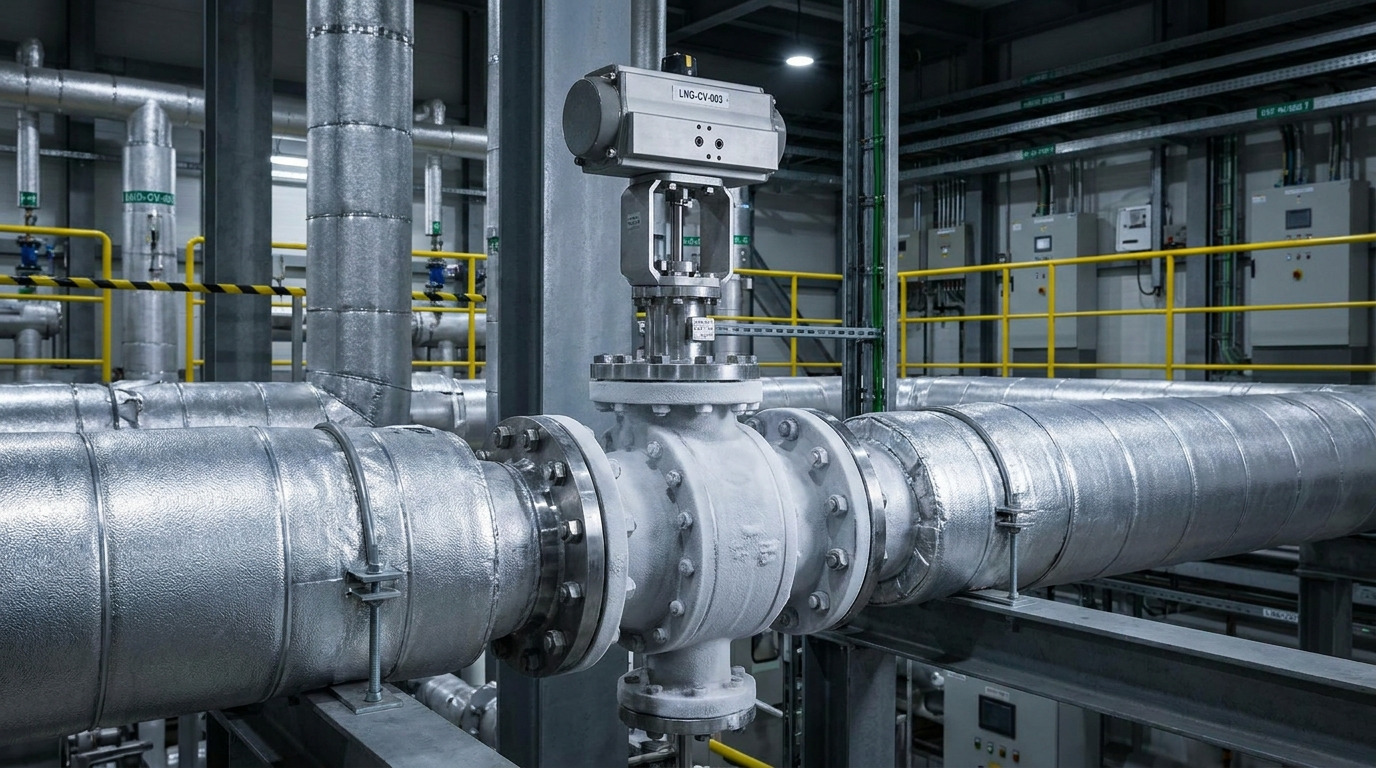
Cryogenic butterfly valves control or isolate very cold fluids while saving space, reducing operating effort, and supporting tight shutoff. On an LNG skid, a bulky valve can crowd piping, raise structural loads, and slow emergency movement; leakage caused by thermal contraction can then turn a cramped layout into a costly shutdown. A properly specified cryogenic butterfly valve addresses those pressures through compact quarter-turn operation, cold-ready materials, suitable sealing, and an extended stem that keeps actuators away from severe cold. This guide shows you where this design fits, why it performs well, and what procurement details protect your project.
Where Does a Cryogenic Butterfly Valve Work Best?
A cryogenic butterfly valve works best in large-bore lines carrying LNG, liquid nitrogen, liquid oxygen, or other refrigerated media where low weight and short face-to-face length matter. Typical duties include storage tank isolation, loading arms, vapor-return systems, liquefaction trains, air-separation units, and cold-box piping. You should match every location with its real temperature, pressure, flow direction, cycle rate, and permitted leakage rather than relying on a general low-temperature label.
Which Service Conditions Define a Suitable Location?
Here’s the practical test: a sound application has a compatible material set, enough actuator torque, and accessible stem packing. Review these conditions with your process and piping teams:
- Minimum metal temperature during operation and depressurization
- Fluid phase, cleanliness, flammability, and oxygen compatibility
- Maximum differential pressure at opening and closure
- Required shutoff direction, cycle rate, and fail position
| Application | Main Duty | Selection Focus |
|---|---|---|
| LNG terminal | Isolation | Fire-safe design and leakage control |
| Air separation | Flow control | Cleanliness and cold cycling |
| Research skid | Fine adjustment | Repeatability and compact size |
This comparison points your specification toward service risks rather than a generic catalogue range.
Key Takeaway: You gain a better fit when every valve location has its own operating envelope.
How Does a Cryogenic Butterfly Valve Support LNG Plants?
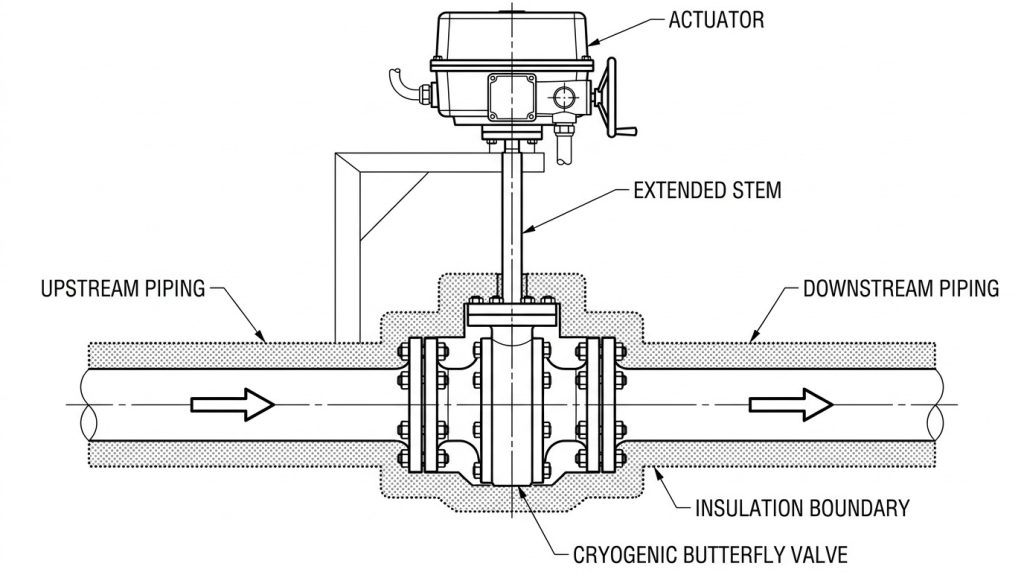
A cryogenic butterfly valve supports LNG plants through rapid quarter-turn isolation, high capacity, and a compact body suited to crowded modules. LNG commonly remains near −162°C, so ordinary packing, seats, and stem arrangements may shrink, harden, or leak. Extended stems move packing and actuation away from cold fluid while low-temperature alloys retain toughness. For large transfer lines, reduced mass can also lower pipe-support loads and simplify installation.
What Should You Check Across an LNG Train?
The deciding detail comes next: duty changes from liquefaction and storage through loading, so one configuration rarely suits every point. Check these items before releasing a purchase order:
- Normal flow, cooldown rate, and trapped-liquid scenarios
- Emergency shutdown time and actuator fail action
- Seat leakage target in both flow directions
- Fire-safe, fugitive-emission, and project documentation needs
| LNG Area | Typical Need | Design Response |
|---|---|---|
| Liquefaction train | Stable flow | Characterized disc and suitable actuator |
| Storage manifold | Tight isolation | Qualified seat and packing system |
| Loading line | Fast shutdown | Quarter-turn automated package |
The pattern shows why valve data should follow each line list rather than one plant-wide assumption.
Key Takeaway: You can reduce commissioning surprises by specifying LNG valves around each duty point.
Why Use a Cryogenic Butterfly Valve in Petrochemicals?
A cryogenic butterfly valve suits petrochemical service because it combines high flow capacity with quick isolation and a small installation envelope. Refrigerated hydrocarbon separation, recovery, and storage systems often place valves beside exchangers, columns, or packaged equipment where room remains limited. Yet chemical compatibility still governs selection: body, disc, shaft, seat, packing, and gaskets must all tolerate both fluid chemistry and lowest metal temperature.
How Do You Control Chemical and Leakage Risks?
What deserves closer attention? A valve may pass a warm shop test yet behave differently after repeated cold cycles. Your review should cover:
- Material traceability for every pressure-containing part
- Seat behavior under thermal contraction and pressure reversal
- Packing design for low fugitive emissions
- Cleaning rules for reactive or high-purity media
| Risk | Possible Result | Procurement Control |
|---|---|---|
| Wrong seat compound | Loss of shutoff | Verify media-temperature compatibility |
| Brittle body material | Crack initiation | Set minimum design metal temperature |
| Weak stem seal | External leakage | Request cold-cycle qualification |
These links between failure mode and purchase control help you review bids with greater precision.
Key Takeaway: You protect personnel and uptime when wetted materials and sealing details receive equal scrutiny.
Can a Cryogenic Butterfly Valve Deliver Precise Control?
A cryogenic butterfly valve can deliver dependable control when its installed flow curve, operating range, and actuator resolution match system behavior. Disc angle does not translate into an equal percentage of flow, and low openings can create high velocity, vibration, or unstable response. You should size from minimum, normal, and maximum flow cases while accounting for pressure available across the valve, not merely match nominal pipe diameter.
Which Sizing Inputs Prevent an Unstable Loop?
Here’s where sizing earns its value: a line-size selection may spend normal operation near an ineffective angle. Supply these inputs for a defensible calculation:
- Required Cv at minimum, normal, and maximum flow
- Upstream and downstream pressure for each case
- Fluid density, vapor pressure, and temperature
- Acceptable noise, velocity, cavitation, and flashing limits
| Control Check | Preferred Evidence | Warning Sign |
|---|---|---|
| Operating angle | Supplier curve | Normal duty near closed position |
| Actuator response | Resolution data | Large movement steps |
| Pressure drop | System calculation | Insufficient valve authority |
This review reveals whether sizing or actuator behavior will limit control quality.
Key Takeaway: You get a steadier process when valve capacity follows actual system curves.
What Sealing Advantages Does a Cryogenic Butterfly Valve Offer?
A cryogenic butterfly valve can provide tight shutoff through an engineered seat, controlled disc geometry, and stem packing selected for cold cycling. Triple-offset designs use a conical sealing path that minimizes rubbing during travel, while qualified resilient or laminated seats may suit less severe duties. Leakage claims still need a named test method, direction, pressure, temperature, and acceptance level before they carry procurement value.
How Should You Verify a Sealing Claim?
The proof sits in test scope: a room-temperature certificate cannot alone predict cryogenic performance. Ask your supplier for evidence covering:
- Shell and seat testing under the specified code
- Cryogenic leakage measurement at required temperature
- Repeated thermal and mechanical cycling
- Packing leakage and actuator operation during testing
| Seal Element | Cold-Service Concern | Useful Verification |
|---|---|---|
| Seat | Shrinkage or distortion | Low-temperature seat test |
| Packing | Hardening or relaxation | External leakage record |
| Disc alignment | Uneven contact | Cycle inspection |
The evidence should connect each sealing component with a measurable acceptance criterion.
Key Takeaway: You can compare suppliers fairly when every leakage promise has a defined test basis.
Why Is a Cryogenic Butterfly Valve Compact and Efficient?
A cryogenic butterfly valve remains compact because its disc rotates inside a short body instead of moving through a long linear stroke. That architecture reduces face-to-face length, valve mass, support demand, and actuator travel, especially at larger diameters. It also leaves the disc in the flow path, so efficiency depends on disc profile, opening angle, and actual Cv rather than compactness alone. Relevant butterfly valve flow characteristics help you quantify that tradeoff.
Where Do Space and Energy Savings Appear?
The benefit reaches beyond purchase price: lighter assemblies affect structure, lifting, access, and pump duty. Review likely gains in these areas:
- Modular skids with tight equipment spacing
- Large-bore pipelines with limited support capacity
- Automated lines requiring fast quarter-turn movement
- Systems sensitive to permanent pressure loss
| Design Factor | Project Effect | Check Required |
|---|---|---|
| Short body | Smaller envelope | Flange and access clearance |
| Low mass | Easier handling | Cold insulation support |
| High Cv | Lower pumping demand | Installed pressure-drop study |
This balance confirms that compact geometry works best when paired with hydraulic data.
Key Takeaway: You can save space and structural weight without accepting uncertain flow performance.
How Does a Cryogenic Butterfly Valve Reduce Lifecycle Cost?
A cryogenic butterfly valve can reduce lifecycle cost through fewer moving parts, smaller actuators, lower installation weight, and straightforward access to wear components. Purchase price alone gives an incomplete comparison because insulation work, supports, commissioning, leakage losses, spare parts, and shutdown labor may outweigh initial savings. A higher-grade seat or cold-tested packing system can cost more upfront yet avoid repeated intervention during service.
Which Costs Belong in Your Comparison?
Here’s the commercial reality: low bid value may conceal expensive field exposure. Compare each option across these cost groups:
- Valve, actuator, controls, and cold extension
- Freight, lifting, supports, welding, and insulation
- Inspection, planned service, and critical spares
- Leakage, lost production, and emergency replacement
| Cost Stage | Commonly Missed Item | Better Bid Input |
|---|---|---|
| Installation | Support steel | Assembly weight and dimensions |
| Operation | Energy loss | Cv and pressure-drop data |
| Maintenance | Shutdown access | Service plan and spare list |
The table shifts bid review from unit price toward measurable ownership exposure.
Key Takeaway: You make a stronger capital decision when cost covers installation through planned retirement.
What Materials Suit a Cryogenic Butterfly Valve?
A cryogenic butterfly valve needs materials that retain toughness, dimensional stability, and corrosion resistance at its minimum design temperature. Austenitic stainless steels often serve very cold duties, while low-temperature carbon steels may fit less severe ranges subject to specification and impact testing. Seat, packing, bolting, stem, and gasket choices matter just as much as body grade, since one incompatible part can govern service limits.
What Belongs on a Material Data Sheet?
Now focus on traceability: a grade name without heat records or test scope leaves a verification gap. Request these records:
- Material certificates linked to heat and part numbers
- Impact-test requirements at specified temperature
- Positive material identification where project rules call for it
- Seat, packing, lubricant, and gasket compatibility statements
| Component | Required Property | Review Record |
|---|---|---|
| Body and disc | Low-temperature toughness | Material certificate |
| Stem and bolting | Strength and compatibility | Grade and heat trace |
| Soft goods | Flexibility and chemical resistance | Supplier qualification |
This component-level view exposes weak links hidden by a body-only material description.
Key Takeaway: You receive a verifiable cold-service assembly when traceability covers every pressure and sealing part.
How Easy Is a Cryogenic Butterfly Valve to Maintain?
A cryogenic butterfly valve can be relatively easy to maintain because its quarter-turn mechanism has few moving parts and many designs permit direct access to packing and actuation. Cryogenic service still demands disciplined isolation, warm-up, depressurization, purging, and oxygen-safe practices where applicable. Maintenance intervals should follow leakage trends, cycle count, process cleanliness, and manufacturer guidance rather than a fixed calendar alone.
Which Maintenance Actions Protect Availability?
The useful signal often appears early: rising torque or small packing leakage can warn of seat damage, misalignment, or thermal effects. Build your plan around these actions:
- Record baseline torque, stroke time, and leakage after commissioning
- Inspect insulation interfaces and extended-stem areas for icing
- Check packing adjustment without masking stem misalignment
- Stock qualified seats, packing, gaskets, and actuator parts
| Observation | Likely Cause | Planned Response |
|---|---|---|
| Rising torque | Deposits or seat wear | Inspect before forcing movement |
| External icing | Cold leakage | Test stem and packing area |
| Slow stroke | Actuator or supply issue | Verify controls and torque margin |
Trend data helps your team intervene during planned access instead of after loss of function.
Key Takeaway: You improve availability when condition records guide each service decision.
How Do You Specify a Cryogenic Butterfly Valve Correctly?
A cryogenic butterfly valve should be specified through a complete data sheet covering service conditions, materials, design basis, testing, actuation, documentation, and inspection. A short request such as “LNG valve, Class 150” leaves suppliers guessing about temperature, leakage, fail action, and cold testing. Clear bid data also makes technical comparisons faster because deviations become visible before manufacturing begins.
What Should Your Purchase Specification Contain?
This is the final procurement check: every performance claim needs a value, code, or acceptance record. Include these items:
- Size, pressure class, end connection, and face-to-face basis
- Design pressure, design temperature, medium, and flow direction
- Leakage class, cryogenic test scope, and cycle requirement
- Actuator supply, fail position, accessories, and torque margin
- Drawings, certificates, inspection plan, and spare parts
| Specification Block | Minimum Detail | Acceptance Evidence |
|---|---|---|
| Process | Pressure, temperature, fluid | Approved data sheet |
| Mechanical | Materials and dimensions | Drawing and certificates |
| Testing | Code and leakage limit | Signed test report |
The completed sheet turns general expectations into auditable supplier obligations.
Key Takeaway: You reduce technical ambiguity when process, mechanical, and quality requirements share one controlled document.
Ready to Build a More Reliable Cryogenic Valve Package?
Cryogenic butterfly valves can solve space, flow-control, sealing, maintenance, and ownership-cost challenges when their materials, geometry, actuation, and tests match real duty. If you need help translating line data into a practical valve specification, contact us today for configuration support and a documented proposal. We believe cold-service flow control should pair compact engineering with evidence you can verify, creating safer and more dependable fluid systems across every project.
FAQ
Can I Use a Cryogenic Butterfly Valve for LNG Isolation?
Yes, provided the full assembly carries a rating for LNG temperature, pressure, leakage, and operating duty. Confirm cold-qualified materials, an extended stem, suitable packing, actuator torque, and documented cryogenic testing.
What’s the Best Butterfly Valve Design for Very Low Temperatures?
A triple-offset design often fits severe cryogenic isolation, especially where metal sealing and low rubbing matter. Your best choice still depends on media, pressure class, bore size, leakage target, and cycle rate.
How Do I Know If the Valve Needs an Extended Stem?
You generally need one when cold fluid or thick insulation could expose packing and actuation components to damaging temperatures. Stem length should maintain a workable thermal gradient and provide enough clearance for insulation and service.
Can I Throttle Flow With a Cryogenic Butterfly Valve?
Yes, if the valve has a suitable characteristic curve and operates within a stable angle range. Check Cv at each operating point, available pressure drop, velocity, actuator resolution, and vibration risk.
What’s the Best Way to Verify Cryogenic Leakage Performance?
A witnessed cold test against a named procedure offers the strongest evidence. Set test temperature, pressure, flow direction, cycle count, measurement method, and allowable leakage in your purchase specification.