

A butterfly valve size chart matches nominal pipe size with face-to-face length, body height, flange interface, and installation clearance. Yet selecting a valve from pipe diameter alone can leave you with mismatched drilling, blocked disc travel, or an actuator that collides with nearby equipment. This butterfly valve size chart gives you a practical route from basic dimensions through standards, measurement, clearance, and purchasing checks.
How Do Butterfly Valve Types Affect Their Dimensions?
Body construction determines how much pipeline space a valve occupies and how it connects. A butterfly valve size chart should therefore identify wafer, lug, or double-flanged construction beside every dimensional value.
Which Body Styles Should You Compare?
Here’s the key point: two valves sharing one DN designation may have very different body widths, bolt requirements, and maintenance capabilities.
- Wafer bodies fit compactly between mating flanges.
- Lug bodies use threaded inserts for independent flange attachment.
- Double-flanged bodies provide rigid connections for larger pipelines.
- High-performance bodies may need wider face-to-face dimensions.
How Does Each Type Change Installation Space?
Wafer models usually require little axial space, while flanged designs need more room and stronger pipe support. Lug bodies sit between these options and may permit downstream pipe removal when rated for dead-end service.
Key Takeaway: Identifying body style before checking dimensions helps you avoid incorrect bolts, unsupported weight, and inaccessible maintenance points.
| Body style | Typical space need | Main installation feature |
|---|---|---|
| Wafer | Low | Clamped between flanges |
| Lug | Low to medium | Bolted from each side |
| Double-flanged | Higher | Separate flange joints |
Body style provides the starting point for every dimensional review.
What Does a Butterfly Valve Size Chart Show?
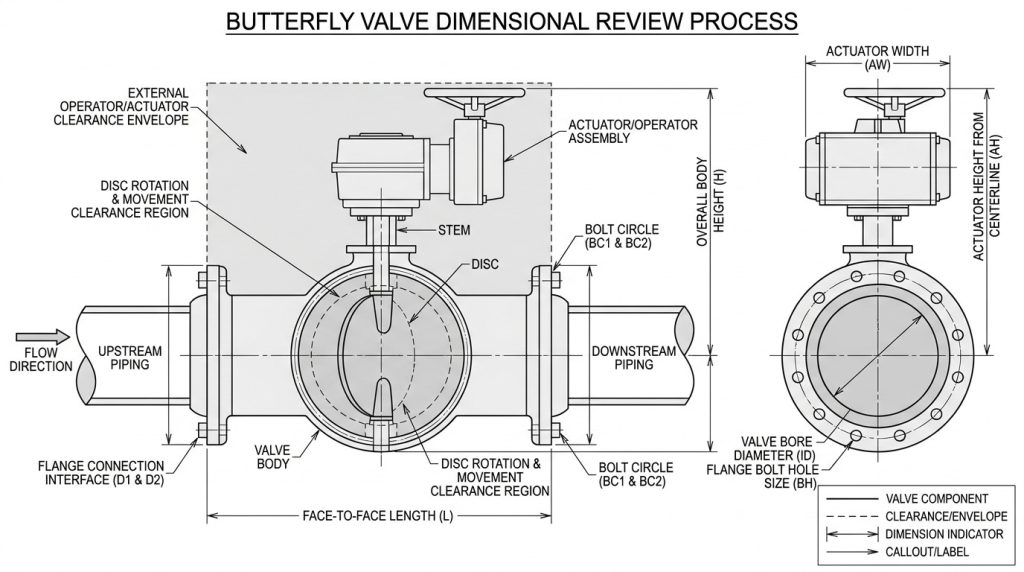
A butterfly valve size chart shows nominal size, face-to-face length, body height, and related interface dimensions. You should treat each value as a planning reference until an approved manufacturer drawing confirms it.
Which Measurements Matter Most?
What does that mean for you? A usable chart must cover more than pipe diameter because surrounding equipment can interfere with a correctly sized bore.
- NPS and DN nominal designations
- Face-to-face length
- Height above and below centerline
- Flange drilling compatibility
- Disc opening clearance
- Operator or actuator envelope
What Are Typical Wafer Face-to-Face Values?
Common wafer dimensions often follow a recognized short-pattern series, though seat construction and pressure class can change them. Confirm each figure against project specifications before releasing a purchase order.
Key Takeaway: Use chart values for layout work, then obtain a certified drawing before fabrication or installation.
| NPS | DN | Typical face-to-face |
|---|---|---|
| 2 | 50 | 43 mm |
| 3 | 80 | 46 mm |
| 4 | 100 | 52 mm |
| 6 | 150 | 56 mm |
| 8 | 200 | 60 mm |
| 10 | 250 | 68 mm |
| 12 | 300 | 78 mm |
These short-pattern values show why butterfly valves suit space-limited piping.
Which Dimensions Define a 6-Inch Butterfly Valve?
A 6-inch valve usually corresponds with DN150 piping, but its final dimensions depend on body pattern and flange system. This linked butterfly valve size chart helps separate nominal size from Class 150 drilling and valve-specific bolt length.
What Should You Check on a DN150 Drawing?
This is where errors surface: a 56 mm face-to-face value does not confirm stem height, bolt clearance, or actuator space.
- Body face-to-face length
- Disc swing beyond body faces
- Stem and mounting-pad dimensions
- Bolt-hole arrangement
- Total operator height
- Approximate installed weight
How Much Space Does a 6-Inch Valve Need?
A typical short-pattern wafer body may measure about 56 mm between flange seating planes. Height, lever reach, gearbox size, and actuator envelope remain product-specific values that require a dimensional drawing.
Key Takeaway: Treat “6-inch” as a connection designation rather than a complete physical description.
| DN150 item | Typical reference | Verification source |
|---|---|---|
| Nominal size | NPS 6 / DN150 | Piping specification |
| Wafer face-to-face | About 56 mm | Valve drawing |
| Mounting interface | Product-dependent | Data sheet |
| Operator clearance | Product-dependent | Assembly drawing |
A DN150 review remains incomplete until every external clearance has been checked.
How Do You Measure an Existing Butterfly Valve?
You measure an existing valve across its seating faces, bore, flange pattern, centerline heights, and operator envelope. The butterfly valve size chart then helps you compare recorded measurements with possible replacement configurations.
Which Measurements Should You Record On-Site?
A practical warning: never measure a pressurized or operating assembly without an approved isolation procedure.
- Measure face-to-face distance across seating planes.
- Record pipe bore and nominal flange size.
- Count bolt holes and measure bolt-circle diameter.
- Note body, seat, disc, and stem materials.
- Measure space above, below, and around the operator.
How Can You Avoid Measurement Errors?
Use calibrated tools and photograph each measurement beside its reference points. Record flange markings, pressure class, seat projection, flow direction, and any eccentric shaft offset.
Key Takeaway: A complete field record lets suppliers compare geometry without relying on a worn or unreadable nameplate.
| Field check | Tool | Common error |
|---|---|---|
| Face-to-face | Caliper or tape | Measuring raised features |
| Bore | Internal gauge | Confusing bore with DN |
| Bolt circle | Tape or template | Measuring adjacent holes |
| Total height | Tape | Excluding actuator |
Consistent reference points make replacement comparisons far more reliable.
Why Are Butterfly Valves Shorter Than Ball Valves?
Butterfly valves are shorter because their rotating disc sits inside a narrow body rather than within a long pressure-containing cavity. A butterfly valve size chart commonly shows much less axial length than an equivalent full-bore ball valve drawing.
Where Does the Space Saving Help?
Here’s where compact geometry pays off: reduced length and weight can simplify support design in crowded mechanical rooms.
- Skids with limited piping length
- Large-diameter water networks
- HVAC plant rooms
- Marine utility lines
- Retrofit projects with fixed flange spacing
When Might a Ball Valve Still Suit the Duty?
Ball valves can provide unobstructed full-port flow and strong isolation for demanding process duties. Butterfly valves generally offer lower weight and cost at larger diameters, though disc presence affects flow characteristics.
Key Takeaway: Compare operating duty beside physical size instead of choosing solely from face-to-face length.
| Factor | Butterfly valve | Ball valve |
|---|---|---|
| Axial length | Short | Longer |
| Weight at large sizes | Lower | Higher |
| Flow path | Disc remains in bore | Full-port option available |
| Large-size cost | Usually lower | Usually higher |
Geometry favors butterfly valves where footprint and structural load drive selection.
Which Standards Control Butterfly Valve Dimensions?
Valve, flange, and face-to-face standards jointly control dimensional compatibility. A butterfly valve size chart must state its governing system because ASME Class 150 and EN PN16 drilling cannot be treated as interchangeable.
Which Documents Commonly Apply?
The detail that matters: one project may reference several documents because no single document defines every interface.
- API 609 for butterfly valve design categories
- ASME B16.5 for many inch-series flanges
- EN 593 for industrial butterfly valves
- EN 1092-1 for European flange connections
- ISO 5752 for face-to-face dimensions
- ISO 5211 for part-turn actuator mounting
Can Similar Nominal Sizes Use Different Drilling?
Yes. NPS 8 and DN200 describe closely related nominal sizes, yet bolt count, hole diameter, and bolt circle can differ between flange systems.
Key Takeaway: Put valve standard, flange standard, pressure designation, and face-to-face series on every inquiry.
| Interface | Typical reference | Controls |
|---|---|---|
| Valve design | API 609 or EN 593 | Construction and testing |
| Flange drilling | ASME B16.5 or EN 1092-1 | Bolt pattern |
| Face-to-face | ISO 5752 or project series | Installed length |
| Actuator pad | ISO 5211 | Mounting geometry |
A clear standards package prevents near-match components from reaching site.
How Do DN and NPS Size Designations Compare?
DN and NPS are nominal piping labels rather than direct measurements of bore diameter. The butterfly valve size chart should display both systems while keeping their governing flange specifications separate.
Can You Convert DN Directly Into Inches?
Here’s the catch: common pairs support identification, but multiplying DN by a fixed factor does not reproduce every real dimension.
- NPS 2 commonly corresponds with DN50.
- NPS 4 commonly corresponds with DN100.
- NPS 6 commonly corresponds with DN150.
- NPS 8 commonly corresponds with DN200.
- NPS 12 commonly corresponds with DN300.
What Must Accompany the Nominal Size?
State pressure class, flange standard, body style, face-to-face series, and pipe schedule where bore clearance matters. Add units beside every numerical value because mixed-unit drawings invite costly interpretation errors.
Key Takeaway: Use DN or NPS for identification, then use controlled drawings for manufacturing dimensions.
| NPS | Common DN | Direct physical conversion? |
|---|---|---|
| 2 | 50 | No |
| 4 | 100 | No |
| 6 | 150 | No |
| 8 | 200 | No |
| 12 | 300 | No |
Nominal equivalents support communication but never replace interface data.
How Much Disc and Actuator Clearance Is Required?
Required clearance equals the full moving envelope of the disc, stem, coupling, and operator. This butterfly valve size chart should be paired with torque and assembly data whenever you specify automated operation.
Can the Disc Extend Beyond the Valve Body?
Yes. Many discs project beyond narrow body faces while opening, which can contact a small-bore pipe, liner, gasket, or nearby fitting.
- Check upstream and downstream disc sweep.
- Keep weld necks and reducers outside moving clearance.
- Verify lining thickness and pipe inside diameter.
- Confirm gasket placement against seat design.
What Changes After an Actuator Is Added?
Now for the practical part: an actuator can make total height and side clearance far larger than bare-valve dimensions suggest. Allow room for cable entries, air connections, limit switches, manual overrides, and maintenance removal.
Key Takeaway: Model the complete valve assembly rather than placing only its body in a piping layout.
| Clearance zone | Possible conflict | Required check |
|---|---|---|
| Internal bore | Disc or liner contact | Open-disc envelope |
| Above stem | Structure or pipework | Total assembly height |
| Actuator side | Wall or equipment | Rotation and removal space |
| Service zone | Tool access | Maintenance envelope |
Assembly-level checking catches collisions that body dimensions cannot reveal.
How Do Pressure and Materials Change Valve Dimensions?
Pressure rating and material selection can increase wall thickness, flange thickness, shaft diameter, and operator size. A butterfly valve size chart should never be reused across pressure classes or construction materials without drawing confirmation.
Which Design Changes Affect the Envelope?
Consider what happens under greater load: stronger bodies and shafts may alter both weight and external geometry.
- Higher differential pressure can require a larger stem.
- Metal seats may need different body construction.
- Corrosion allowance can increase wall thickness.
- Heavy discs can require gear operation.
- Lined bodies may reduce available bore clearance.
Does Temperature Affect Dimensional Selection?
Temperature changes allowable pressure, seat choice, material behavior, and actuator torque. Thermal growth in connected piping can also transfer loads into a valve whose nominal dimensions appear correct.
Key Takeaway: Dimensional fit must be reviewed beside pressure, temperature, media, and operating frequency.
| Service variable | Possible dimensional effect | Design response |
|---|---|---|
| Higher pressure | Thicker body or stem | Check rated drawing |
| High temperature | Seat and material changes | Review limits |
| Corrosive media | Lining or alloy body | Confirm clear bore |
| Abrasive flow | Heavier disc or seat | Check torque and weight |
Service data explains why two equal-size valves may not share one envelope.
What Should You Verify Before Ordering a Butterfly Valve?
You should verify interfaces, duty conditions, materials, actuation, documentation, and installed clearance before ordering. A linked butterfly valve size chart can support body-style review, but your approved project data must control final selection.
What Belongs in a Purchase Specification?
The safest approach is simple: provide suppliers with one coordinated data package rather than scattered verbal requirements.
- DN or NPS and quantity
- Pressure rating and flange standard
- Wafer, lug, or flanged body
- Face-to-face series
- Media, temperature, and pressure differential
- Body, disc, shaft, and seat materials
- Manual or powered operating method
Which Documents Should You Approve?
Request a dimensional drawing, data sheet, material records, pressure-test documentation, and actuator sizing record where applicable. Check revision status before pipe fabrication begins.
Key Takeaway: A controlled submittal process turns a generic chart into a verified installation decision.
| Approval item | Confirms | Review owner |
|---|---|---|
| Dimensional drawing | Fit and clearances | Piping engineer |
| Data sheet | Duty and materials | Process engineer |
| Actuator record | Torque capacity | Controls engineer |
| Test documentation | Inspection scope | Quality team |
Early cross-discipline review reduces site changes and delayed commissioning.
Ready to Specify a Valve That Fits Without Rework?
You now know how body style, nominal size, face-to-face length, flange drilling, disc sweep, standards, pressure, and actuation shape a reliable dimensional decision. Use chart values for screening, then confirm every interface through an approved drawing tied directly to your project conditions.
For application review, dimensional support, or a project-specific valve proposal, contact us today. We help you turn operating requirements into dependable valve specifications because sound fluid-control engineering begins with fit, traceability, and service-aware design.
FAQ
Can I Select a Butterfly Valve Using Pipe Size Alone?
No. Pipe size identifies a nominal connection, but you must also confirm flange standard, pressure rating, body type, face-to-face series, disc clearance, and operator space.
What’s the Best Body Style for Limited Installation Space?
A wafer body usually provides the smallest axial footprint. A lug body may suit you better where downstream removal or rated dead-end service forms part of the maintenance plan.
How Do I Know If a Valve Matches My Existing Flanges?
Check flange markings, bolt count, bolt-hole diameter, bolt circle, nominal size, and pressure designation. Compare those field details with an approved valve drawing before purchase.
Can I Use Class 150 and PN16 Dimensions Interchangeably?
No. Their nominal sizes may appear similar, but drilling patterns and rated conditions can differ. Specify one flange system clearly and verify every mating interface.
What’s the Best Way to Confirm Actuator Clearance?
Use a complete assembly drawing showing valve, bracket, coupling, actuator, accessories, and removal space. Compare that envelope against nearby piping, walls, cable routes, and structural steel.