
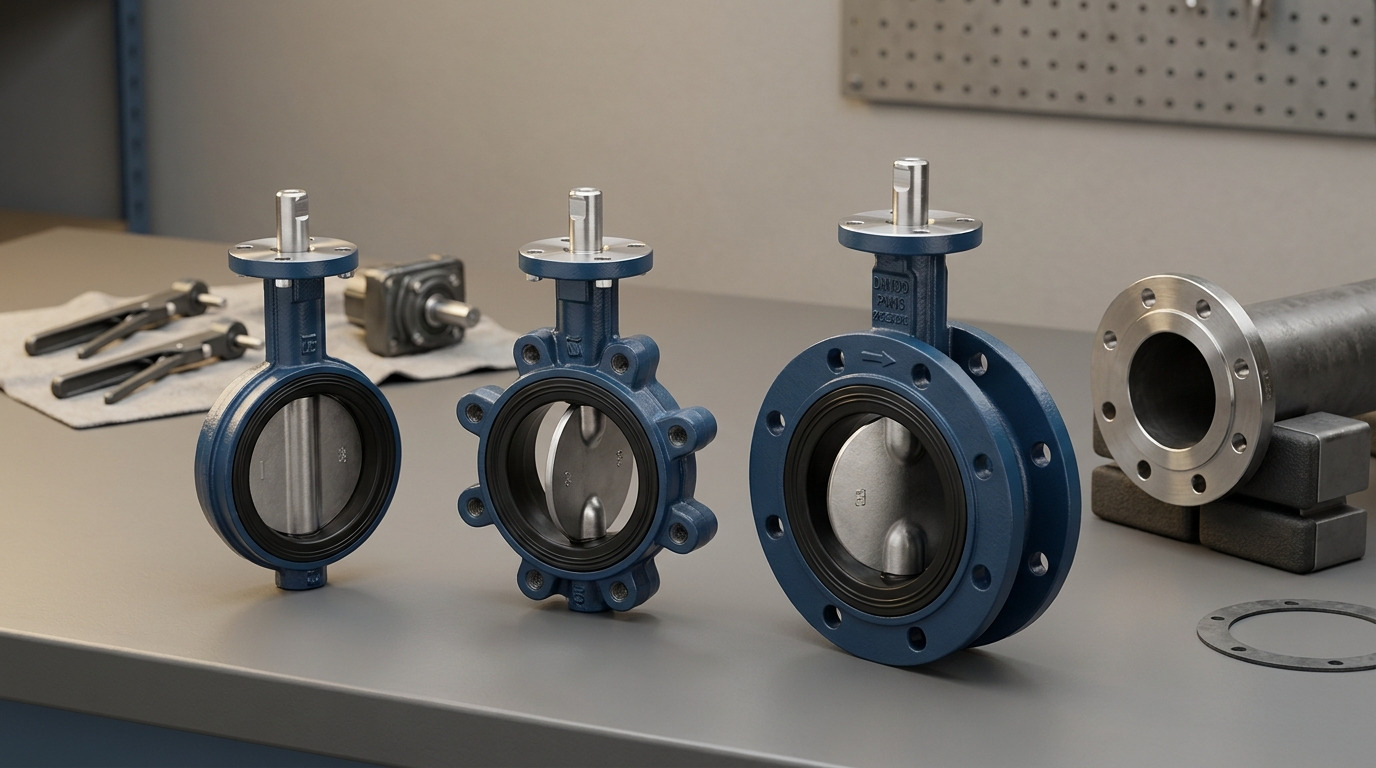
The butterfly valve characteristics that matter most in selection are flow behavior, shutoff performance, pressure drop, seat design, material compatibility, body style, actuator torque, and compliance with the right valve standards. Butterfly valve characteristics should always be judged against your actual media, pressure, temperature, pipe size, control purpose, and installation limits, because the same valve can perform very differently in water, steam, chemical, HVAC, or slurry service.
For example, a DN300 cooling-water line may look simple until the flow becomes unstable when the valve moves only a few degrees. In that case, the issue is not just “valve size”; it may be disc geometry, Cv curve, pressure drop, actuator resolution, or the valve operating too close to its closed position. If you are comparing an industrial butterfly valve range, the safest starting point is to define what the valve must do: isolate, throttle, automate, reduce space, resist corrosion, or handle a demanding shutoff condition.
Key Butterfly Valve Characteristics to Compare
The best way to compare butterfly valves is to separate mechanical characteristics from flow and sealing characteristics. A butterfly valve is a quarter-turn valve, so the disc normally rotates about 90 degrees from fully closed to fully open, but the engineering decision is about what happens between those two positions.
Use this table to connect each characteristic with the decision it affects.
| Characteristic | What You Should Check | Why It Matters | Practical Selection Clue |
|---|---|---|---|
| Disc travel | 0 to 90 degree quarter-turn movement | Determines operating speed and control sensitivity | Good for fast isolation and coarse control |
| Flow characteristic | Cv curve at different opening angles | Shows how flow changes as the disc moves | Do not assume equal flow change per degree |
| Pressure drop | Cv, K factor, and line velocity | Affects pump energy, noise, and vibration | Confirm at normal, minimum, and maximum flow |
| Seat design | Soft seat, PTFE seat, metal seat, or laminated seal | Defines shutoff, temperature limit, and wear behavior | Match seat to media before choosing body material |
| Body style | Wafer, lug, semi-lug, or flanged | Affects installation, maintenance, and dead-end use | Use rated lug designs for dead-end service |
| Material set | Body, disc, stem, seat, liner, and packing | Controls corrosion, erosion, and temperature resistance | Check wetted materials, not only valve body |
| Actuator torque | Seating, unseating, running, and dynamic torque | Prevents actuator undersizing | Size actuator for differential pressure and fail position |
| Standard basis | API 609, MSS SP-67, EN 593, AWWA C504, ISO 5211 | Aligns dimensions, testing, and project acceptance | Put required standards in the purchase specification |
The table is only a first-pass filter. Final values such as Cv, torque, pressure rating, face-to-face length, and seat temperature limit must be confirmed against the valve drawing or manufacturer data sheet.
How Does the Disc Shape Control Flow?
The disc shape controls flow because it remains inside the pipeline even when the valve is open. This is the main difference between a butterfly valve and a full-bore ball valve or gate valve: the disc reduces weight and face-to-face length, but it also creates a flow obstruction.
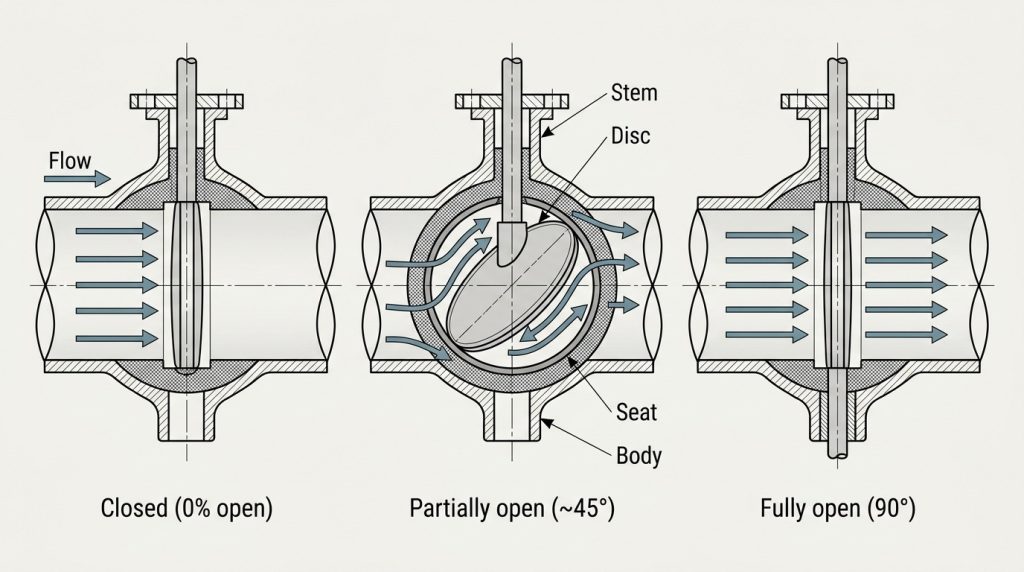
When the disc is near the closed position, small angle changes can create large changes in flow area and torque. When the disc is near fully open, additional rotation may add very little useful flow capacity. That is why a butterfly valve can work well for isolation or coarse throttling, but it is not automatically a precision control valve.
Why Is the Flow Not Linear?
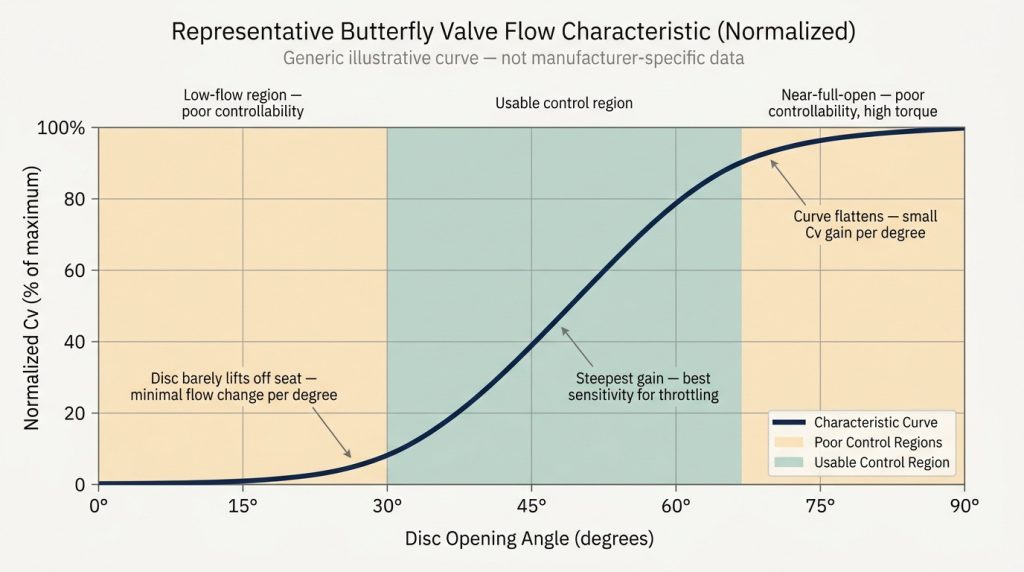
Butterfly valve flow is not perfectly linear because the disc does not uncover the pipe area at a constant rate. The flow path changes with disc angle, edge shape, shaft position, seat intrusion, and downstream piping conditions.
For many valves, the most usable control region is in the middle of travel, not at the first few degrees after opening and not at the last few degrees before fully open. If your process needs repeatable modulation, review the butterfly valve flow vs percent open relationship instead of selecting only by nominal pipe size.
When Is a Butterfly Valve Good for Throttling?
A butterfly valve is suitable for throttling when the process can tolerate moderate control accuracy, some pressure drop, and a disc in the flow path. Cooling water, HVAC water, general utility lines, and some low-viscosity process fluids often fit this profile.
It is less suitable when you need very fine control at low flow, severe cavitation resistance, or stable control under large pressure changes. In those cases, a characterized control valve or globe-style control valve may be a better fit.
Flow Characteristic, Cv, and Pressure Drop
Flow characteristic and Cv are the numbers that turn a valve choice into a hydraulic decision. Cv is the U.S. flow coefficient: the number of U.S. gallons per minute of water at 60°F that will pass through a valve with a 1 psi pressure drop at a stated opening position.
For liquids, a common sizing relationship is:
Delta P = (Q / Cv)^2 x SG
In this formula, Delta P is pressure drop in psi, Q is flow in gpm, and SG is liquid specific gravity. This calculation is only valid when the valve Cv corresponds to the actual valve size and opening angle, so the manufacturer’s Cv curve matters more than a single full-open Cv number.
What Does the Cv Curve Tell You?
The Cv curve tells you how much flow capacity the valve has at each opening position. A full-open Cv may look attractive, but it does not tell you whether the valve can control smoothly at 25%, 40%, or 60% open.
If a valve is oversized, normal operation may occur near the closed position, where flow response is steep and torque can be unstable. If it is undersized, the valve may create excessive pressure drop, noise, or pump load. A butterfly valve Cv curve is therefore a useful tool for checking both flow capacity and controllability.
How Much Pressure Drop Is Acceptable?
Acceptable pressure drop depends on whether the valve is mainly for isolation or control. For isolation service, you usually want low pressure loss in the fully open position; for throttling service, some pressure drop is necessary for control authority.
A practical review should compare at least three operating points: minimum flow, normal flow, and maximum flow. Final acceptance should also check fluid velocity, noise, cavitation risk, and whether the valve will operate for long periods at a small opening angle.
Shutoff, Seat Type, and Leakage Expectations
Shutoff performance depends more on seat design and test standard than on the word “butterfly” itself. A resilient-seated concentric valve can provide tight shutoff in many water and utility services, while a metal-seated high-performance valve may be selected for high temperature, abrasive media, or higher pressure classes.
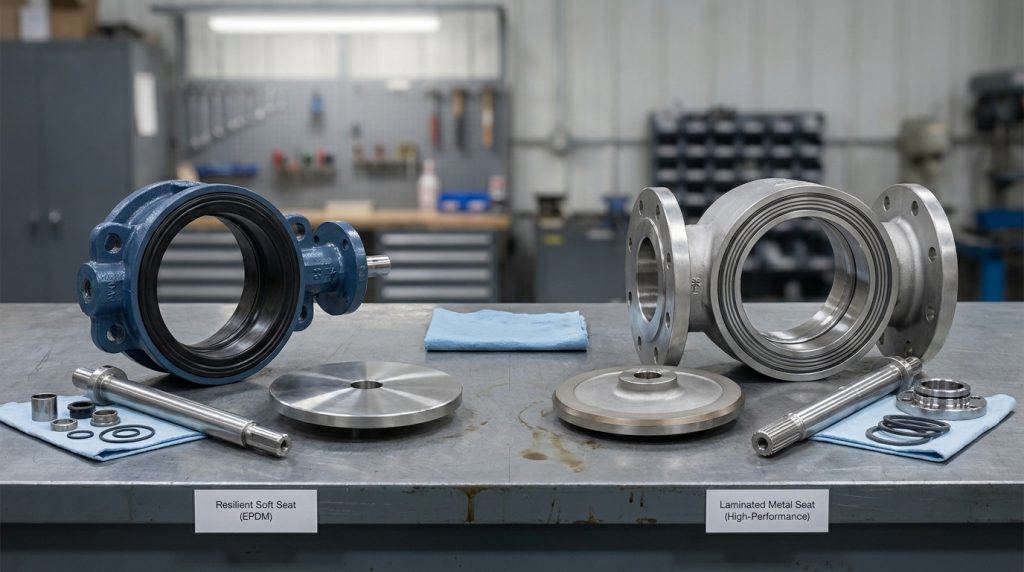
Soft seats often seal well at moderate temperature and pressure, but they can swell, harden, or wear if the media is wrong. Metal seats tolerate heat and abrasion better, but their leakage expectation must be specified by test standard and leakage class rather than assumed.
Soft Seat or Metal Seat?
Choose a soft seat when shutoff tightness, low torque, and clean compatible media are the main priorities. EPDM is commonly used for water and HVAC service, NBR for some oil and air services, PTFE for chemical resistance, and FKM for many hydrocarbon or higher-temperature applications.
Choose a metal seat when temperature, abrasion, fire-safe requirements, or severe service conditions exceed the safe range of elastomers or PTFE. Typical soft-seat screening ranges may run around -20°C to 120°C for EPDM and around -20°C to 180°C or 200°C for many PTFE-lined designs, but these are not universal limits; the final limit must come from the valve data sheet, pressure rating, and media compatibility review.
What Does Zero Leakage Really Mean?
Zero leakage should mean a tested shutoff requirement under defined conditions, not a marketing phrase. In purchase documents, you should state the applicable test standard, test medium, pressure, direction, and acceptance criterion.
API 598 is commonly used for valve inspection and pressure testing. For many steel and alloy valves, hydrostatic shell testing is commonly based on 1.5 times the pressure rating at 38°C, while high-pressure closure testing is commonly based on 1.1 times the rating; exact requirements vary by valve type, material, and project specification.
Body Style and Installation Characteristics
Body style affects whether the valve is easy to install, safe to remove, and suitable for one-sided pressure. Wafer, lug, semi-lug, and flanged butterfly valves may look similar in a catalog, but they do not behave the same during maintenance or dead-end operation.
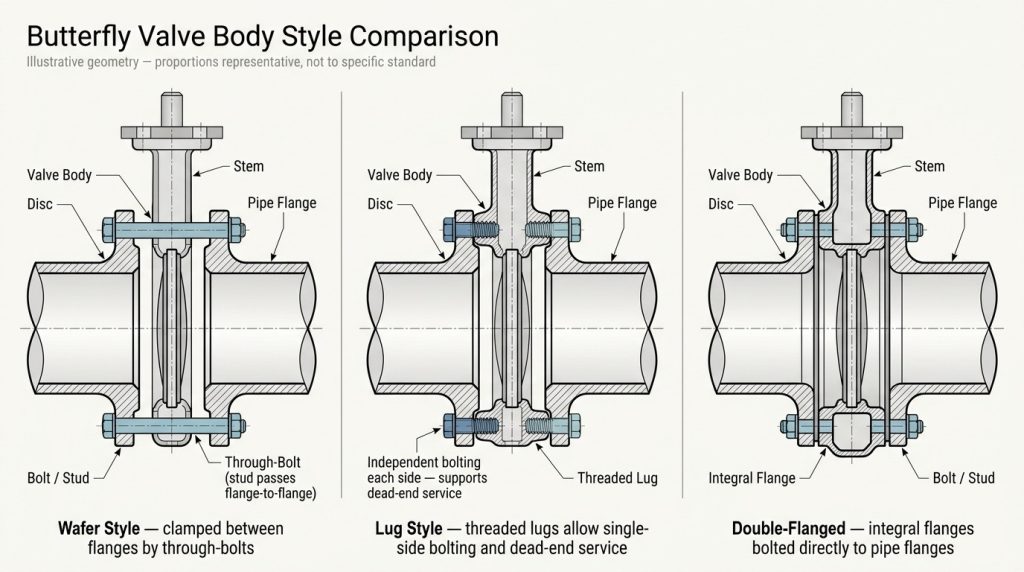
Wafer valves are compact and economical because they are clamped between two pipe flanges. Lug valves use threaded lugs or body inserts so each flange side can be bolted independently. Flanged and double-flanged valves provide more robust pipe connection and are often preferred for larger sizes or heavier-duty service.
Can a Lug Valve Handle Dead-End Service?
A lug valve can handle dead-end service only if the manufacturer rates it for that condition. The body, lugs, bolts, seat retention, and pressure direction must all support the load with one side of the piping removed.
This is a common place for specification mistakes. If your system needs downstream pipe removal while upstream pressure remains, select a rated lug-style butterfly valve and confirm the allowable dead-end pressure on the data sheet.
Why Do Face-to-Face Dimensions Matter?
Face-to-face dimensions matter because butterfly valves are often used as space-saving alternatives to gate, globe, or ball valves. A valve that fits the pipe diameter may still fail to fit the piping layout if the face-to-face length, flange drilling, gasket contact, or disc clearance is wrong.
For ASME piping, ASME B16.5 covers flanges and flanged fittings from NPS 1/2 through NPS 24 across Class 150 through Class 2500, while larger flange systems may use ASME B16.47. For European projects, EN 1092-1 flange drilling and EN 593 butterfly valve requirements may be relevant.
Materials, Temperature, and Media Compatibility
Material compatibility should be checked at the wetted-part level, not only by body material. The valve body may be ductile iron, carbon steel, stainless steel, or alloy steel, but the disc, stem, seat, liner, bushings, and packing may have different exposure and different failure limits.
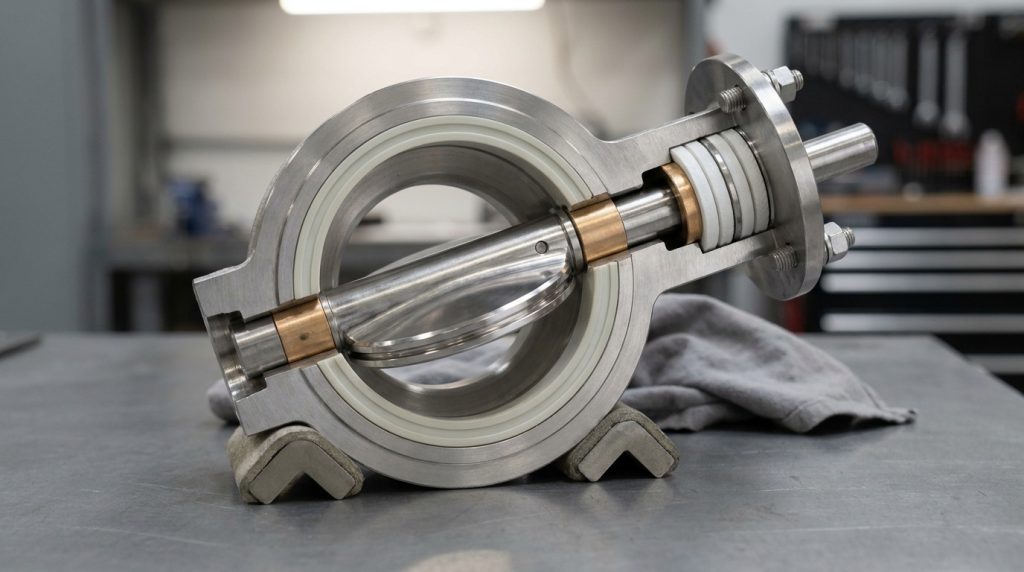
For clean water, ductile iron with EPDM or similar rubber seating may be economical. For chemical service, you may need stainless steel, PTFE lining, or higher alloy wetted parts. For steam, high temperature gas, or abrasive service, a soft-seated concentric valve may not be suitable even if its pressure rating looks acceptable.
How Should You Screen Seat Materials?
Screen seat materials by media first, then temperature, then pressure differential and cycling frequency. A material that seals well in clean water may fail quickly in oil, solvent, steam, or abrasive slurry.
A practical first-pass check looks like this:
- EPDM: often suitable for water, wastewater, HVAC water, and some dilute chemicals, but usually not for oils or hydrocarbons.
- NBR: often used for air, oil, and some fuel-related service, but less suitable for ozone and some chemicals.
- PTFE: useful for chemical resistance and low friction, but pressure and temperature capacity depend on backing design.
- FKM: useful for many hydrocarbons and higher-temperature services, but not universal for steam or all chemicals.
- Metal or laminated seal: preferred for heat, abrasion, fire-safe designs, and demanding shutoff classes.
For temperature-sensitive applications, review butterfly valve material limits together with pressure and media, not as an isolated number.
What About Abrasive or Corrosive Media?
Abrasive and corrosive media require a different mindset because the seat and disc edge are exposed to flow impact. Slurry, crystallizing fluids, chloride-containing water, acids, and gas with particles can all damage sealing surfaces.
For these services, check flow velocity, solids content, corrosion allowance, coating or lining, disc edge hardness, and whether the valve will throttle. A valve that works well fully open may wear quickly if it spends long periods partially open in abrasive flow.
Actuation and Operating Torque
Actuation succeeds only when the actuator is sized for the real torque conditions of the valve. Butterfly valve torque is affected by seat friction, pressure differential, flow velocity, disc angle, media deposits, temperature, and how often the valve cycles.
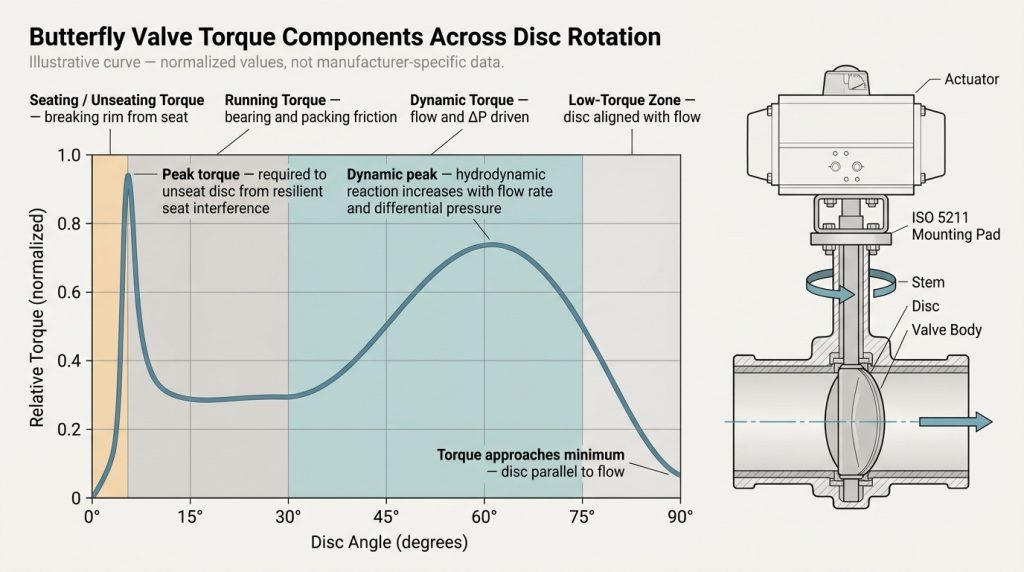
Manual levers are practical for smaller low-torque valves. Gear operators help on larger diameters or higher differential pressure. Pneumatic, electric, or hydraulic actuators are used when the system needs remote control, fail-open or fail-close action, position feedback, or automated modulation.
Which Torque Values Should You Request?
Request seating torque, unseating torque, running torque, and dynamic torque when automation is involved. Do not size an actuator only from a generic valve size chart.
You should also confirm safety factor, air supply pressure for pneumatic actuators, motor duty for electric actuators, and the valve’s required fail position. If the media can crystallize, scale, or leave deposits, discuss additional torque margin rather than assuming clean-water values.
Why Does ISO 5211 Matter?
ISO 5211 matters because it standardizes the mounting interface for part-turn valve actuators. A matching ISO mounting pad helps connect valves, brackets, couplings, and actuators with fewer adaptation problems.
Still, matching the flange pattern does not prove the actuator is correctly sized. Mechanical fit and torque capacity must both be confirmed.
Standards and Specification Details to Confirm
Standards help define what the valve is, how it fits, and how it should be tested. They do not replace project-specific selection, but they reduce ambiguity between engineering, procurement, and manufacturing.
For industrial butterfly valves, API 609 is commonly used for double-flanged, lug, wafer, and related butterfly valve designs. MSS SP-67 may apply to general-purpose butterfly valves, while MSS SP-68 is often associated with high-pressure offset designs. EN 593 is commonly referenced in European industrial applications.
Which Standard Fits Water Service?
For water service, AWWA C504 is important for rubber-seated butterfly valves. It covers butterfly valves in the 3 in. to 72 in. size range for raw water, potable water, wastewater, and reclaimed water within a pH range of 6 to 12 and a temperature range of 33°F to 125°F, or 0.6°C to 52°C.
AWWA C504 also references pressure classes up to 250 psig and fully open velocity limits up to 16 ft/s depending on valve class and design. If your project is a water and wastewater treatment system, those limits are more useful than a generic “industrial valve” description.
What Should Be on the Data Sheet?
A good butterfly valve data sheet should make the decision traceable. At minimum, it should define valve size, pressure class, body style, flange standard, face-to-face standard, body material, disc material, stem material, seat material, test standard, actuator type, and operating conditions.
For throttling or automated service, add Cv by opening angle, required control range, actuator torque basis, fail position, accessories, and signal type. For shutoff-critical service, state leakage requirement, test medium, pressure direction, and whether bidirectional sealing is required.
Common Selection Mistakes to Avoid
Most butterfly valve problems come from assuming one characteristic can stand in for the whole valve. Pipe size alone does not prove flow capacity, pressure class alone does not prove media compatibility, and a soft-seat shutoff claim does not prove suitability for high temperature.
Avoid these mistakes during selection:
- Selecting by line size without checking Cv and operating angle.
- Using EPDM or NBR seats without confirming media compatibility.
- Assuming wafer valves are suitable for dead-end service.
- Ignoring actuator torque under differential pressure.
- Treating “zero leakage” as valid without a test standard.
- Forgetting disc clearance inside lined pipe, thick gaskets, or nearby fittings.
- Using a control valve positioner without reviewing the valve’s usable control range.
Key Takeaway: A reliable selection starts with service conditions, then checks flow, shutoff, material, body style, actuator, and standard requirements in that order.
Conclusion
Butterfly valve characteristics are not just catalog features; they are the engineering clues that tell you whether the valve will control flow, seal reliably, fit the piping, survive the media, and operate safely over time. If you are comparing options for a project, you can share your operating conditions with pressure, temperature, media, pipe size, flange standard, actuator preference, and shutoff requirement for a practical selection discussion.
FAQ
Can I Use a Butterfly Valve for Flow Control?
Yes, but only when the required control accuracy is moderate. Butterfly valves can throttle water, HVAC, and many utility services, but they are less stable near the closed position and may not replace a dedicated control valve in severe or precise modulating service.
What’s the Best Seat Material for Water Service?
EPDM is often the practical first choice for clean water, wastewater, and HVAC water. You still need to confirm temperature, disinfectants, pressure differential, and local water chemistry because seat compatibility is media-specific.
How Do I Know if My Butterfly Valve Is Oversized?
You can suspect oversizing if normal control happens at a very small opening angle. Check the Cv curve at your minimum, normal, and maximum flow points; if the valve operates too close to closed, flow may be unstable and actuator response may feel too sensitive.
Can I Use a Soft-Seated Butterfly Valve for Steam?
Usually no for higher-temperature steam service. Many soft seats lose strength, harden, or deform under steam conditions, so steam applications often require a metal-seated eccentric butterfly valve or another valve type selected for the exact pressure and temperature.
How Do I Specify Leakage Clearly?
State the test standard, leakage class or acceptance level, pressure, test medium, direction, and whether shutoff must be bidirectional. This is much clearer than writing only “tight shutoff” or “zero leakage,” because those phrases mean little without test conditions.