
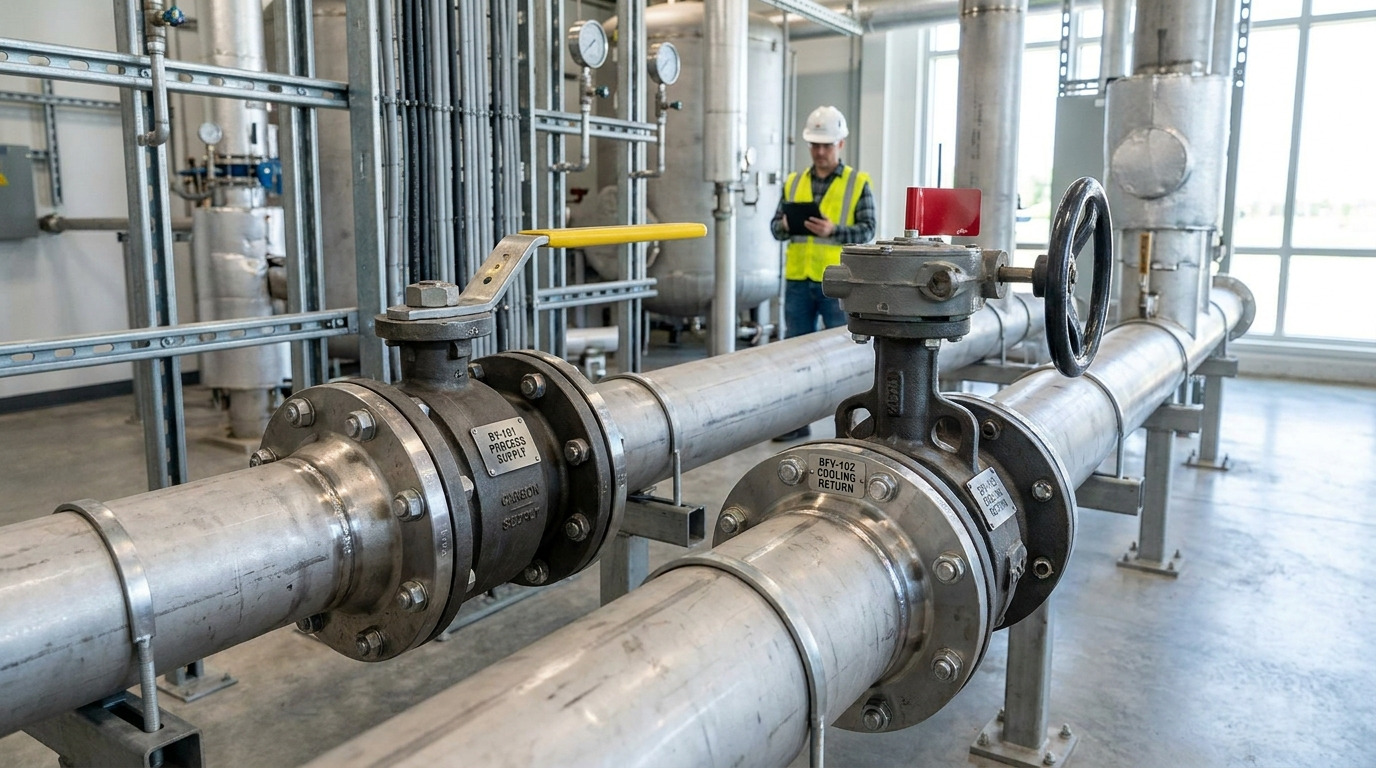
A ball valve usually wins on tight shutoff and high-pressure isolation, while a butterfly valve often wins on size, weight, and cost in large lines. Yet choosing the wrong design can leave you with leaking seats, excessive pump load, oversized actuators, or a valve that will not fit your piping envelope. A clear ball vs butterfly valve review solves that problem by matching construction, flow behavior, media, pressure, and maintenance needs with your actual duty. This guide gives you a practical B2B selection method grounded in how both quarter-turn valves behave in service.
What Does a Ball vs Butterfly Valve Comparison Reveal?
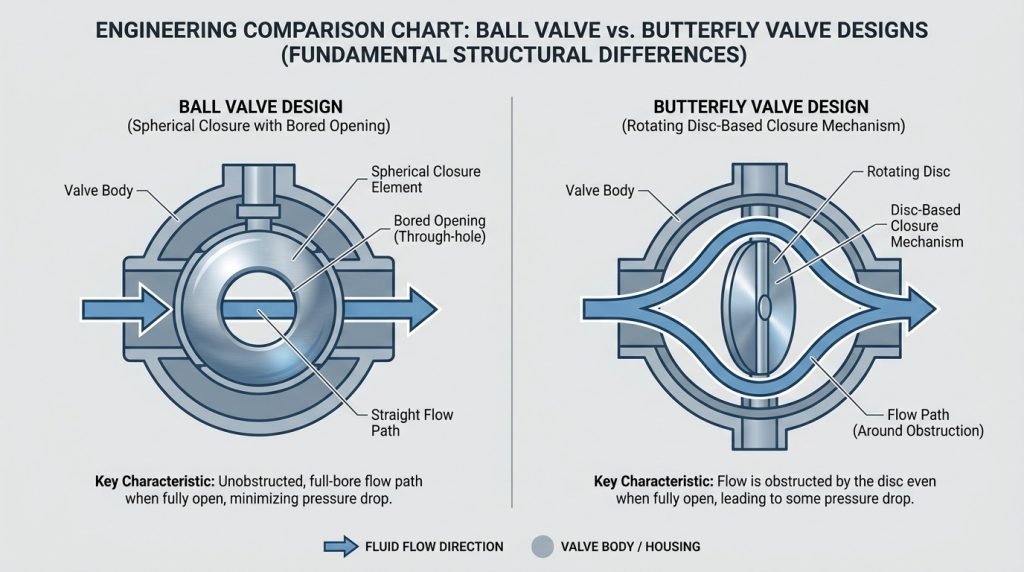
A ball vs butterfly valve comparison reveals that their shared 90-degree motion hides major differences in sealing and flow geometry. A ball uses a bored sphere that can create a straight flow path, whereas a butterfly valve keeps a rotating disc inside that path.
How Do Their Core Designs Differ?
Here’s the central point: internal geometry drives pressure loss, shutoff quality, weight, and torque. Compare these features before reviewing price:
- Ball valves use floating or trunnion-mounted spheres.
- Butterfly valves use concentric or offset discs.
- Full-port balls create a nearly unobstructed bore.
- Butterfly discs remain exposed to moving media.
Which Difference Matters Most in Service?
Sealing demand usually decides close calls, though line size can shift that decision toward a butterfly design. A clean water main may favor compactness, while a hazardous gas line may demand bubble-tight isolation.
| Design factor | Ball valve | Butterfly valve |
|---|---|---|
| Closure member | Bored sphere | Rotating disc |
| Full-open path | Clear in full-port form | Disc remains present |
| Typical strength | Tight isolation | Compact large-bore control |
This comparison shows why duty conditions should lead procurement.
Key Takeaway: You can narrow your choice quickly by defining shutoff class, line size, and allowable pressure loss before requesting quotations.
How Does a Ball Valve Control Flow?
A ball vs butterfly valve decision favors a ball valve when you need rapid isolation through a straight, low-loss flow path. Its drilled sphere aligns with piping when open and turns across that path when closed.
What Happens During a Quarter Turn?
Watch what happens next: handle or actuator motion transfers through a stem and rotates the ball exactly 90 degrees. You gain:
- Fast opening during process startup
- Fast closure during an upset
- Clear visual position with a manual lever
- Simple electric or pneumatic automation
Which Ball Construction Fits Your Duty?
Floating balls suit smaller sizes and moderate pressure, while trunnion supports reduce seat loading in larger high-pressure lines. Full-port bodies favor pigging and low loss; reduced-port bodies trim weight and purchase cost.
| Ball design | Best fit | Main caution |
|---|---|---|
| Floating | Smaller, moderate-pressure lines | Rising torque at larger sizes |
| Trunnion | Large or high-pressure lines | Higher purchase complexity |
| Full port | Low-loss or piggable service | Larger body |
This breakdown connects construction directly with operating risk.
Key Takeaway: You can prevent excess torque and seat wear by matching ball support and bore size with pressure, diameter, and flow demand.
How Does a Butterfly Valve Regulate Flow?
A ball vs butterfly valve decision favors a butterfly valve for compact, economical control of high flow through larger pipework. Its stem rotates a thin disc from a face-on closed position toward an edge-on open position.
Why Does Disc Angle Matter?
This is where sizing gets practical: equal changes in disc angle do not produce equal changes in flow. Your review should cover:
- Cv or Kv at each operating angle
- Minimum, normal, and maximum flow
- Available differential pressure
- Cavitation, noise, and velocity limits
Where Should a Control Valve Operate?
Stable throttling usually occurs through a valve’s usable middle travel, subject to manufacturer curves. Operation near closed can create a damaging jet, while travel near fully open may add little control authority.
| Travel zone | Typical behavior | Engineering response |
|---|---|---|
| Low opening | Sharp response, high local velocity | Check oversizing |
| Mid travel | More usable modulation | Target normal duty here |
| High opening | Limited remaining authority | Check maximum-flow margin |
The pattern makes installed flow curves more useful than nominal diameter alone.
Key Takeaway: You can improve loop stability by selecting from actual Cv data rather than assuming pipe-size matching will provide good control.
Which Ball Valve Types Match Different Systems?
A ball vs butterfly valve review shows that ball variants cover more circuit and pressure functions than one standard two-way body suggests. Port count, ball support, body assembly, seat design, and end connection all change field performance.
Can Port and Body Design Simplify Piping?
Consider this shortcut: one correctly selected valve can replace extra fittings or reduce shutdown work. Common options include:
- Two-way valves for basic isolation
- Three-way L-port valves for diversion
- Three-way T-port valves for mixing
- Three-piece bodies for in-line maintenance
When Do Special Features Pay Back?
Vented balls relieve trapped cavity pressure in sensitive thermal service, while fire-safe seats support hydrocarbon isolation after soft-seat damage. Anti-static devices and blowout-resistant stems also address ignition and personnel hazards.
| Feature | Practical use | Buyer check |
|---|---|---|
| Three-way port | Mix or divert flow | Confirm flow diagram |
| Three-piece body | Easier service access | Check bolt and seal materials |
| Vented ball | Cavity pressure relief | Verify vent direction |
These options show how small design choices can remove larger system risks.
Key Takeaway: You can reduce piping complexity and maintenance hours by specifying port geometry, body assembly, and safety features early.
Which Butterfly Valve Types Suit Different Duties?
A ball vs butterfly valve comparison shows that butterfly performance changes sharply across concentric, double-offset, and triple-offset designs. Offset designs reduce rubbing during travel, which supports higher pressure, temperature, cycling, or shutoff demands.
How Do Disc Offsets Change Performance?
Here’s why offsets matter: they move sealing surfaces apart earlier during opening and reduce sliding contact. You can compare:
- Concentric designs for water and HVAC duties
- Double-offset designs for tougher process isolation
- Triple-offset designs for heat and metal-seated shutoff
- Wafer, lug, or flanged bodies for piping access
Which Body Style Supports Maintenance?
Wafer bodies save space between flanges, while lug bodies can support selected dead-end service when properly rated. Double-flanged bodies bring rigidity for large diameters and demanding installations.
| Butterfly design | Typical advantage | Main check |
|---|---|---|
| Concentric | Low cost, resilient seal | Media and temperature |
| Double offset | Lower seat wear | Shutoff rating |
| Triple offset | High-temperature capability | Torque and sealing class |
This progression helps you pay for performance only where duty requires it.
Key Takeaway: You can extend seat life by matching offset geometry and body style with cycling, temperature, and maintenance access.
Where Do Ball Valves Perform Best?
A ball vs butterfly valve selection favors ball valves in high-pressure isolation, hazardous media, small-to-medium piping, and duties demanding very low leakage. Correct seats and body alloys remain necessary because tight geometry cannot overcome poor material compatibility.
Which Industries Depend on Ball Valves?
Look at real duty patterns: ball valves commonly serve systems where reliable isolation protects people, product, or uptime. Examples include:
- Natural gas transmission and fuel skids
- Chemical transfer and batch processing
- Steam or thermal oil with suitable metal seats
- Sanitary lines using cleanable end connections
What Should You Verify Before Specification?
Record media composition, solids, design pressure, temperature extremes, flow direction, cycle rate, and required leakage class. Then verify fire-safe, anti-static, emissions, and documentation requirements against project codes.
| Service | Favored configuration | Main reason |
|---|---|---|
| High-pressure gas | Trunnion, fire-safe | Low torque and tight shutoff |
| Corrosive chemical | Compatible alloy, soft seat | Media resistance |
| Piggable line | Full-port welded body | Clear bore |
This matrix turns broad application labels into configuration choices.
Key Takeaway: You can protect uptime by defining operating limits and compliance documents before selecting a ball valve model.
Where Do Butterfly Valves Deliver More Value?
A ball vs butterfly valve selection favors butterfly valves in large water, wastewater, cooling, HVAC, and utility lines where compact size matters. Suitable disc, liner, stem, and seat materials must still match chemistry and temperature.
Why Do Large-Diameter Projects Favor Them?
Here’s the commercial advantage: material use grows more gently than with a thick spherical closure and larger ball-valve body. Benefits often include:
- Short face-to-face dimensions
- Lower shipping and handling weight
- Smaller installation envelope
- Cost-effective automation at large bore
Which Services Need Extra Caution?
Abrasive slurry can attack disc edges, while high differential pressure can raise cavitation or torque concerns. Hydrocarbons may rule out EPDM, and hot service may demand offset metal-seated construction.
| Service | Likely butterfly choice | Design check |
|---|---|---|
| Potable water | Resilient concentric | Approval and liner grade |
| Cooling circuit | Wafer or lug | Cv and actuator torque |
| Hot process fluid | Offset metal seat | Pressure-temperature rating |
The application still succeeds only when every wetted component fits its media.
Key Takeaway: You can gain space and cost savings in large lines without sacrificing reliability when materials and torque are properly checked.
What Benefits Make Each Valve Competitive?
A ball vs butterfly valve comparison gives ball valves an edge in shutoff and full-bore flow, while butterfly valves lead in compactness and large-size economy. Your best value depends on lifecycle performance rather than purchase price alone.
Where Does a Ball Valve Create Value?
The payoff is straightforward: a full-port ball can protect pump efficiency and meet demanding isolation targets. Key strengths include:
- Bubble-tight soft-seat shutoff
- Strong high-pressure capability
- Minimal full-open restriction
- Reliable manual or automated action
Where Does a Butterfly Valve Create Value?
Butterfly designs reduce weight, occupied space, and installed cost as diameter rises. Their disc also supports practical throttling in many water and utility processes when sizing places normal flow within stable travel.
| Value driver | Ball valve advantage | Butterfly valve advantage |
|---|---|---|
| Shutoff | Very tight | Good with matched seat design |
| Footprint | Larger | Compact |
| Large-bore cost | Higher | Usually lower |
| Full-open loss | Low with full port | Disc creates some loss |
This balance explains why neither design wins every project.
Key Takeaway: You can make a stronger business case by comparing energy, installation, maintenance, and downtime costs across service life.
What Limitations Can Affect Reliability?
A ball vs butterfly valve review finds that ball valves can become heavy and costly at large sizes, while butterfly valves retain a flow obstruction and may face pressure or leakage limits. Reliability depends on recognizing these boundaries before purchase.
What Can Go Wrong With Ball Valves?
The hidden cost appears later: an inexpensive selection may produce rising torque or rapid seat damage. Common risks include:
- Trapped cavity pressure
- Soft-seat temperature failure
- Abrasion during throttling
- Difficult handling at large diameter
What Can Go Wrong With Butterfly Valves?
An oversized butterfly valve may hunt near closed, and a poorly matched actuator may stall under dynamic torque. Disc interference also creates pressure loss, while exposed seats can suffer erosion or chemical attack.
| Risk | Ball valve response | Butterfly valve response |
|---|---|---|
| High temperature | Use suitable metal seat | Consider offset metal seat |
| Abrasive media | Avoid severe standard-ball throttling | Protect disc and seat |
| Large diameter | Review weight and support | Review shaft and torque |
These limits point toward targeted engineering checks rather than blanket rejection.
Key Takeaway: You can prevent recurring failures by treating temperature, solids, pressure drop, and actuator torque as linked selection variables.
How Should You Choose a Ball vs Butterfly Valve?
A ball vs butterfly valve choice should start with duty, not valve price: choose a ball valve for demanding isolation or an open bore, and choose a butterfly valve for compact large-line control. Validate that starting point against media, pressure, temperature, leakage, Cv, torque, standards, and maintenance access.
What Data Should You Give a Supplier?
Make the request count: a complete datasheet prevents assumptions and weak substitutions. Provide:
- Fluid name, concentration, solids, and phase
- Minimum and maximum pressure and temperature
- Normal, minimum, and maximum flow
- Pipe size, flange standard, and orientation
- Shutoff class, actuation, and fail position
How Can You Compare Bids Fairly?
Place each proposal beside one technical compliance sheet, then flag deviations in materials, pressure class, seat rating, testing, certificates, dimensions, and lead time.
| Decision factor | Choose ball when | Choose butterfly when |
|---|---|---|
| Isolation | Leakage tolerance is near zero | Good shutoff meets duty |
| Diameter | Bore and pressure justify weight | Large size favors compactness |
| Control | Characterized ball fits range | Moderate control suits disc |
| Budget | Risk reduction supports cost | Installed economy leads |
This final screen keeps commercial pressure from weakening technical fit.
Key Takeaway: You can reach a defensible purchase decision by scoring compliant bids against duty, risk, and lifecycle cost.
Which Valve Choice Will Protect Your Next Project?
Ball valves bring tight isolation, pressure strength, and low-loss full-port flow; butterfly valves bring compact construction, lower large-bore cost, and useful control across many utility systems. This guide has resolved how design, types, applications, benefits, limits, materials, sizing, and bid review shape your decision.
Send your media, pressure, temperature, size, flow, and shutoff requirements when you contact us today. We can help you turn those parameters into a documented valve configuration that supports safe operation and predictable procurement. Our position is simple: dependable flow control begins with engineering evidence and ends with accountable manufacturing.
FAQ
Can I use a butterfly valve for throttling?
Yes, in many water, HVAC, and utility duties. Check manufacturer Cv curves and place normal operation within stable mid-travel while screening pressure drop, cavitation, and torque.
Can I use a ball valve for flow control?
Yes, with the right ball and trim. Standard full-port balls suit occasional adjustment, while characterized or segmented balls offer better modulation for demanding control.
What’s the best valve for a large water line?
A butterfly valve is often the stronger fit. Its compact body, lower weight, and economical large-diameter construction work well when seat material and shutoff rating match water quality.
How do I know if I need bubble-tight shutoff?
You need it when even minor leakage creates a safety, environmental, product-quality, or process-isolation risk. State an accepted leakage standard and test method in your purchase specification.
What’s the best information to send with an RFQ?
A complete process datasheet is best. Include media, concentration, solids, pressure, temperature, flow range, size, end connection, leakage class, actuator, codes, certificates, quantity, and delivery schedule.