
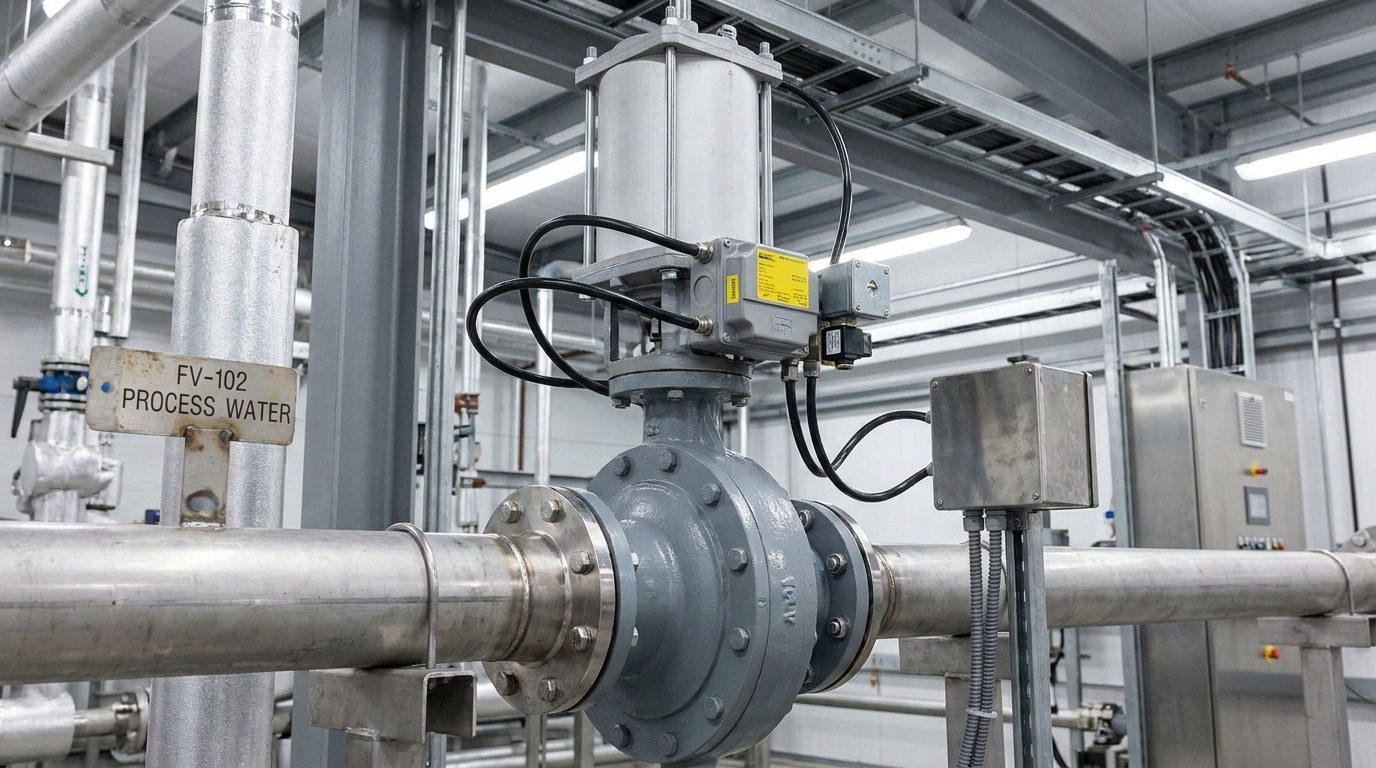
An air butterfly valve uses compressed air to rotate a disc through 90 degrees, giving you fast isolation or controlled flow when properly sized. Yet a valve that looks correct on a datasheet can stall, leak, or cycle slowly when its actuator, seat, or accessories do not match real operating conditions.
Consider a typical process line: production needs remote shutoff, but falling plant-air pressure prevents an undersized actuator from breaking the disc away from its seat. Downtime grows while maintenance teams chase electrical faults that do not exist. A correctly specified air butterfly valve solves this problem through matched torque, compatible wetted materials, suitable control hardware, and a defined failure position.
Why Is an Air Butterfly Valve Cost-Effective?
A properly selected air butterfly valve lowers installed cost through compact dimensions, low weight, and rapid quarter-turn operation. It can also reduce pipe-support loads and actuator size compared with heavier valve designs.
Where Does It Offer the Most Value?
Here’s the practical point: its savings become clearer as pipe diameter increases. You gain the most value in water, HVAC, utility air, and general process services requiring frequent automated isolation.
- Compact bodies fit crowded pipe racks
- Fast strokes support short process cycles
- Few moving parts simplify routine service
When Is Another Valve Type Better?
A globe valve may suit fine throttling under a high pressure drop, while a ball valve may suit demanding gas shutoff. Compare control duty rather than choosing solely by purchase price.
- Review required rangeability
- Check allowable pressure loss
- Define leakage acceptance
| Duty | Practical Choice |
|---|---|
| Fast isolation | Butterfly valve |
| Fine throttling | Globe valve |
| High-integrity gas shutoff | Ball valve |
This comparison shows why operating duty should guide valve choice.
Key Takeaway: You control lifecycle cost by matching valve geometry with process duty, not simply selecting the lowest quotation.
How Does an Air Butterfly Valve Work?
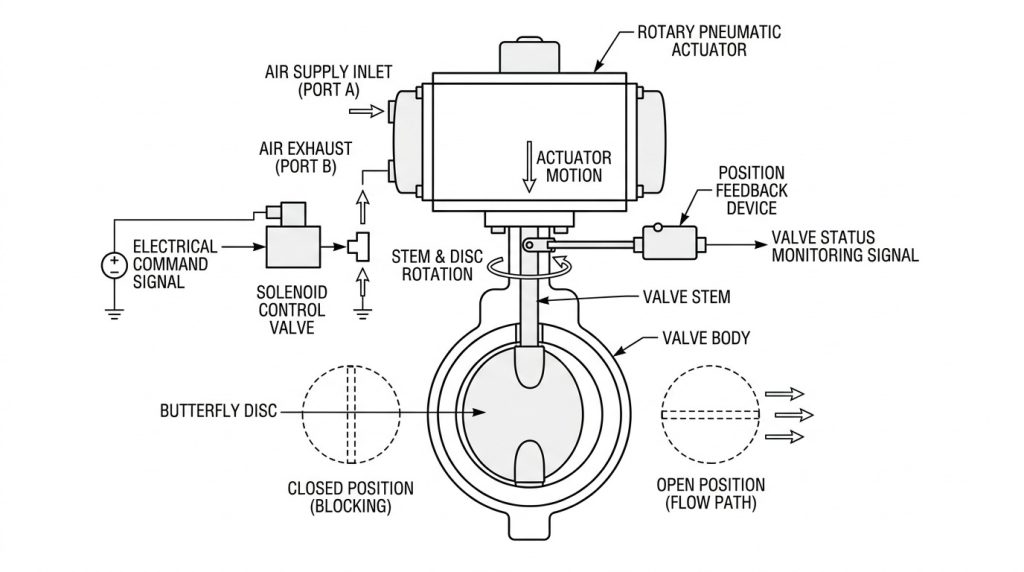
An air butterfly valve works by converting compressed-air energy into rotary stem movement. Pistons inside its actuator drive a rack-and-pinion or scotch-yoke mechanism, turning the disc between open and closed positions.
How Is Air Pressure Converted into Rotation?
Watch what happens next: air enters one actuator chamber and pushes one or more pistons. Mechanical gearing changes that linear piston travel into a controlled quarter turn.
- Air enters through a selected port
- Pistons move across actuator chambers
- Drive components rotate the valve stem
Which Operating Sequence Controls Flow?
A solenoid receives an electrical command and redirects air toward the required chamber. Limit switches can then report open or closed status back to your control system.
- Command reaches the solenoid coil
- Actuator rotates the disc
- Feedback confirms valve position
| Stage | Input | Result |
|---|---|---|
| Command | Electrical signal | Solenoid shifts |
| Actuation | Compressed air | Stem rotates |
| Feedback | Limit switch | Position confirmed |
Each stage must respond correctly for dependable remote operation.
Key Takeaway: Understanding this sequence helps you separate air-supply, mechanical, and control-signal faults during troubleshooting.
Which Pneumatic Actuator Type Fits Your Process?
The correct air butterfly valve actuator depends on your required failure position, available air supply, and operating torque. Double-acting units use air in both directions, while spring-return units use stored spring force for one stroke.
When Should You Use a Double-Acting Actuator?
The trade-off is simple: double-acting actuators offer compact torque delivery without a spring pack. They work well where the valve may remain in its last position after air loss.
- Air powers opening and closing
- Torque remains balanced across both strokes
- Air consumption occurs during each movement
When Does Spring Return Provide Safer Operation?
Spring-return actuation suits lines that must fail open or fail closed after loss of air or electrical power. Your hazard review should define that position before actuator selection.
- Fail closed can stop hazardous feed
- Fail open can protect cooling flow
- Springs require a larger actuator body
| Actuator | Air Use | Air-Loss Response |
|---|---|---|
| Double acting | Both strokes | Holds or drifts |
| Spring return | One stroke | Moves to safe position |
This distinction directly affects plant response during utility failure.
Key Takeaway: You should specify the failure position before requesting actuator torque or pricing.
How Should You Match the Seal to Process Media?
An air butterfly valve needs a seat material compatible with its fluid, temperature, pressure, and cleaning chemicals. EPDM commonly serves water, NBR handles many oil-based duties, and PTFE supports broader chemical resistance.
Which Soft Seat Matches Common Services?
Here’s where failures often begin: a seat may swell, harden, or lose elasticity even when its pressure rating looks adequate. Confirm compatibility against every process and cleaning fluid.
- EPDM commonly suits water and glycol
- NBR commonly suits oils and fuels
- PTFE suits many corrosive chemicals
When Should You Specify a Metal Seat?
Metal seats suit elevated temperatures, abrasive media, and duties where elastomers cannot retain their properties. Double-offset or triple-offset geometry reduces rubbing during movement.
- Check required shutoff class
- Review thermal cycling
- Account for solids and erosion
| Seat | Typical Strength | Common Limitation |
|---|---|---|
| EPDM | Water service | Petroleum exposure |
| NBR | Oil resistance | Elevated temperature |
| PTFE | Chemical resistance | Cold flow |
| Metal | Heat and abrasion | Higher torque |
Media compatibility narrows viable options before cost comparison begins.
Key Takeaway: Correct seat selection protects shutoff performance and prevents avoidable actuator overload.
How Do You Size Actuator Torque Correctly?
An air butterfly valve actuator must exceed maximum required valve torque at minimum available air pressure. Size from breakaway, running, and seating torque rather than nominal pipe diameter alone.
Why Does Breakaway Torque Control Sizing?
This is the catch: a seated disc often needs its highest torque before movement starts. Static friction, deposits, and seat compression can make breakaway harder than normal travel.
- Request torque across full disc travel
- Use minimum plant-air pressure
- Include differential pressure at closure
How Much Torque Margin Should You Allow?
A suitable margin covers pressure fluctuation, media buildup, seal aging, and air-line losses. The selected percentage should reflect service severity rather than a universal rule.
- Clean utility duty needs moderate reserve
- Slurry or powder service needs more reserve
- Long idle periods can raise breakaway demand
| Condition | Torque Effect |
|---|---|
| Low air pressure | Reduces actuator output |
| Seat swelling | Raises friction |
| Solids buildup | Raises breakaway load |
| Pressure increase | Raises dynamic load |
This table shows why laboratory torque can differ from field demand.
Key Takeaway: Sizing against worst credible conditions helps your valve complete every commanded stroke.
Which Materials Give an Air Butterfly Valve Longer Life?
A water-service air butterfly valve lasts longer when body, disc, stem, and seat materials match corrosion and erosion exposure. Wetted-part selection matters more than body material alone.
When Is Stainless Steel Worth Its Cost?
Look beyond purchase price: a plated disc may corrode rapidly after coating damage, while solid stainless steel retains resistance through its thickness. SS316 often suits chlorides and chemical exposure better than common plated iron.
- Check chloride concentration
- Review cleaning chemicals
- Request material certificates
Why Does Stem Construction Affect Safety?
A blowout-resistant stem uses internal retention so line pressure cannot eject it if upper hardware fails. Bearings and stem seals must also tolerate cycle frequency and media exposure.
- Specify internal stem retention
- Confirm bearing compatibility
- Review stem-to-disc connection
| Component | Common Option | Selection Driver |
|---|---|---|
| Body | Ductile iron or steel | Pressure and environment |
| Disc | SS304 or SS316 | Media compatibility |
| Stem | Stainless steel | Strength and corrosion |
| Seat | Elastomer, PTFE, or metal | Fluid and temperature |
The entire wetted material set determines expected service life.
Key Takeaway: You reduce corrosion risk by reviewing every media-contact component as one material system.
What Accessories Does Automated Control Require?
An air butterfly valve usually needs a solenoid, air filter regulator, and position feedback device for dependable automation. Modulating duty also requires a positioner matched with the plant control signal.
How Do Basic Accessories Work Together?
Here’s how the chain connects: filtered air reaches the solenoid, which routes pressure into the actuator, while limit switches report end position. A weak component anywhere in that chain can stop operation.
- Filter regulator supplies clean stable air
- Solenoid directs actuator airflow
- Limit switch box confirms travel
When Do You Need a Positioner?
A positioner serves applications requiring intermediate disc angles rather than simple open-and-close operation. It compares a command signal with actual stem position and adjusts actuator pressure.
- Use it for modulating control
- Match 4–20 mA or fieldbus signals
- Confirm required positioning accuracy
| Accessory | Primary Function |
|---|---|
| Filter regulator | Conditions air |
| Solenoid valve | Routes air |
| Limit switch box | Reports position |
| Positioner | Controls disc angle |
Accessory coordination determines how accurately your control system operates the valve.
Key Takeaway: You should specify the complete control package rather than treating each accessory as an isolated item.
How Do You Select the Right Valve Configuration?
A correctly configured air butterfly valve matches media, temperature, pressure, flow range, connection, and control duty. Pipe size alone does not prove that a valve will regulate flow steadily.
Which Process Data Should You Collect?
The useful part is this: a structured datasheet prevents assumptions from moving into production. Record normal and maximum conditions along with abnormal cases that the assembly must survive.
- Media and solids content
- Minimum, normal, and maximum flow
- Pressure, temperature, and line size
- Failure position and cycle rate
How Should You Compare Candidate Designs?
Use verified Cv curves, torque data, seat limits, and dimensional drawings when comparing options. A broader review of butterfly valve characteristics can expose hidden differences between similar quotations.
- Compare wafer, lug, and flanged bodies
- Check concentric or offset geometry
- Verify mounting and flange standards
| Service | Likely Configuration |
|---|---|
| Clean water | EPDM, concentric |
| Chemical line | PTFE, compatible alloy |
| Steam | Offset design, metal seat |
| Modulating duty | Positioner and verified Cv |
This matrix provides a screening point rather than a finished specification.
Key Takeaway: Complete operating data allows you to compare configurations on performance instead of catalogue labels.
What Field Failures Should You Troubleshoot?
An air butterfly valve should be checked systematically for signal, air, actuator, stem, disc, and seat faults. Separating control problems from mechanical resistance prevents unnecessary component replacement.
Why Might the Valve Refuse to Open?
Start with evidence: normal gauge pressure does not prove adequate pressure reaches the actuator during movement. A blocked solenoid exhaust, restricted tube, seized disc, or weak coil may still prevent travel.
- Energize and verify the solenoid
- Measure pressure during actuation
- Decouple and test actuator movement
- Check valve breakaway torque
What Causes Slow Response or Leakage?
Slow travel often comes from dirty air, restricted exhaust, damaged seals, or undersized tubing. Leakage may point toward seat damage, chemical swelling, deposits, or disc misalignment.
- Inspect air filters and silencers
- Check seat condition
- Verify disc centering
- Test position feedback
| Symptom | Likely Area |
|---|---|
| No movement | Signal or air path |
| Slow travel | Restriction or seal wear |
| External leak | Stem seal or body joint |
| Seat leak | Seat, disc, or alignment |
Symptom grouping shortens diagnostic time and limits unnecessary disassembly.
Key Takeaway: A staged troubleshooting method helps your maintenance team find root causes faster.
What Should Your Purchase Specification Include?
An air butterfly valve purchase specification should define process conditions, construction, actuation, control accessories, testing, documentation, and acceptance criteria. Clear requirements protect both buyer and manufacturer from interpretation gaps.
Which Technical Details Belong in an RFQ?
Here’s what procurement needs: engineering data must remain attached to every commercial request. Without it, suppliers may quote assemblies built around different assumptions.
- Valve size and pressure class
- Media and operating temperature
- Minimum air pressure and failure position
- Seat, disc, body, and stem materials
- Connection and control requirements
Which Records Should Arrive with the Valve?
Request approved drawings, material records, pressure-test reports, torque data, and traceable identification where your project requires them. Define witness points before production starts.
- Dimensional drawing
- Material certificate
- Shell and seat test report
- Serial-number traceability
| Document | Purpose |
|---|---|
| Approved drawing | Confirms interfaces |
| Material record | Confirms construction |
| Test report | Confirms pressure integrity |
| Torque sheet | Confirms actuator sizing |
A defined document package speeds inspection and project handover.
Key Takeaway: A complete RFQ turns operating needs into measurable manufacturing and acceptance requirements.
Ready to Build a More Reliable Valve Package?
You now have a practical method for choosing valve geometry, actuator action, torque margin, sealing materials, accessories, and documentation. This approach addresses the failures that cause stalled discs, unstable control, premature leakage, and confusing field diagnostics.
RUITO supports valve projects with application review, configurable manufacturing, testing records, and export documentation. Contact us today with your media, pressure, temperature, line size, air supply, and failure position. Reliable flow control begins with specifications grounded in real operating conditions.
Frequently Asked Questions
Can I use an air butterfly valve for throttling?
Yes, within a suitable control range. Ask for Cv data across disc angles and use a positioner when your process requires repeatable intermediate flow.
What’s the best actuator for a fail-closed valve?
A spring-return actuator commonly provides fail-closed action. Its spring pack must produce enough closing torque at maximum differential pressure.
How do I know if my actuator is undersized?
Check whether the valve stalls near breakaway or closure while supply pressure remains within its stated range. Compare measured operating conditions with valve torque and actuator output data.
Can I operate the valve with wet compressed air?
No, not reliably. Moisture and contamination can damage seals, restrict solenoid passages, and corrode feedback contacts.
What’s the best information to send with an RFQ?
Send media, size, pressure, temperature, flow range, materials, air pressure, cycle rate, control signal, and required failure position. Drawings and applicable project standards will improve quotation accuracy.