
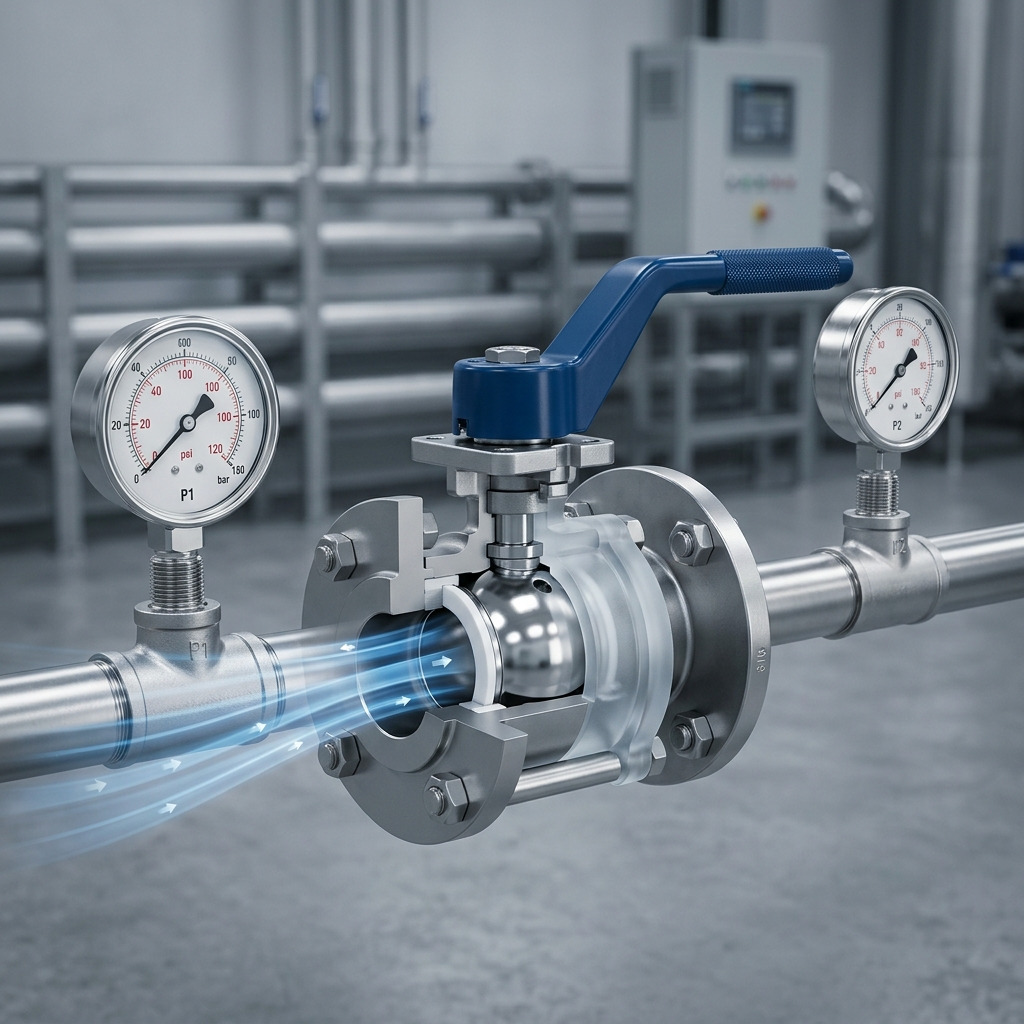
Ball valve pressure drop is the loss of pressure across the valve body, and it matters most when the valve must pass a required flow without starving downstream equipment, overloading a pump, or creating unstable flow. In a pump skid, cooling loop, water line, gas header, or process utility line, a ball valve that looks correct by nominal pipe size can still restrict flow if the bore, seat design, Cv, or installation layout is not matched to the duty.
For engineers and purchasing teams, the practical solution is not to treat pressure drop as an isolated number. It should be checked together with flow rate, fluid properties, upstream and downstream pressure, valve port design, and the published data for the selected valve. If you are comparing industrial ball valve configurations, the key question is simple: will this valve isolate the line while keeping flow loss inside the system’s allowable pressure budget?
What Ball Valve Pressure Drop Means in a Piping System
Ball valve pressure drop is the difference between inlet pressure and outlet pressure while fluid is moving through the valve. A closed valve stops flow; an open valve still creates some resistance because the fluid passes through the bore, seats, body cavity, end connections, and nearby pipe geometry.
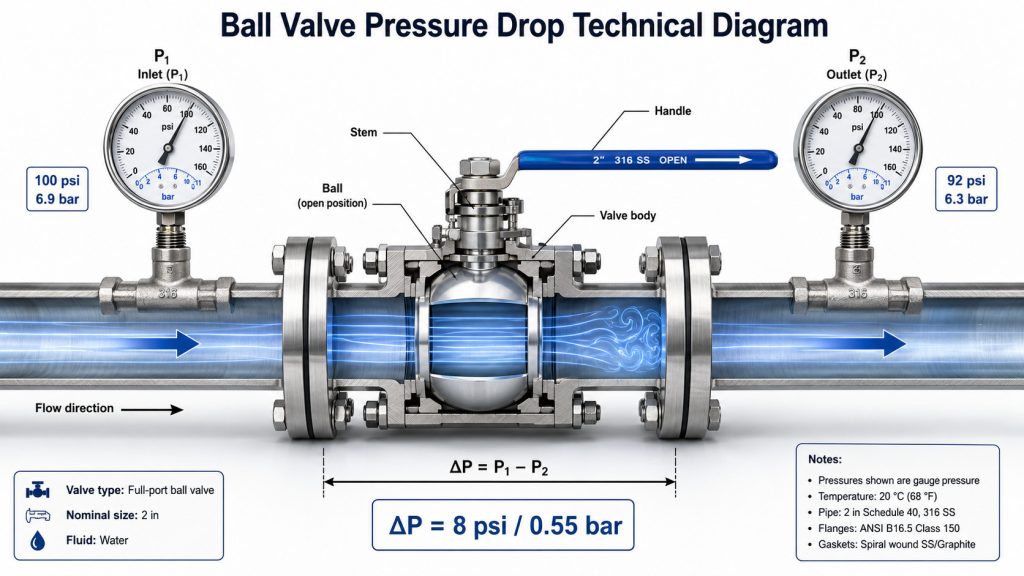
Pressure drop is not pressure rating
Pressure rating tells you the pressure boundary a valve is designed to withstand under specified temperature and material conditions. Pressure drop tells you how much pressure the moving fluid loses while passing through the valve.
This distinction prevents a common specification mistake. A valve may have a suitable pressure class but still create excessive flow loss if it has a reduced bore, small Cv, rough flow path, partially open position, or tight surrounding pipe layout.
The ball opening controls the flow path
A ball valve uses a quarter-turn spherical closure member with a hole through the center; when the hole aligns with the pipe, flow passes through, and when it turns 90 degrees, flow is blocked. That basic mechanism is why ball valves are usually selected for shutoff rather than fine throttling.
The pressure drop is low when the ball port is well aligned and sized close to the pipeline flow requirement. It rises quickly when the valve is partially open, when the bore is smaller than the pipe, or when reducers and elbows disturb the flow near the valve. For a broader mechanical explanation, the way a ball valve works in industrial piping helps connect the pressure-drop issue to the actual internal structure.
Why Bore Design Changes the Pressure Loss
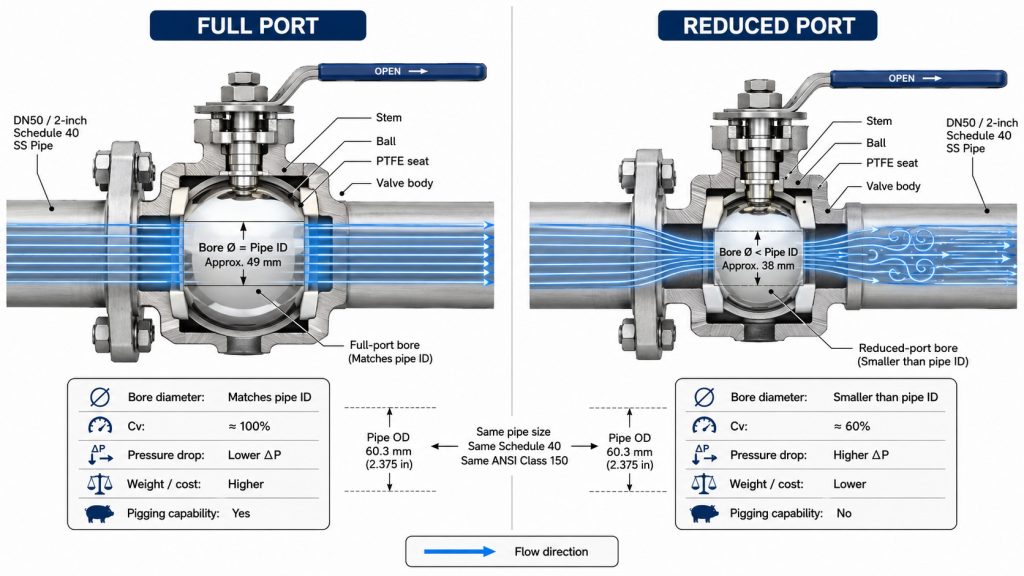
Bore design changes pressure loss because it changes the available flow area inside the valve. A full-port ball valve usually creates less restriction than a reduced-port valve in the same nominal pipe size, but the better choice depends on flow demand, allowable pressure loss, cost, weight, and whether the line needs pigging or unobstructed passage.
Full port favors low restriction
A full-port ball valve has a bore closer to the pipe inside diameter, so the flow path is less interrupted. This is useful when the system has a tight pressure budget, high flow demand, pigging requirements, or sensitivity to velocity increase.
Full port does not remove all pressure drop. Seats, body transitions, surface finish, end connections, and nearby fittings still matter. It is better to think of full port as a way to reduce avoidable restriction, not as a promise of no loss.
Reduced port can be acceptable when duty allows
A reduced-port valve can be suitable when the line has enough available pressure, flow demand is moderate, and the valve is mainly used for isolation. It may also reduce valve size, weight, and cost in applications where the added pressure drop is acceptable.
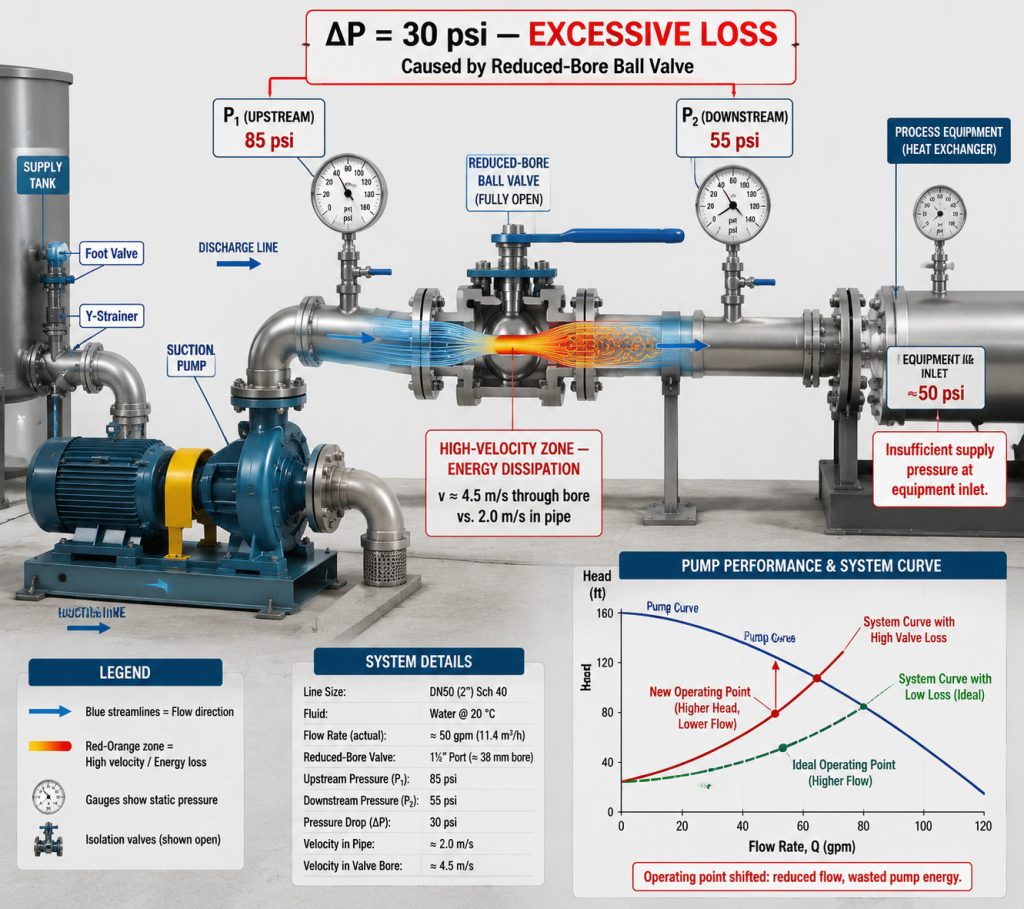
The risk appears when a reduced-port valve is chosen only because the pipe nominal size matches. In high-flow water loops, pump discharge lines, or process transfer lines, the smaller internal passage can raise velocity, increase local turbulence, and consume more of the pressure budget than the designer expected.
Floating and trunnion designs affect torque and sealing
Floating and trunnion-mounted ball valves do not automatically define pressure drop by themselves; the bore and Cv still matter. However, the design becomes important when bore size, pressure differential, seat load, and operating torque increase.
For larger bore or higher differential-pressure isolation service, a trunnion ball valve design may help manage seat loading and operating torque more predictably than a floating design. That choice should still be checked against the actual flow requirement, not only the valve type name.
How Cv Turns Flow Demand Into a Pressure Estimate
Cv turns pressure drop from a vague concern into a sizing check. For liquid service, it helps estimate how much pressure loss a valve will create at a given flow rate, provided the fluid behavior and valve data fit the assumptions behind the calculation.
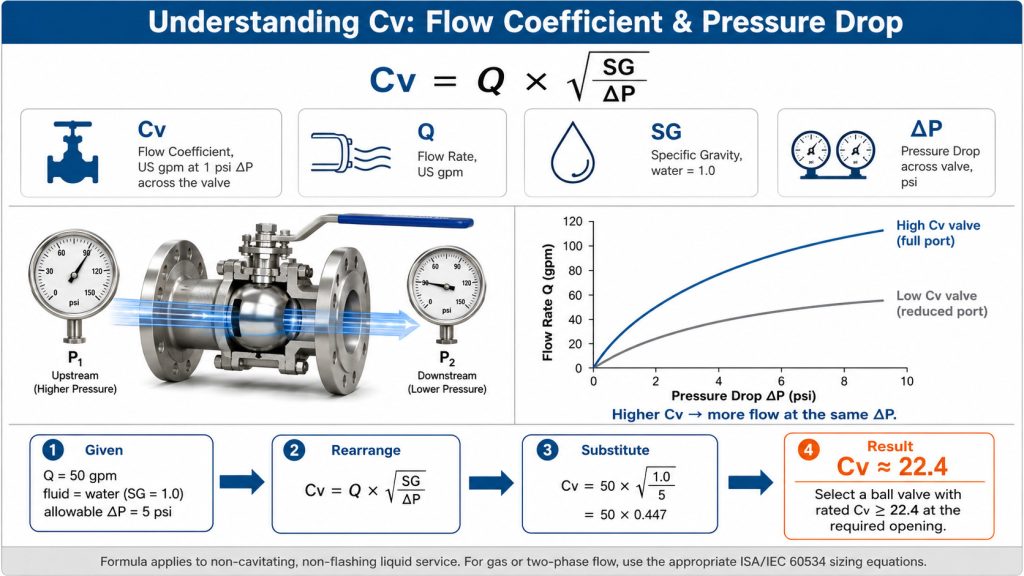
The liquid Cv relationship
Under the common U.S. liquid convention, Cv represents the flow of water in U.S. gallons per minute at 60°F that produces a 1 psi pressure drop across the valve. A valve sizing technical bulletin explains this convention and uses pressure drop, flow, and fluid properties to estimate valve capacity.
For turbulent liquid flow under this convention, the relationship is commonly rearranged as:
Delta P = SG x (Q / Cv)^2
Here, Delta P is pressure drop in psi, SG is liquid specific gravity, Q is flow in gpm, and Cv is the valve flow coefficient. This means pressure drop rises with the square of flow rate. If flow doubles and Cv stays the same, the pressure drop trend is much more severe than a simple one-to-one increase.
This table shows which inputs should be confirmed before treating a pressure-drop estimate as useful.
| Input to Confirm | Useful Reference Point | Why It Matters |
|---|---|---|
| Valve Cv | Cv is tied to water at 60°F and 1 psi differential under the common liquid convention | Higher Cv generally means lower pressure drop at the same liquid flow |
| Flow rate | Use the actual required flow, not only pipe size | Pressure drop rises roughly with the square of flow in the basic liquid relationship |
| Fluid specific gravity | The liquid equation includes SG | Heavier liquids increase pressure drop compared with water at the same Q and Cv |
| Pressure units | The NIST SI conversion table lists 1 psi as 6.894757 kPa | Unit mistakes can distort pump head and pressure-loss comparisons |
The main lesson is that nominal valve size is not enough. A correct comparison needs Cv, bore type, actual flow, fluid data, and the allowable pressure difference across the valve.
Gas, steam, and mixed fluids need more care
Gas and steam calculations are more sensitive because compressibility, pressure ratio, temperature, and possible choked flow can change the result. For control-valve sizing, IEC 60534-2-1:2011 covers equations for compressible and incompressible fluids, while also noting limits for non-Newtonian fluids, slurries, fluid mixtures, and liquid-solid conveyance systems.
That caution matters for ball valves too. Even if the valve is used for isolation, a buyer should not apply a simple water-based Cv calculation to gas, steam, slurry, or flashing liquid service without checking the correct sizing method and manufacturer data.
When Pressure Drop Becomes a System Risk
Pressure drop becomes a risk when it consumes too much available system pressure or creates unstable local flow conditions. A small loss may be acceptable in an isolation valve, but excessive loss can affect pump energy, downstream equipment performance, noise, vibration, erosion, and control stability.
Pump energy and downstream pressure
In pumping networks, every unnecessary restriction adds head loss that the pump must overcome. A single valve may not dominate the system, but multiple restrictive valves, strainers, elbows, and reducers can add up.
This is especially important in utility networks and water and wastewater treatment systems, where pumps may operate for long hours and pressure loss can affect both energy use and downstream process stability. In these applications, a low-restriction valve selection can support the broader hydraulic design instead of fighting it.
Velocity, erosion, and seat wear
When a reduced bore or partially open ball valve forces fluid through a smaller passage, velocity increases through the restriction. If the medium contains particles, scale, slurry, or corrosive components, that velocity increase can accelerate wear at the seats, ball surface, and downstream pipe wall.
For clean water or compatible fluids, the risk may be manageable. For abrasive, crystallizing, or corrosive service, the same pressure drop can become a durability issue because the valve is not only losing pressure; it is concentrating energy in a smaller flow path.
Cavitation and flashing
For liquids, pressure drop must be checked against vapor pressure and downstream pressure. If local pressure falls too low, cavitation or flashing may occur, depending on whether vapor bubbles collapse or remain in the downstream flow.
Ball valves are not normally chosen as precision throttling valves, so keeping them mostly open or fully closed helps avoid using the ball edge as a high-energy restriction. If the duty requires regular throttling, a valve designed for control service may be more suitable than forcing an isolation ball valve into that role.
How to Reduce Ball Valve Pressure Drop During Specification
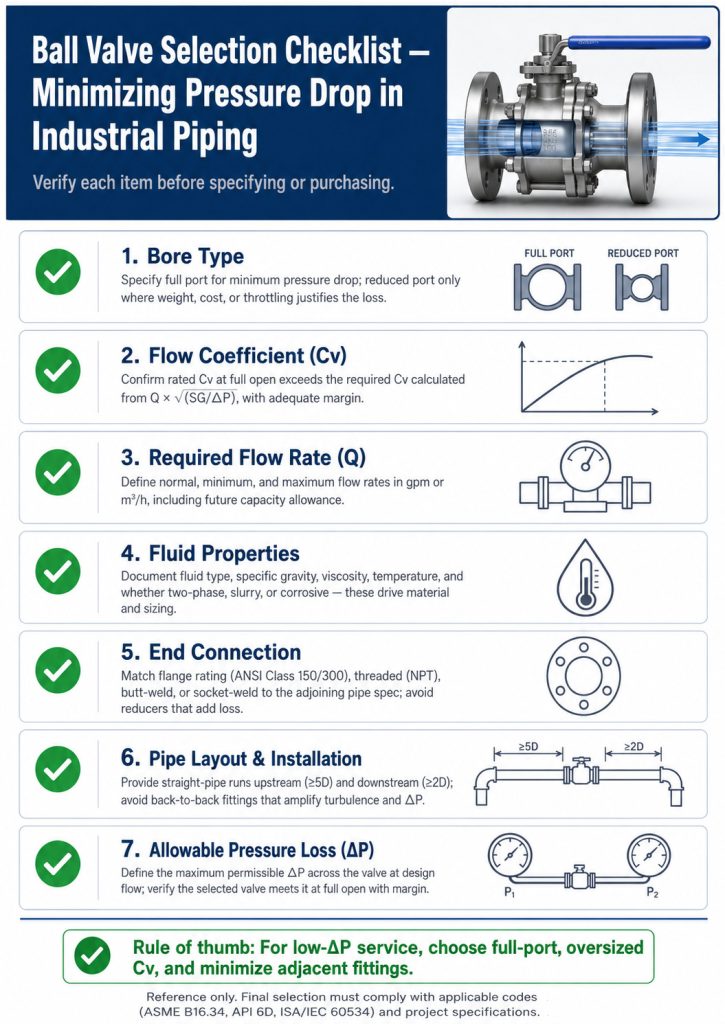
Reducing ball valve pressure drop starts with the specification, not the installation crew. The most useful steps are to define the allowable pressure loss, request Cv or flow data, choose the right bore, and avoid layout choices that make the valve look worse than it is.
Match bore to required flow
If the line has high flow demand or limited pressure margin, start by checking a full-port option. If a reduced-port option is being considered, compare the Cv and calculate the expected pressure drop at normal, minimum, and maximum flow.
Do not rely on the pipe nominal size alone. Two valves with the same nominal connection can have different internal bore dimensions, body transitions, and published flow coefficients.
Avoid using ball valves for routine throttling
A ball valve can pass through partially open positions, but that does not make it an ideal throttling device. Near-partial openings, the flow jet can be concentrated at the edge of the port, increasing noise, vibration, seat wear, and unstable flow.
If the process requires frequent modulation, compare a control valve, globe valve, characterized ball valve, or another suitable control device. The lower initial cost of using a standard ball valve for throttling may be offset by poor controllability or accelerated wear.
Check nearby fittings and reducers
Pressure drop measured across a valve can be affected by upstream and downstream piping. Elbows, tees, reducers, strainers, and short straight runs can disturb the velocity profile and make measured performance differ from ideal catalogue data.
For critical lines, ask whether the published Cv assumes a specific test arrangement. Then compare it with the actual pipe layout so the pressure-drop estimate reflects the installed system, not only the valve body.
What to Confirm Before Ordering or Replacing a Ball Valve
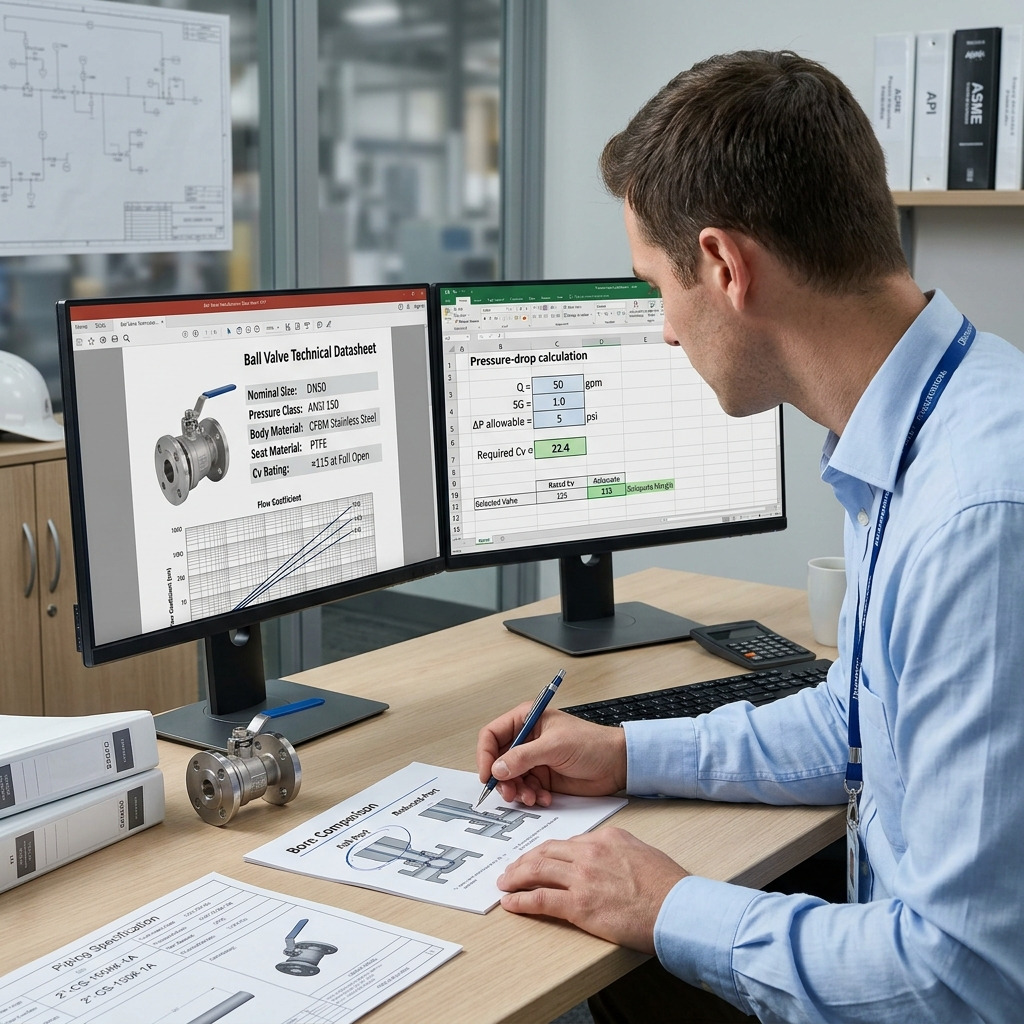
Before ordering or replacing a ball valve, confirm the data that actually changes pressure drop and suitability. The most important items are flow rate, fluid, temperature, pressure, bore type, Cv, end connection, operating position, and the relevant valve standard or project specification.
Standards define boundaries, not the pressure drop
Standards are essential, but they do not replace sizing. ASME B16.34-2025 covers pressure-temperature ratings, dimensions, tolerances, materials, nondestructive examination requirements, testing, and marking for relevant valve constructions. That helps define pressure boundary requirements, but it does not tell you the pressure drop for your flow rate.
For pipeline and piping valves in petroleum and natural gas applications, an API publication describes API Specification 6D as covering design, manufacturing, assembly, testing, and documentation for ball, check, gate, and plug valves. If API 6D is specified, it belongs in the procurement requirement, but Cv and bore data still need to be checked separately for hydraulic performance.
Ask for the right project data
For a practical pressure-drop review, prepare these items before discussing the valve with a manufacturer or supplier:
- Fluid name, phase, specific gravity, viscosity, and any solids or corrosion concerns
- Normal, minimum, and maximum flow rate
- Upstream pressure, downstream pressure, and allowable pressure drop
- Operating temperature range and expected pressure surges
- Required bore type, end connection, face-to-face requirement, and pipe schedule
- Manual, pneumatic, or electric operation, including torque or actuator limits
- Applicable standards, inspection expectations, and documentation requirements
This information keeps the discussion focused. Instead of asking whether a ball valve is “low pressure drop,” you can ask whether a specific valve design and Cv meet the pressure budget of your system.
Conclusion
Ball valve pressure drop is not just a calculation detail; it is a practical sign of whether the valve’s bore, Cv, fluid compatibility, and installation context fit the system. A well-specified ball valve should provide reliable isolation while keeping flow loss within the pressure margin that the pump, process, or downstream equipment can tolerate.
RUITO’s position is that valve selection should make hydraulic performance visible before purchase, not after installation. If you are comparing full-port and reduced-port options, checking Cv data, or reviewing a replacement valve for pressure-loss concerns, you can share your operating conditions and project requirements with RUITO for a focused specification discussion.
FAQ
Is pressure drop across a ball valve usually high?
Usually no, if the valve is fully open and properly sized. A full-port ball valve often has relatively low restriction compared with more tortuous valve types, but pressure drop can still become significant when the bore is reduced, the flow rate is high, or the valve is partly open.
Can I use pipe size to estimate ball valve pressure drop?
No, pipe size alone is not enough. You need the valve Cv, bore type, fluid properties, and actual flow rate because two ball valves with the same nominal pipe size can have different internal flow areas and pressure-loss behavior.
Does a higher pressure rating mean lower pressure drop?
No, pressure rating and pressure drop measure different things. Pressure rating relates to the valve pressure boundary under defined material and temperature conditions, while pressure drop depends on moving flow through the valve.
Is a reduced-port ball valve a bad choice?
Not necessarily. A reduced-port ball valve can be acceptable when the system has enough pressure margin and does not require full-bore flow, but it should be checked against the required flow rate and allowable pressure loss.
What should I send before asking for a ball valve quote?
Send the flow rate, fluid, temperature, upstream and downstream pressure, allowable pressure drop, pipe size, end connection, bore preference, actuation method, and applicable standards. These details help the supplier discuss a valve that fits the actual duty instead of only matching the nominal pipe size.