
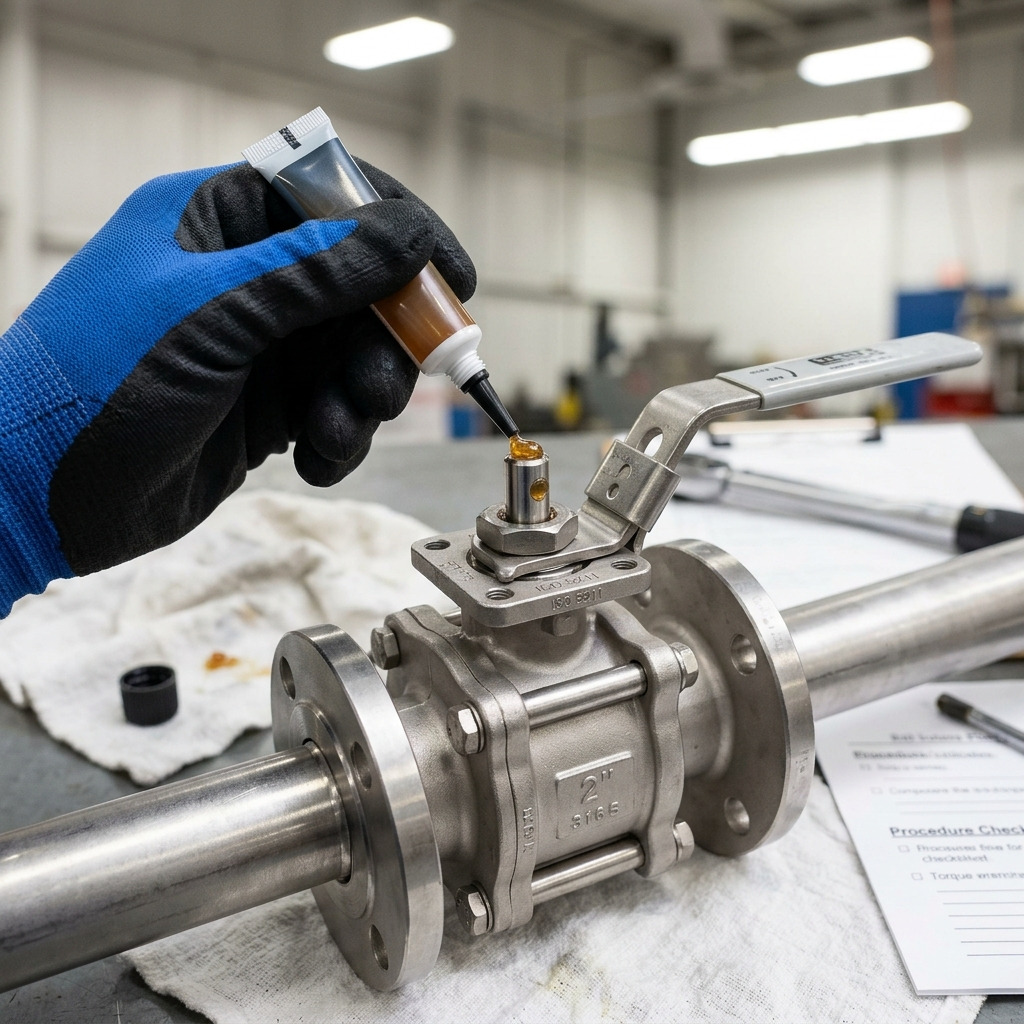
A ball valve lubricant should reduce operating torque without attacking the seats, stem packing, O-rings, or process media. In industrial maintenance, the real question is not simply which grease is slippery, but which lubricant is compatible with the valve design, media, temperature, safety rules, and downstream use of the line.
When a manual valve becomes hard to turn, an actuator stalls, or a stem packing area starts to drag, maintenance teams may reach for grease before checking the root cause. That can help in some places, but the wrong lubricant can swell elastomers, contaminate a process stream, hide a damaged seat, or create a fire risk in oxygen service. This guide explains how to select and apply lubricant around industrial ball valves with a manufacturer-minded focus on reliability, material compatibility, and practical project communication.
What lubricant should do in a ball valve
A lubricant for a ball valve should control friction at the right contact point while staying chemically and mechanically compatible with the valve. It should not be treated as a general fix for leakage, corrosion, scoring, wrong seat material, or an undersized actuator.
Lubrication is not the same as sealing
Most soft-seated ball valves seal because the ball contacts polymer or elastomer seats under controlled compression. If the seat is cut, chemically attacked, thermally damaged, or loaded beyond its rating, adding grease to the outside of the valve will not restore the sealing geometry.
Lubrication can lower stem friction, protect external threaded parts, help O-rings during assembly, or support special sealant systems on some trunnion-mounted valves. It should not be used to mask a seat leak or force a valve that has already shown mechanical damage.
The ball and seat may already be low friction
Many ball valves use PTFE, reinforced PTFE, or other engineered polymer seats because these materials can provide low friction and good chemical resistance within their rated limits. The lubricant decision therefore depends on the actual seat material, not only the valve size or handle torque.
The function of the valve also matters. A quarter-turn isolation valve has different friction points from a control valve, and how a ball valve works in industrial piping systems helps explain why the stem, seat load, bore, and actuator connection all influence torque in different ways.
Where lubrication belongs on a ball valve
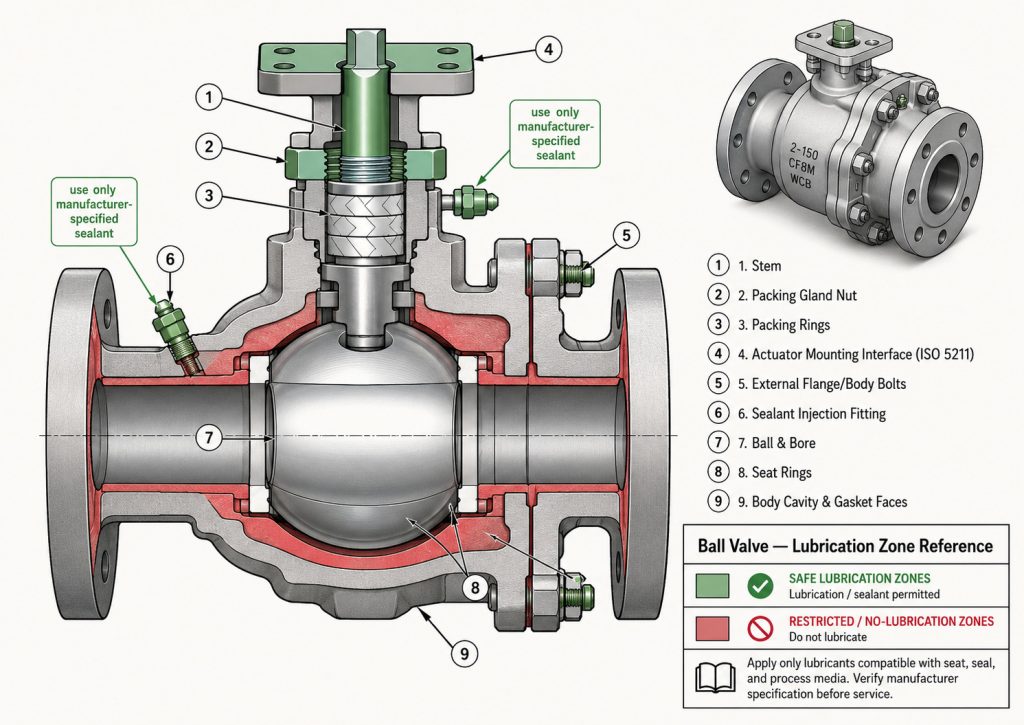
Lubrication usually belongs on mechanical interfaces, external threads, packing-contact areas, or designated injection fittings, not randomly inside the flow path. Before applying anything, confirm whether the valve is designed to accept lubricant at that point.
Manual stem and packing areas
On a manual ball valve, rising operating torque may come from stem packing compression, corrosion around exposed parts, deposits near the stem, or seat load. A small amount of compatible lubricant may help exposed mechanical contact areas, but it should not be pushed into packing or the body cavity unless the design and maintenance instructions allow it.
If the stem leaks, tightening or lubrication should be conservative because over-compressing packing can increase torque and damage sealing parts. A persistent stem leak should be treated as a maintenance or repair decision, not only a lubrication issue.
Automated actuator interfaces
For automated valves, the actuator, coupler, bracket, stem, and valve torque requirement must be considered together. If a ball valve stuck on an automated actuator continues to stall after safe isolation and inspection, adding grease may hide the fact that the actuator is undersized, the stem is misaligned, or the seat has been damaged by media conditions.
Lubrication around the actuator interface should stay out of electrical enclosures, pneumatic ports, limit switches, and position feedback devices. For pneumatic or electric actuation, use the actuator manufacturer’s lubricant guidance for actuator internals and the valve manufacturer’s guidance for the valve stem and packing area.
Special sealant injection fittings
Some large trunnion-mounted pipeline ball valves include sealant or emergency injection fittings. These systems are not the same as general greasing points on small industrial ball valves, and they require the correct sealant, injection pressure procedure, and maintenance plan for that valve design.
If a valve has no injection fitting, do not drill, tap, or force sealant into the body. The safer route is to identify the valve construction, check drawings or datasheets, and decide whether lubrication, repair, or replacement is the right action.
How to choose a compatible ball valve lubricant
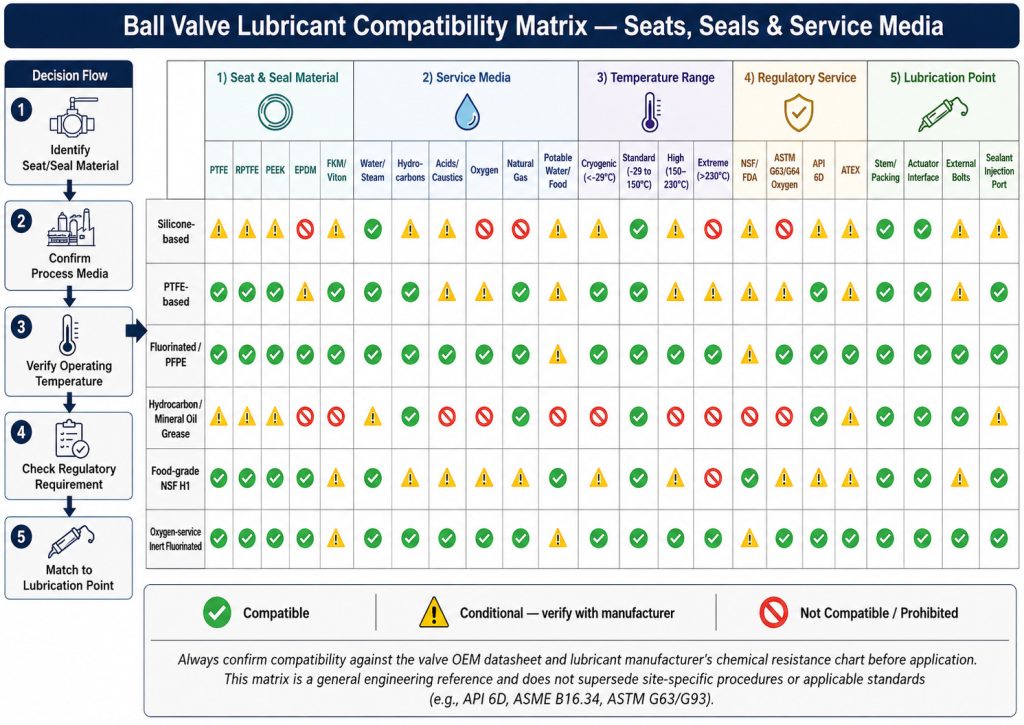
The right ball valve lubricant is selected by contact location, material compatibility, media exposure, temperature, regulatory requirements, and grease consistency. A lubricant that works on an external bolt may be unacceptable near an elastomer seal or in a food, oxygen, potable water, or high-purity chemical line.
The table below helps maintenance and procurement teams compare the checks that matter before specifying or applying a lubricant.
| Lubrication point or service condition | What to verify before use | Technical reason | Risk if ignored |
|---|---|---|---|
| Stem, packing-contact area, or slow moving metal interface | Grease consistency and product data. The NLGI Grease Glossary defines NLGI grade by ASTM D217 worked penetration at 25 degrees C, including grade 1 at 310-340 and grade 2 at 265-295 | Consistency affects whether grease stays in place or creates drag | Too soft may migrate; too stiff may increase torque in cold service |
| O-rings, elastomer seals, and assembly contact | Compatibility with NBR, EPDM, FKM, silicone, PTFE, or the actual seal material | Base oil and additives can swell, shrink, harden, or soften sealing materials | Seal leakage, higher operating torque, or early packing failure |
| Food and beverage equipment | Whether the lubricant is suitable for incidental contact under 21 CFR § 178.3570 or registered as H1 or certified to ISO 21469 | NSF notes a 10 ppm limit for lubricant base oils in food if incidental contact occurs in its food-grade lubricant guidance | Product contamination, audit failure, or unsuitable maintenance records |
| Oxygen or oxygen-enriched service | Oxygen compatibility, cleanliness, and whether the system exceeds normal air oxygen concentration | EIGA oxygen pipeline guidance states that many nonmetals used for seats, packing, thread seals, and lubricants are flammable in oxygen at purities above 23.5 percent | Fire or ignition hazard from incompatible grease or contamination |
| PTFE or reinforced PTFE seats | Seat material grade, pressure-temperature rating, and whether lubricant contacts the seat | PTFE fluoropolymer resin product information lists second melting peak values around 327 +/- 10 degrees C for several PTFE grades, but that is not a valve seat pressure rating | False confidence in high-temperature service or wrong lubricant selection |
The key lesson is that the lubricant label is not enough. A useful specification should name the contact point, valve material, seat and seal material, service media, operating temperature range, cleaning requirement, and any food, potable water, oxygen, or customer documentation requirement.
Match the lubricant to the weakest material
The most vulnerable part is often not the metal body. It may be the stem seal, O-ring, soft seat, packing ring, liner, or actuator seal near the lubrication point.
For a ball valve PTFE seat, the lubricant may not even need to touch the seat during normal maintenance. If it does, confirm compatibility and temperature limits against the valve datasheet, not only against generic PTFE material information.
Treat clean services as special cases
Potable water, food and beverage, pharmaceutical utilities, oxygen, medical gas, semiconductor chemicals, and high-purity gas systems need stricter lubricant control. In these services, the correct answer may be a qualified lubricant, a no-lubricant assembly method, cleaned components, or a valve specified with the right seat and packing from the start.
For oxygen service especially, ordinary petroleum grease should not be assumed safe. The valve, lubricant, packing, cleaning method, and packaging must be treated as one compatibility system.
Grease oil paste and dry film are not interchangeable
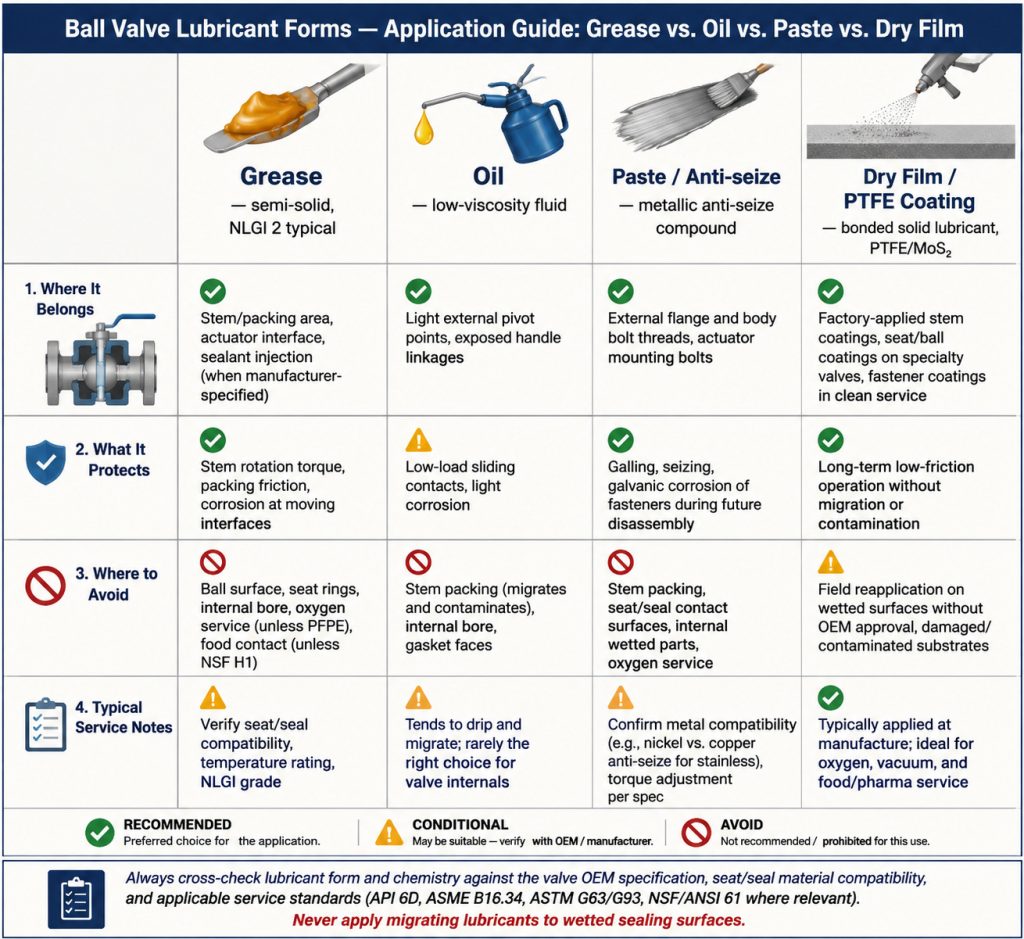
Grease, oil, paste, and dry-film coatings solve different friction problems, so choosing the category matters before choosing a brand or product. The safest starting point is the valve drawing, maintenance manual, or lubricant specification for the exact contact point.
Grease stays in place better than oil
Grease is often preferred for slow-moving parts because it can stay near the contact surface better than a light oil. That makes consistency, thickener chemistry, base oil, and additives important.
Do not assume that a thicker grease is better. In cold conditions or low-torque actuated valves, excessive stiffness can increase breakaway torque and make the actuator appear undersized.
Oil is usually an assembly aid or light-duty choice
Oil can help with temporary assembly, hinge-like motion, or light corrosion protection where migration is not a problem. It is usually less suitable where the lubricant must remain in a packing zone or resist washout.
Oil also migrates more easily into the process side. In valves used for water, food, oxygen, chemicals, or clean gas, this migration risk can matter more than the lubricity benefit.
Paste belongs on threads and bolted joints
Anti-seize paste can help external threaded fasteners, gland bolts, or assembly hardware when galling or later disassembly is a concern. It should be kept away from seats, stem packing, and process-wetted surfaces unless the product is explicitly approved for that use.
Metal-filled pastes, graphite-containing compounds, or high-temperature anti-seize materials may be useful in some bolted joints but inappropriate near elastomers or clean service lines. Treat paste as a controlled assembly material, not a universal valve lubricant.
A practical lubrication procedure for maintenance teams
A safe lubrication procedure starts with isolation, identification, cleaning, and compatibility checks before any lubricant touches the valve. The aim is to restore controlled movement without contaminating the line or hiding a defect.
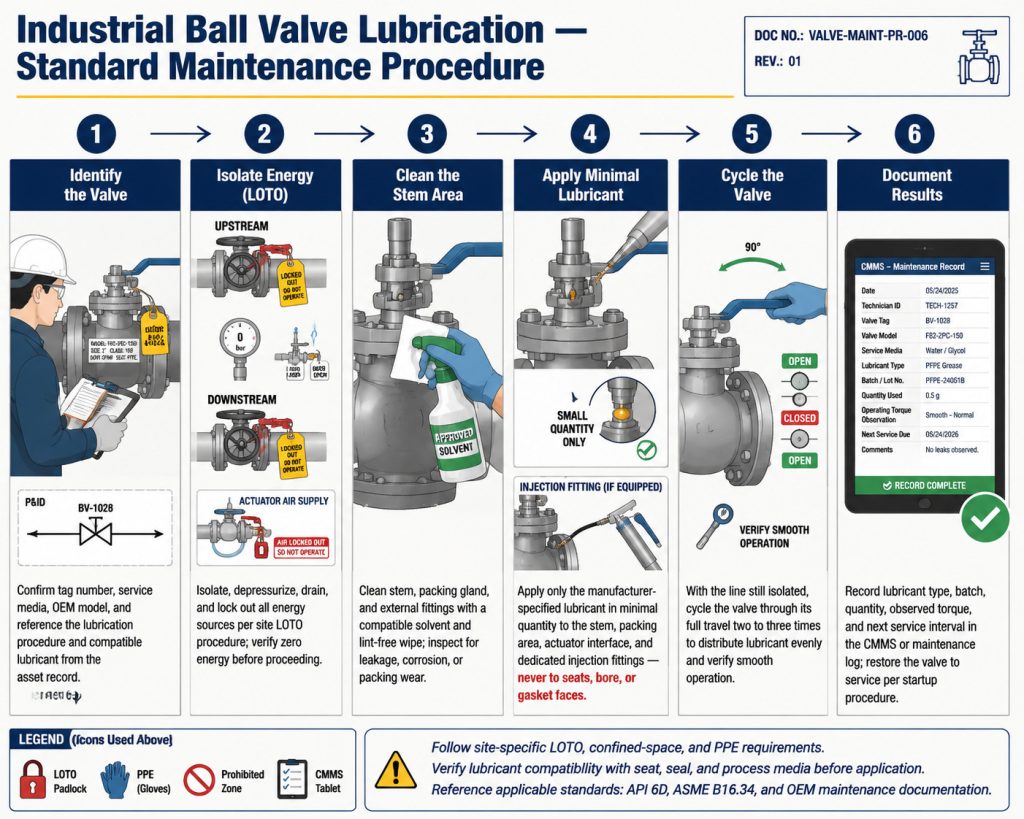
Step 1 Identify the valve and service
Record the valve type, size, body material, seat material if known, seal material if known, media, pressure, temperature, connection type, and actuator type. If the valve is in hazardous service, oxygen service, food service, or a high-purity line, stop and verify the approved lubricant list before applying anything.
Also check whether the valve is two-piece, three-piece, welded-body, floating-ball, trunnion-mounted, soft-seated, or metal-seated. These design details affect whether lubrication is a normal maintenance action or a sign that replacement or repair should be considered.
Step 2 Isolate and clean before applying lubricant
Do not lubricate a pressurized or energized valve as a shortcut. OSHA explains that lockout/tagout procedures under 29 CFR 1910.147 are intended to control hazardous energy during servicing and maintenance of machines and equipment.
After isolation, clean the external stem area and surrounding hardware so dirt is not carried into the moving interface. Use only a small amount of compatible lubricant, and keep it away from the bore unless the valve design specifically requires internal sealant injection.
Step 3 Cycle gently and inspect the result
Cycle the valve slowly through its normal range if the system condition allows it. Do not use a cheater bar to force the handle, because excessive torque can twist stems, damage stops, crack handles, or overload an actuator.
After movement improves, inspect the stem, body joints, seat leakage indicators, actuator coupling, and any visible packing area. If torque remains high or leakage appears, stop treating the issue as lubrication and move into root-cause diagnosis.
When lubrication is the wrong fix
Lubrication is the wrong fix when the valve has a sealing defect, incompatible material, internal deposit, actuator sizing problem, or pressure-temperature mismatch. In those cases, the correct next step is inspection, repair evaluation, or valve replacement with a better-matched specification.
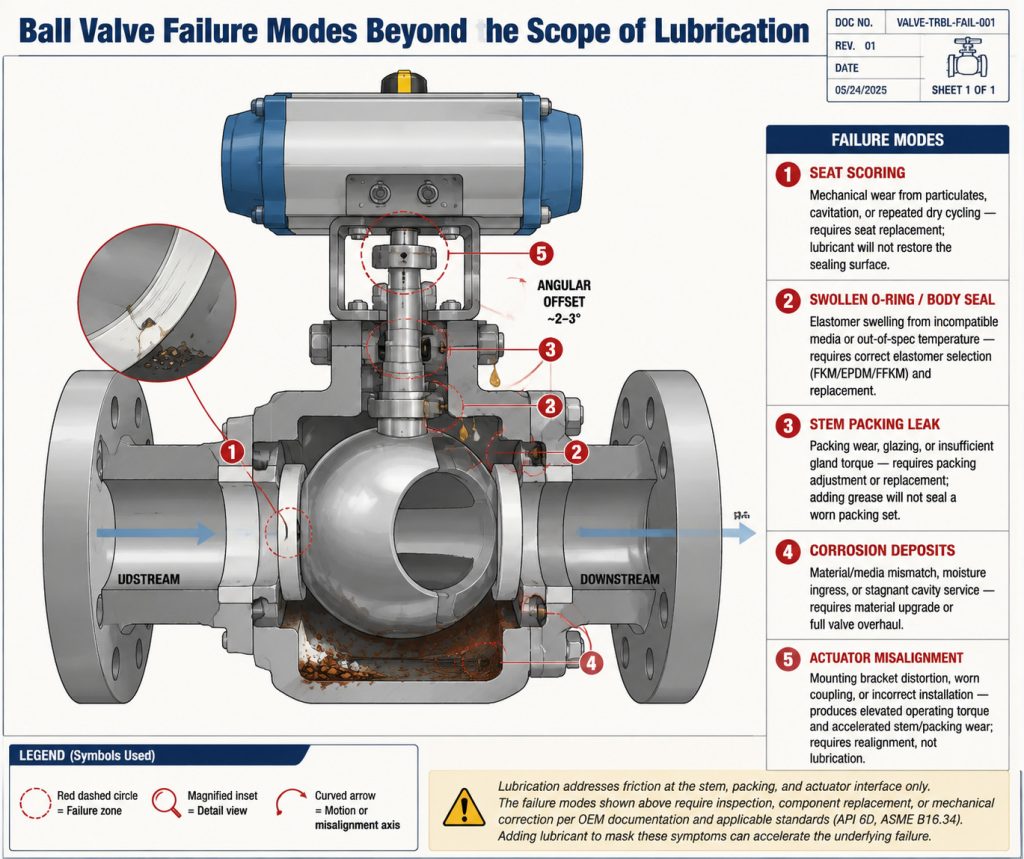
Symptoms that point beyond lubrication
High torque after lubrication can point to deposits around the ball, seat swelling, galling, corrosion, or pressure locking in certain designs. Leakage through the closed valve suggests seat damage, debris, wrong seat material, or a closure problem rather than poor lubrication.
External leakage near the stem may require packing adjustment, packing replacement, or repair review. If the valve must be disassembled, a structured ball valve repair without guesswork approach is more reliable than repeated greasing.
Testing matters after repair or replacement
If a valve has been opened, rebuilt, or replaced for a critical service, the maintenance plan should consider pressure and closure testing requirements. ISO 5208:2015 specifies examinations and tests used to establish pressure boundary integrity and verify valve closure tightness for industrial metallic valves, while the applicable product standard or project specification may add further requirements.
This matters because lubrication can make movement feel smoother without proving that the valve seals. For procurement teams, the better question is not “which grease will make it turn,” but “what valve design, seat material, lubricant rule, and test requirement fit this service?”
Conclusion
A ball valve lubricant is useful only when it is applied to the correct contact point and matched to the valve materials, process media, temperature, safety environment, and documentation requirements. For industrial systems, lubricant selection should be treated as part of valve reliability, not as a quick cover for seat damage, stem leakage, actuator mismatch, or the wrong valve specification.
RUITO’s position is that maintenance-friendly valves start with clear material selection, realistic service limits, and honest communication about where lubrication can help and where a different valve specification is needed. If you are comparing lubricants, reviewing a stuck or high-torque valve, or preparing a replacement order, you can share your valve specifications and service conditions so RUITO can discuss suitable valve construction, seat and sealing materials, actuation options, and manufacturing requirements for the project.
FAQ
Can I use ordinary grease on a ball valve?
Usually no, unless the grease is compatible with the exact valve materials and service conditions. Ordinary grease may be acceptable on some external mechanical parts, but it can be unsuitable near elastomer seals, food-contact equipment, oxygen service, potable water systems, or chemical lines.
Should lubricant be applied inside the ball valve bore?
Normally no, unless the valve design specifically includes an approved internal sealant or injection system. Randomly adding lubricant to the bore can contaminate the media, collect debris, or interfere with seat sealing.
What is the best lubricant for a stiff ball valve handle?
The best choice depends on why the handle is stiff. If the cause is external corrosion or stem-area friction, a compatible grease may help; if the cause is seat swelling, deposits, internal corrosion, or pressure-temperature mismatch, lubrication will not solve the root problem.
Do PTFE seated ball valves need lubrication?
Often they do not need lubricant on the seat during normal operation. PTFE is commonly used because it can provide low friction within its rated limits, but the valve’s actual pressure-temperature rating and media compatibility still depend on the complete seat design and manufacturer data.
What should I share to confirm lubricant compatibility?
Provide the valve type, size, body material, seat and seal materials, media, operating pressure, temperature range, cleaning requirement, actuator type, and any food, potable water, oxygen, or customer standard requirement. That information lets the supplier evaluate compatibility instead of guessing from the valve name alone.