
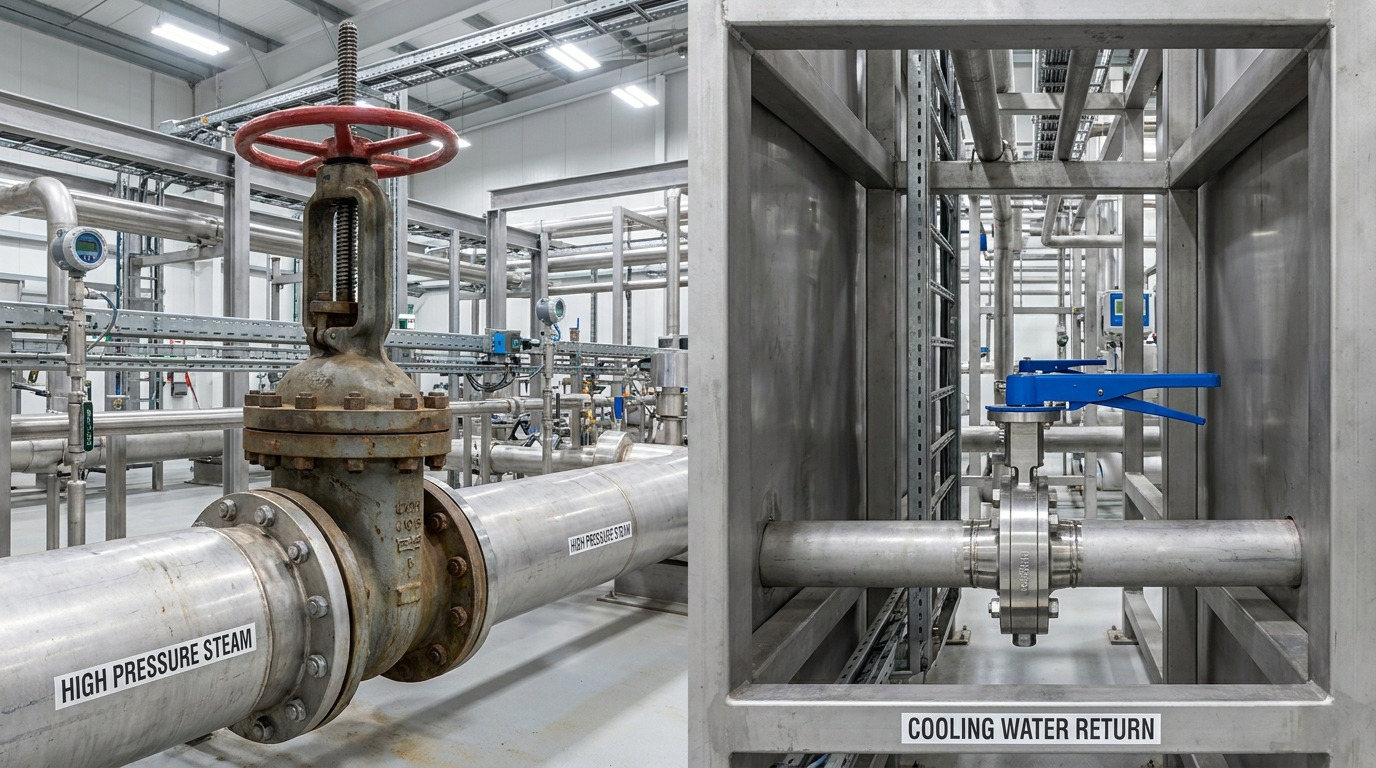
To choose the right valve for you, select a gate valve when you need a 100% unobstructed, bi-directional seal for high-pressure isolation, and opt for a butterfly valve when you need compact, fast-acting flow control or throttling in tight spaces. Picture yourself staring at a complex pipeline design with critical budget, space, and efficiency constraints. Picking the wrong component means dealing with devastating pressure drops, costly line leakage, or premature hardware failure that halts your entire plant operation. Understanding the core differences of a gate vs butterfly valve allows you to make an informed, confident decision that keeps your fluids moving safely.
How does a gate vs butterfly valve work?
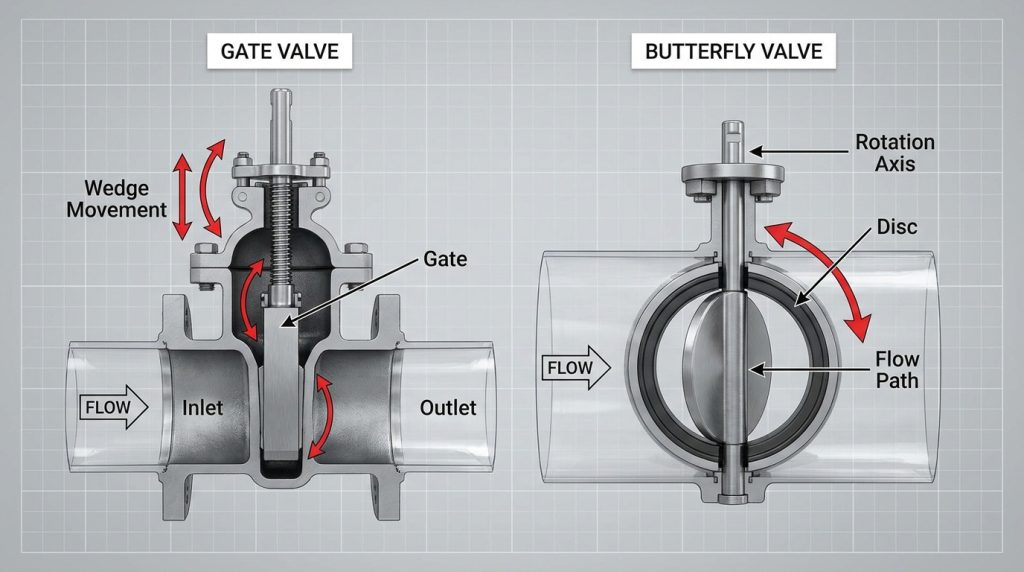
Gate valves isolate flow by driving a solid vertical wedge up and down across the line, while butterfly valves utilize a rotating disc that pivots 90 degrees inside the pipe. This operational difference determines how each gate vs butterfly valve regulates pressure and velocity. Understanding these mechanical processes ensures you select the correct control method for your piping architecture.
How do gate valves isolate media?
Gate valves rely on a linear mechanism to move an internal barrier out of the fluid path. They require multiple rotations of the handwheel to lift the gate completely.
Think about it:
- Multi-turn handwheel: You must rotate the stem multiple times to completely lift or lower the gate.
- Linear movement: The wedge slides perpendicular to the fluid flow.
- Full-bore opening: Once fully opened, the wedge rests completely inside the valve bonnet.
How do butterfly valves rotate to control flow?
Butterfly valves use a simpler, faster quarter-turn rotary disk mechanism to control fluid. This allows for rapid operation but leaves the disc directly in the flow path.
Here is why:
- Quarter-turn design: A simple 90-degree turn of the handle or actuator fully opens or closes the valve.
- Central disc axis: The disc rotates on a central shaft directly inside the flow stream.
- Constant obstruction: The disc remains in the media flow even when fully open.
Key Takeaway: Understanding the operational movement helps you select a valve that matches your actuation system and cycle-speed requirements.
| Feature Comparison | Gate Valve | Butterfly Valve |
|---|---|---|
| Motion Type | Linear travel (up/down) | Rotary travel (90-degree rotation) |
| Flow Path Status | Completely unobstructed (when open) | Obstruction present (disc in flow path) |
| Operational Turns | Multi-turn | Quarter-turn |
The contrasting operational movement shows why linear systems favor gate valves and rotary-driven networks demand butterfly setups.
Which design wins in gate vs butterfly valve?
Butterfly valves win the design match when it comes to weight and compact dimensions, while gate valves dominate in heavy-duty structural robustness. Each gate vs butterfly valve layout serves different structural priorities within your plant. Evaluating your footprint limits will guide you to the winning design.
What makes up a gate valve’s heavy profile?
Gate valves are designed with thick-walled, heavy-duty body castings to handle massive physical stresses. They feature a vertical construction that rises high above the pipeline.
Look:
- Tall bonnets: The upper housing must be large enough to hold the retracted gate wedge.
- Flanged ends: Robust flange connections make the unit wider and heavier.
- Dense castings: Thicker iron or steel walls maximize long-term mechanical safety.
Why is the butterfly valve design so lightweight?
Butterfly valves prioritize high material efficiency and a very thin profile. They are incredibly compact, making them simple to install in lightweight systems.
The best part?
- Wafer-thin design: The narrow body slides easily between standard pipe flanges.
- Low material mass: It uses up to 70% less metal than a comparable gate valve.
- Integrated seats: The compact liner minimizes the face-to-face dimension.
Key Takeaway: Opting for the lightweight, compact butterfly valve saves you significant layout space and reduces structural load stress on your piping hangers.
| Structural Aspect | Gate Valve | Butterfly Valve |
|---|---|---|
| Profile Width | Long face-to-face dimension | Narrow face-to-face (wafer/lug) |
| Vertical Height | High (due to rising stem and bonnet) | Low (compact actuator/lever only) |
| Metal Volume | Heavy casting footprint | Minimal materials utilized |
Evaluating physical profile characteristics reveals how butterfly designs minimize physical plant footprints compared to heavy-duty gate alternatives.
Where does space favor gate vs butterfly valve?
Space heavily favors butterfly valves in narrow pipeline configurations because of their slim face-to-face profile and small overhead footprint. Deciding where to place a gate vs butterfly valve depends greatly on your system’s vertical and lateral spatial limits. Understanding these physical bounds keeps your maintenance paths open and clear.
Do gate valves need vast vertical clearance?
Rising stem gate designs demand significant vertical space to operate successfully. This makes them highly difficult to integrate into tight modular layouts.
Let’s face it:
- Overhead clearance: The stem extends upward as the valve opens, requiring double the height.
- Handwheel access: Operators need a wide clearance radius to spin the handwheel.
- Heavy structural anchors: Large physical profiles require dedicated support brackets.
Can butterfly valves squeeze into tight spaces?
Butterfly valves easily adapt to dense piping configurations and tight modular skids. They occupy minimal space both horizontally and vertically.
By contrast:
- Minimal footprint: The narrow design sits tightly between existing flanges.
- Close-coupled actuators: Lever or gear operators stay close to the pipeline centerline.
- No hanger strain: Lightweight construction eliminates the need for expensive piping reinforcements.
Key Takeaway: Selecting butterfly valves for tight layouts allows you to maximize space on modular skids without compromising pipeline accessibility.
| Spatial Variable | Gate Valve | Butterfly Valve |
|---|---|---|
| Overhead Space | Large clearance required | Minimal clearance required |
| Pipe Support Needs | High (due to valve weight) | Low (self-supporting in most cases) |
| Lateral Clearance | Moderate to high | Compact and streamlined |
The physical dimensions prove that spatial constraints dictate a shift toward wafer or lug-style butterfly installations.
Can you throttle with gate vs butterfly valve?
You can throttle effectively with a butterfly valve, whereas a gate valve is strictly designed for full on-off isolation and will fail if used for throttling. Attempting to use a gate vs butterfly valve incorrectly in a flow control loop leads to rapid mechanical wear. Let’s look at the fluid dynamics to understand why this happens.
Why does throttling destroy gate valves?
Using a gate valve for partial flow regulation quickly ruins the internal sealing surfaces. The fluid forces cause severe damage to the wedge assembly.
Wait, there’s more:
- Wedge vibration: High-velocity fluid causes the loose wedge to vibrate violently against its guides.
- Erosive damage: The bottom edge of the wedge and the seats suffer rapid erosion.
- Imprecise control: The linear travel profile is highly non-linear for flow coefficients.
How do butterfly valves handle flow control?
Butterfly valves are highly capable of modulating and adjusting flow rates. Their rotating disc can be set at intermediate positions with ease.
Here is the deal:
- Pivoting disc control: The disc can sit at precise intermediate angles to regulate flow.
- Balanced forces: Modern offset designs reduce fluid drag forces on the seating interface.
- Linear response curves: The flow rate changes predictably as you turn the operating lever.
Key Takeaway: Utilizing a butterfly valve for throttling ensures you get reliable flow regulation without sacrificing the long-term integrity of your sealing components.
| Throttling Capability | Gate Valve | Butterfly Valve |
|---|---|---|
| Primary Design Purpose | On/Off Isolation Only | Isolation & Throttling |
| Vibration Resistance | Poor (vibrates when partially open) | High (stable at variable angles) |
| Flow Control Precision | Non-linear and inaccurate | Predictable control curve |
The comparison shows that while gate valves must stay fully open or closed, butterfly valves safely handle moderate flow modulation.
How does pressure affect gate vs butterfly valve?
High pressure favors gate valves because their solid, rigid wedge design easily withstands massive differential pressures, whereas standard butterfly valves can deform under extreme loads. Choosing the wrong gate vs butterfly valve under high mechanical stresses can trigger catastrophic system blowouts. You must match your pressure rating precisely to the proper valve housing.
Why do gate valves handle high-pressure classes?
Gate valves feature rigid bodies and robust internal barriers that excel in high-pressure networks. They are built to handle structural loads that would compromise lighter valves.
What does this mean?
- Heavy bolted bonnets: Secure bonnet joints contain extreme high-pressure surges.
- Metal-to-metal seating: Solid metal contact handles extreme thermal expansion and high PSI ratings.
- Wedge stability: The solid wedge cannot easily flex or twist under high differential forces.
What are the pressure limits of butterfly designs?
Butterfly valves face strict operational limits when subjected to high differential pressures. Their thinner components are more prone to mechanical stress under load.
The reality is:
- Disc deflection: Extreme pressures can bend the thin disc, causing downstream leaks.
- Soft liner limits: Standard elastomeric seats can blow out or deform under excessive load.
- High-torque demands: High pressure increases seat friction, requiring huge actuators.
Key Takeaway: Specifying gate valves for high-pressure systems guarantees a leak-tight, reliable barrier that easily handles extreme operational spikes.
| Pressure and Temp Limits | Gate Valve | Butterfly Valve |
|---|---|---|
| Maximum Pressure Class | Up to ASME Class 2500+ | Usually limited to ASME Class 150/300 |
| Seating Material | Metal-to-metal (Standard) | Elastomer soft seats (Standard) |
| Thermal Tolerance | Excellent for extreme steam/hot oils | Limited by rubber or PTFE liner |
Analyzing these pressure limits explains why high-stress chemical processing lines rely heavily on gate valve configurations.
Which is more durable, gate vs butterfly valve?
Gate valves are generally more durable in severe-service, high-temperature, and highly abrasive environments, while butterfly valves offer outstanding durability in clean, low-to-medium pressure utility systems. The longevity of your gate vs butterfly valve depends entirely on the chemical and physical traits of the media. Let’s look closer at how wear impacts each valve over time.
What makes gate valves durable in harsh media?
Gate valves feature rugged internal parts built to survive thick, heavy, or abrasive fluids. The sealing surfaces stay protected from direct wear during operation.
Think about it:
- Retractable wedge design: The sealing wedge retreats completely away from the abrasive media path.
- Heavy metal alloys: Hardened faces resist physical wear from sliding friction.
- Corrosion resistance: Standard builds offer thick body castings that handle long-term chemical wear.
How does media wear down butterfly valves?
Butterfly valves are more vulnerable to abrasive or high-velocity media erosion. Their exposed components must endure constant friction.
Look:
- Constant exposure: The central disc stays directly in the fluid stream, absorbing continuous impact.
- Liner degradation: Abrasive solids can quickly tear soft rubber or plastic liners.
- Shaft wear: Constant rotational friction on the stem can degrade internal bearings over time.
Key Takeaway: Matching the valve’s physical materials to your media ensures your valves run smoothly for years with zero premature wear.
| Material Durability | Gate Valve | Butterfly Valve |
|---|---|---|
| Abrasive Resistance | Excellent (fully retracted gate) | Moderate (disc is always exposed) |
| Erosion Hotspots | Bottom of wedge (only if partially open) | Entire disc edge and seat liner |
| Slurry Capability | Highly recommended | Limited to low concentrations |
This durability data helps plant operators pick the most robust valve style based on internal media aggressiveness.
Is maintenance easier for gate vs butterfly valve?
Maintenance is much easier and cheaper for butterfly valves due to their lightweight design and replaceable soft liners, whereas gate valves require heavy-duty labor and precision seat grinding to repair. When comparing long-term operational costs for a gate vs butterfly valve, ease of maintenance must be a primary focus. Minimizing downtime translates directly to higher plant profitability.
Why are gate valve repairs so labor-intensive?
Servicing a gate valve typically demands highly specialized tools and heavy physical effort. Their massive components are difficult to handle on-site.
Here is why:
- In-line difficulties: Servicing seats often requires completely removing the heavy body from the line.
- Precision grinding: Metal-seated gate valves require tedious lapping and alignment.
- Heavy component handling: Lifting heavy bonnets and wedges requires extra rigging equipment.
What makes butterfly valve maintenance so simple?
Butterfly valves are designed for fast disassembly and straightforward parts replacement. Their light construction makes servicing them extremely efficient.
The best part?
- Replaceable liners: You can swap out worn rubber seats quickly with basic shop tools.
- Light components: The light profile allows a single technician to handle the valve safely.
- Fewer moving parts: The simple disc-and-shaft design reduces points of failure.
Key Takeaway: Standardizing on butterfly valves for accessible lines reduces your scheduled maintenance windows from hours to mere minutes.
| Maintenance Effort | Gate Valve | Butterfly Valve |
|---|---|---|
| Service Speed | Slow (often requires shop repair) | Fast (frequently done in-line) |
| Liner Replacement | Difficult (requires seat machining) | Very simple (slip-in replacement) |
| Required Manpower | High (frequently requires multiple technicians) | Low (often handled by one technician) |
Evaluating the maintenance profile highlights how ease of repair reduces lifetime operational expenditures for your business.
Which is cheaper, a gate vs butterfly valve?
Butterfly valves are significantly cheaper to purchase, ship, and install than gate valves, especially in larger nominal diameters. The financial difference between a gate vs butterfly valve can shape your entire project budget. Understanding where your capital expenditure goes is key to smart procurement.
Why do gate valves cost more upfront?
The structural complexity of gate valves naturally commands a higher market price. They use more raw materials and require complex machining.
Let’s face it:
- High material volume: Bulkier castings mean more raw steel or iron is consumed during manufacturing.
- Intricate machining: Threaded stems, guides, and wedge gates require precision machining.
- Higher shipping fees: Massive weights drive up freight and logistics costs substantially.
How do butterfly valves save your budget?
Butterfly valves use material-efficient designs to deliver lower unit costs. They streamline your physical system and lower total system expenses.
By contrast:
- Streamlined casting: The wafer/lug body uses minimum metal.
- Low shipping weights: Lighter packages lower your import and transport costs.
- Cheaper automation: Smaller torque needs mean you can use smaller, cheaper actuators.
Key Takeaway: Selecting butterfly valves for large-diameter lines keeps your project well within budget constraints without sacrificing system reliability.
| Financial Variable | Gate Valve | Butterfly Valve |
|---|---|---|
| Raw Material Cost | High (large structural body) | Low (minimal footprint wafer design) |
| Machining Overhead | High (threaded stems and gate guides) | Low (simple central disc shaft) |
| Logistics Expenses | High (requires heavy freight carriers) | Low (can ship via standard carriers) |
Comparing the initial capital outlays shows why budgetary constraints frequently favor butterfly valve integrations.
How does leakage differ in gate vs butterfly valve?
Butterfly valves provide excellent bubble-tight zero leakage in low-to-medium pressure systems using soft resilient seats, while gate valves rely on metal-to-metal seats that can allow minor bypass over time unless precision-machined. Choosing a gate vs butterfly valve requires evaluating how critical an absolute bubble-tight seal is to your process safety. Let’s look at how their sealing technologies compare.
How do gate valves achieve high-pressure seals?
Gate valves use high systemic forces to wedge metal sealing faces tightly together. This is ideal for steam and hydrocarbons where soft materials fail.
Wait, there’s more:
- System pressure sealing: Upstream pressure pushes the wedge tightly against the downstream seat.
- Double-sided sealing: High-quality gate valves provide tight seals in both flow directions.
- Debris vulnerability: Tiny particles trapped on the seat can scratch the metal, causing minor leaks.
Why do butterfly valves offer bubble-tight seals?
Resilient-seated butterfly valves compress elastomeric materials to guarantee a complete seal. This creates a highly reliable barrier for clean service.
Here is the deal:
- Resilient compression: The disc squeezes fully into a soft rubber or PTFE seat liner.
- Zero-leakage standards: Ideal for clean gas or liquid systems that require zero bypass.
- Triple-offset options: High-end metal-seated butterfly valves can achieve zero leakage even at high temperatures.
Key Takeaway: Choosing the correct seating style protects your facility from hazardous fluid leaks and maintains absolute process integrity.
| Sealing Capability | Gate Valve | Butterfly Valve |
|---|---|---|
| Sealing Surface | Metal-to-metal (typical) | Resilient elastomer / PTFE (typical) |
| Zero-Leakage Level | Hard to achieve at low pressures | Easily achieved (bubble-tight standard) |
| Bypass Risk | Moderate over time (due to seat wear) | Low (until soft seat wears out) |
Sealing capability comparisons help you match the strict leakage requirements of your specific media stream.
What is the best fit for gate vs butterfly valve?
Gate valves are the best fit for main isolation lines in oil, gas, steam, and slurry systems, while butterfly valves are the perfect match for HVAC, water distribution, and low-pressure utility lines. Mapping out the optimal fit for a gate vs butterfly valve ensures your system runs safely and efficiently. Let’s look at the ultimate application environments for each style.
Where are gate valves irreplaceable?
Heavy industrial processes depend on gate valves to handle extreme, severe duties. Their durable construction makes them the industry standard for tough applications.
What does this mean?
- Petrochemical refining: Standard for high-temperature hydrocarbons and heavy crude.
- Power generation: Essential for high-pressure main boiler feedwater and steam loops.
- Mining & Slurry: The only choice for thick, abrasive mineral ore slurries.
Where do butterfly valves dominate the market?
Water, air, and modular process lines are the primary home for butterfly valves. They are perfect for applications requiring high flow volumes at moderate temperatures.
The reality is:
- Water utility systems: Ideal for bulk municipal water distribution and chemical treatment.
- HVAC systems: Standard for regulating chilled water flow and air damper lines.
- Chemical skids: Prefabricated modular skids rely on their lightweight, compact layout.
Key Takeaway: Aligning your valve choice with specific industrial application fields prevents catastrophic design mismatch errors.
| Optimal Application Fit | Gate Valve | Butterfly Valve |
|---|---|---|
| Steam & Hydrocarbons | Excellent (withstands high heat/pressure) | Limited (unless triple-offset metal design) |
| Municipal Water Systems | Good for bulk main trunklines | Excellent for treatment plant systems |
| Pulp & Paper Slurries | Excellent (shear action cuts through pulp) | Poor (pulp fibers clog the disc stem) |
This final application match chart provides a quick reference tool to select your perfect flow control component.
Which valve is the right choice for your system?
Selecting between these two valve designs ultimately depends on your system pressure, spacing limits, budget, and media characteristics. If you are designing high-pressure steam pipelines or handling thick, abrasive slurries, the gate valve’s robust, full-bore layout is irreplaceable. On the other hand, if your project involves low-to-medium pressure fluid regulation, space constraints, or tight budget limitations, specifying a lightweight butterfly valve is the most efficient path forward.
Ready to solve your flow control challenges and streamline your piping efficiency? We invite you to contact us today to consult with our application engineers and secure high-performance industrial flow control solutions tailored to your plant’s needs.
FAQ
Can I replace an existing gate valve with a butterfly valve?
Yes, but you must confirm the system’s pressure rating and face-to-face dimensions first. A gate valve has a much wider installation width, meaning you will need to install a pipe spool piece or adapt your pipeline flanges to accommodate the narrower butterfly wafer body.
What’s the best valve choice for slurry pipelines?
A gate valve is definitely the superior option for pipelines transporting abrasive sludges or solids. Because its gate retracts completely out of the path of flow, it avoids the constant erosive wear and debris clogging that a butterfly disc would face inside the media stream.
How do I know if my system requires a double or triple-offset butterfly valve?
You will need a double or triple-offset butterfly valve if your system operates under higher pressures and temperatures than soft elastomeric seats can handle. Offset designs minimize seat friction during rotation and utilize durable metal-to-metal seals suitable for severe services.
Can I automate both gate and butterfly valves?
Yes, both designs can be automated using electric, pneumatic, or hydraulic actuators. However, butterfly valves require much smaller, less expensive quarter-turn actuators, while gate valves demand larger, multi-turn actuators to drive their vertical stem travel.
What is the best way to prevent water hammer when using butterfly valves?
The best way is to install manual gear operators or program slow-ramping pneumatic positioners. These control devices force the disc to close slowly and gradually, safely preventing hydraulic shock waves from damaging your pipeline network.