
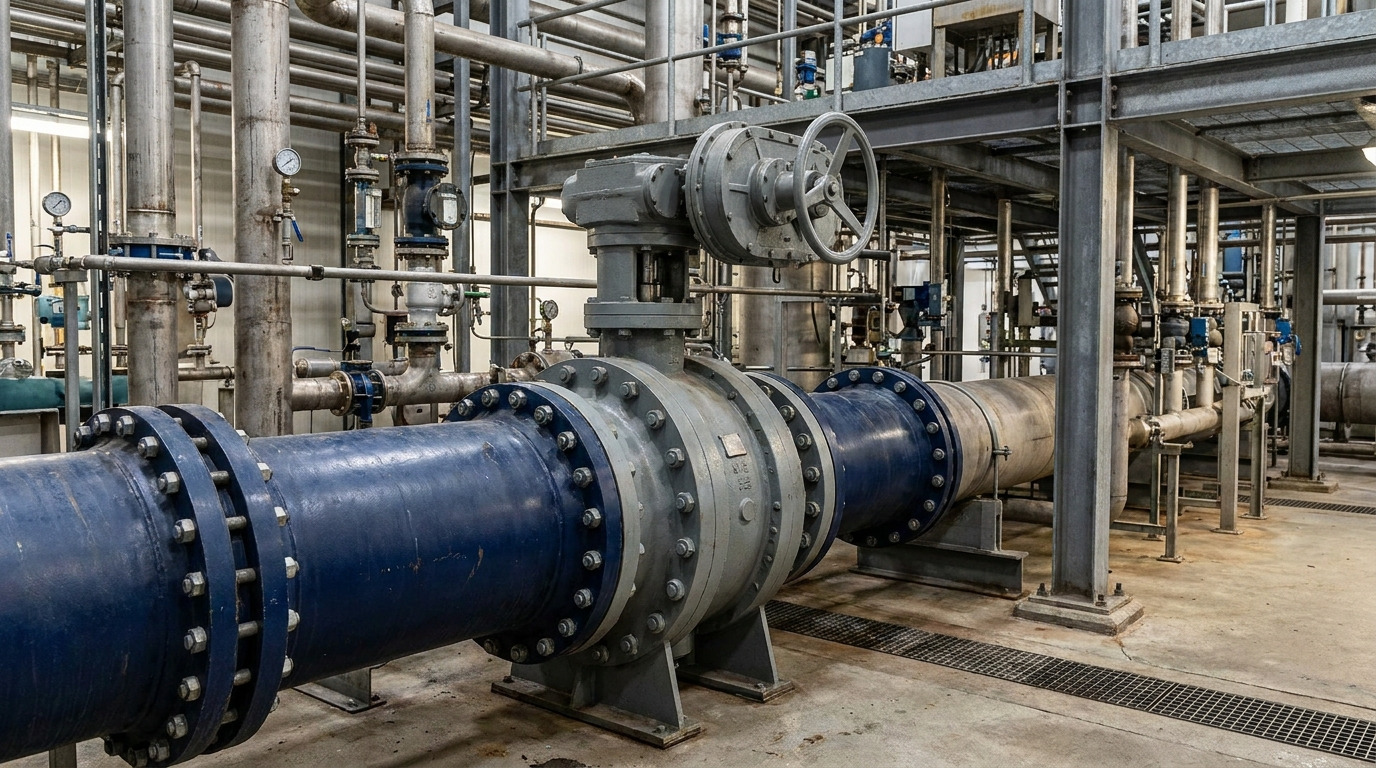
Choosing between wafer and lug-style designs is the most critical decision you face when specifying quarter-turn isolation components for industrial pipelines. Imagine a scenario where a routine downstream pump swap requires immediate pipeline isolation, but your team is stuck with a standard wafer valve. To perform this quick repair, you are forced to shut down and completely drain the entire piping loop, incurring massive operational downtime and lost productivity. You can easily solve this operational bottleneck by specifying a robust lug body butterfly valve to achieve independent downstream line disassembly.
What is a lug body butterfly valve?
A lug body butterfly valve is a quarter-turn flow control device featuring threaded metal lugs surrounding its outer casing to facilitate independent flange connection. Using a lug body butterfly valve allows process lines to be secured on each side using individual flange bolts.
This mechanical layout ensures that the valve body remains securely anchored even if one side of the pipeline is disassembled.
Mechanical Design Elements
Here is the deal:
You need to understand how the cast-on casing protects your system from fluid bypass during maintenance.
- Threaded Lugs: Internal female threads match ANSI/DIN flange patterns.
- Rigid Cast Casing: Robust metallic frame handles high piping stresses.
- Polished Disc: Centralized disk rotates to seal fluid loops.
Key Takeaway
The mechanical layout uses integrated threaded metal lugs to allow independent, dual-sided piping connections.
| Design Feature | Technical Function |
|---|---|
| Threaded Lugs | Direct bolt connection |
| Cast Casing | Prevents pipe stress distortion |
This dual-sided independent configuration provides the physical foundation for safe single-sided line servicing.
Why select a lug body butterfly valve?
You should select a lug body butterfly valve because it provides critical line-isolation capabilities and superior system safety during component maintenance. Incorporating a lug body butterfly valve into your piping layout prevents downstream fluid blowouts while keeping upstream segments active.
This added layer of security ensures your mechanical operators are protected when exposing open pipe ends.
Main Structural Advantages
Think about it:
How much capital would you save if your plant stayed running during a pump replacement?
- Independent Bolting: Lets you isolate sections without line pressure drops.
- Blowout Protection: Solid metallic walls hold the disc securely in place.
- Low Operating Footprint: Delivers equivalent isolation safety in half the space of gate valves.
Key Takeaway
Choosing a lugged body design guarantees localized piping maintenance capability without dropping system pressure.
| Operational Benefit | Safety Action |
|---|---|
| Localized Isolation | Safely disconnects downstream loops |
| Higher Rigidity | Resists high pressure deformation |
Selecting this design ensures your plant maintains maximum operational uptime during planned equipment overhauls.
How does a lug body butterfly valve work?
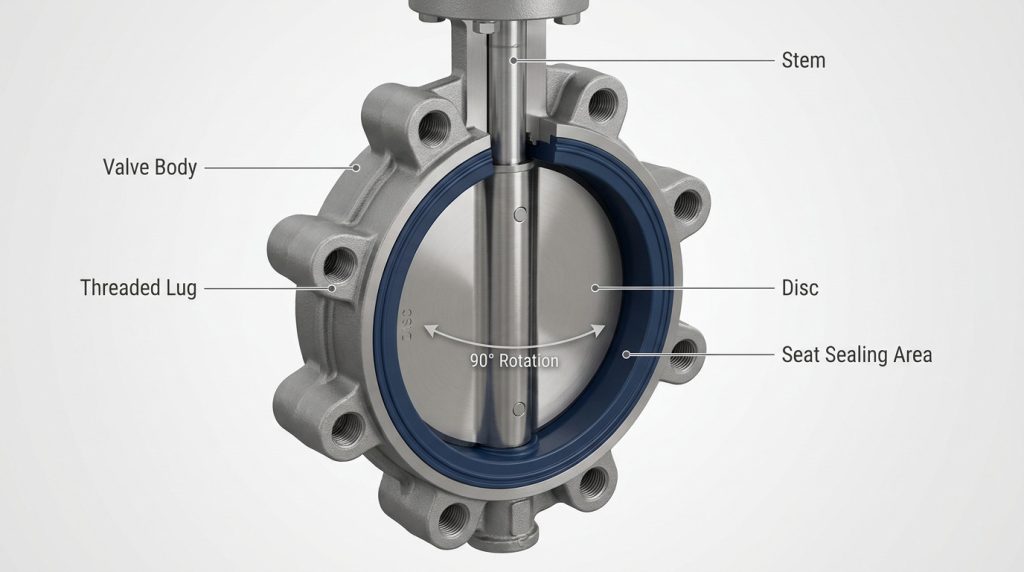
A lug body butterfly valve works by rotating a centralized metal disc 90 degrees inside the flow path to open, throttle, or completely isolate the fluid media. A lug body butterfly valve relies on the actuator to rotate the stem shaft, which presses the disc edge tightly against the compressed elastomer seat.
Because each flange is bolted independently to the threaded lugs, the sealing mechanism remains stable even if one side is unbolted.
Symmetrical Sealing Dynamics
But wait, there is more:
You get a highly balanced sealing surface that distributes line torque evenly across the entire circumference.
- Rotary Stem: Directly transfers actuator torque to the internal disc.
- Elastomer Seat: Deforms under compression to eliminate fluid bypass.
- Symmetrical Disc: Provides equal sealing efficiency against bidirectionally active process flows.
Key Takeaway
The valve works by translating mechanical shaft rotation into tight radial seal compression against a resilient liner.
| Mechanical Stage | Valve Action |
|---|---|
| Quarter-Turn | Swings disc 90 degrees |
| Seat Compression | Achieves bubble-tight closure |
This simplified mechanical action minimizes moving parts and ensures a reliable and predictable valve lifecycle.
Can you dead-end a lug body butterfly valve?
Yes, you can safely use a lug body butterfly valve for dead-end service because its independent flange bolts remain fully anchored when downstream piping is removed. When selecting a lug body butterfly valve, you must confirm that the design’s body is rated for full-pressure dead-end duty.
Using this configuration prevents upstream line pressure from blowing out the valve assembly.
Dead-End Sealing Safety
Here is the deal:
You must always specify matching downstream companion flanges or blind flanges to guarantee long-term safety.
- Downstream Isolation: Holds full line pressure on the pressurized upstream face.
- Secure Bolting: Retains flange gaskets without slipping out of place.
- Safety Compliance: Meets OSHA and regional plant safety standards.
Key Takeaway
Lug designs are structurally rated for dead-end service, provided you secure the open side with a blind flange.
| Service Setup | Flange Requirement |
|---|---|
| Active Isolation | Bolted between active pipes |
| Dead-End Service | Requires downstream blind flange |
Verifying your pressure limits before installation prevents seat displacement during dead-end operations.
What is the lug body butterfly valve pressure rating?
The standard pressure rating for a lug body butterfly valve spans from PN10 up to PN25 (or ASME Class 150/300) depending on body metallurgy and seat material. Choosing a high-performance lug body butterfly valve ensures that your piping system can handle high-pressure fluctuations up to 25 bar.
Standard test procedures require testing the valve at 1.5 times the working pressure.
Working Pressure Envelopes
Think about it:
How critical is it to match your valve’s rating to your pump’s peak discharge pressure?
- Class 150 Ratings: Standard design limits up to 16 bar.
- Class 300 Ratings: Reinforced castings rated up to 40 bar.
- Hydrostatic Compliance: Tested at 1.5 times working pressure to ensure safety.
Key Takeaway
Valve pressure ratings range from PN10 to PN25, matching most municipal utility and industrial processing applications.
| Nominal Class | Pressure Limit |
|---|---|
| Class 150 (PN16) | 16 bar working pressure |
| Class 300 (PN25) | 25 bar working pressure |
Aligning your design limits to these standardized ratings protects your downstream instrumentation from high-pressure spikes.
How to install your lug body butterfly valve?
To install your lug body butterfly valve, align the companion pipe flanges and tighten the short flange bolts in a star pattern. When deploying a lug body butterfly valve, you must keep the disc slightly open during alignment to prevent edge damage.
Ensuring correct piping alignment prevents uneven stress on the threaded lugs.
Field Installation Checklists
Here is the deal:
You will avoid costly seat distortion and bypass leakage by checking your pipe alignment before tightening.
- Prerun Flange Check: Ensure the mating pipes are parallel and concentric.
- Star Pattern Sequence: Tighten bolts in opposing pairs to distribute force.
- Calibrated Torque: Follow the manufacturer’s torque limits to protect the lugs.
Key Takeaway
Successful installation relies on precise flange centering and progressive, star-pattern bolt torque application.
| Installation Action | Critical Tool |
|---|---|
| Bolt Tensioning | Calibrated torque wrench |
| Centering Check | Flange alignment pins |
Correct physical mounting ensures low operating torque and protects the elastomer seat from tearing.
Is a lug body butterfly valve bidirectional?
Yes, a lug body butterfly valve is bidirectional and is designed to provide bubble-tight sealing against flow and pressure from either direction. Integrating a bidirectional lug body butterfly valve into your fluid network prevents reverse flow contamination during multi-phase cycles.
This symmetrical design makes installation faster by removing direction-specific positioning concerns.
Symmetric Bidirectional Performance
But wait, there is more:
You get identical sealing security regardless of whether the fluid flows forward or in reverse.
- Mirror-Image Seat: Symmetrical profiles ensure equal compression from both sides.
- Error-Free Mounting: Eliminates the risk of field crews installing the valve backward.
- Backflow Block: Protects high-value upstream equipment from process backflow.
Key Takeaway
Bidirectional sealing provides complete process isolation and eliminates installation orientation mistakes.
| Flow Vector | Sealing Class |
|---|---|
| Forward Flow | API 598 Class VI (Zero-leakage) |
| Reverse Flow | API 598 Class VI (Zero-leakage) |
Standardizing on bidirectional designs simplifies your piping blueprints and reduces spare parts inventory.
Which seat fits a lug body butterfly valve?
The ideal seat for a lug body butterfly valve is determined by the chemical compatibility, temperature, and abrasiveness of your process media. When configuring your lug body butterfly valve, you can select from EPDM, NBR, or high-performance PTFE seat inserts.
Selecting the wrong elastomer chemistry can lead to premature seat swelling and system leakage.
Material Selection Matrices
Think about it:
Would you risk chemical corrosion when a simple seat upgrade can guarantee years of operation?
- EPDM Liners: Best for water, HVAC glycol, and low-temperature applications.
- NBR Sealing: Perfect for oil, gas, lubricants, and pneumatic loops.
- PTFE Materials: Recommended for aggressive acids, solvents, and corrosive chemicals.
Key Takeaway
Select your seat material based on system temperature limits and chemical compatibility with your media.
| Seat Compound | Temp Range |
|---|---|
| EPDM | -20°C to +130°C |
| PTFE | -20°C to +200°C |
Specifying the correct seal polymer prevents premature swelling, tearing, and system fluid contamination.
How to test a lug body butterfly valve?
You test a lug body butterfly valve by performing standardized hydrostatic shell tests and pneumatic seat leakage tests to verify structural integrity. Every quality-assured lug body butterfly valve undergoes strict pressure testing to ensure it meets API 598 and ISO 5208 standards.
These verified QA steps guarantee that each valve is documentation-ready before arriving on-site.
Certified Testing Standards
Here is the deal:
You should require complete batch test reports to confirm your valves are 100% leak-free before installation.
- Shell Hydrotest: Done at 1.5 times the pressure rating to verify body strength.
- Seat Leak Check: Air pressure test at 1.1 times rated pressure to confirm zero leakage.
- High-Cycle Calibration: Verifies that operational torque remains within design limits.
Key Takeaway
Quality valves undergo hydrostatic shell and air seat tests to ensure bubble-tight isolation.
| Test Parameter | Target Pressure |
|---|---|
| Shell Hydro-Test | 1.5x working pressure |
| Seat Leakage Test | 1.1x working pressure |
Receiving traceable test certificates per lot guarantees code-compliant field handovers.
How to order your lug body butterfly valve?
To order your lug body butterfly valve, compile your pipe size, operating pressure, temperature limits, flange standard, and actuation needs. When ready to purchase a lug body butterfly valve, sharing these details with the technical team ensures a precise mechanical match.
This prevents sizing errors and configuration issues during on-site commissioning.
Ordering Specification Datasets
But wait, there is more:
You can easily request custom engineering adjustments to align with your legacy piping drawings.
- Define Connection Standards: Specify ANSI, DIN, or JIS bolt circle dimensions.
- Select Actuator Drives: Choose from manual levers, gears, or pneumatic actuators.
- Request QA Packs: Ask for ISO 9001, CE, and material test reports.
Key Takeaway
Order valves by specifying exact size, pressure class, seat polymers, and required code certifications.
| Order Metric | Technical Detail |
|---|---|
| Sizing Scope | DN25 to DN1200 |
| Actuation Options | Bare shaft, manual lever, or pneumatic actuator |
Submitting complete design data upfront ensures rapid manufacturing and short delivery turnarounds.
Streamline Your Industrial Flow Control Systems
By specifying the correct lug design, you solve the critical pipeline challenges of downtime, unsafe line maintenance, and premature component fatigue. Ruito Flow combines ISO 9001-certified Chinese manufacturing with robust CAD/CAE design and customized engineering to deliver dependable, code-compliant solutions to chemical processing, municipal water, and district energy projects globally. Our vision is to elevate B2B procurement with predictable lead times, transparent QA documentation, and technical support. If you are ready to request an engineering review, contact us today to receive a comprehensive technical quote within 24 hours.
Frequently Asked Questions
Can I use a wafer valve for terminal end-of-line service?
No, you cannot. Wafer valves require pipeline pressure from both sides to hold them in place, whereas a lug style provides the independent bolting necessary for safe end-of-line isolation.
What’s the best seat material for handling corrosive acids?
PTFE is the best choice. It provides exceptional chemical resistance and thermal stability, preventing degradation when exposed to aggressive industrial chemicals.
How do I know if my system requires a gear operator?
Yes, manual handles are suitable for sizes up to DN150, but you should specify a gear operator or pneumatic actuator for sizes DN200 and larger to manage the higher operating torques safely.
Can I order custom flange drillings to match old JIS pipelines?
Yes, you can. Ruito Flow provides customized machining to meet ANSI, DIN, or JIS standards, ensuring seamless compatibility with legacy piping systems.
How do I verify that the valve has been pressure tested?
Yes, every shipment includes an EN 10204 Type 3.1 Material Test Certificate and a traceable hydrostatic pressure test report confirming bubble-tight shutoff.