
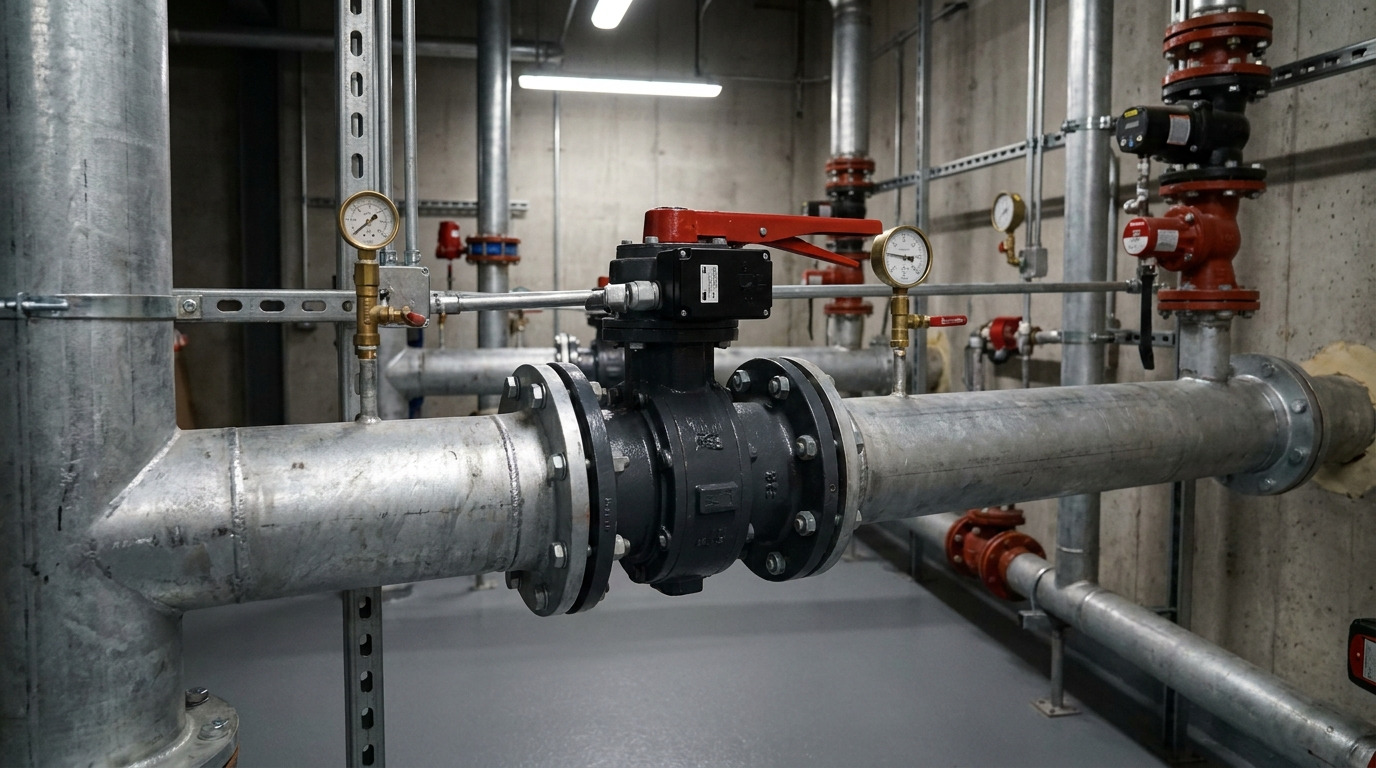
A butterfly valve in a fire fighting system is a high-performance quarter-turn rotary valve used to isolate, regulate, and direct the flow of pressurized fire suppression water. Imagine a sudden thermal trigger activating a building’s sprinkler system, only for water pressure to plunge due to an unisolated, leaking pipeline branch. This high-stakes operational failure occurs when facility managers rely on slow-acting, bulky isolation valves that seize during critical emergencies. To secure immediate, reliable system response and prevent catastrophic property loss, engineers install specialized butterfly valve fire protection systems designed to open fully in seconds and ensure absolute tight shut-off.
How does butterfly valve fire protection secure water supply?
Butterfly valve fire protection secures water supply by providing rapid, reliable isolation and distribution control within main supply networks during an emergency. Incorporating proper butterfly valve fire protection units ensures that water pressure remains constant where it is needed most.
What is the role of valves in fire pipelines?
Main line isolation valves allow maintenance crews to service localized segments of your sprinkler system without taking the entire building offline. Keeping water pressure balanced across the system is absolutely vital.
Here is why:
- They prevent complete system pressure drop during repairs.
- They isolate ruptured lines instantly to minimize water damage.
Why is rapid system responsiveness mandatory?
When a fire sprinkler activates, every second counts to prevent flame spread. Quick-acting valves ensure that pressurized water instantly reaches active discharge heads without delay.
Think about it. Fast-acting quarter-turn mechanisms are the standard for modern high-rise water mains.
Key Takeaway: Integrating highly responsive flow control is the single most critical factor in mitigating system-wide pressure losses during localized thermal events.
| System Metric | Butterfly Valve Performance | Standard Gate Valve | Design Implication |
|---|---|---|---|
| Response Speed | Under 5 Seconds | 30 to 60 Seconds | Minimizes initial pressure drop delays |
| Seizing Risk | Minimal (Rotary Motion) | Moderate (Stem Scaling) | Lowers mandatory inspection failures |
| Space Required | Extremely Compact | High Clearance Required | Allows dense riser room configurations |
Let’s evaluate how these responsiveness metrics influence the actual physical layout of your setup.
What is a butterfly valve fire protection system setup?
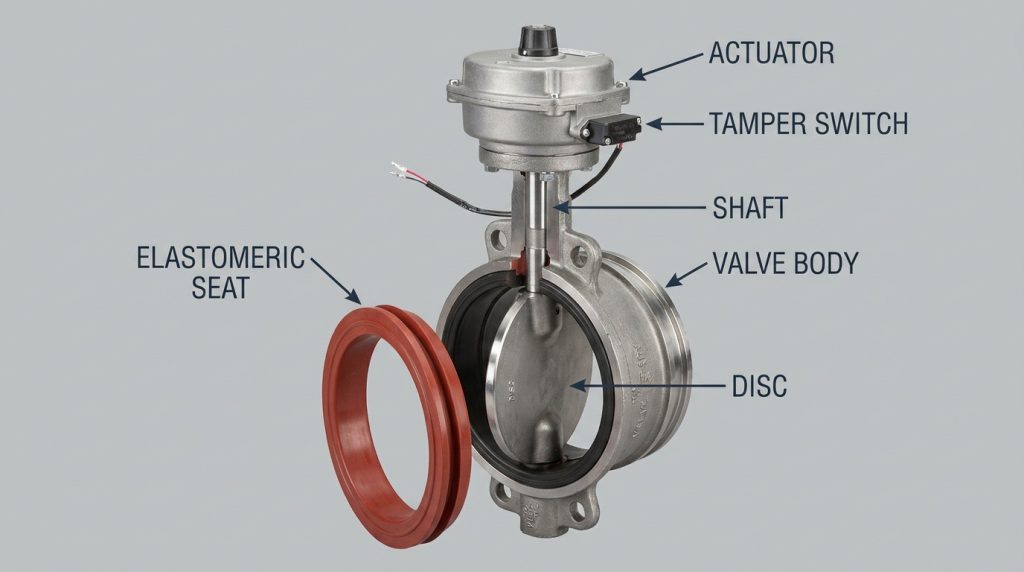
A butterfly valve fire protection system setup consists of a quarter-turn valve body, an actuator, and electronic monitoring components integrated directly into wet or dry risers. Specifying an optimized butterfly valve fire protection assembly ensures complete mechanical compatibility with municipal systems.
What are the primary physical components?
The valve assembly features a durable ductile iron body housing a flexible elastomeric seat and a rotating internal disc. Additionally, an integrated tamper switch monitors whether the valve is open or closed.
Think about it. This simple combination of parts yields unmatched reliability.
- The ductile iron shell provides excellent pressure containment.
- The elastomeric seat guarantees bubble-tight shut-off.
What makes these valves uniquely space-saving?
Unlike heavy gate valves, these units feature a narrow, wafer-thin face-to-face dimension. This compact footprint allows designers to fit multiple valves into tight riser rooms effortlessly.
The best part? It lowers structural support costs throughout the building.
Key Takeaway: The simplified mechanical design of modern quarter-turn valves minimizes moving parts, dramatically lowering the probability of internal physical interference.
| Anatomy Element | Standard Material Spec | Operational Purpose | Failure Mitigation |
|---|---|---|---|
| Valve Body | ASTM A536 Ductile Iron | Structural Pressure Containment | Prevents body cracking under hydraulic shock |
| Internal Disc | Al-Bronze or Nylon Coated | Primary Flow Obstruction | Resists cavitation-induced pitting |
| Elastomeric Seat | EPDM / NBR | Drop-Tight Sealing | Eliminates slow internal bypass leaks |
Understanding this physical layout helps clarify the mechanical actions occurring inside the valve body.
How does a butterfly valve fire protection mechanism function?
A butterfly valve fire protection mechanism functions by rotating an internal disc ninety degrees to quickly block or permit water flow. Deploying a reliable butterfly valve fire protection system provides direct mechanical shut-off under extreme pressure spikes.
How does the quarter-turn mechanism work?
Rotating the handwheel turns the internal gear operator, which directly rotates the valve shaft and disc. This rotary movement requires minimal manual force to operate smoothly.
The best part?
- You only need a 90-degree turn for full isolation.
- It minimizes mechanical wear on moving parts.
What occurs during full disc closure?
As the disc turns perpendicular to the pipeline, its edge compresses the resilient rubber seat. This tight seal completely stops high-velocity water flow without any bypass leakage.
Think about it. A secure mechanical seal is your last line of defense against system leakage.
Key Takeaway: Quick mechanical rotation ensures that critical fire lines can transition from isolated standby to active discharge within seconds.
| Disc Angle (Degrees) | Flow Percentage | Pressure Drop (Δp) | System State |
|---|---|---|---|
| 90° (Fully Open) | 100% Flow | Minimal Loss | Fire suppression active and pressurized |
| 45° (Throttling) | 40% Flow | Moderate Drop | System testing or line balancing |
| 0° (Closed) | 0% (Bubble-Tight) | Full Isolation | Branch isolation for system maintenance |
This simple mechanical design translates directly into practical performance advantages over other common valve types.
Why select butterfly valve fire protection over other options?
You should select butterfly valve fire protection over other options because it is lighter, more compact, faster to operate, and highly cost-effective. Choosing a high-performance butterfly valve fire protection model over heavy gate valves reduces structural loads and eases pipeline configuration.
Why is speed critical in emergency shut-off?
A burst pipe during a fire emergency can cause severe water damage to lower floors. Fast-acting quarter-turn valves allow teams to shut down broken branches immediately.
Here is why:
- It minimizes structural and asset water damage.
- It keeps pressure stable in adjacent fire zones.
How do compact designs lower system weight?
Because these valves use less raw metal, they weigh significantly less than equivalent gate valves. This reduced weight lowers shipping costs and simplifies overhead installation.
Think about it.
- Lighter valves put less stress on pipe hangers.
- They require less structural bracing in seismic zones.
Key Takeaway: Optimizing system weight and footprint directly reduces both structural support engineering costs and total project installation times.
| Parameter | Advanced Butterfly Valve | Traditional Gate Valve | High-Performance Globe Valve |
|---|---|---|---|
| Weight (DN150) | Approx. 12 kg | Approx. 45 kg | Approx. 60 kg |
| Face-to-Face Width | Very Narrow (Wafer) | Wide | Extremely Wide |
| Installation Labor | Low (Two-bolt alignment) | High (Multi-flange bolting) | High |
Selecting the right valve type is only half the battle; you must also choose the optimal connection configuration.
Which butterfly valve fire protection types fit your pipeline?
The right butterfly valve fire protection types for your pipeline depend on whether your layout requires wafer, lug, grooved, or flanged connection standards. Matching the correct butterfly valve fire protection model to your specific pipe joint reduces installation errors and prevents leaks.
When should you choose wafer connections?
Wafer-style valves slide directly between standard pipe flanges, offering the most compact installation profile available. They are perfect for general indoor sprinkler risers where space is at a premium.
Here is why:
- They are the most cost-effective connection type.
- They require minimal space between adjacent pipes.
Why are grooved ends popular in sprinklers?
Grooved valves connect rapidly using standard mechanical couplings without requiring hot welding on site. This design dramatically cuts down installation hours in large commercial projects.
The best part?
- It simplifies system retrofits and updates.
- It accommodates minor thermal pipe expansion.
Key Takeaway: Matching the mechanical connection style to the piping architecture ensures rapid system assembly and leak-free joints under high pressure.
| Connection Type | Maximum Pressure | Primary Application | Major Limitation |
|---|---|---|---|
| Wafer | Class 150 (PN16) | Indoor Riser Rooms | Cannot be used for end-of-line isolation |
| Lug | Class 300 (PN25) | Plant Isolation Lines | Slightly heavier than wafer designs |
| Grooved | PN16 / PN25 | Standard Wet Sprinklers | Requires compatible grooved pipe fittings |
Regardless of the connection type you select, the valves must comply with rigorous international safety standards.
Which standards govern butterfly valve fire protection designs?
Industry certifications like UL listings and FM approvals govern butterfly valve fire protection designs to ensure reliable performance under extreme stress. Specifying a certified butterfly valve fire protection model ensures compliance with standard municipal building codes.
Why are UL and FM certifications critical?
Testing organizations subject listed valves to intense high-pressure bursts and cyclic durability tests. These certifications give engineers peace of mind during emergency activations.
Here is why:
- They verify the structural integrity of the valve body.
- They guarantee the electrical tamper switch functions perfectly.
What is the role of AWWA C504 standards?
This standard dictates the precise thickness, material grades, and leakage criteria for rubber-seated valves. Following these benchmarks keeps fire protection systems highly dependable over decades of service.
Think about it.
- It guarantees standardized dimensions for easy swap-outs.
- It ensures the valve seat handles continuous standby pressure.
Key Takeaway: Mandating UL-listed and FM-approved products is standard practice to satisfy municipal building codes and lower insurance risk.
| Standard Body | Specific Regulation | Technical Objective | Compliance Verification |
|---|---|---|---|
| Underwriters Labs | UL 1091 | Fire Protection Valve Safety | Verifies electrical tamper switch signal |
| Factory Mutual | FM Class 1112 | High-Performance Integrity | Ensures bubble-tight seal under surge limits |
| EN / ISO | EN 593 / ISO 5752 | Structural Face-to-Face Norms | Standardizes replacement part dimensions |
Maintaining compliant hardware also means understanding how to troubleshoot minor operational issues when they arise.
How to resolve butterfly valve fire protection pipeline issues?
You can resolve butterfly valve fire protection pipeline issues by establishing routine flushing protocols and using epoxy-coated components to prevent seal degradation. Addressing common butterfly valve fire protection issues early prevents unexpected downtime in active safety lines.
How do you prevent elastomeric seat leaks?
Fine grit and rust particles can easily scar the internal soft rubber lining when operating the valve. Flushing the line thoroughly before pressure tests keeps the seating area clean.
Think about it.
- It eliminates slow, hard-to-detect bypass leakage.
- It extends the operational lifespan of the internal seal.
How to stop corrosion in wet pipe systems?
Using fusion-bonded epoxy coatings protects the internal ductile iron body from aggressive rust scaling. This preventative layer ensures the disc rotates smoothly without binding.
The best part?
- It prevents internal mechanical seizing.
- It maintains pristine water quality inside the system.
Key Takeaway: Implementing proactive pipeline flushing prior to final testing prevents catastrophic seal degradation and costly early valve failure.
| Symptom | Probable Root Cause | Field Action Plan | Preventative Metric |
|---|---|---|---|
| Slow Pass-By Leakage | Torn elastomer seal | Replace internal seat cartridge | Install upstream strainers |
| Stiff Handwheel Torque | Gearbox corrosion | Pack gearbox with high-grade grease | Standardize biannual cycling |
| Tamper Signal Fault | Misaligned switch cam | Calibrate internal mechanical limit | Verify signal wire connections |
Solving operational challenges is much easier when you select the exact valve model matched to your technical criteria.
How to specify the best butterfly valve fire protection model?
Specifying the best butterfly valve fire protection model requires calculating exact flow requirements, pressure limits, and chemical compatibility profiles. Selecting the correct butterfly valve fire protection unit guarantees optimal performance across the lifetime of your pipeline.
How to calculate operating torque needs?
Dynamic flow velocities exert rotational forces against the disc, which impacts the required gearbox actuation torque. Always specify gear operators that handle maximum booster pump pressures easily.
Here is why:
- It prevents manual operators from locking up.
- It protects internal gears from mechanical overload.
Which body and disc materials fit best?
For standard water systems, ductile iron paired with bronze or stainless steel discs offers excellent performance. If handling brackish or marine water, always choose corrosion-resistant nickel alloys.
Think about it.
- Bronze discs resist pitting from harsh, mineral-rich water.
- Epoxy-coated bodies resist external environmental rust.
Key Takeaway: Calculating dynamic operational torque under full design flow conditions prevents gearbox overload and ensures manual operations remain easy.
| Engineering Parameter | Core Specification Range | Critical Design Consideration |
|---|---|---|
| Pressure Rating | PN16, PN25, or Class 150/300 | Must exceed maximum booster pump deadhead pressure |
| Flow Coefficient (Cv) | 200 to 12,000+ (Size dependent) | Keep velocity under 5 m/s to prevent erosion |
| Internal Coating | Fusion Bonded Epoxy (FBE) | Must be NSF 61 or WRAS compliant for dual-use lines |
With the correct model specified, you can determine exactly where to deploy these units across your facility.
Where should butterfly valve fire protection units be deployed?
You should deploy butterfly valve fire protection units at key control intersections, including riser floor feeds, pump intake pipelines, and industrial manifolds. Correctly placing your butterfly valve fire protection units ensures quick zone-by-zone isolation during critical emergencies.
How do these valves protect sprinkler mains?
Serving as floor isolation valves, these units allow maintenance teams to shut down specific floors without disabling the entire network. Their built-in tamper switches alert monitoring stations if anyone closes the line.
The best part?
- They provide instant electronic status feedback to the control room.
- They maintain high safety compliance without physical audits.
Why deploy them in heavy industrial plants?
Industrial sites rely on large-volume deluge systems that must activate in seconds to suppress flash fires. High-capacity rotary valves provide the swift actuation required to flood manifolds instantly.
Think about it.
- They fit into dense, complicated piping manifolds.
- They allow rapid manual override in power-failure scenarios.
Key Takeaway: Positioning indicating valves with integrated electronic monitoring at all riser intersections prevents unauthorized manual shutdowns.
| System Location | Primary Valve Function | Critical Feature Required | Technical Rationale |
|---|---|---|---|
| Riser Floor Isolator | System isolation & testing | Integrated tamper switch | Sends real-time open status to building safety |
| Fire Pump Suction | Pump service isolation | Non-turbulent flow design | Prevents intake cavitation during active pumping |
| Deluge Manifolds | Rapid water routing | Gearbox manual override | Allows emergency mechanical bypass operation |
Ensuring these installations function over their expected service life requires setting up a strict maintenance routine.
Why is maintenance vital for butterfly valve fire protection?
Regular maintenance is vital for butterfly valve fire protection to clear out interior mineral buildup and verify the electronic monitoring signals remain active. Standardizing your butterfly valve fire protection inspection routines guarantees that the valve operates perfectly the moment a fire is detected.
How often should test cycles be conducted?
Safety standards recommend cycling indicating valves at least once a quarter to keep mechanical joints free of scale. This simple check ensures that the internal disc remains completely mobile.
Here is why:
- It keeps the mechanical gearbox parts well-lubricated.
- It prevents internal mineral scaling on the valve seat.
What does standard annual inspection entail?
The annual test requires verifying the full range of motion, performing visual leak checks, and confirming that the electronic tamper alarm functions correctly at the master panel.
Think about it.
- A faulty tamper switch could leave a closed valve undetected.
- Early seal inspections prevent costly, unexpected leaks during operations.
Key Takeaway: Strictly adhering to standardized cycling intervals eliminates long-term mineral buildup and ensures reliable emergency operation.
| Frequency | Action Required | Expected Result | NFPA Standard |
|---|---|---|---|
| Quarterly | Handwheel cycling (Full travel) | Smooth rotation, no binding | NFPA 25 Sec. 13.3.3 |
| Semiannually | Tamper switch signal test | Alarm registers at panel | NFPA 25 Sec. 13.3.4 |
| Annually | External seal visual audit | Zero trace of weeping or rust | NFPA 25 Sec. 13.3.1 |
This structured maintenance ensures your fire protection infrastructure stands ready to perform at a moment’s notice.
How can we assist with butterfly valve fire protection needs?
Selecting the right valve configuration requires precise coordination between hydraulic calculations, standard certifications, and budget boundaries. Our engineering team designs and manufactures high-performance valves engineered to perform reliably under intense pressure. Protect your personnel and your high-value assets by installing components designed to last. For detailed technical brochures, custom CAD drawings, or pricing details, contact us today to consult with a dedicated valve applications specialist.
FAQ
Can I use standard industrial butterfly valves for fire protection?
No, standard industrial valves cannot be substituted because they lack the required third-party fire ratings and standard safety features. NFPA codes mandate using UL-listed and FM-approved models. These certified designs include features like integrated dual-tamper monitoring switches to prevent unauthorized closures.
What’s the best connection type for high-rise building sprinklers?
Grooved end connections are the ideal choice for high-rise building sprinkler installations. They are lightweight, allow for slight piping misalignment, and use standard mechanical couplings that speed up installation. This configuration reduces labor costs compared to traditional, heavy-flanged installations.
How do I know if my butterfly valve seal needs replacement?
Continuous downstream weeping when fully closed or significantly elevated operating torque indicates a failing elastomer seal. If flushing the line does not restore a tight seal, the internal elastomer seat has likely suffered tears from pipeline debris or wear. This requires immediate cartridge replacement to prevent pressure drops.
Can I install a butterfly valve in either horizontal or vertical pipes?
Yes, butterfly valves operate efficiently in both horizontal and vertical piping runs. For horizontal lines, the shaft should be aligned horizontally to prevent debris from settling in the lower shaft bearings. Vertical installations are common in space-constrained building risers and provide excellent water flow control.