
Choose a ball valve when tight isolation, a clear bore, or high differential pressure is the main requirement; choose a butterfly valve when large line size, low installed weight, compact dimensions, or modulating duty matters more. That is the practical answer to the ball valve vs butterfly valve decision, but it is only a starting point.
The wrong choice often happens because a team compares two generic valve names instead of two complete configurations. A full-port, trunnion-mounted ball valve is not equivalent to a reduced-port floating ball valve. A resilient-seated concentric butterfly valve is not equivalent to a high-performance or triple-offset design. You need to compare the actual bore, seat, materials, pressure-temperature limits, flow coefficient, connection, and actuator. RUITO’s range of industrial ball valve configurations shows how much the design can vary within one valve family.
Ball Valve vs Butterfly Valve at a Glance
A ball valve is usually the stronger first candidate for demanding isolation, while a butterfly valve is usually the stronger first candidate for large-diameter, space-sensitive, or modulating service.
The table below turns that general rule into a usable first screening.
| Decision factor | Ball valve | Butterfly valve |
|---|---|---|
| Closing element | A bored ball rotates between seats | A disc rotates on a shaft inside the flow path |
| Fully open flow path | A full-port design can provide a straight, unobstructed passage; a reduced port cannot | The disc and shaft remain in the flow path |
| Isolation | Often preferred for critical shutoff, gas service, or high differential pressure | Resilient, high-performance, and triple-offset designs can provide tight shutoff within their rated conditions |
| Flow control | Standard round-port designs are mainly for on/off duty; characterized or V-port designs suit control | Commonly used for modulation when the Cv curve, operating angle, torque, and actuator are correctly selected |
| Size, weight, and space | Weight and support requirements rise quickly with size | Compact face-to-face dimension and lower weight are major advantages in large lines |
| Piggable or clean-bore duty | A verified full-bore design is normally the better candidate | The disc obstructs the passage, so it is generally unsuitable for pig passage |
| Installation risk | Check body length, support, cavity venting, and maintenance access | Check flange compatibility, disc clearance, gasket position, and dead-end rating |
| Cost pattern | Often competitive in smaller sizes or where isolation performance avoids added equipment | Bare-valve cost advantage often increases with diameter, but actuation and installation still matter |
This table is a screening tool, not a purchase specification. A specialized butterfly valve can outperform a basic ball valve in severe service, and an engineered ball valve can be built for very large lines. The final choice must be based on the exact model and operating envelope.
How Construction Changes System Behavior
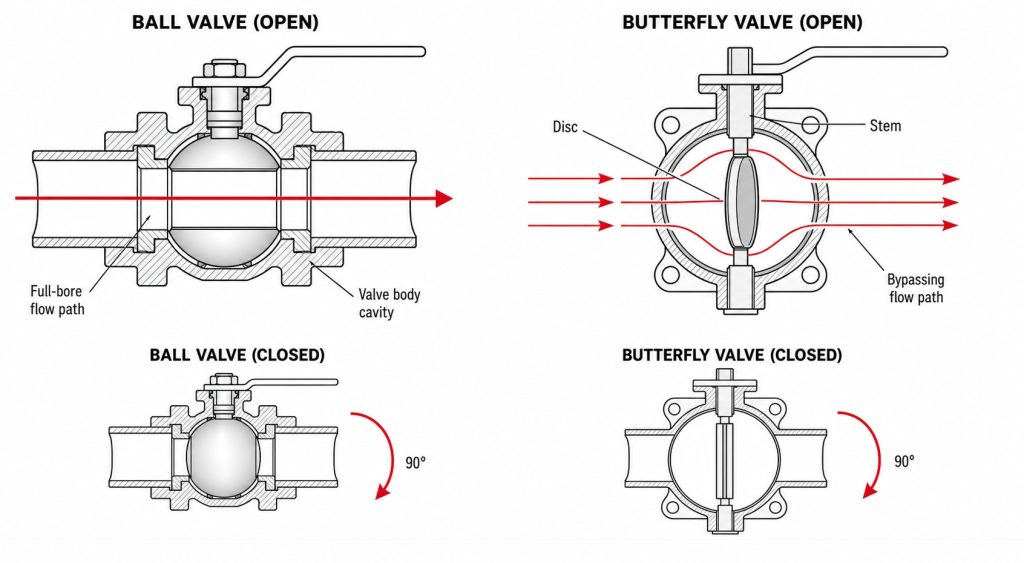
The closing element changes the flow path, sealing load, torque, and maintenance risks even though both valves operate with a quarter turn.
Ball valve behavior
When a ball valve opens, its bore aligns with the pipe. A full-port design minimizes obstruction and may allow pig passage, but you must confirm the guaranteed clear bore against the pig and the actual pipe internal diameter. A reduced-port design is lighter and less expensive, yet its smaller opening raises velocity and pressure loss.
The ball also creates a body cavity between the seats. Media can become trapped there, so liquid thermal expansion, polymerizing fluids, solids, and cleaning requirements may require cavity relief, venting, draining, or a special seat arrangement. Floating and trunnion-mounted designs also develop different seat loads and operating torques.
Butterfly valve behavior
A butterfly valve keeps its disc and shaft in the line at every position. That makes the body compact, but the disc affects pressure loss, control behavior, dynamic torque, and clearance with the adjacent pipe. Available butterfly valve connection and material options include wafer, lug, and flanged bodies plus several seat, disc, and body combinations.
Do not treat all butterfly designs as one performance class. Concentric resilient-seated valves, double-offset high-performance valves, and triple-offset metal-seated valves use different sealing geometries and suit different pressure, temperature, cycling, and leakage requirements.
Compare Flow Capacity and Control With Real Data
Valve type alone does not predict pressure drop or control quality; compare the manufacturer’s Cv or Kv data at the required size and opening.
For on/off service, calculate the pressure loss at normal and maximum flow with the valve fully open. A full-port ball valve will generally have less obstruction than a butterfly valve, but “full port” does not mean zero loss, and a reduced-port ball valve can impose a meaningful restriction. If your design uses Cv, this ball valve pressure-drop calculation method provides the next step after the initial comparison.
For modulating service, request the Cv curve by opening angle, the recommended control range, maximum allowable velocity, cavitation or flashing assessment, and torque data across the travel. A standard round-port ball valve may produce an abrupt response and concentrated seat wear when held partly open. A characterized ball or properly sized butterfly valve can give better control, but neither should be selected from nominal line size alone.
Also check the installed characteristic, not only the inherent valve curve. Pump head, downstream resistance, and changing system pressure can make a valve that looks acceptable on a catalog curve unstable or insensitive in the real system.
Match the Seal and Materials to the Full Envelope
The reliable choice comes from the complete pressure, temperature, media, and leakage envelope rather than from a blanket rule that one valve family seals better.
Start with maximum line pressure and maximum shutoff differential pressure in both directions. Add minimum and maximum temperature, startup and surge conditions, vacuum exposure, cycle frequency, and how long the valve may remain stationary. Then verify the body, ball or disc, stem, seats, seals, packing, coating, and fasteners against the fluid and contaminants.
Soft-seated ball valves often provide very low leakage in clean service, but temperature, abrasion, chemical attack, and trapped solids can damage the seats. Metal-seated ball valves extend the service envelope but may have a different allowable leakage rate and higher torque. Resilient-seated butterfly valves work well in many water and utility systems; offset and metal-seated designs extend butterfly service into higher temperature or more demanding cycling conditions.
Do not write “zero leakage” or “bubble-tight” without an acceptance basis. Specify the test standard, test medium, pressure, duration, flow direction, and permitted leakage rate. ISO 5208:2015 covers pressure-boundary examinations and the verification of closure tightness for metallic industrial valves, while the applicable product standard can impose different requirements.
Installation and Maintenance Can Reverse the Choice
A valve that fits the duty but conflicts with the piping interface or maintenance plan is still the wrong valve.
For either type, confirm nominal size, pipe schedule or bore, end standard, pressure class, flange drilling, face-to-face dimension, orientation, actuator envelope, lifting points, and access for removal. For valves within its material and construction scope, ASME B16.34 addresses pressure-temperature ratings, dimensions, tolerances, materials, testing, and marking. Other projects may require different product and flange standards.
Butterfly valves need several extra checks. Confirm that the open disc clears the pipe bore, liner, gasket, and any adjacent fitting. Verify whether the body is wafer, lug, or double flanged, and never assume that every lug body has the same dead-end pressure rating. This guide to wafer and lug butterfly valves in real piping conditions explains why connection style affects isolation and removal plans.
Ball valves need room and support for the body and actuator, especially as size and pressure class increase. Confirm whether a three-piece body permits the maintenance approach you expect, whether the bore is genuinely piggable, and whether vents, drains, cavity relief, double isolation, or fire-safe features are required. For automated valves, size the actuator for breakaway, running, and seating torque at the worst differential pressure, with the project’s required margin and fail position.
Use This Six-Question Selection Sequence
The fastest reliable decision is to answer six questions in order and reject any option that cannot meet one of them.
- What must the valve do? Define isolation, emergency shutdown, modulation, diversion, pig passage, draining, or maintenance segregation. Do not combine duties unless the proposed design is rated for all of them.
- What is the operating envelope? Record normal and maximum line pressure, maximum differential pressure, temperature limits, vacuum, transients, cycle frequency, and required service life.
- What passes through it? Identify phase, composition, concentration, solids size and loading, abrasiveness, corrosion risk, tendency to polymerize or crystallize, and cleaning chemicals.
- What hydraulic result is acceptable? State minimum, normal, and maximum flow; allowable pressure loss; required Cv or Kv; and the usable control range if the valve modulates.
- What must physically match? Provide pipe size and schedule, connection and flange standard, face-to-face limit, available space, orientation, support, actuator interface, and maintenance removal path.
- How will acceptance be proved? State material certificates, approved drawings, leakage rate and test standard, shell and seat test records, marking, inspection hold points, actuator functional test, and document language.
After those questions, the choice is usually clear. Favor a ball valve when an unobstructed bore, critical isolation, gas service, or high differential pressure dominates. Favor a butterfly valve when large diameter, low weight, limited space, or properly sized modulation dominates. If both remain viable, compare total installed cost and lifecycle risk rather than bare valve price.
Turn the Choice Into an Auditable Valve Specification
The selection is complete only when the purchase documents define the exact configuration and the evidence required for acceptance.
Your RFQ should name the valve type and design variant, size, pressure class, bore or disc style, body and trim materials, seat and packing materials, end connection, flow direction, design and test standards, leakage acceptance, actuator supply and fail action, accessories, coating, quantity, and required documents. Attach the P&ID, line list, datasheet, and interface drawing when they affect the decision.
Ask the supplier to return a marked-up datasheet, dimensional drawing, pressure-temperature rating, Cv or Kv data, torque data, material list, and exception schedule before production. Hold approval until every deviation is visible. A generic catalog statement cannot replace model-specific confirmation.
RUITO’s documented U.S. replacement-valve workflow includes pre-production interface drawings, material test certificates, and shell and seat test records. For a ball or butterfly valve package, we can use the same evidence structure to link delivered materials, dimensions, and test results to the approved specification. The purpose is not extra paperwork; it is to prevent the wrong valve from reaching installation.
The Better Valve Is the One the Service Can Prove
Ball valves usually lead when shutoff integrity, a clear bore, or high differential pressure controls the decision; butterfly valves usually lead when diameter, weight, space, or modulating duty controls it. The exceptions are why the model, seat, materials, interfaces, Cv, torque, and leakage acceptance must be verified before purchase.
If you send RUITO your media, operating envelope, line data, duty, and acceptance requirements through our project contact page, our engineering team can compare the two configurations and return a specification-focused recommendation.
Frequently Asked Questions
Is a butterfly valve always cheaper than a ball valve?
No. A butterfly valve often has a lower bare-valve cost as diameter increases, but total installed cost also includes flanges, actuator size, supports, bypasses, testing, maintenance access, and expected leakage risk. Compare complete configurations at the same duty and acceptance criteria.
Can a butterfly valve provide bubble-tight shutoff?
Yes, some resilient-seated butterfly valves can meet very low leakage requirements within specified pressure, temperature, direction, and test conditions. Put the required standard and allowable leakage rate in the datasheet instead of relying on the phrase “bubble-tight.”
Can a standard ball valve be used for throttling?
Only for limited or coarse throttling when the manufacturer permits it. Holding a standard round-port ball partly open can create high-velocity jets, unstable response, and localized seat wear. Use a characterized or V-port design for sustained control duty and verify its sizing and operating range.
Is every lug butterfly valve suitable for dead-end service?
No. Dead-end capability depends on the exact body design, size, pressure, temperature, flange arrangement, and bolting. Require the manufacturer’s dead-end rating for the proposed model and check whether the rating is reduced from normal bidirectional service.