
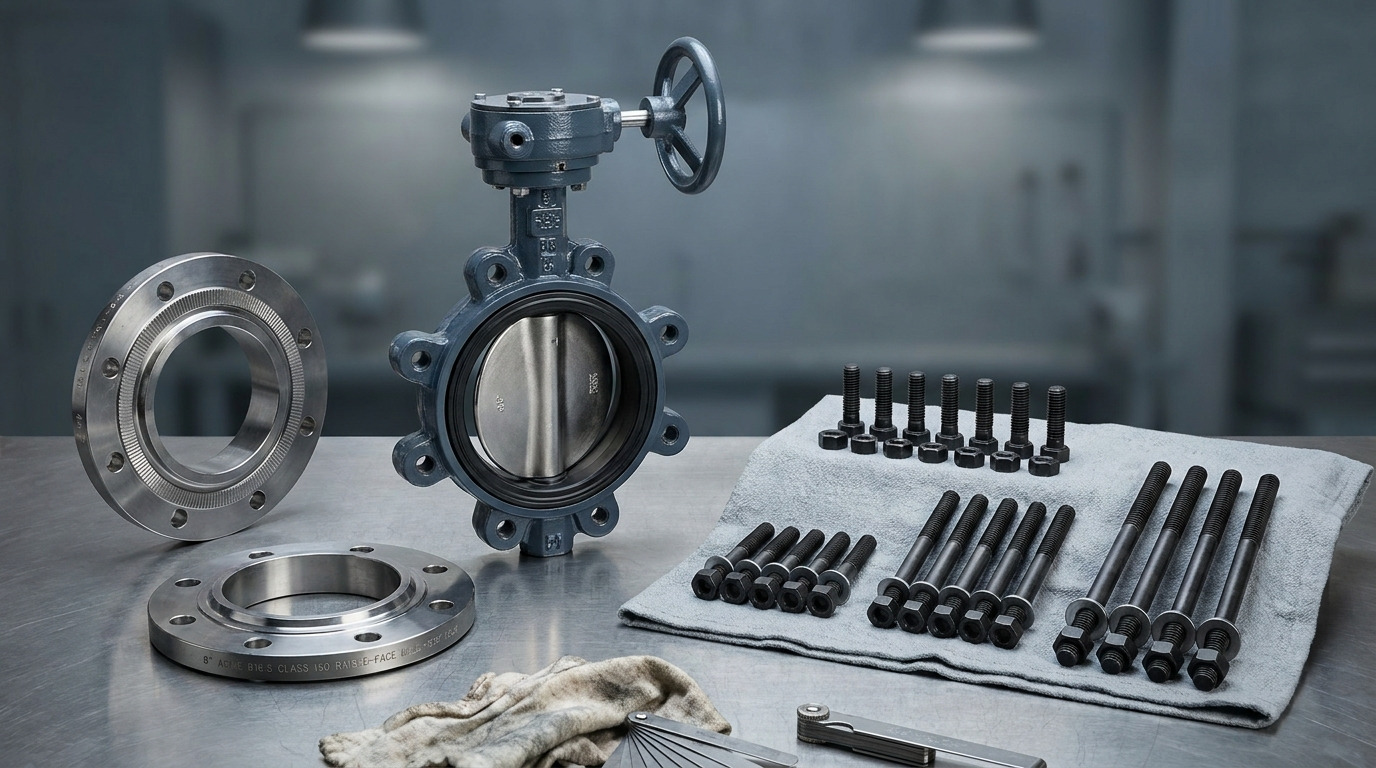
For an 8 inch ASME Class 150 butterfly valve, the usual bolt size is 3/4 in-10 UNC, but the correct length depends on whether the valve is wafer, lug, or flanged. The 8 inch butterfly valve bolt size also changes when you move from ASME Class 150 to Class 300, or from an inch-based ASME flange to a metric DN200 PN10 or PN16 flange.
A common field problem is simple: someone orders bolts from a flange chart, then finds that the studs are too short for a wafer valve or too long for a tapped lug body. This guide helps you separate flange drilling, valve body style, bolt length, material, and installation checks so you can specify industrial butterfly valves with fewer fit-up surprises.
8 Inch Butterfly Valve Bolt Size Quick Chart
For most 8 inch butterfly valve installations, start with the flange standard and pressure class, then adjust the length for the valve body style. The table below gives practical starting points, but the final length must be checked against the valve drawing, flange type, gasket thickness, washers, and required thread engagement.
| Valve and flange condition | Typical fastener count | Bolt diameter and thread | Typical length starting point | Important note |
|---|---|---|---|---|
| NPS 8 ASME Class 150 flange pair only | 8 studs | 3/4 in-10 UNC | 4-1/4 in RF, 4-3/4 in RTJ per common ASME B16.5 charts | This is for flange-to-flange bolting, not a wafer body |
| NPS 8 ASME Class 150 wafer butterfly valve | 8 through fasteners | 3/4 in-10 UNC | About 6 in machine bolts or 6-3/4 to 7 in studs in many Class 125/150 butterfly valve guides | Body thickness makes this longer than a plain flange joint |
| NPS 8 ASME Class 150 lug butterfly valve | 16 cap screws for both sides | 3/4 in-10 UNC | Often about 2-1/4 to 2-1/2 in cap screws, or longer studs/hex bolts where specified | Do not bottom out in tapped lugs |
| NPS 8 ASME Class 300 flange pair only | 12 studs | 7/8 in-9 UNC | 5-1/2 in RF, 6 in RTJ per common ASME B16.5 charts | Class 300 uses more and larger fasteners |
| DN200 PN10 butterfly valve | 8 bolts | M20 | Length depends on body style and flange/gasket stack | EN 1092-1 drilling commonly uses 8 x 22 mm holes on 295 mm PCD |
| DN200 PN16 butterfly valve | 12 bolts | M20 | Length depends on body style and flange/gasket stack | EN 1092-1 drilling commonly uses 12 x 22 mm holes on 295 mm PCD |
The key point is that diameter and count usually come from the flange standard, while length comes from the installed stack. If you only remember one rule, remember this: an 8 inch Class 150 wafer valve does not normally use the same length studs as an 8 inch Class 150 flange pair with no valve between the flanges.
Why The Flange Standard Comes First
The flange standard decides the bolt circle, hole count, and bolt diameter before the butterfly valve body style decides the length. In inch-based piping, ASME B16.5 covers NPS 1/2 through NPS 24 flanges and includes pressure classes such as 150, 300, 600, 900, 1500, and 2500, with bolt and bolt-hole diameters expressed in inch units.
That matters because “8 inch valve” alone is not a complete bolting specification. You still need NPS or DN size, pressure class, flange standard, face type, valve style, and whether the joint uses separate gaskets, seat sealing faces, washers, or special retainer geometry.
Can ASME Class 150 And PN16 Use The Same Bolts?
No, you should not assume ASME Class 150 and PN16 use the same bolts, even when the nominal valve size looks similar. NPS 8 and DN200 are often treated as near equivalents in conversation, but their drilling patterns can differ in bolt count, hole size, and bolt circle.
For example, a common ASME Class 150 NPS 8 flange uses 8 fasteners at 3/4 in diameter. A common EN 1092-1 DN200 PN16 flange uses 12 M20 fasteners, while DN200 PN10 commonly uses 8 M20 fasteners. If you are replacing a valve, measure butterfly valve sizes by checking the actual flange drilling instead of relying only on the nominal pipe size.
What Changes At Class 300?
Class 300 usually increases both the number and diameter of fasteners compared with Class 150. For NPS 8 ASME Class 300 flange bolting, a common chart value is 12 studs at 7/8 in-9 UNC, while NPS 8 Class 150 commonly uses 8 studs at 3/4 in-10 UNC.
This is why a Class 150 butterfly valve should not be casually installed between Class 300 flanges unless the valve design, rating, face-to-face, and drilling are specifically made for that connection. Higher pressure class does not just mean “stronger bolts”; it changes the whole flange joint geometry.
Wafer, Lug, And Flanged Bodies Need Different Lengths
The body style changes bolt length because the fastener either passes through the full joint, threads into the valve body, or clamps two flanged ends. A wafer valve, a lug valve, and a double-flanged butterfly valve may all be called “8 inch,” but the bolting method is different.
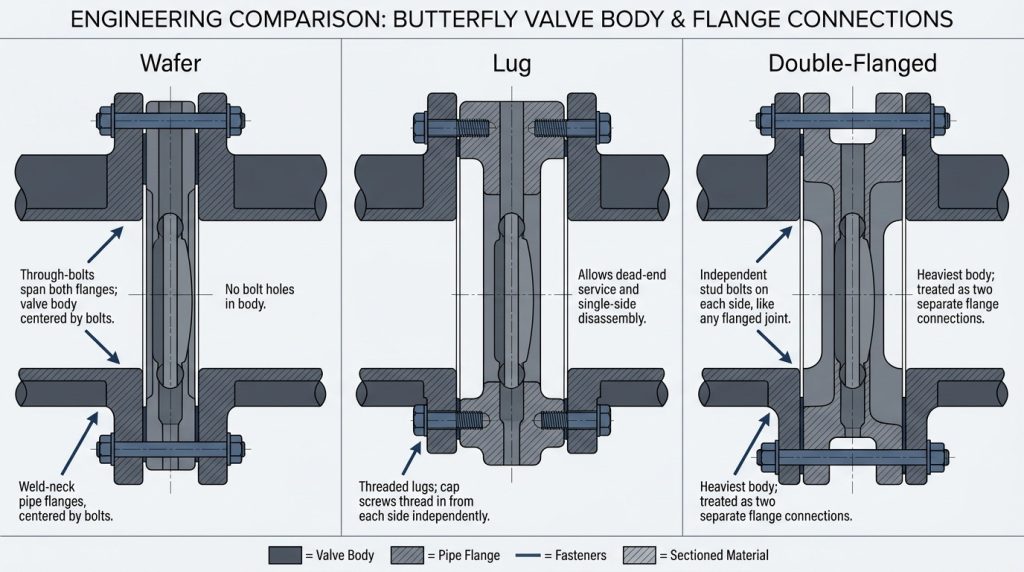
This is the main gap in many quick bolt charts. They may give diameter and count, but they often under-explain whether the length is for a plain flange pair, a wafer body, a lug body, or a specific valve series.
How Do Wafer Bolts Span The Joint?
A wafer butterfly valve is clamped between two pipe flanges, so the through-bolts or studs must span the valve body plus the flange stack. For an 8 inch Class 150 wafer valve, many manufacturer bolting guides place 3/4 in-10 UNC through-bolting around 6 to 7 in, depending on whether machine bolts, studs, nuts, and washers are used.
The length can change if the seat design eliminates separate flange gaskets, if washers are added, or if the flange face is raised. Use the published value only as a starting point, then confirm against the valve face-to-face and bolting drawing.
Why Are Lug Bolts Shorter But More Numerous?
A lug butterfly valve uses tapped lugs, so the fasteners usually enter from each side instead of passing completely through the valve and both flanges. For an 8 inch Class 150 lug valve, the project may need 16 cap screws total, commonly 8 from each side, with typical 3/4 in-10 UNC cap screw lengths around 2-1/4 to 2-1/2 in in many resilient-seat Class 125/150 guides.
The risk is different from wafer bolting. If the cap screw is too short, thread engagement is weak; if it is too long, it can bottom out, meet the opposite screw, or damage the lug. For dead-end or downstream removal conditions, a proper lug style butterfly valve installation also needs the valve rating and manufacturer limits checked, not only the bolt length.
When Does A Flanged Body Use Standard Studs?
A double-flanged butterfly valve is bolted like a flange-to-flange joint on each side, so standard flange stud charts become more directly useful. Still, the valve flange thickness, facing, gasket type, and pressure class must match the piping specification.
For an NPS 8 Class 150 raised-face flange joint, the common ASME B16.5 stud size is 3/4 in, with 8 studs. For Class 300, the common value changes to 7/8 in, with 12 studs. If the valve has integral flanges to a different standard, the drawing wins over the generic chart.
Key takeaway: bolt diameter usually follows the flange standard, but bolt length follows the real installed stack.
How To Confirm The Correct Bolt Length
The safest way to confirm bolt length is to build the installed stack from the drawing rather than copying a chart value without context. Start with the valve body style, then add the flange thickness, gasket or seat requirements, washer thickness, nut height, raised-face allowance, and thread projection.
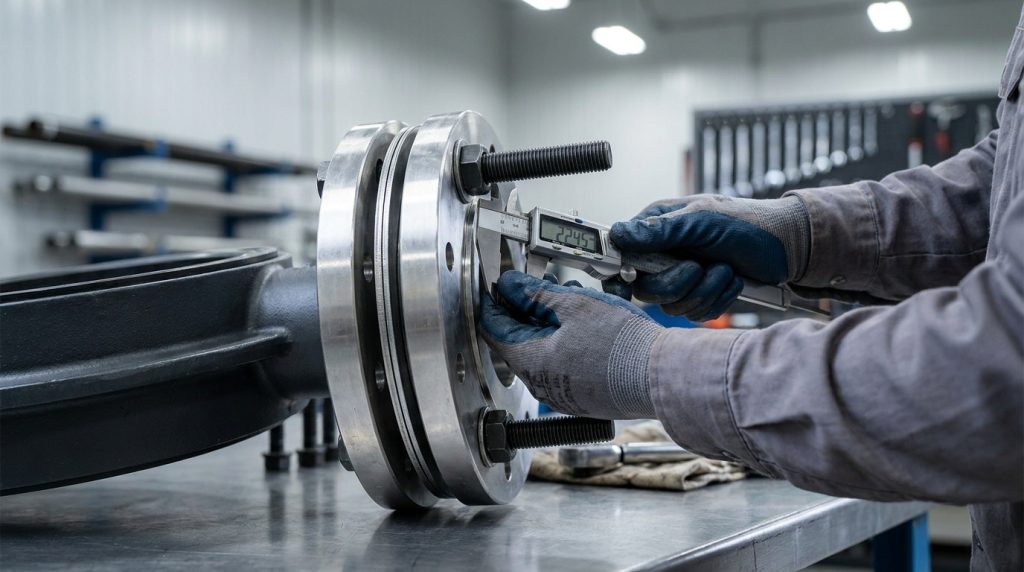
For wafer valves, a practical length check is: valve body thickness at the bolting path plus two flange thicknesses plus any gasket or seat allowance plus two washers, two nuts, and enough thread projection. For lug valves, the check is different: flange thickness plus washer and gasket allowance plus required thread engagement, while staying below the tapped-hole depth.
How Much Thread Engagement Is Enough?
A common manufacturer guide for lug-style butterfly valves uses minimum thread engagement equal to the bolt diameter. For a 3/4 in fastener, that means about 3/4 in of effective thread engagement, unless the valve drawing or project specification requires more.
Do not confuse total cap screw length with engaged thread length. Part of the fastener length is consumed by flange thickness, washer thickness, gasket or raised-face geometry, and any clearance. The thread that actually holds inside the lug is what protects the joint from pullout.
What Measurements Should You Send For Review?
You should send enough information to define the joint, not just the nominal valve size. A useful bolt confirmation request includes:
- Valve size, such as NPS 8 or DN200
- Flange standard, such as ASME B16.5 Class 150 or EN 1092-1 PN16
- Valve body style, such as wafer, lug, or double flanged
- Valve face-to-face or model drawing
- Flange type and thickness
- Gasket type and thickness, if separate gaskets are used
- Washer use and nut type
- Bolt material or project fastener specification
For metric projects, the same logic applies to PN16 butterfly valve installation: check the drilling, pressure rating, and valve body details before ordering the fastener set.
Bolt Material And Thread Choices That Affect Safety
Bolt material should match the pressure class, fluid environment, flange material, and project specification. The right diameter with the wrong material can still fail through corrosion, galling, loss of preload, or code noncompliance.
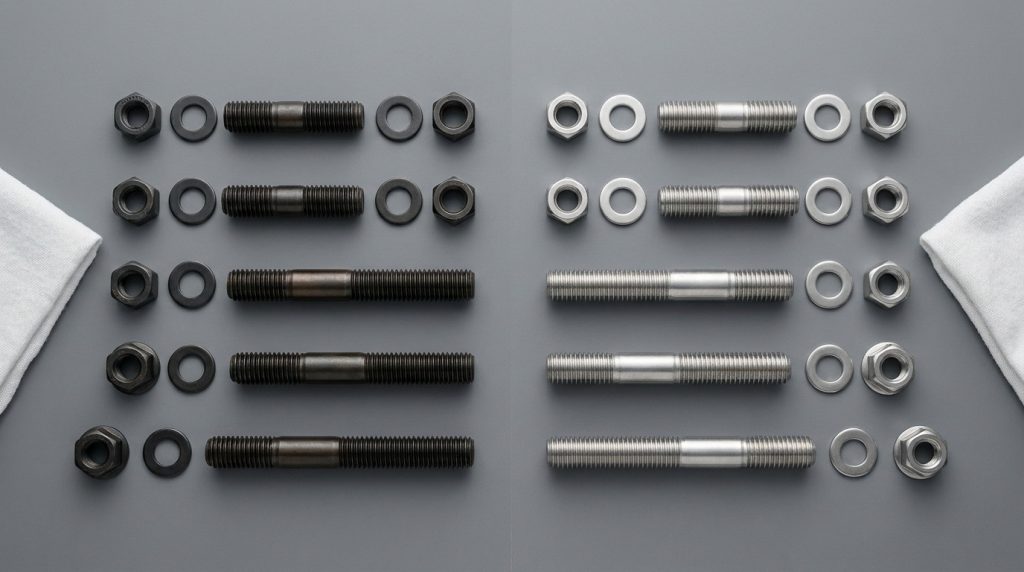
For many carbon steel industrial flange joints, ASTM A193 Grade B7 studs with ASTM A194 Grade 2H heavy hex nuts are common. Stainless service may use ASTM A193 B8 or B8M with matching ASTM A194 8 or 8M nuts, while lower-pressure utility service may specify other fastener grades where permitted by the piping specification.
Can Stainless Bolts Always Replace Carbon Steel Bolts?
No, stainless bolts are not an automatic upgrade in every butterfly valve joint. Stainless bolting may help in corrosive or washdown environments, but it can gall during tightening, may have different strength properties, and can create galvanic concerns when paired with some materials.
If the valve is installed in water treatment, marine service, or chemical processing, corrosion resistance can be important. If the valve is in carbon steel process piping with higher preload demands, the project specification may prefer alloy steel bolting with appropriate coating instead.
What Thread Form Is Typical For 8 Inch ASME Valves?
For ASME Class 150 NPS 8 butterfly valves, 3/4 in-10 UNC is the common coarse thread callout. For ASME Class 300 NPS 8 flange bolting, 7/8 in-9 UNC is common.
UNC threads are widely used for inch-based flange bolting because they are robust, easy to assemble, and consistent with common ASME B1.1 thread practice. For DN200 metric flanges, M20 is common for PN10 and PN16 drilling, but the bolt count differs between PN10 and PN16, so metric size alone is not enough.
Installation Checks Before Tightening An 8 Inch Valve
A correct bolt can still leak if the valve is misaligned, over-compressed, or tightened unevenly. Before tightening, center the valve, check disc clearance, verify that the disc can open without hitting the pipe ID or gasket, and confirm that the flange faces are clean and parallel.
On resilient seated butterfly valves, excessive bolt force can distort the seat area or body. Manufacturer installation guides for 5 to 8 inch resilient-seat valves may list general flange torque values around 45 lb-ft, or 60 Nm, for lubricated 3/4 in fasteners, but this is not a universal torque. Use the valve manufacturer, gasket supplier, and project piping specification as the controlling documents.
How Should The Bolts Be Tightened?
Tighten the bolts in a cross or star pattern so the valve is compressed evenly between the flanges. For an 8-bolt pattern, move across the flange rather than tightening adjacent bolts in a circle.
A practical sequence is:
- Hand-tighten all fasteners first
- Bring the joint snug while checking valve centering
- Tighten in staged passes, such as 25 percent, 50 percent, and 100 percent of the final torque where the procedure allows
- Cycle the disc carefully after initial alignment checks
- Recheck for even compression before pressure testing
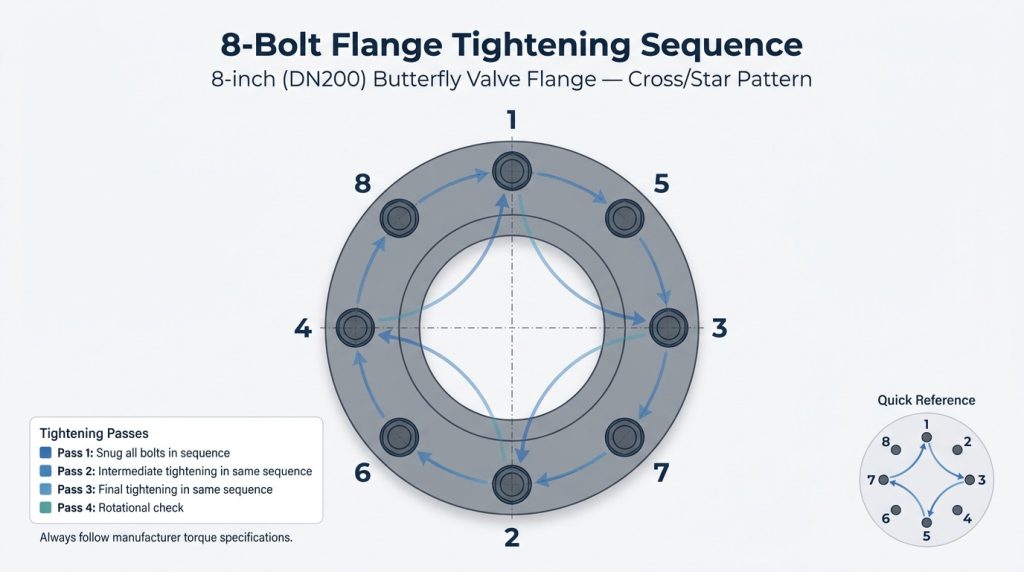
This is especially important for wafer bodies because uneven pull-up can shift the valve or pinch the seat. Good butterfly valve alignment protects both the seal and the disc edge.
What Should You Check Before Pressure Testing?
Before pressure testing, confirm that every bolt has the same grade, diameter, and thread form, and that the nuts turn freely without cross-threading. Also check that no lug cap screw has bottomed out before clamping the flange.
For an 8 inch valve, the disc should be slightly open during installation unless the manufacturer instructs otherwise, because a fully closed disc may contact the pipe or gasket during fit-up. After tightening, operate the valve slowly to confirm free movement before the line is pressurized.
Common Mistakes That Cause Leaks Or Damaged Lugs
Most bolt-size failures come from mixing a flange chart with a valve body style it was not meant to cover. A plain ASME B16.5 flange stud length is not automatically a wafer butterfly valve stud length, and a wafer through-stud is not automatically safe for a lug valve.
Watch for these common problems:
- Ordering 4-1/4 in Class 150 flange studs for a wafer body that needs a longer through-fastener
- Using PN10 bolt count on a DN200 PN16 flange
- Installing 3/4 in cap screws that bottom out in tapped lugs before the flange is clamped
- Reusing stretched, corroded, or damaged fasteners
- Mixing stainless and carbon steel fasteners without checking corrosion and strength requirements
- Tightening one side fully before the valve is centered
- Assuming all 8 inch butterfly valves have the same face-to-face dimension
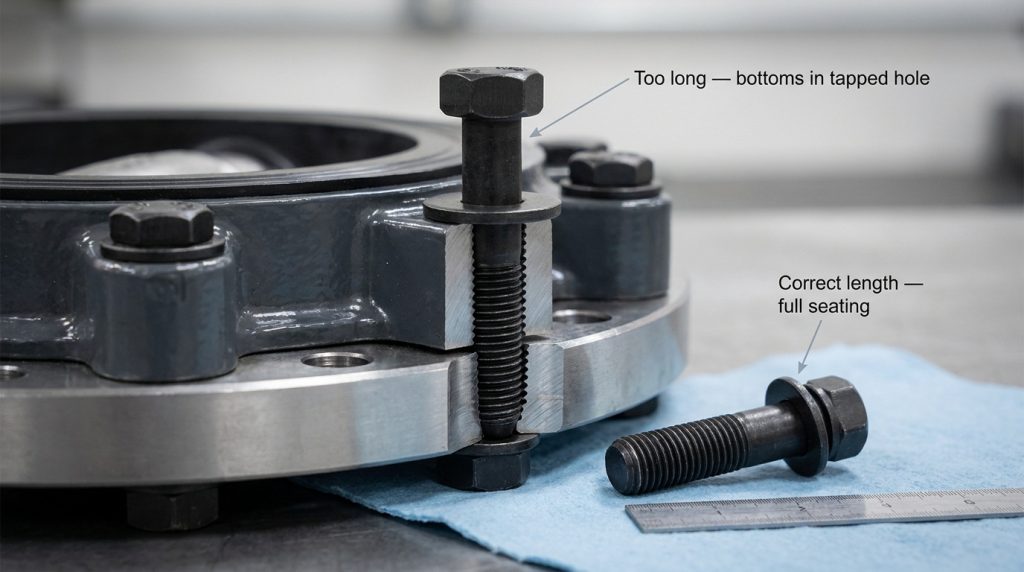
The practical fix is simple: specify the flange standard first, then the valve style, then the fastener material and length. If any of those are unknown, do not treat the bolt chart as final.
Conclusion
The correct 8 inch butterfly valve bolt size is not a single number for every installation. For ASME Class 150, 3/4 in-10 UNC is the common diameter, but wafer valves, lug valves, flanged valves, Class 300 flanges, and DN200 PN10 or PN16 metric flanges all change the final fastener count or length.
Use the chart as a starting point, then confirm the actual drawing, flange standard, gasket stack, washer use, material grade, and thread engagement before ordering. For project-specific valve sizing, flange drilling, or bolt confirmation, you can send your valve and flange details for a practical specification review.
FAQ
Can I use the same bolts for wafer and lug 8 inch butterfly valves?
No, wafer and lug valves normally use different bolt lengths and sometimes different quantities. A wafer valve often uses through-bolts or studs across the full joint, while a lug valve uses shorter fasteners threaded into the valve body from each side.
What is the best bolt size for an 8 inch Class 150 butterfly valve?
The usual starting size is 3/4 in-10 UNC. For ASME Class 150 NPS 8 flanges, the common fastener count is 8, but the final length depends on wafer, lug, or flanged body construction.
How do I know if my 8 inch valve is ASME or PN drilled?
Check the flange marking, bolt count, bolt circle, and bolt-hole diameter. NPS 8 ASME Class 150 commonly has 8 fasteners, while DN200 PN16 commonly has 12 M20 fasteners, so the hole pattern quickly reveals the difference.
Can I reuse old bolts when replacing an 8 inch butterfly valve?
Usually, replacement is safer when the bolts are corroded, stretched, damaged, or from an unknown grade. Reuse should only be considered when the fasteners are verified, clean, undamaged, and still compliant with the project specification.
How do I know if the bolt length is too long for a lug valve?
The bolt is too long if it bottoms out in the tapped lug before clamping the flange. Check the lug thread depth, required engagement, flange thickness, washer thickness, and gasket allowance before tightening.