

Butterfly valves suit compact, fast-cycling duties; gate valves suit full-bore isolation; plug valves suit robust quarter-turn shutoff, including many solids-bearing services. Yet a specification that looks acceptable on a data sheet can still raise pumping costs, jam during a shutdown, or demand more actuator torque than expected. A crowded plant room, abrasive process stream, or strict isolation point turns a routine purchase into a costly risk.
This plug valve vs butterfly valve comparison also covers gate valves, giving you a practical route from service conditions through valve geometry, sealing, pressure loss, actuation, and maintenance. Use it to screen options before requesting drawings, Cv data, torque figures, material certificates, and pressure-test records from a supplier.
What Do These Three Shutoff Valves Have in Common?
The plug valve vs butterfly valve choice, like a gate-valve choice, mainly concerns reliable isolation rather than precise continuous control. All three designs can pass high flow with less resistance than a globe-style control valve. Each can also suffer seat wear, vibration, or unstable operation if left at a poor intermediate position. Your specification should state whether service means on-off isolation, occasional balancing, emergency shutdown, or repeated modulation.
Which Shared Limits Should You Check?
Here’s the practical point: valve type alone never defines field performance. Check these factors before comparing purchase prices:
- Normal and maximum differential pressure
- Fluid temperature, chemistry, solids, and viscosity
- Required leakage class and flow direction
- Cycle rate, closing time, and fail position
- Available space, support, and maintenance access
| Shared concern | Buyer question | Required evidence |
|---|---|---|
| Shutoff | How tight must isolation be? | Test standard and result |
| Flow | What loss can pumps absorb? | Cv or resistance data |
| Actuation | Can drive torque cover worst case? | Torque curve and safety factor |
This snapshot shows why duty data should come before body style.
Key Takeaway: You can reject weak bids early when every supplier answers one common service checklist.
How Does a Butterfly Valve Handle Shutoff Duty?
A plug valve vs butterfly valve review shows that a butterfly valve provides quicker, lighter, and more compact shutoff across many large pipe sizes. Its circular disc rotates 90 degrees and remains within the flow path while open. That geometry cuts weight and face-to-face length, though it creates some turbulence and pressure loss. Soft-seated concentric designs often fit water or HVAC service, while offset metal-seated designs cover hotter or more severe duties.
Where Does Its Disc Design Work Best?
Here’s where the design earns its place: you gain rapid actuation without a tall stem envelope. Typical strengths include:
- Large-diameter water and utility mains
- Tight mechanical rooms or skid packages
- Frequent operation with manual or automated drives
- Moderate throttling where accurate low-flow control is unnecessary
- Wafer, lug, or flanged installation choices
| Butterfly feature | Practical benefit | Watch point |
|---|---|---|
| Quarter-turn disc | Fast operation | Fluid-hammer risk |
| Short body | Lower weight and support load | Disc clearance |
| Disc in flow | Compact construction | Residual pressure loss |
This pattern favors space and speed over a completely open bore.
Key Takeaway: You gain the most from a butterfly valve when compact size and quick cycling outweigh minor hydraulic resistance.
How Does a Gate Valve Handle Shutoff Duty?
A plug valve vs butterfly valve assessment places a gate valve ahead when full opening must leave an unobstructed flow path. A flat or wedge-shaped gate moves linearly into seats and retracts outside the bore. Slow multi-turn travel reduces sudden flow changes, though operation takes longer and rising-stem models need vertical clearance. Gate designs belong in fully open or fully closed service because partial opening can erode seats and excite vibration.
When Does Full-Bore Isolation Pay Off?
The payoff becomes clear here: a clean bore protects system head and supports pigging where valve construction permits. Review these uses:
- High-flow transmission lines
- Isolation points operated infrequently
- Duties with strict full-bore requirements
- Higher-pressure service under a qualified design
- Knife-gate variants for selected slurry systems
| Gate feature | Practical benefit | Watch point |
|---|---|---|
| Retracted gate | Very low open-valve loss | Slow stroke |
| Linear seating | Strong isolation | Seat wear if throttled |
| Rising stem option | Visible position | Tall operating envelope |
This comparison links hydraulic value with installation space and cycle time.
Key Takeaway: You should favor a gate valve where open-bore efficiency matters more than speed, weight, or compact installation.
How Does a Plug Valve Handle Shutoff Duty?
A plug valve vs butterfly valve review shows that a plug valve combines quarter-turn action with a ported cylindrical or tapered closure member. Aligning its port with piping permits flow, while a 90-degree rotation blocks passage. Close body-to-plug clearances reduce cavities where grit might settle, making many plug designs useful for dirty, viscous, or solids-bearing media. Operating torque can rise sharply under differential pressure, especially without suitable lubrication or lining.
Why Can a Plug Tolerate Difficult Media?
Now for the useful distinction: plug geometry offers a wiping action and fewer exposed stem surfaces than some alternatives. Buyers often specify it for:
- Slurries, dirty liquids, or viscous products
- Chemical routing with suitable lining materials
- Two-way, three-way, or four-way flow arrangements
- Rapid isolation where a compact rotary drive fits
- Systems needing accessible internal cleaning
| Plug feature | Practical benefit | Watch point |
|---|---|---|
| Close-clearance closure | Low solids accumulation | Higher operating torque |
| Multi-port option | Simplified routing | Port-position verification |
| Lubricated design | Lower friction and good sealing | Lubricant compatibility |
This profile makes media behavior a stronger selection factor than nominal size alone.
Key Takeaway: You can choose a plug valve confidently when difficult media justify greater torque and maintenance attention.
What Are the Advantages and Drawbacks of Gate Valves?
The plug valve vs butterfly valve debate frames gate valves as slower but hydraulically cleaner isolation devices. Their open passage limits turbulence and leaves little obstruction in suitable full-bore designs. Bidirectional arrangements and high-pressure capability add value, subject to seat, body, and standard. Drawbacks include greater mass, taller operating clearance, slow travel, and vulnerability to damage during prolonged throttling. Low differential pressure may also reduce sealing force in some constructions.
Which Trade-Offs Affect Ownership Cost?
What does that mean for your budget? Purchase price covers only part of service cost. Account for:
- Pipe-support and lifting demands
- Stem packing access and lubrication
- Time needed for manual closure
- Seat damage caused by partial opening
- Debris collection in body recesses
| Gate-valve factor | Advantage | Drawback |
|---|---|---|
| Full bore | Low energy loss | Larger body mass |
| Multi-turn motion | Gradual flow change | Slow emergency response |
| Seat geometry | Firm isolation | Dirt can hinder closure |
This balance often supports gate valves at permanent isolation boundaries rather than high-cycle control points.
Key Takeaway: You protect lifecycle value by reserving gate valves for infrequent isolation and keeping them away from routine throttling.
What Are the Advantages and Drawbacks of Butterfly Valves?
The plug valve vs butterfly valve comparison favors butterfly valves for low weight, short face-to-face dimensions, quick operation, and economical large-bore service. A handle or actuator position also gives a clear visual state. Yet the open disc obstructs flow, catches some stringy material, and experiences hydrodynamic forces. Fast closure may trigger fluid hammer, while long throttling near closed can accelerate cavitation, vibration, and seat wear.
Which Trade-Offs Matter in Large Lines?
The numbers change with diameter: compact construction can sharply reduce lifting, support, and actuator demands. Your review should cover:
- Disc clearance through adjacent pipe and liners
- Seat compatibility with fluid and temperature
- Dynamic torque across each opening angle
- Closing speed under surge analysis
- Dead-end rating for lugged bodies
| Butterfly factor | Advantage | Drawback |
|---|---|---|
| Compact body | Lower installed weight | Disc stays in bore |
| Quarter-turn action | Rapid response | Surge risk if closed fast |
| Soft seat | Tight shutoff at moderate duty | Media and heat limits |
This comparison explains why large water lines often favor butterfly construction after surge and seat checks.
Key Takeaway: You can reduce installed cost with a butterfly valve if you validate pressure loss, disc clearance, and closing time.
How Does Plug Valve vs Butterfly Valve Performance Differ?
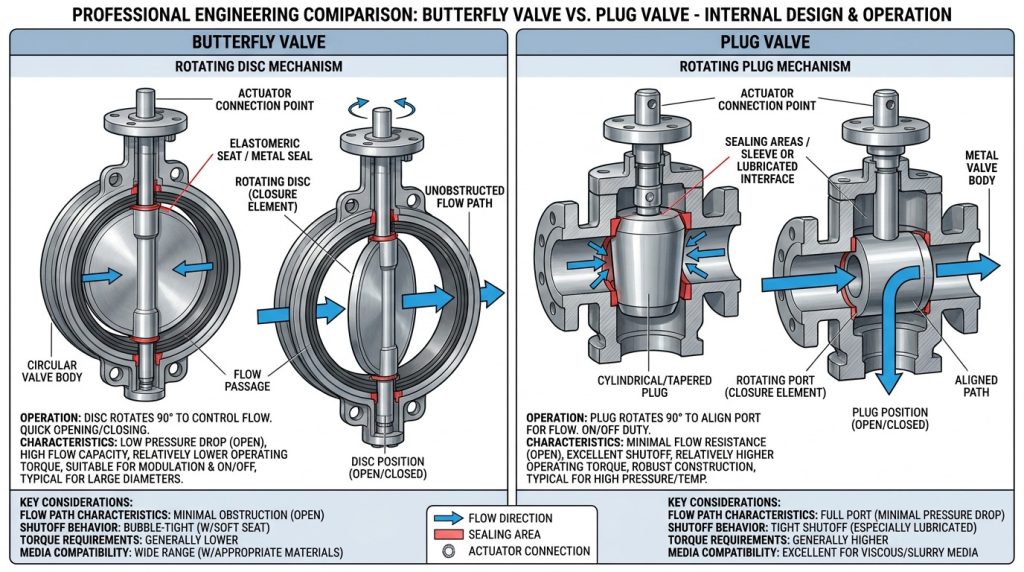
Plug valve vs butterfly valve performance differs mainly in flow-path geometry, torque, solids tolerance, and scalable size. Butterfly valves usually weigh less and need smaller installation envelopes, particularly on large pipelines. Plug valves offer a ported closure with fewer collection pockets, though plug contact area can demand higher breakaway torque. Both operate through 90 degrees and can provide clear external position indication, making either design suitable for automation after torque review.
What Should Drive a Direct Comparison?
Here’s the short list: let operating media and line size narrow your field. Compare:
- Clean water versus abrasive or sticky mixtures
- Acceptable open-valve pressure loss
- Available actuator torque and power source
- Required port arrangement and flow routing
- Inspection, lubrication, and seat-replacement access
| Decision point | Butterfly valve | Plug valve |
|---|---|---|
| Large diameter | Usually lighter | Usually heavier |
| Dirty service | Disc may collect debris | Close clearances resist buildup |
| Torque | Often lower | Often higher under pressure |
| Routing | Mainly two-way | Multi-port choices available |
This side-by-side view turns a broad type comparison into four measurable checks.
Key Takeaway: You should pick butterfly construction for compact scale and plug construction for difficult media or routing flexibility.
Which Valve Gives Better Flow and Pressure Performance?
A plug valve vs butterfly valve calculation usually gives a full-bore gate valve the lowest fully open pressure loss, followed by a full-port plug design, while a butterfly disc adds permanent obstruction. Actual ranking still depends on port area, disc profile, line velocity, fittings, and opening position. Never infer hydraulic performance from nominal diameter. Request Cv, which expresses flow capacity at a defined pressure drop, or a resistance coefficient for each expected operating point.
How Should You Compare Hydraulic Data?
This is where estimates become engineering: calculate minimum, normal, and maximum flow cases. Include these inputs:
- Manufacturer Cv or Kv at relevant travel
- Fluid density, viscosity, and vapor pressure
- Available differential pressure
- Velocity limits and downstream recovery
- Noise, cavitation, and surge exposure
| Hydraulic measure | What it tells you | Buying use |
|---|---|---|
| Cv or Kv | Flow capacity | Size valve and actuator case |
| Pressure drop | Pumping penalty | Compare energy demand |
| Velocity | Erosion and noise exposure | Check bore and travel |
This data set reveals whether low purchase cost would create higher operating expense.
Key Takeaway: You get a defensible choice when supplier curves support calculations at every real operating condition.
Which Valve Fits Solids, Slurries, and Harsh Media?
The plug valve vs butterfly valve choice for harsh media often favors a lined or lubricated plug valve, while selected butterfly and knife-gate designs remain viable under defined conditions. Plug geometry limits stagnant pockets and can wipe sealing surfaces during rotation. Butterfly discs stay exposed to impact and stringy debris, while conventional gate-body cavities may pack with settled solids. Material compatibility and particle behavior matter more than generic valve labels.
What Media Details Change the Answer?
Here’s what suppliers need from you: describe process reality rather than writing only “slurry” or “chemical.” Provide:
- Solids percentage, particle size, hardness, and shape
- Fluid pH, chlorides, solvents, and concentration
- Crystallization or polymerization tendency
- Normal and upset temperatures
- Flushing method and cleaning frequency
| Media behavior | Likely concern | Candidate response |
|---|---|---|
| Abrasive particles | Disc or seat erosion | Hard coating or suitable plug |
| Stringy solids | Fouling around disc | Clear bore or alternate geometry |
| Corrosive liquid | Body and seal attack | Compatible lining and alloy |
This matrix starts a materials review rather than replacing chemical-compatibility data.
Key Takeaway: You reduce premature failure when particle data and chemistry guide closure geometry, lining, and flushing provisions.
How Should You Select the Right Shutoff Valve?
A plug valve vs butterfly valve decision should begin with a written duty specification and include a gate option whenever low-loss full-bore isolation matters. Rank process safety, sealing, hydraulic loss, media resistance, installation space, actuation, maintenance, and total ownership cost. Then ask shortlisted suppliers for drawings, materials, standards, bidirectional ratings, torque curves, and witnessed test options. A low quote without traceable data leaves expensive uncertainty.
What Belongs on Your Procurement Checklist?
Ready to make the choice? Put measurable acceptance criteria in your request:
- Size, pressure class, temperature range, and flow rate
- Body, closure, stem, seat, lining, and packing materials
- Leakage requirement with test medium and standard
- Flange, face-to-face, actuator, and fail-position details
- Certificates, inspection points, spares, and delivery schedule
| Duty priority | Strong starting candidate | Verification |
|---|---|---|
| Compact large-bore service | Butterfly valve | Cv, torque, surge |
| Unobstructed isolation | Gate valve | Bore, seat, stem space |
| Dirty media or routing | Plug valve | Torque, lining, port form |
This final screen helps procurement compare compliant offers on equal terms.
Key Takeaway: You gain a safer specification when process evidence selects valve type before price negotiations begin.
What Should You Remember Before Specifying a Valve?
The plug valve vs butterfly valve comparison favors compact butterfly designs for scale and sturdy plug designs for many difficult media duties, while gate valves bring low-loss full-bore isolation. This article resolved how their mechanisms affect pressure loss, solids handling, torque, space, throttling, and ownership cost. For application-specific material review, sizing support, drawings, and test documentation, contact us today with your medium, pressure, temperature, size, and operating cycle. We believe dependable flow control starts with transparent engineering evidence, not catalog shorthand.
What Questions Do Buyers Ask Most Often?
Buyers most often ask how plug valve vs butterfly valve selection affects control, sizing, actuator torque, and difficult-media service.
Can I Use a Butterfly Valve for Throttling?
Yes, within a suitable control range. Butterfly valves can regulate many water, HVAC, and utility flows, though operation near closed may produce unstable response, cavitation, or high seat wear. Ask for Cv data by opening angle and verify actuator resolution across minimum, normal, and maximum demand.
What’s the Best Valve for a Large Water Main?
A butterfly valve is often the strongest starting choice. Its compact body, lighter mass, short installation length, and quarter-turn operation suit large diameters. Still, you should verify surge behavior, seat compatibility, pressure rating, disc clearance, and required leakage performance against actual water chemistry.
How Do I Know if a Gate Valve Fits My Line?
Confirm its dimensions and duty before ordering. Check flange standard, face-to-face length, bore, pressure class, flow direction, stem travel, overhead clearance, and actuator access. Keep a conventional gate valve fully open or closed unless its manufacturer explicitly rates another operating mode.
Can I Use a Plug Valve for Slurry Service?
Often yes, with a matched design and materials. Close clearances and wiping motion can limit solids accumulation, yet abrasive particles may raise torque or wear sealing surfaces. Give your supplier solids concentration, particle size, hardness, chemistry, temperature, and flushing plan.
How Do I Know if an Actuator Has Enough Torque?
Compare its available output with worst-case valve demand plus an approved safety factor. Use maximum differential pressure, fluid temperature, seat condition, breakaway torque, running torque, closing torque, air pressure, supply voltage, and required fail position. A generic nominal torque figure cannot support reliable sizing.