
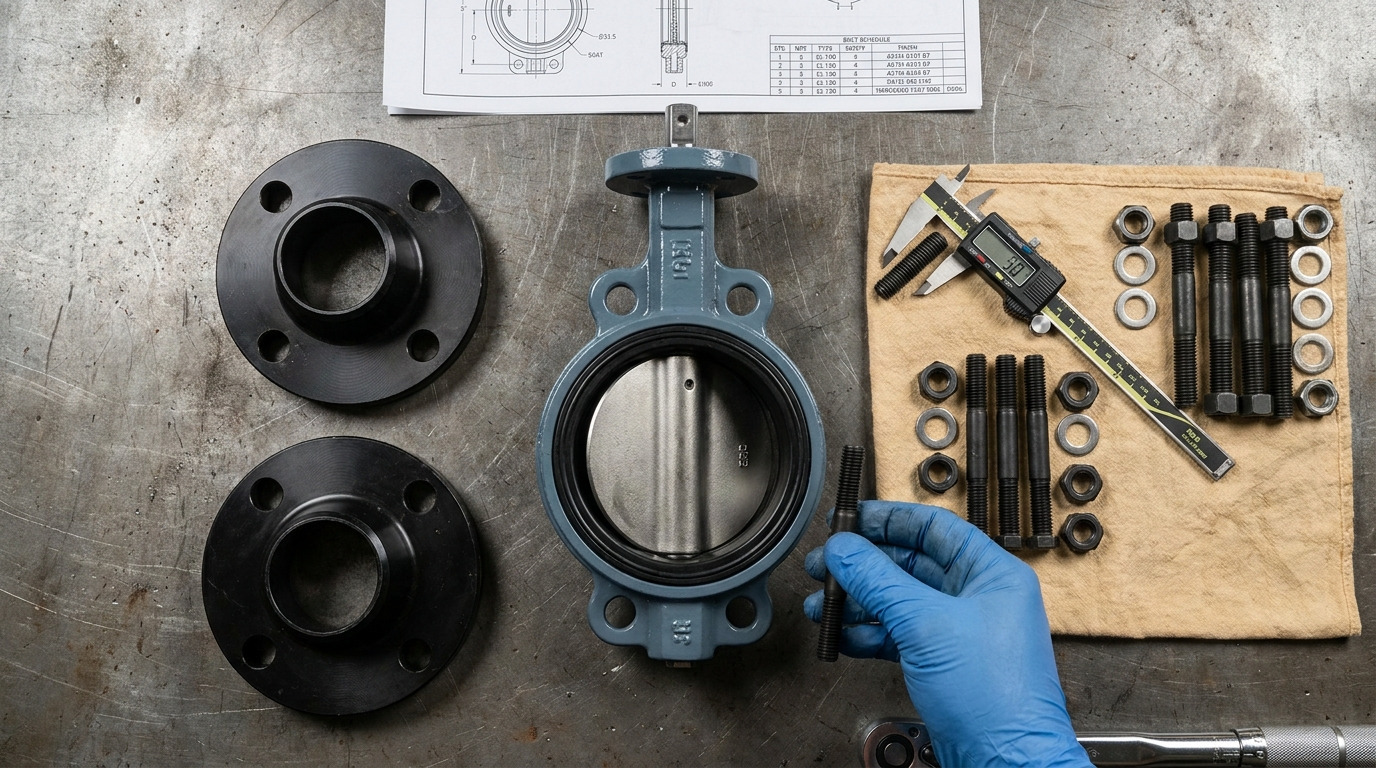
For a 3 inch butterfly valve, the bolt size is usually 5/8 in for ASME Class 150 flanges, 3/4 in for ASME Class 300 or Class 600 flanges, and M16 for DN80 PN16 flanges, but you must confirm the flange standard, pressure class, and valve body style before ordering bolts. If you are searching for 3 butterfly valve bolt size, treat it as a flange-matching question, not a valve-size-only question.
A common field problem starts when a tag says “3 in” and someone orders four 5/8 in bolts, only to find that the line is Class 300 and needs eight 3/4 in fasteners. If you are matching a 3 inch butterfly valve to an existing pipeline, the safer path is to confirm the flange drilling first, then confirm bolt length from the valve drawing.
3 Inch Butterfly Valve Bolt Size by Flange Class
The correct 3 inch butterfly valve bolt size depends mainly on flange class and standard. In ASME piping, “3 inch” usually means NPS 3; in metric piping, the closest common valve size is DN80. These sizes are nominal, so do not measure the valve opening and assume that the bolt pattern will follow from that alone.
ASME B16.5 covers flanges from NPS 1/2 to NPS 24 across common pressure classes, and the NPS 3 bolt pattern changes clearly as pressure class increases. EN 1092-1 uses DN and PN designations, so DN80 PN16 uses a metric bolt pattern rather than the ASME inch pattern. If you also need to confirm whether your valve marking, pipe OD, and face-to-face dimension are consistent, reviewing butterfly valve sizes helps avoid mixing nominal size systems.
The table below gives practical starting data for the most common 3 inch and DN80 flange matches. Final bolt length still needs the valve drawing because wafer, lug, semi-lug, and flanged butterfly valves do not all use the same bolting arrangement.
| Flange condition | Bolt pattern | Hole and bolt circle | Length note |
|---|---|---|---|
| ASME B16.5 NPS 3 Class 150 | 4 x 5/8 in, usually 5/8-11 UNC | 0.75 in holes, 6.00 in bolt circle | Flange-only RF stud reference is 3-1/2 in; valve drawing controls final length |
| ASME B16.5 NPS 3 Class 300 | 8 x 3/4 in, usually 3/4-10 UNC | 0.88 in holes, 6-5/8 in bolt circle | Flange-only RF stud reference is 4-1/4 in; valve body thickness may require different bolts |
| ASME B16.5 NPS 3 Class 600 | 8 x 3/4 in, usually 3/4-10 UNC | 0.88 in holes, 6-5/8 in bolt circle | Flange-only RF stud reference is 5 in; confirm for high-performance valve designs |
| EN 1092-1 DN80 PN16 | 8 x M16 | 18 mm holes, 160 mm bolt circle | Length depends on flange type, gasket or seat design, and valve body style |
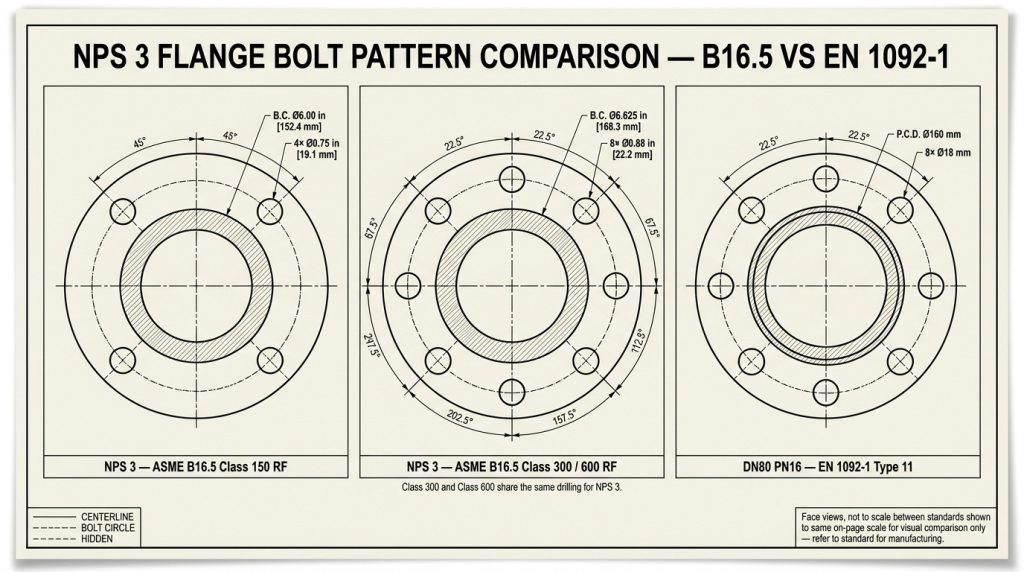
The key point is simple: the common 3 inch Class 150 answer is 4 x 5/8 in, but that answer becomes wrong as soon as the flange class or standard changes.
What size is common for ASME Class 150?
For NPS 3 ASME Class 150, the usual bolt pattern is four 5/8 in bolts or studs. The matching flange data is 0.75 in bolt holes on a 6.00 in bolt circle, with a 7-1/2 in flange outside diameter.
This is the bolt pattern many people mean when they ask for a “3 inch butterfly valve bolt size.” It is still not enough for a purchase order unless you also define body style, facing, gasket or seat arrangement, and whether the fastener is a through-stud or a cap screw.
What changes in Class 300 and Class 600?
For NPS 3 ASME Class 300 and Class 600, the bolt diameter normally increases to 3/4 in and the bolt count increases to eight. The bolt hole is typically 0.88 in, and the bolt circle is 6-5/8 in for both Class 300 and Class 600 at NPS 3.
The length changes because flange thickness and facing height change. That is why a Class 300 or Class 600 3 inch butterfly valve should never be installed using a Class 150 bolt set just because the nominal valve size is the same.
How does DN80 PN16 compare with NPS 3?
DN80 PN16 is not the same bolt standard as ASME NPS 3 Class 150, even though both are often treated as “3 inch” in everyday conversation. Per EN 1092-1 PN16 data, DN80 uses eight M16 bolts, 18 mm bolt holes, and a 160 mm bolt circle.
M16 and 5/8 in are close in diameter, but they are not interchangeable as a specification. Thread form, pitch, nut standard, washer size, coating, and flange drilling must match the project standard.
Why Valve Style Changes Bolt Length
Bolt diameter and bolt count come from the flange standard, but bolt length comes from the full assembly. A 3 inch wafer butterfly valve, lug butterfly valve, and flanged-end butterfly valve can share the same nominal flange size while needing different fastener lengths.
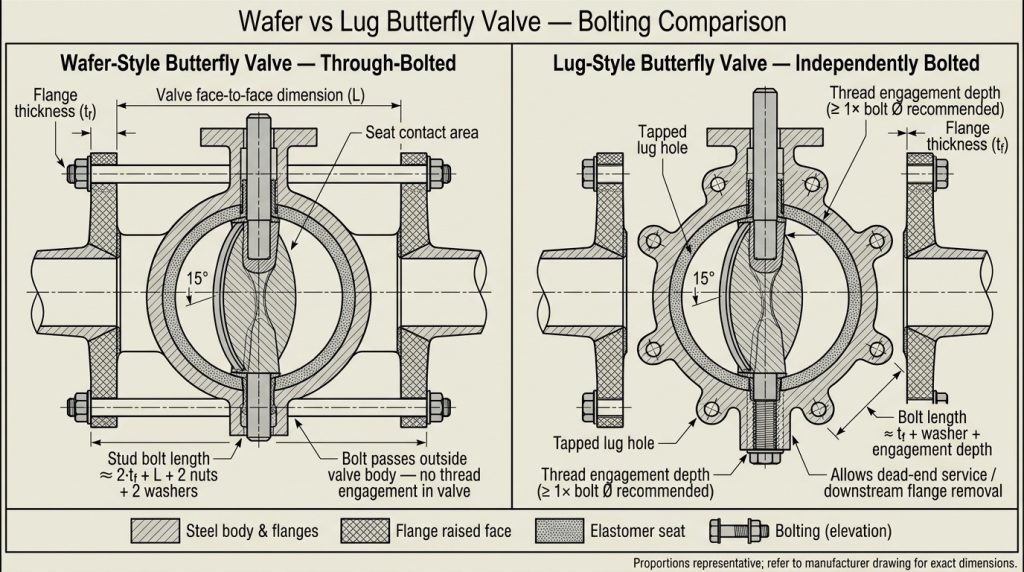
A wafer valve usually sits between two pipe flanges, with long bolts or studs passing through the flange holes around the valve body. A lug valve has threaded or tapped lugs, so each flange side is bolted separately; if both sides are installed, the total number of individual bolts may look higher even though each flange pattern is unchanged.
Can I use one bolt length for wafer and lug valves?
No, you should not use one bolt length for all body styles. A wafer valve length must account for two flanges, the valve body face-to-face dimension, sealing arrangement, washers, nuts, and enough exposed thread. A lug valve length must account for flange thickness, gasket or seat compression, washer thickness, and safe thread engagement without bottoming inside the lug.
For a lug-style butterfly valve, the drawing should also state whether the valve is suitable for dead-end service and what bolting arrangement is allowed. That matters because the lugs carry the load differently from a wafer-style through-bolt installation.
What should a valve drawing confirm?
A valve drawing should confirm the face-to-face dimension, flange compatibility, hole clearance, lug thread depth, and any restriction on gasket use. Many resilient seated butterfly valves rely on the valve seat to seal against the flange face, so adding a separate gasket without approval can alter compression and bolt length.
For tapped lugs, the bolt should engage enough full threads to carry load but should not hit the bottom of the hole. As a practical check, steel tapped holes often target at least one bolt diameter of full thread engagement, while softer materials may require more; the manufacturer’s drawing should override any rule of thumb.
How to Confirm the Right Bolt Before Ordering
The best way to confirm the right bolt is to verify the flange standard, pressure class, valve body type, and fastener material before you quote or buy. This avoids the most expensive mistake: receiving bolts that fit the nominal valve size but not the actual flange connection.
Use this sequence when the valve tag, old bolts, or site notes are incomplete:
- Confirm whether the line is ASME, EN, JIS, or another flange standard.
- Confirm pressure class or PN rating, such as Class 150, Class 300, PN10, or PN16.
- Confirm whether the valve is wafer, lug, semi-lug, or flanged end.
- Check whether the fasteners are through-studs, machine bolts, or cap screws.
- Confirm bolt material, nut material, washer requirements, and coating.
- Check whether the seat design allows or forbids separate flange gaskets.
- Confirm the final bolt length from the valve drawing or approved datasheet.
What details should you verify first?
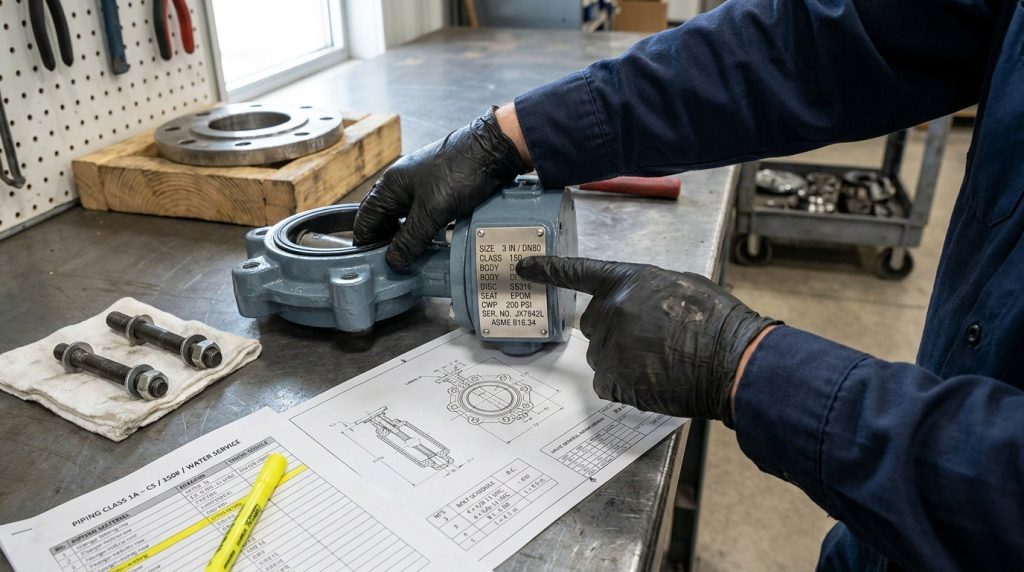
Start with the flange marking or project piping specification because that determines the bolt circle and hole pattern. A 3 inch valve installed between ASME Class 150 flanges is a different bolting job from a DN80 PN16 valve, even if both are used in similar water, HVAC, or process lines.
Next, identify the body style before you calculate length. If the valve is a PN16 butterfly valve, the metric bolt pattern may be clear, but you still need the actual body construction before selecting the bolt length.
Which dimensions belong in a purchase note?
A clear purchase note should include nominal size, flange standard, pressure class, body style, bolt diameter, thread, bolt length, material grade, nut grade, washer requirement, and coating. For ASME service, a note might say “NPS 3, ASME B16.5 Class 150, wafer butterfly valve, 5/8-11 UNC studs, length per valve drawing.”
For metric service, a note might say “DN80, EN 1092-1 PN16, M16 bolts, length per approved drawing.” The phrase “per approved drawing” is important because the drawing captures the valve body thickness and thread engagement that a generic flange chart cannot know.
Bolt Materials, Threads, and Coatings
The fastener material should match pressure, temperature, corrosion exposure, and flange material. Bolt size only tells you whether the fastener fits; material and grade tell you whether it can keep the joint clamped in service.
For many carbon steel ASME flange assemblies, ASTM A193 B7 studs with ASTM A194 2H nuts are a common high-strength combination. Stainless options such as ASTM A193 B8 or B8M may be used where corrosion resistance is more important, but stainless bolting can gall and may have different strength behavior, so lubricant and tightening procedure matter.
When are B7, 2H, B8, or B8M used?
B7 and 2H are common for carbon steel flanged piping where strength and temperature capability are needed. B8 and B8M are stainless bolting options often considered for corrosive, outdoor, or chemical environments, with B8M linked to molybdenum-bearing stainless steel grades.
Do not choose stainless bolts only because the valve is in a wet area. In some joints, a coated carbon steel stud may be more suitable than stainless, depending on required preload, flange material, temperature, and corrosion risk. For seawater, chemical, or washdown duty, coating and material should be reviewed together rather than treated as separate choices.
Torque and Tightening Checks for 3 Inch Valves
Torque should come from the valve, gasket or seat, bolt grade, lubrication, and flange combination, not from bolt diameter alone. ASME PCC-1 treats bolted flange assembly as a controlled procedure because friction, gasket stress, and joint alignment all affect final clamp load.
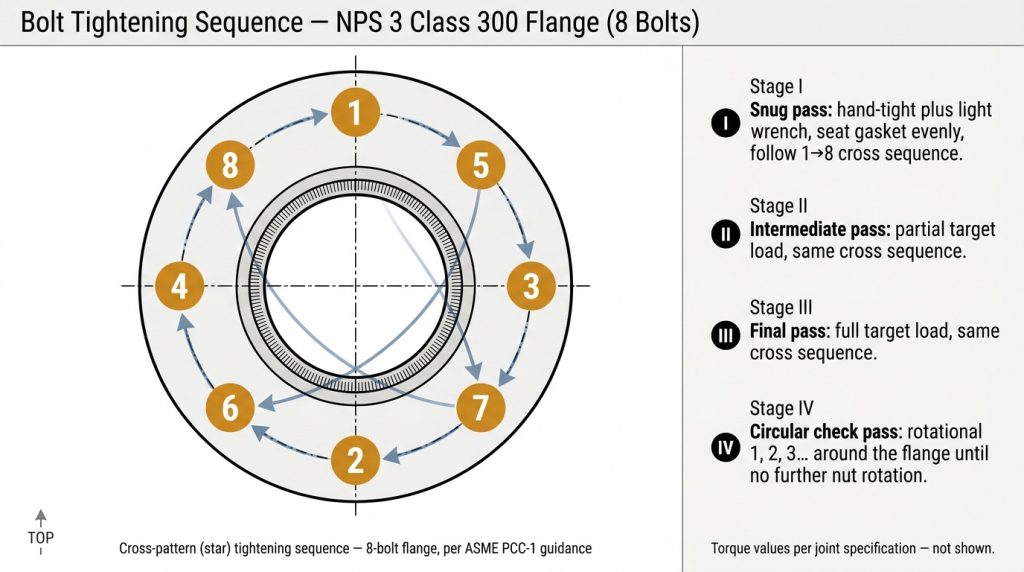
For rubber-seated butterfly valves, over-tightening can distort the seat, make the disc rub, or create uneven sealing stress. Under-tightening can leave the valve body unsupported or allow flange leakage after pressure cycling. Either problem may look like a valve defect when the real issue is bolting practice.
What tightening pattern works best?
Use a cross-pattern tightening sequence and bring the bolts up gradually in multiple passes. A common field approach is to snug all bolts first, then tighten in staged passes, then perform a final circular check after the joint has settled.
Before final tightening, open and close the valve disc enough to confirm it does not contact the pipe ID, gasket, or flange face. If the valve is misaligned, do not use the bolts to pull the flanges into position.
How do I avoid seat or flange damage?
Keep the valve centered and support the piping so the valve is not carrying pipe stress. A butterfly valve installed with proper alignment is less likely to suffer seat distortion, uneven compression, or premature leakage.
Also check washer placement, thread lubrication, and nut rotation. Dry threads can consume much more torque in friction, while lubricated threads can create higher bolt load at the same wrench reading. That is why torque values should be tied to the specified thread condition.
Common Specification Mistakes to Avoid
Most 3 inch butterfly valve bolting errors come from assuming the nominal valve size is enough. It is not. You need the standard, class, body style, material, and length basis before the bolt set is complete.
Watch for these common mistakes:
- Ordering 5/8 in bolts for every 3 inch valve, including Class 300 lines.
- Mixing M16 and 5/8 in fasteners because they look similar.
- Using flange-only stud lengths for wafer butterfly valves.
- Installing lug valves with bolts that bottom out before clamping the flange.
- Adding gaskets to resilient seated valves without checking the valve design.
- Reusing corroded bolts because the diameter appears correct.
- Tightening one side fully before seating the opposite side.
- Treating torque as universal instead of condition-based.
A good specification removes guesswork. Instead of writing “3 inch butterfly valve bolts,” write the full condition: “NPS 3 ASME B16.5 Class 150 wafer butterfly valve, 5/8-11 UNC bolting, final length per approved valve drawing, material and coating per service condition.”
Conclusion
A 3 inch butterfly valve does not have one universal bolt size. The practical answer is 4 x 5/8 in for ASME Class 150, 8 x 3/4 in for ASME Class 300 or Class 600, and 8 x M16 for DN80 PN16, with final bolt length confirmed from the valve drawing and installation style.
Before ordering, confirm the flange standard, pressure class, body type, fastener material, thread system, and tightening procedure. If you are checking a project specification or replacing an existing valve, you can share the flange standard, valve drawing, service condition, and required bolting details through the project specification contact page for a more focused discussion.
FAQ
Can I use 5/8 in bolts on every 3 inch butterfly valve?
No, 5/8 in bolts are mainly the common ASME Class 150 answer for NPS 3. If the same 3 inch valve connection is Class 300 or Class 600, the usual ASME B16.5 bolt diameter is 3/4 in with eight bolts.
What’s the best bolt material for a 3 inch butterfly valve?
The best material depends on pressure, temperature, corrosion exposure, and flange material. ASTM A193 B7 with A194 2H nuts is common for many carbon steel ASME flange assemblies, while B8 or B8M stainless options may be considered for corrosive service.
How do I know if my valve is NPS 3 or DN80?
Check the valve nameplate, drawing, flange drilling, and project piping standard. NPS 3 is normally used with ASME flange data, while DN80 is normally used with metric EN, DIN, or other metric flange systems.
Can I reuse existing bolts when replacing the valve?
You can reuse them only if they match the new valve and are in acceptable condition. Confirm diameter, length, thread, grade, coating, corrosion condition, and whether the new valve body style changes the required length.
How do I know if the bolt length is correct?
The bolt length is correct when it clamps the full assembly, provides proper nut engagement or lug thread engagement, and does not bottom out. For wafer and lug butterfly valves, the approved valve drawing is the final reference.