
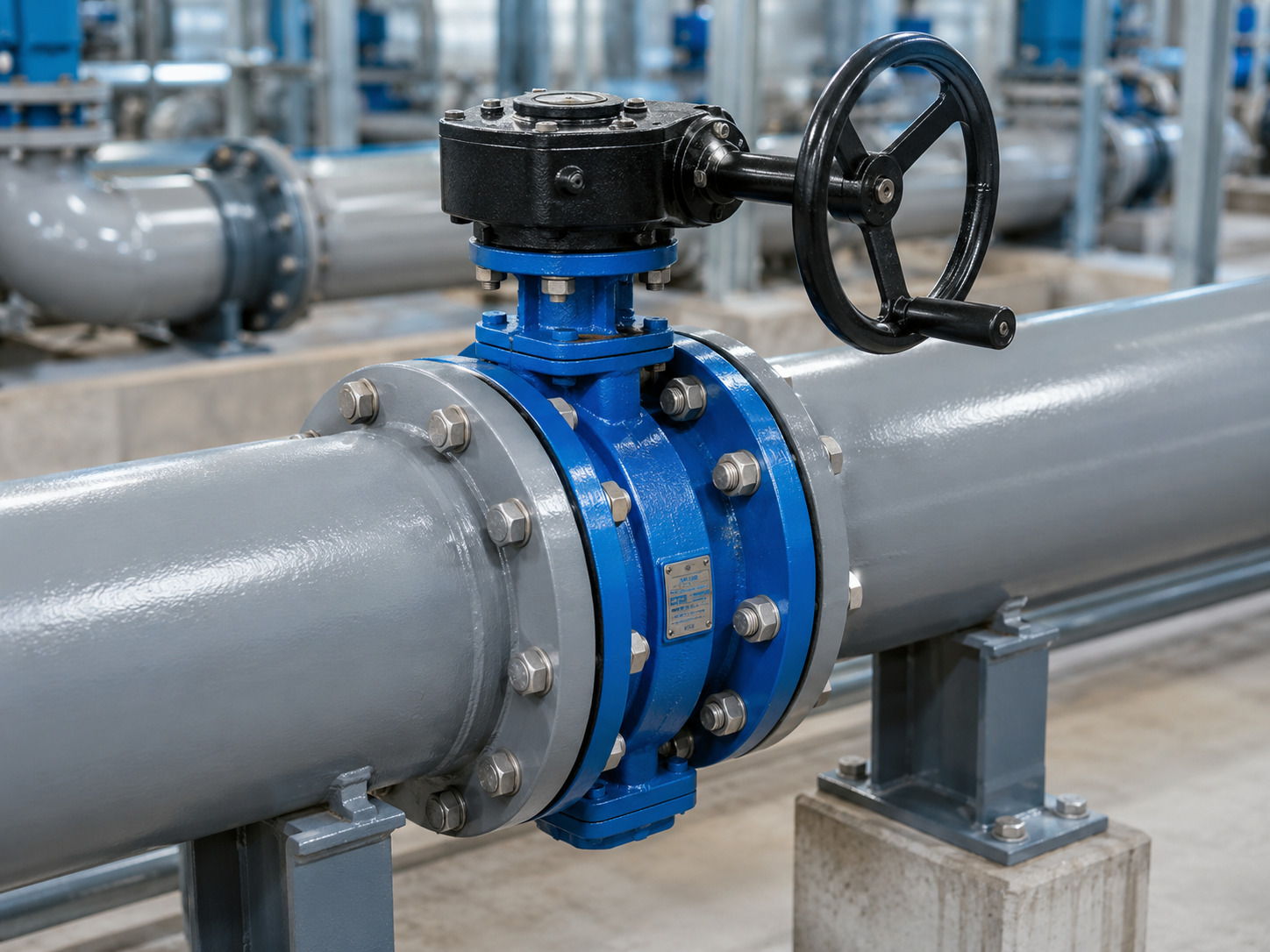
A butterfly valve is a quarter-turn rotary valve used to start, stop, or regulate flow with a disc that turns inside the pipe. It offers fast operation, a short face-to-face dimension, and low weight, but the disc remains in the flow path and creates limits for pigging, solids handling, pressure loss, and fine throttling.
If you are evaluating an industrial butterfly valve range, do not select from pipe size alone. First decide whether the valve will isolate or control flow, then match its seat, disc, body style, pressure-temperature rating, and operator to the actual service.
What Is a Butterfly Valve?
A butterfly valve controls a pipeline through a circular disc mounted on a rotating stem or shaft. Turning the stem through a quarter turn moves the valve from fully closed to fully open; intermediate disc angles can restrict the flow.
Unlike a gate that moves out of the bore, a butterfly disc rotates in place and remains inside the bore even when fully open.
That geometry explains the valve’s main value. Its body can be compact, actuation can be quick, and large sizes require less material and support than many alternative valve designs. It also explains why a fully open butterfly valve still adds some obstruction and pressure loss.
How Does a Butterfly Valve Work?
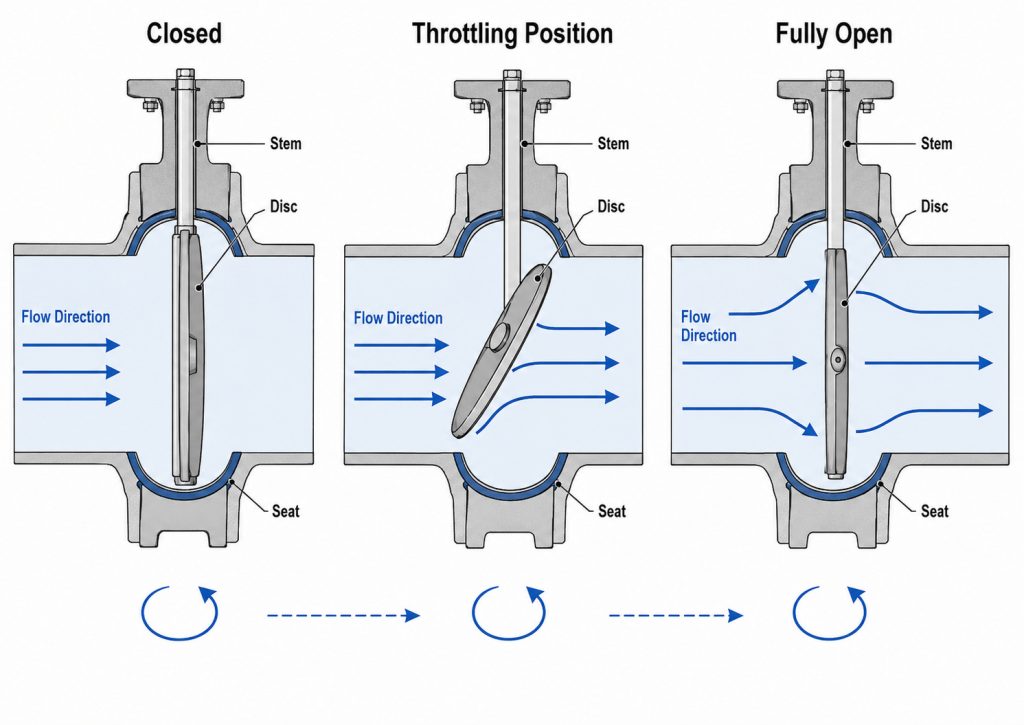
A butterfly valve works by rotating its disc relative to the direction of flow. When the disc face is approximately perpendicular to the pipeline, it covers the bore and presses against the seat to stop flow. When the disc turns approximately parallel to the flow, fluid passes around both sides of it.
The stem transfers torque from a lever, gearbox, or actuator to the disc. Small manual valves may use a lever for fast positioning. Larger valves often use a worm gearbox to reduce the input torque, while automated systems may use electric, pneumatic, or hydraulic actuation.
The position between open and closed requires more care. A butterfly valve can throttle, but disc angle alone does not tell you the flow rate. The result also depends on valve size, disc geometry, differential pressure, fluid properties, and the installed piping system. For control duty, use a Cv or Kv curve by disc angle and check minimum, normal, and maximum flow rather than assuming that 50% open produces 50% flow.
Which Parts Make the Valve Function?
The main parts are the body, disc, stem, seat, stem sealing system, bearings or bushings, and operating device. Each part affects a different aspect of performance, so the valve should be treated as a material and mechanical system rather than a generic body shape.
- Body: Connects the valve to the pipeline and carries pressure loads. Common patterns include wafer, lug, and double-flanged bodies.
- Disc: Interrupts or redirects the flow. Its profile and offset geometry affect capacity, torque, pressure recovery, and seat contact.
- Stem or shaft: Transfers operating torque to the disc. It may be a one-piece or two-piece design, depending on the valve.
- Seat: Creates the shutoff seal. Resilient seats suit many utility services; engineered polymer or metal seating may be needed for chemical, temperature, pressure, or leakage requirements.
- Stem seals and bearings: Keep the medium contained and support shaft rotation.
- Operator: Positions the disc manually or automatically. Actuator sizing must account for maximum differential pressure, seat breakaway, dynamic torque, safety margin, and required operating time.
Body, disc, stem, seat, coating, and fasteners must be compatible with the medium and temperature as a set.
What Are the Main Butterfly Valve Types?
The main design families are concentric, double-offset, and triple-offset butterfly valves. The difference is the relationship between the stem axis, disc centerline, and seat geometry; these offsets change how the disc contacts and leaves the seat.
| Design | Basic geometry | Typical strength | Main selection check |
|---|---|---|---|
| Concentric | Stem and disc centered in the bore | Simple, compact isolation for many water, HVAC, and utility duties | Confirm elastomer compatibility, temperature, pressure, and cycling duty |
| Double-offset | Stem is offset from the disc center and sealing plane | Reduced seat rubbing and better suitability for more demanding pressure-temperature service | Confirm seat construction, shutoff direction, torque, and rating |
| Triple-offset | A third, angled seating geometry creates a cam-like closing action | Metal-seated shutoff for severe temperature or process conditions | Confirm leakage requirement, pressure direction, materials, and test basis |
Offset count is not a quality ranking. A concentric valve may be the correct and most economical choice for clean water, while a triple-offset valve can add unnecessary cost and complexity if the service does not require metal seating or severe-duty performance.
Body connection is a separate decision. Wafer valves are clamped between flanges with through-bolts; lug valves permit independent bolting on each side; double-flanged valves have integral flanges. For a practical wafer-versus-lug selection, use the maintenance plan and dead-end requirement. A lug body must be specifically rated for one-sided pressure before downstream piping is removed.
Where Do Butterfly Valves Work Best?
Butterfly valves work best where compact isolation, quick operation, and high flow capacity matter without requiring an unobstructed bore. Examples include cooling water, municipal water, wastewater, HVAC circuits, fire-water systems, utility air, and selected process lines.
They are particularly useful as pipe diameter increases because body length and weight remain relatively low. A correctly selected valve can also provide moderate flow regulation when its operating range, Cv or Kv curve, pressure drop, and actuator resolution have been verified. In water and wastewater systems, butterfly valves commonly serve at intakes, filtration units, pump stations, and discharge networks, but seat and disc materials still need to match debris, chemistry, and cycling conditions.
Use the following service-fit test before choosing one:
- Define the task. State whether the valve is for isolation, emergency shutoff, balancing, or continuous modulation.
- Define the medium. Record composition, solids, particle size, viscosity, corrosiveness, cleaning chemicals, and whether deposits can build around the disc or seat.
- Define the operating envelope. Provide design and operating pressure, temperature, maximum differential pressure, flow range, and required shutoff direction.
If those three definitions are incomplete, the valve type is not ready to approve.
When Is a Butterfly Valve the Wrong Choice?
A butterfly valve is the wrong choice when its permanent disc obstruction or rotary seating action conflicts with the process requirement. The following conditions deserve another valve type or a service-specific engineering review:
- Pigging or an unobstructed bore is required. The disc and stem occupy the flow path even when the valve is open.
- Very fine low-flow control is required. An oversized butterfly valve may operate near closed, where a small movement can create a large and unstable flow change.
- The pressure drop is severe. High velocity and pressure recovery around the disc can increase noise, vibration, cavitation, torque, and trim damage.
- The medium contains fibrous, abrasive, or settling solids. Material can collect around the shaft and seat or erode the disc edge. A full-bore or slurry-specific valve may perform better.
- Seat compatibility is uncertain. Temperature or chemistry can harden, swell, soften, or chemically attack a resilient seat.
- The valve must hold pressure at a disconnected pipe end. Body style alone does not prove a dead-end rating.
The useful question is not simply “Can a butterfly valve pass this fluid?” but “Can this exact design isolate or control it under the worst operating condition?”
How Do You Select the Right Butterfly Valve?
Select the right butterfly valve by converting the service into a complete data sheet. Diameter and pressure class are only the starting points; materials, torque, shutoff performance, and installation fit also matter.
For throttling duty, review butterfly valve flow characteristics and request Cv or Kv values by opening angle. A full-open coefficient can confirm maximum capacity, but it cannot show whether normal flow falls in a stable part of the valve travel.
Include these items in the technical request or RFQ:
- Fluid name, composition, solids, specific gravity, viscosity, and temperature
- Minimum, normal, and maximum flow
- Inlet pressure, outlet pressure, design pressure, and maximum differential pressure
- DN or NPS, pressure class or PN rating, flange standard, and face-to-face requirement
- Wafer, lug, or flanged body; state any dead-end duty and the pressure side
- Body, disc, stem, seat, and coating requirements
- Isolation or control duty, leakage requirement, and permitted flow direction
- Manual or actuated operation; for automation, add supply, signal, operating time, feedback, and fail position
- Applicable design, connection, testing, inspection, and documentation requirements
- Required drawings, Cv or Kv curves, torque data, material certificates, and pressure-test records
The requested range must then be checked against a real manufacturing envelope. RUITO’s published butterfly valve offering covers DN25-DN3000 and PN10-PN25, while its manufacturing information lists ductile iron, carbon steel, 304/316L stainless steel, and bronze options with EPDM, NBR, and PTFE sealing choices. It also states that material certificates and test reports can be supplied by batch, with pressure testing and lot traceability. These are useful capabilities only after the exact configuration has been confirmed for the service.
Make the Valve Match the Service
A butterfly valve is a compact, fast quarter-turn valve that can isolate flow and, when correctly sized, regulate it. Its best applications combine suitable media, moderate pressure-loss requirements, compatible seat and disc materials, and a piping layout that accepts a disc remaining in the bore.
The safest next step is to send the full service envelope, connection details, control duty, and verification requirements before choosing a model. For a project-specific review or quotation, contact our engineering team with your line data and required documents.
FAQ
Is a lever valve the same as a butterfly valve?
No. A lever describes an operating method, while a butterfly valve describes the internal valve design. Many small butterfly valves use a lever, but the same valve type can also use a gearbox or an electric, pneumatic, or hydraulic actuator.
Can a butterfly valve prevent backflow?
Not automatically. A closed butterfly valve can isolate reverse pressure if its seat and pressure-direction rating permit it, but it does not respond automatically like a check valve. If backflow prevention is the task, specify a suitable check valve or a designed isolation sequence.
Can a butterfly valve be used at the end of a pipeline?
Only when the exact valve is rated for dead-end service. A lug-style body is often considered for this duty, but allowable pressure, pressure direction, seat design, and any downstream-flange requirement must be confirmed in the manufacturer’s data.