
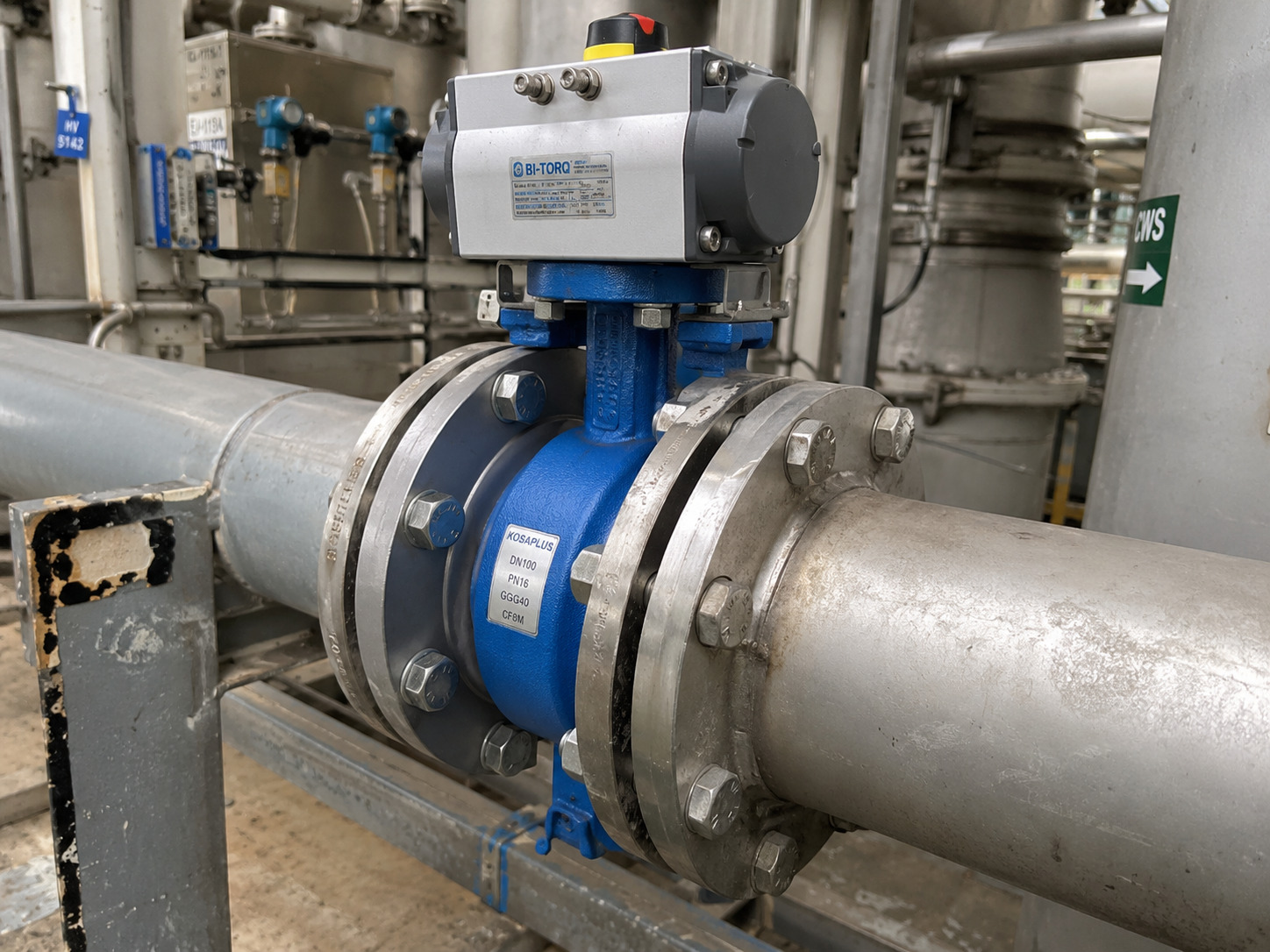
A butterfly wafer valve is the right choice when you need compact inline isolation between two flanges and can confirm flange fit, seat compatibility, disc clearance, differential pressure, and a full-line shutdown plan. The wafer body may reduce weight, space, and purchase cost, but those advantages disappear if the valve arrives with the wrong flange pattern, an incompatible liner, or an actuator that cannot seat the disc at maximum differential pressure.
For a technical buyer, the task is therefore not simply to find the correct nominal diameter. You need a specification and acceptance package that prove the valve will fit, shut off, operate, and remain maintainable in the actual line.
What a Butterfly Wafer Valve Actually Does
A butterfly wafer valve is a quarter-turn valve with a short body clamped between two mating pipe flanges by through-bolts or studs. A stem turns the disc about 90 degrees between closed and open positions, while the seat provides shutoff at the disc edge; on many resilient-seated designs, the seat face also seals against the pipe flanges.
The body normally depends on both adjacent flanges for support and compression. Centering holes are not the same as threaded lugs, so a standard wafer valve should not be treated as a pipe-end or one-sided maintenance valve unless the exact model has a documented rating for that duty.
The disc remains in the flow path when open. That makes the valve short and light, but it also means the disc profile, opening angle, pipe bore, and nearby fittings affect pressure loss and control behavior.
Choose the Body Style from the Maintenance Plan
Choose wafer, lug, or flanged construction from the shutdown and pipe-removal plan, not from unit price alone. A wafer valve is usually the best fit when both sides remain connected and the complete section can be isolated and depressurized before maintenance.
This table turns body style into a project decision.
| Project condition | Wafer body decision | What to review instead |
|---|---|---|
| Compact inline isolation; both flanges stay connected | Strong candidate | Confirm flange pattern, bore, and pressure class |
| Full-line shutdown is available for maintenance | Strong candidate | Document isolation and drain points |
| Downstream pipe may be removed while upstream remains pressurized | Do not assume suitability | Review a lug or flanged valve with a stated dead-end rating |
| High external pipe loads or large misalignment risk | Use caution | Review a flanged body and piping support |
| Frequent control near the closed position | Body style is not enough | Size the exact valve from its Cv curve and service conditions |
The decisive boundary is maintenance isolation. The detailed wafer-versus-lug decision should be settled before the buyer compares actuator packages or commercial terms.
Build the Specification from Service Conditions
Build the specification in the order of media, temperature, pressure, flange interface, duty, and actuation. Starting with a catalog model can hide the condition that will ultimately limit the valve.
Match the materials to media and temperature
State the fluid name, concentration, solids content, cleaning chemicals, and minimum, normal, and maximum temperatures. Then select the body, disc, stem, and seat as one material package. EPDM, NBR, PTFE, FKM, and metal seats have different chemical, temperature, friction, and leakage characteristics; the material name alone is not approval for a service.
Match rating and size to the line
State both operating and design pressure, including the maximum differential pressure across the closed disc. Across RUITO’s published industrial butterfly valve range, the broader portfolio spans DN25-DN3000, PN10-PN25, and a material-dependent temperature range of -40°C to +550°C. The same page identifies a standard wafer stock scope of DN50-DN600, PN10/PN16, with ductile-iron bodies and EPDM or NBR seats. These are portfolio boundaries, not an automatic rating for every material combination; the approved data sheet must govern the ordered valve.
Define actuation from worst-case torque
Specify manual, gearbox, pneumatic, or electric operation only after the supplier calculates required torque at the worst differential pressure and temperature. For automation, add available air pressure or voltage, control signal, fail position, required closing time, enclosure or hazardous-area requirement, position feedback, and mounting interface. A mounting pattern shows mechanical compatibility; it does not prove the actuator has enough output torque.
Prove Flange Fit Before Purchase Approval
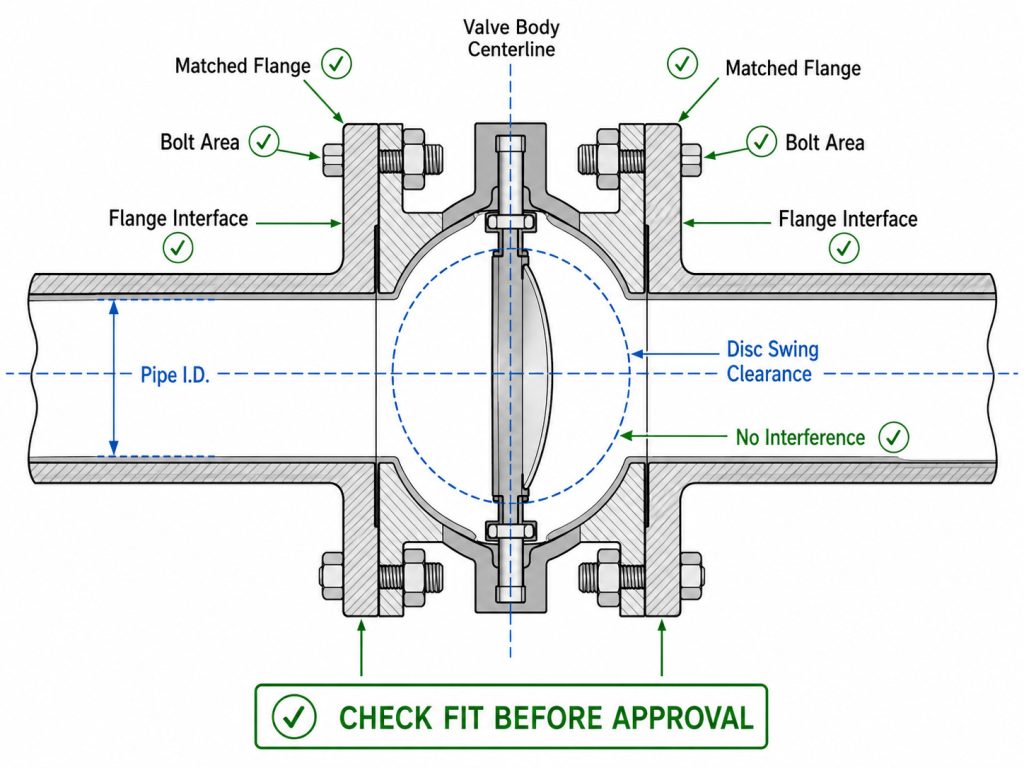
Prove fit with the valve drawing and the actual flange data before releasing the purchase order. Nominal size alone does not establish the bolt circle, pressure class, flange face, pipe bore, body clearance, or disc swing envelope.
Ask the supplier to mark the applicable flange standard and class on the dimensional drawing. Compare the bolt quantity and diameter, valve centering features, face-to-face dimension, flange bore, and the disc’s maximum outside sweep with the pipeline drawing. Pay special attention to thick liners, reducing flanges, pipe schedules with small bores, weld intrusions, and fittings installed immediately beside the valve.
The installation team should center the body, keep flange faces clean and parallel, tighten bolts gradually in a cross pattern, and cycle the disc before startup. Many resilient-seated models use the liner face as the flange seal, so an extra gasket can distort the seat and raise operating torque; other designs have different requirements. Follow the model-specific manual rather than applying a universal “no gasket” rule. Use this wafer-valve installation risk check during drawing review and site preparation.
Separate Isolation Duty from Control Duty
Separate on-off isolation from modulating control because the same line-size valve may be acceptable for shutoff yet unstable for throttling. For isolation, define allowable leakage, pressure direction, operating frequency, and the maximum differential pressure at closing.
For modulating duty, request the Cv-versus-angle data for the exact body, disc, seat, and size. Calculate required Cv at minimum, normal, and maximum flow using the pressure drop available across the valve. If normal operation falls close to the seat or near full travel, the valve has little usable control range and may suffer noise, vibration, cavitation, or rapid seat wear.
Do not substitute a generic chart from another valve. The exact butterfly valve Cv curve should be part of the technical submittal when the valve will regulate flow.
Turn the RFQ into an Acceptance Plan
Turn the RFQ into an acceptance plan by linking every critical service condition to a drawing, certificate, calculation, or test record. This closes the execution gap between “quoted as compliant” and “approved for shipment.”
Use the following fields as the minimum technical inquiry.
| RFQ field | Information to state | Approval evidence |
|---|---|---|
| Service | Medium, concentration, solids, cleaning fluid, min/max temperature | Material compatibility statement |
| Pressure | Operating, design, upset, and maximum shutoff differential | Rated data sheet and pressure-temperature limit |
| Piping interface | Size, flange standard/class, face type, bore, pipe schedule | Approved dimensional drawing and disc-clearance check |
| Valve duty | Isolation or control, cycles, flow direction, allowable leakage | Valve category, closure requirement, and exact Cv curve if controlling |
| Materials | Body, disc, stem, seat/liner, coating | Bill of materials and applicable material certificate |
| Operator | Type, supply, signal, fail action, closing time, environment | Torque calculation, actuator data sheet, and mounting drawing |
| Inspection | Design/test standard and edition, witness or hold points | Inspection and test plan plus signed test records |
| Commercial | Quantity, spares, documentation language, delivery point | Quotation with lead time and document list |
The most important fields are flange geometry, maximum differential pressure, and material compatibility because errors there cannot be corrected by a better actuator or a final pressure test.
RUITO’s published QA route lists configuration-dependent deliverables that buyers can request, including a material certificate, dimensional inspection report, torque test log, hydrostatic test chart, seat-leakage certificate, and pre-shipment release record with photos. It also describes serial-number traceability between the valve and inspection data. State which records are mandatory, which require purchaser review, and which tests require witnessing before production begins.
Reject Quotes That Hide the Engineering Basis
Reject or clarify a quote when it gives a model number without the engineering basis needed for approval. A low price is not comparable if one supplier has priced a generic soft-seated valve while another has included the required trim, actuator, tests, and documentation.
Treat these as red flags:
- “Six-inch wafer valve” with no flange standard, pressure class, or bore check.
- A seat material name without compound limits for the stated medium and temperature.
- An actuator torque figure with no differential-pressure basis or safety margin.
- “Bidirectional” or “zero leakage” without pressure direction, test method, and acceptance criterion.
- “Factory tested” without the standard, test pressure, duration, leakage class, and signed record.
- A dead-end claim for a wafer body without a model-specific rating and installation arrangement.
- No approved drawing before production or no traceable documents before shipment.
Clarifying these points before purchase is faster and less expensive than resolving a flange mismatch or failed closure test at site.
Specify the Service, Then Approve the Valve
A reliable butterfly wafer valve purchase starts with the line conditions and ends with traceable approval evidence. Confirm the maintenance plan, material package, flange geometry, disc clearance, maximum differential pressure, control range, actuator basis, leakage requirement, and document package before comparing final prices.
RUITO can review these inputs, return a configuration and drawing for approval, and align the quotation with the required inspection records. Send the completed RFQ through the contact page to discuss your project.
FAQ
Do wafer butterfly valves need flange gaskets?
Not always. Many resilient-lined wafer valves use the liner face to seal against the flanges and may be damaged or over-compressed by extra gaskets, while other constructions require different sealing arrangements. Follow the exact model’s installation manual and approved drawing.
Can a wafer valve replace a lug valve of the same size?
Not on nominal size alone. Confirm the flange pattern, face-to-face dimension, disc clearance, pressure rating, shutdown method, and whether one side of the line must ever be removed under pressure. A wafer body usually cannot preserve the same dead-end maintenance function as a rated lug valve.
What proves that a wafer valve passed its shutoff test?
A traceable closure-test record should identify the valve, test standard, medium, pressure, duration, pressure direction, and acceptance result. The purchase order must define the leakage criterion before testing; “no visible leakage” and a named leakage rate are not interchangeable unless the governing standard says so.
Is every wafer butterfly valve bidirectional?
No assumption should be made from body style alone. Confirm the exact valve’s permitted pressure direction, differential-pressure rating, seat design, and closure-test direction, especially for offset, metal-seated, or application-specific designs.