
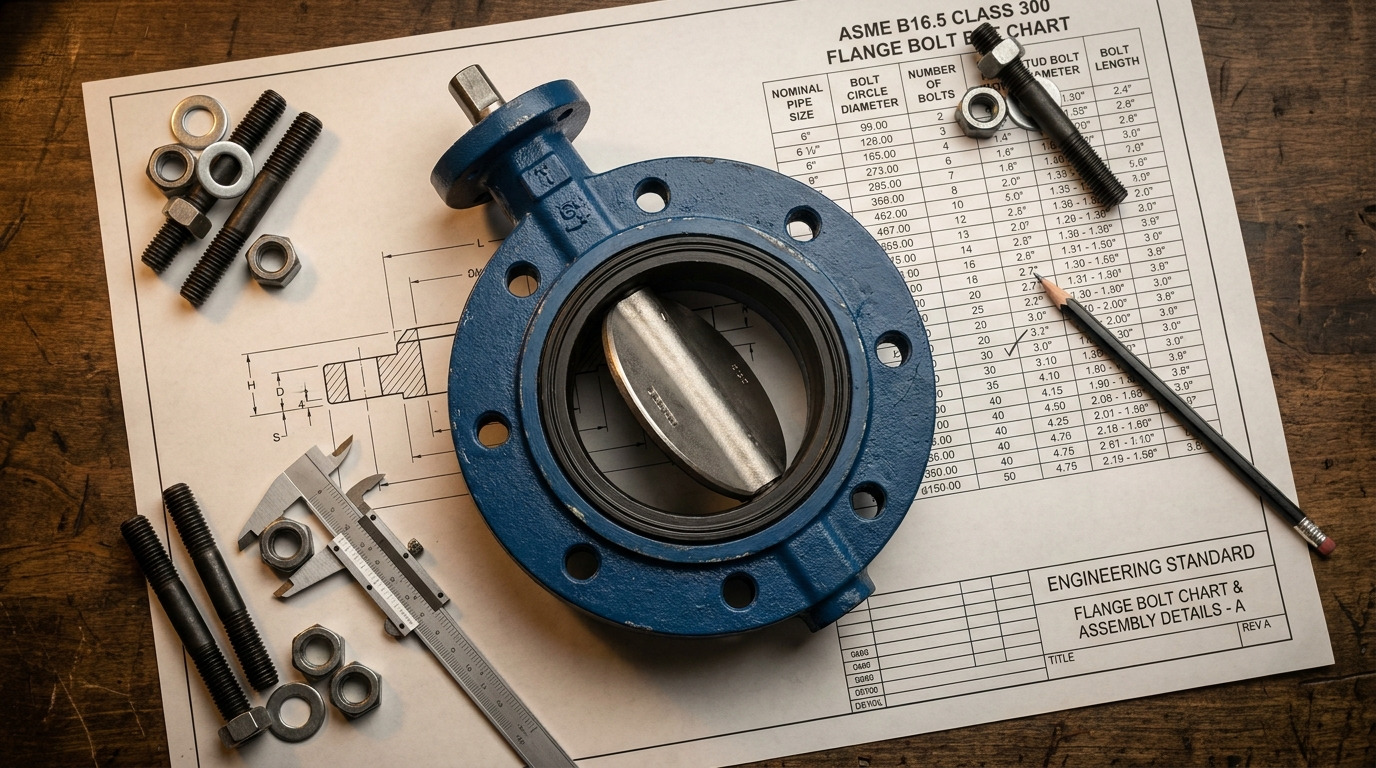
A 300 butterfly valve bolt chart tells you the ASME Class 300 flange bolt count, bolt diameter, bolt-hole size, and bolt-circle diameter for the valve’s nominal pipe size, but final bolt length still has to be confirmed against the valve drawing and gasket stack. If your search for a 300 butterfly valve bolt chart is really about DN300, treat that as a different question until you confirm whether the flange standard is ASME, EN, JIS, or another system.
For engineers, installers, and buyers, the risk is simple: the bolt pattern may look close, but the wrong pressure class, body style, or bolt length can cause misalignment, seat distortion, gasket leakage, or delayed installation. When you are selecting industrial butterfly valves for a Class 300 piping system, you need the flange drilling data first, then the valve-specific drawing before purchasing fasteners.
How to Read a 300 Butterfly Valve Bolt Chart
A useful Class 300 bolt chart should identify the flange standard, nominal pipe size, number of bolts, bolt diameter, bolt-hole diameter, and bolt circle. For ASME flanges, Class 300 is a pressure class, not a direct statement that the valve is rated to only 300 psi. Actual pressure-temperature capability depends on the valve design, body material, seat material, and applicable standard.
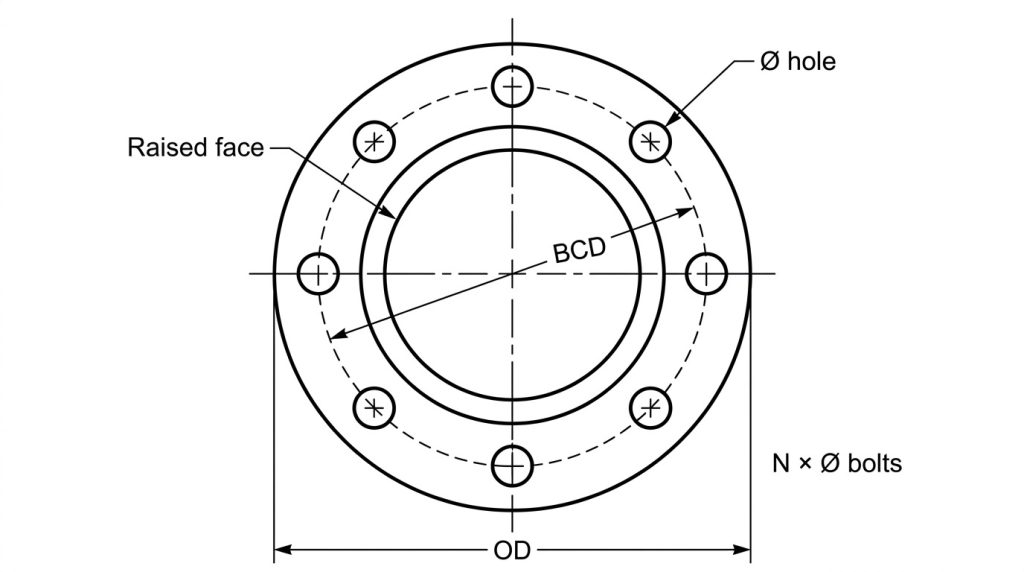
For ASME B16.5, the usual flange size range is NPS 1/2 through NPS 24. For larger steel flanges, ASME B16.47 covers NPS 26 through NPS 60, with Series A and Series B drilling differences that are not interchangeable. That matters because a large-diameter butterfly valve may still be called Class 300, while its bolt circle and hole pattern come from a different flange standard.
What If 300 Means DN300 Instead?
If 300 means DN300, do not use a Class 300 chart automatically. DN300 is commonly matched with NPS 12 by nominal size, but DN300 PN16, DN300 PN25, JIS 10K, and ASME NPS 12 Class 300 use different flange drilling patterns.
The safe check is to confirm three items before reading any chart: nominal size, pressure class or PN rating, and flange standard. Once those three are confirmed, the chart becomes useful instead of misleading.
Class 300 Butterfly Valve Bolt Chart by NPS
Use the following table as a Class 300 ASME B16.5 flange drilling guide for common butterfly valve sizes from NPS 2 to NPS 24. It gives the bolt pattern and bolt diameter, not the final bolt length for every wafer, lug, or flanged valve body.
| Valve Size | Bolt Quantity | Bolt Diameter | Bolt Hole Diameter | Bolt Circle Diameter |
|---|---|---|---|---|
| NPS 2 | 8 | 5/8 in. | 3/4 in. | 5.00 in. |
| NPS 2-1/2 | 8 | 3/4 in. | 7/8 in. | 5.88 in. |
| NPS 3 | 8 | 3/4 in. | 7/8 in. | 6.62 in. |
| NPS 3-1/2 | 8 | 3/4 in. | 7/8 in. | 7.25 in. |
| NPS 4 | 8 | 3/4 in. | 7/8 in. | 7.88 in. |
| NPS 5 | 8 | 3/4 in. | 7/8 in. | 9.25 in. |
| NPS 6 | 12 | 3/4 in. | 7/8 in. | 10.62 in. |
| NPS 8 | 12 | 7/8 in. | 1 in. | 13.00 in. |
| NPS 10 | 16 | 1 in. | 1-1/8 in. | 15.25 in. |
| NPS 12 | 16 | 1-1/8 in. | 1-1/4 in. | 17.75 in. |
| NPS 14 | 20 | 1-1/8 in. | 1-1/4 in. | 20.25 in. |
| NPS 16 | 20 | 1-1/4 in. | 1-3/8 in. | 22.50 in. |
| NPS 18 | 24 | 1-1/4 in. | 1-3/8 in. | 24.75 in. |
| NPS 20 | 24 | 1-1/4 in. | 1-3/8 in. | 27.00 in. |
| NPS 24 | 24 | 1-1/2 in. | 1-5/8 in. | 32.00 in. |
The important pattern is that Class 300 often uses more or larger fasteners than a lower pressure class at the same nominal size. For example, NPS 8 Class 300 uses 12 bolts or studs at 7/8 in. diameter, so you should not carry over assumptions from a Class 150 butterfly valve bolt chart without checking the pressure class.
Key Takeaway: the chart confirms drilling geometry, but it does not replace the valve drawing for bolt length, lug thread depth, gasket selection, or installation torque.
How Body Style Changes Bolt Selection
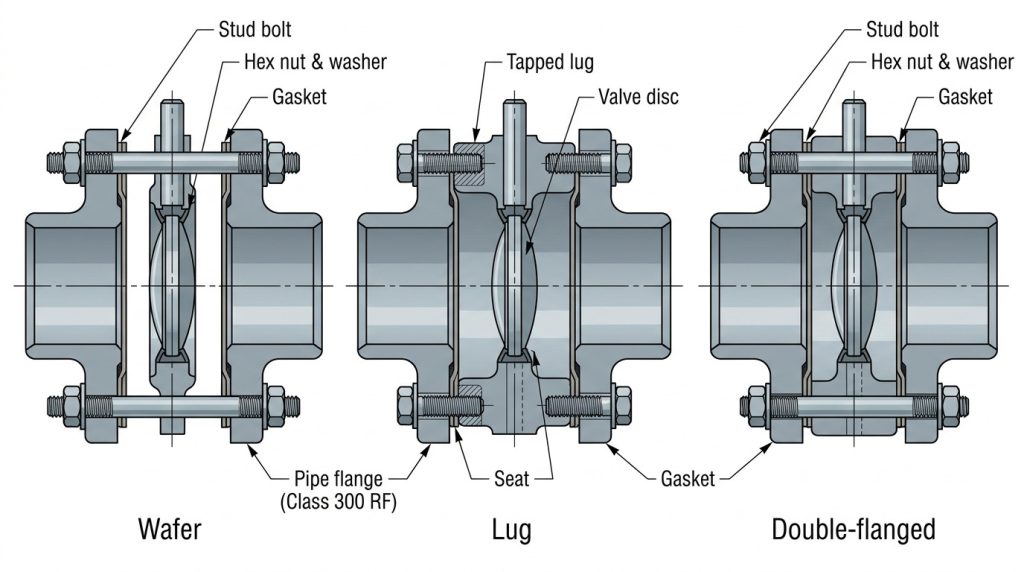
The flange chart sets the bolt pattern, but the butterfly valve body style determines how those bolts actually clamp the joint. A wafer valve, lug valve, and double-flanged valve may share the same ASME Class 300 line flange drilling, yet require different fastener lengths and assembly details.
This is where many installation errors happen. The installer reads the correct NPS and Class 300 row, buys the right diameter, then discovers the bolts are too short, too long, or incompatible with the valve lugs.
How Does a Wafer Body Affect Length?
A wafer butterfly valve sits between two pipe flanges and is held by through-bolts or studs. The fastener length must pass through both flanges, the gasket stack, and the valve body thickness while still allowing proper nut engagement.
The bolt chart gives the diameter and hole pattern, but the valve face-to-face dimension controls the actual length. You also need to check whether the valve body has centering lugs, slots, or clearance limits around the disc and liner.
When Does a Lug Body Need More Care?
A lug body uses threaded or tapped lugs, so the fastener may not pass through the full flange-to-flange stack. This can be useful when one side of the piping must be removed, but dead-end service depends on the valve design, pressure rating, and manufacturer’s limits.
If you are reviewing a lug-style butterfly valve, confirm thread engagement depth, bolt grade, and whether the valve is rated for one-sided pressure. A bolt that is correct for through-bolting a wafer valve may bottom out or under-engage in a lug valve.
What Changes With Flanged Ends?
A double-flanged butterfly valve bolts to each pipe flange like a separate flanged component. You normally size bolts for each side of the connection, and the valve flange thickness becomes part of the length calculation.
This style can be easier to align on larger valves, but it still requires the exact flange standard. A Class 300 double-flanged valve built to ASME drilling should not be assumed to match EN or JIS flanges.
How to Confirm Bolt Length Before Ordering
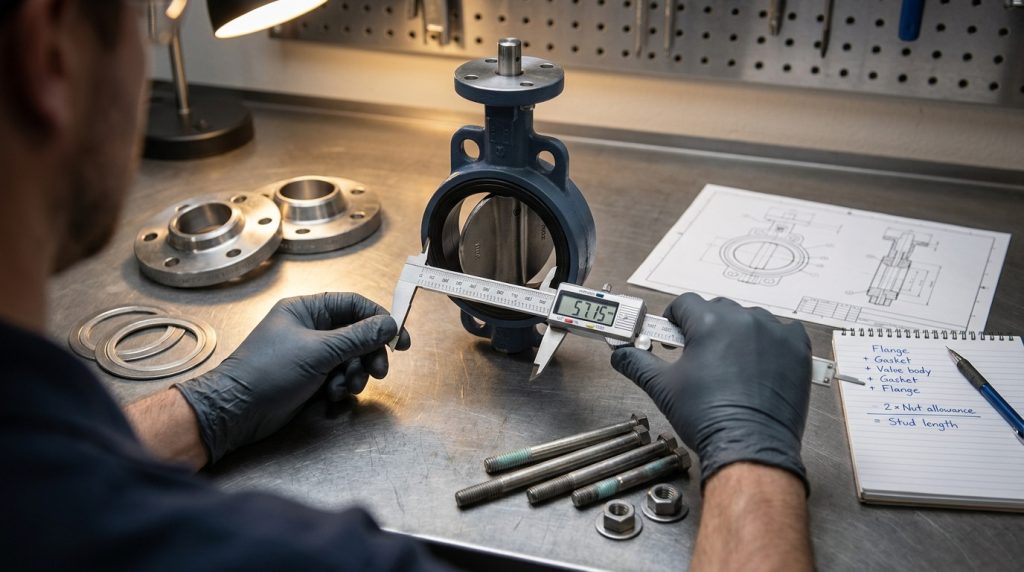
Bolt diameter can be read from the chart, but bolt length must be calculated from the real assembly stack-up. For Class 300 butterfly valves, that stack-up changes with body style, gasket type, flange facing, washer use, and whether the fastener is a stud bolt or machine bolt.
As a practical starting point, standard ASME Class 300 raised-face flange charts commonly show listed stud lengths around 3-1/2 in. for NPS 2, about 5-1/2 in. for NPS 8, about 6-3/4 in. for NPS 12, and around 9 in. for NPS 24. These values are useful for comparison, but final length must be checked against the valve drawing because a butterfly valve body adds geometry that a plain flange pair does not capture.
What Stack-Up Should You Measure?
Measure every part that the fastener must clamp or pass through. That includes pipe flange thickness, valve body thickness or lug depth, gasket thickness, washer thickness, nut height, and required thread projection after tightening.
For stud bolting, many project specifications expect full nut engagement and a small visible thread projection after tightening. A common shop target is about 1 to 3 exposed threads, but your project specification should control the final acceptance rule.
Can One Chart Give the Final Length?
No. One chart can give the flange pattern and a typical flange-pair length, but it cannot know your exact butterfly valve construction. This is especially true for lined wafer valves, lug valves with blind tapped holes, and thicker high-performance bodies.
For a size-specific check, an 8 butterfly valve bolt size example is helpful because NPS 8 Class 300 changes to 12 bolts at 7/8 in. diameter. The final length still depends on whether the body is wafer, lug, or flanged.
Which Bolt Material and Grade Should You Specify
Bolt grade should match pressure class, temperature, corrosion risk, and flange material, not just the diameter shown in the chart. A Class 300 joint creates higher clamping demand than a lighter low-pressure joint, so generic mild steel hardware is usually the wrong choice for industrial service.
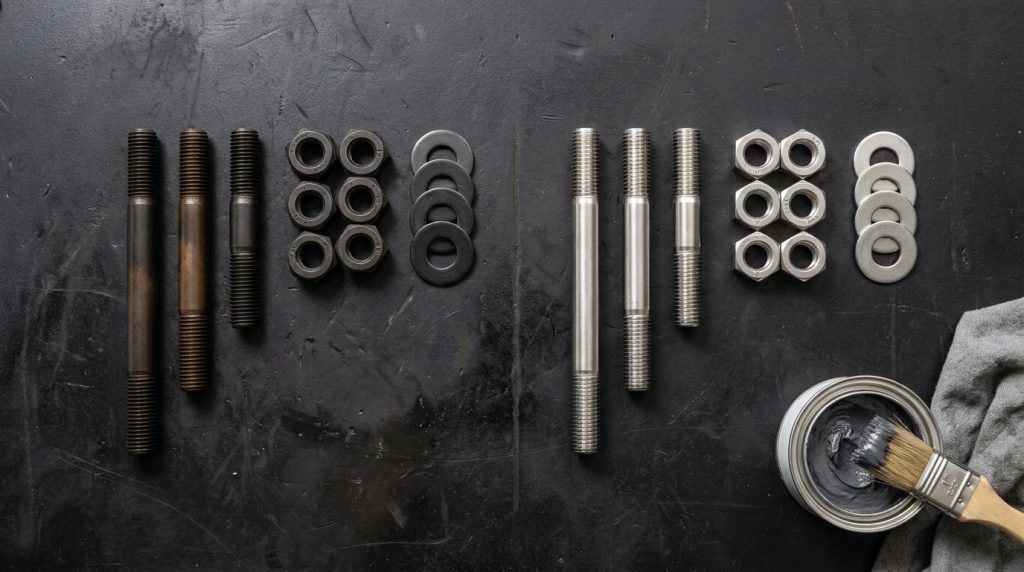
For carbon steel and alloy steel flanged joints, ASTM A193 B7 studs with ASTM A194 2H nuts are a common combination. For stainless or corrosive service, ASTM A193 B8 or B8M bolting may be considered, but strength, galling risk, temperature, and chemical compatibility must all be checked.
When Is Stainless Bolting the Right Choice?
Stainless bolting is usually considered when corrosion resistance is more important than the lowest fastener cost. It can make sense for chemical, marine, outdoor, or washdown environments, but it should not be selected only because the valve body is stainless.
Stainless threads can gall during tightening, especially when the nut and stud are similar materials. Use the lubricant or anti-seize allowed by the project specification, and remember that lubrication changes the torque-to-load relationship.
How to Tighten Class 300 Butterfly Valve Bolts
Tightening should create even gasket and seat compression, not simply hit a number on a torque wrench. A butterfly valve is sensitive to uneven compression because the body, liner, disc clearance, and gasket load all interact.
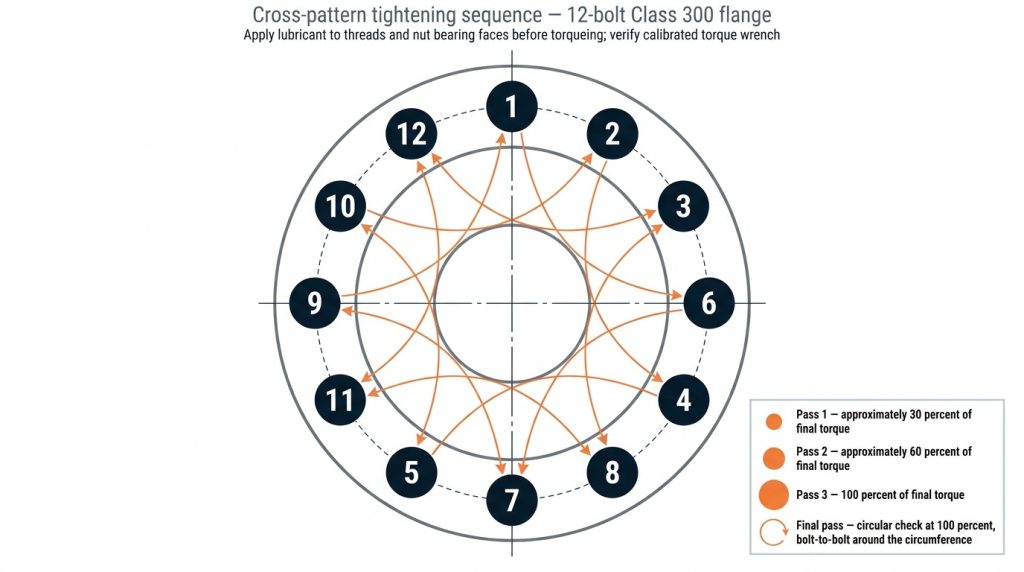
Before tightening, confirm that the pipe flanges are parallel, clean, and aligned. The valve should be centered, the gaskets should be correct for the flange facing and service, and the disc position should follow the valve manufacturer’s installation instructions, often slightly open enough to avoid seat or disc damage.
Why Not Use One Universal Torque Value?
There is no reliable universal torque value for every Class 300 butterfly valve. Torque depends on bolt size, bolt grade, thread condition, lubricant, gasket type, flange surface finish, and the required gasket stress.
A controlled tightening sequence is more useful than a generic number. A common industrial approach is hand-tightening, then cross-pattern passes at about 30%, 60%, and 100% of the specified final torque, followed by a circular check pass. For critical service, the tightening method should be part of the project bolting procedure, often aligned with ASME PCC-1 practices.
Key Takeaway: use the chart to identify the fastener, but use the project procedure and valve documentation to control tightening.
Common Mistakes That Cause Leaks or Misfit
Most bolting problems come from using the right-looking chart under the wrong assumptions. The chart is only correct when the nominal size, pressure class, flange standard, and valve body style are all correct.
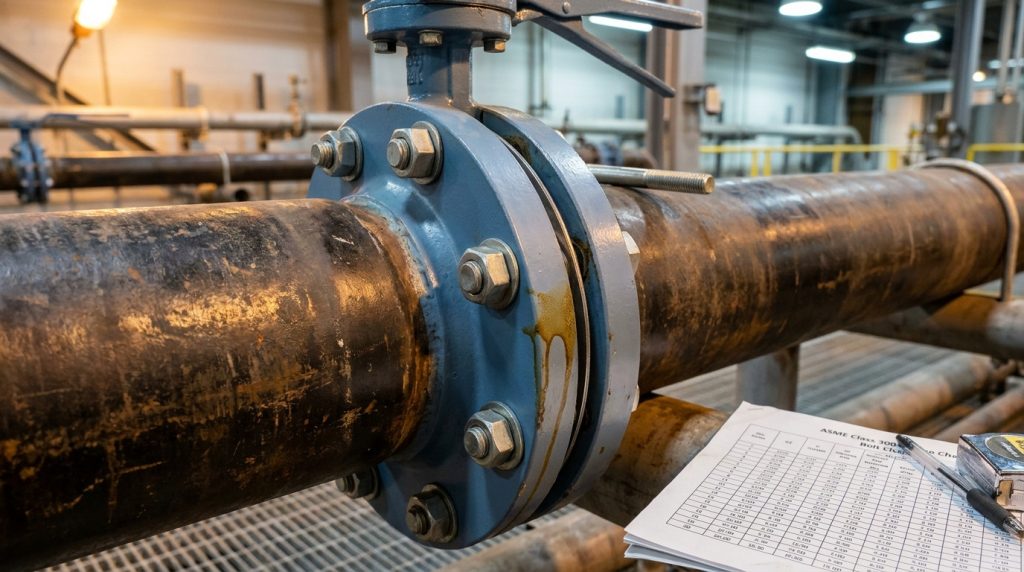
Watch for these common errors:
- Treating Class 300 as the same thing as DN300 or 300 psi.
- Using Class 150, PN16, or JIS drilling data on an ASME Class 300 joint.
- Ordering bolt length from a flange chart without checking valve body thickness.
- Using through-bolts for a lug body where shorter tapped-lug bolts are required.
- Ignoring gasket thickness, washer use, and thread projection.
- Over-tightening soft seats or lined bodies and distorting the sealing area.
- Using unverified fastener grades because the diameter appears correct.
A good purchase package should state valve size, flange standard, pressure class, body style, material, gasket type, bolt grade, nut grade, coating or lubrication requirement, and the drawing revision. That small amount of discipline prevents most Class 300 bolt chart mistakes before the parts reach site.
Conclusion
A 300 butterfly valve bolt chart is the right starting point when you need ASME Class 300 flange drilling data, but it is not the whole installation specification. Start with the correct NPS and flange standard, confirm the Class 300 bolt quantity and diameter, then check body style, gasket stack, bolt material, and tightening procedure before ordering.
If you are matching a butterfly valve to a Class 300 piping system, you can request a specification review with your valve size, flange standard, pressure class, body style, gasket details, and project drawing so the bolting requirements can be discussed clearly before procurement.
FAQ
Can I use a Class 150 bolt chart for a Class 300 butterfly valve?
No. Class 150 and Class 300 flange drilling can differ in bolt count, bolt diameter, bolt-hole size, and bolt circle. Use the chart that matches the actual pressure class and flange standard on the project documents.
What’s the best bolt material for a Class 300 butterfly valve?
There is no single best material for every service. ASTM A193 B7 with ASTM A194 2H nuts is common for carbon steel industrial flanged joints, while stainless grades such as B8 or B8M may fit corrosive services when strength and galling risk are addressed.
How do I know if 300 means DN300 or Class 300?
Check the project documents first. DN300 is a nominal metric size, roughly aligned with NPS 12, while Class 300 is an ASME pressure class. They describe different things and cannot be used interchangeably.
Can I reuse butterfly valve flange bolts after removal?
Usually, you should avoid reuse unless the project specification allows it after inspection. Bolts may have thread damage, corrosion, stretching, coating loss, or unknown lubrication history, all of which can affect clamp load.
How do I know if the bolt length is correct?
The correct length gives proper engagement without bottoming out or leaving too little thread. Confirm the valve drawing, flange thickness, gasket thickness, washer use, nut height, and required thread projection before ordering.