
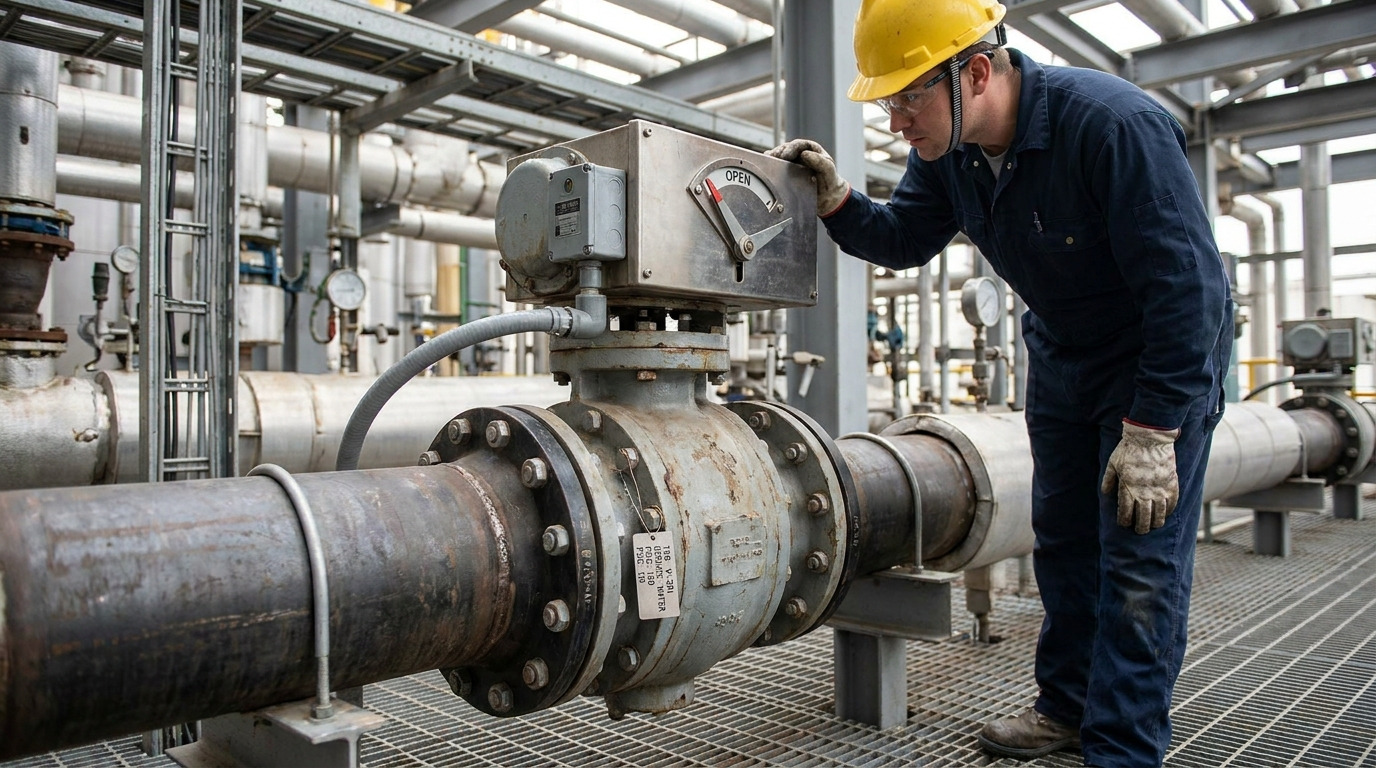
A butterfly valve is in the open position when its disc is aligned with the pipeline so flow can pass through the valve bore. For most quarter-turn valves, the butterfly valve open position is reached after about 90 degrees of shaft rotation from closed, but you should confirm it from the stem, local indicator, actuator feedback, and valve data sheet before relying on it.
This matters when you see a handle, gear pointer, or control-room signal and need to know whether the actual disc is open. In an industrial butterfly valve, the safest judgment is not “the display says open,” but “the mechanical position, indicator, and feedback agree.”
What Defines the Butterfly Valve Open Position
The open position is defined by the disc position inside the valve, not only by the handle or actuator label. In a fully open butterfly valve, the disc edge faces the flow and the disc plane is broadly parallel with the pipe axis, leaving the main flow path open.
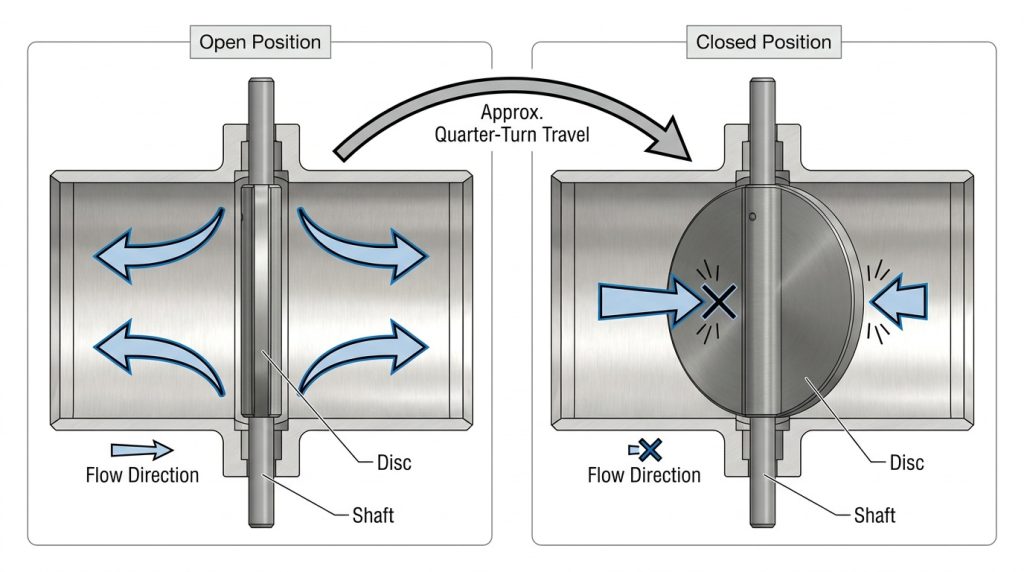
In the closed position, the disc turns across the bore and presses against the seat to stop flow. Many butterfly valve IOMs describe this as a 90-degree operating movement from closed to open. That is why butterfly valves are called quarter-turn valves.
Use this table to separate the real position clue from the common misread.
| Position clue | What it usually means | What you should verify |
|---|---|---|
| Disc or stem indicator aligned with pipe | Valve is normally open | Confirm the stem mark truly follows the disc |
| Indicator reaches the open stop, about 90 degrees from closed | Valve has reached normal full travel | Confirm the stop was set during assembly or commissioning |
| Indicator is between closed and open | Valve is partially open | Do not assume percent open equals percent flow |
| Remote signal says “open” | Actuator or switch reports open | Confirm feedback is tied to actual stem movement |
The key point is simple: the disc is the valve. Everything outside the body is an indication system, and indications can be wrong if the handle, coupling, switch, or actuator stop has shifted.
Is 90 Degrees Always Fully Open
A 90-degree turn is the normal full travel for most butterfly valves used for isolation service. If the calibrated closed position is treated as 0 degrees, full open is normally about 90 degrees from that point.
Do not use 90 degrees as a blind rule when the actuator has been changed, the valve has been repaired, or the indicator has been reinstalled. In those cases, the open stop and closed stop should be checked against the valve drawing, stem mark, or manufacturer data sheet.
Why the Shaft Position Matters More Than the Handle
The shaft is mechanically connected to the disc, so the shaft position is usually closer to the truth than the handle position. A handle can be removed, rotated, or reinstalled in a misleading orientation, especially on small manual valves.
If the shaft has a slot, flat, or top mark, check whether that mark is intended to show disc direction. Some valves use the stem mark as a direct disc indicator, while others rely on a separate pointer or actuator scale. When the marking convention is unclear, do not guess.
How to Check Manual and Gear Operated Valves
For manual valves, you should read the handle or gear pointer first, then confirm that it still matches the stem and travel stops. This is fast, but it prevents the most common mistake: trusting an external handle after maintenance or actuator replacement.
How Do You Read a Lever Handle
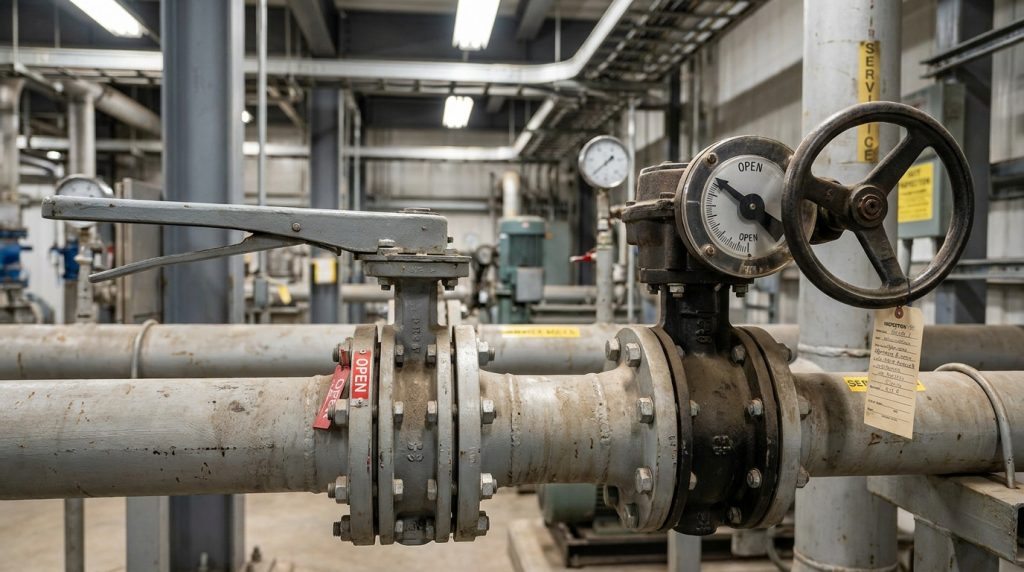
On many lever-operated butterfly valves, a handle parallel to the pipe indicates open, and a handle across the pipe indicates closed. A notched plate or locking plate may show several intermediate positions between fully closed and fully open.
That rule is useful only when the handle is correctly mounted. If you are selecting or replacing manual operators, the choice of butterfly valve handles should match the service conditions, frequency of operation, and need for locking or position visibility.
What Changes With a Gear Operator
A gear-operated butterfly valve often uses a handwheel, chainwheel, or square operating nut. The handwheel may need many turns to move the valve through the same 90-degree disc travel, so you should rely on the pointer, open/close scale, and travel stop rather than wheel direction alone.
Gear operators are common on larger valves or valves with higher torque. If the pointer reaches “open” but the wheel still turns with unusual resistance, stop and check the actuator stop setting instead of forcing the operator.
Can You Trust the Handle After Maintenance
You can trust the handle only after confirming it was reinstalled in the correct orientation. This is especially important when a valve has been disassembled, an actuator has been replaced, or a handle has been removed for access.
A practical check is to move the valve from closed to open under safe conditions and watch whether the stem, pointer, and stop positions agree through the full travel. If any one of those clues disagrees, treat the valve position as unconfirmed.
How to Verify Actuated or Remote Position Signals
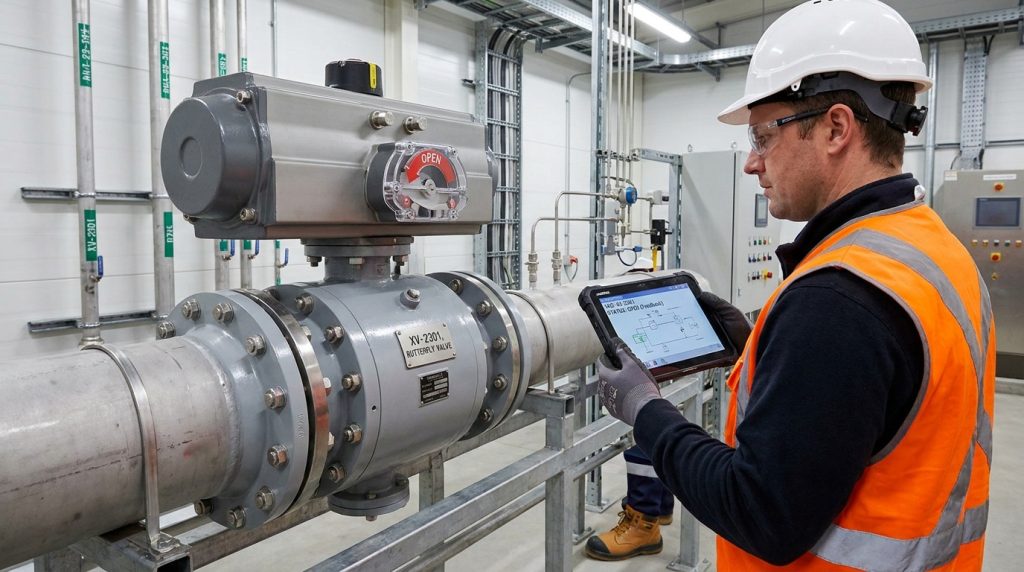
For actuated valves, an open signal is useful but not enough by itself. You need to know whether the signal comes from the actuator motor, a limit switch, a positioner, or a stem-mounted feedback device.
Does an Open Command Prove the Valve Is Open
No, an open command only proves that the control system requested the valve to open. It does not prove that the disc actually moved to the open position.
A stronger signal is an open-limit confirmation from a correctly set switch. Stronger still is position feedback that reflects actual stem or shaft movement. For supervised lines, a butterfly valve tamper switch can help show when a valve has moved away from its intended position, but it still must be installed and tested correctly.
What Should You Compare During Commissioning
During commissioning, compare three things: the local mechanical indicator, the actuator feedback, and the control-room status. They should change together from closed to open and from open to closed.
A useful check sequence is:
- Confirm the valve tag and line number.
- Move the valve to closed and verify the local indicator.
- Move it toward open and watch for smooth travel.
- Confirm the open feedback at the end of travel.
- Record the final open and closed indication method.
If the valve is part of a control loop, also confirm the positioner signal. A 100 percent controller output should not be assumed to mean the disc is physically at full open unless the actuator setup proves it.
How Do Fail Positions Affect the Answer
Fail-open and fail-closed actuators change how you interpret a valve after loss of air, power, or signal. A spring-return pneumatic actuator, for example, may move the valve to its fail position when air pressure is removed.
Always read the actuator nameplate, valve drawing, and control narrative before making assumptions. “Normally open,” “fail open,” and “currently open” are different ideas, and mixing them up can create serious operating errors.
Why Percent Open Is Not the Same as Flow
A butterfly valve’s percent open does not translate directly into percent flow. The disc changes the flow area, turbulence, and pressure drop in a nonlinear way, so a half-open valve rarely gives exactly half the flow.
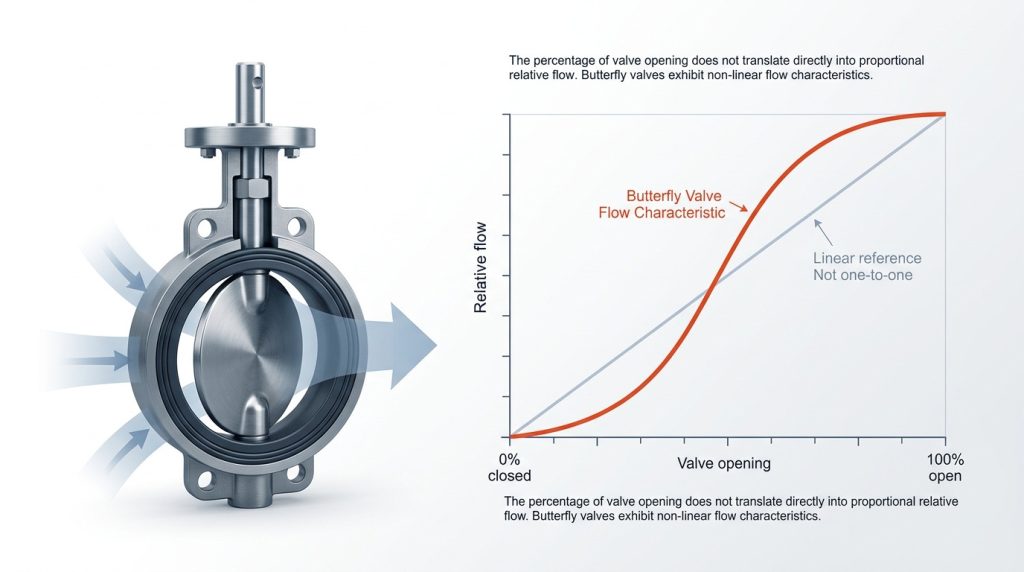
Can 50 Percent Open Mean 50 Percent Flow
No, 50 percent open should be treated as a mechanical position, not a flow guarantee. Actual flow depends on upstream and downstream pressure, fluid properties, pipe size, disc design, and the valve’s Cv or flow coefficient.
For conventional butterfly valves, technical literature commonly treats 0 to 90 degrees as the on/off travel range, while throttling service is often more practical in a narrower range. Some conventional designs may become harder to control near roughly 60 to 70 degrees open because fluid forces and torque behavior change quickly.
When Is Full Open Still Not Enough
Full open may still be insufficient if the valve is undersized, the pressure drop is too high, or the system needs stable control rather than simple isolation. In that case, the question is no longer only “is the valve open?” but “does this open valve pass the required flow under this pressure condition?”
If you are checking flow behavior, a butterfly valve flow vs percent open curve is more useful than the handle angle alone. The final value should still be confirmed from the valve data sheet, Cv curve, and project operating conditions.
Common Mistakes That Cause Wrong Position Judgments
Most wrong open/closed judgments come from reading one clue and ignoring the others. The best method is to look for agreement between the stem, pointer, actuator feedback, and process response.
Watch for these common mistakes:
- Reading the handle direction after the handle has been removed or reinstalled.
- Trusting an open command instead of open feedback.
- Assuming a gear operator pointer is correct without checking stop settings.
- Treating a partially open valve as fully open because flow is present.
- Forcing an actuator against the stop to “make it more open” or “more closed.”
- Confusing storage or installation position with operating position.
For some resilient-seated designs, storage or handling instructions may call for the disc to be left slightly open, often around 3 to 5 degrees, to protect the seat or disc edge. That is not the same as the operating open position, and it should not be used as proof that the line is open for service.
Key takeaway: one indication is a clue; matching mechanical and feedback indications are a confirmation.
A Practical Confirmation Sequence for Open Position
The most reliable way to confirm the butterfly valve open position is to follow a fixed sequence and stop when any clue conflicts. This keeps the check practical without turning it into a full troubleshooting job.
Use this sequence when you are authorized to operate or inspect the valve:
- Confirm the valve tag, service, and line direction.
- Check whether the valve is manual, gear operated, electric, pneumatic, or hydraulic.
- Read the local position indicator before moving anything.
- Compare the handle, stem mark, or gear pointer with the expected pipe direction.
- If actuated, compare the local indicator with open feedback at the control panel.
- Move the valve only within the permitted operating procedure.
- At full open, confirm the travel stop, indicator, feedback, and process response agree.
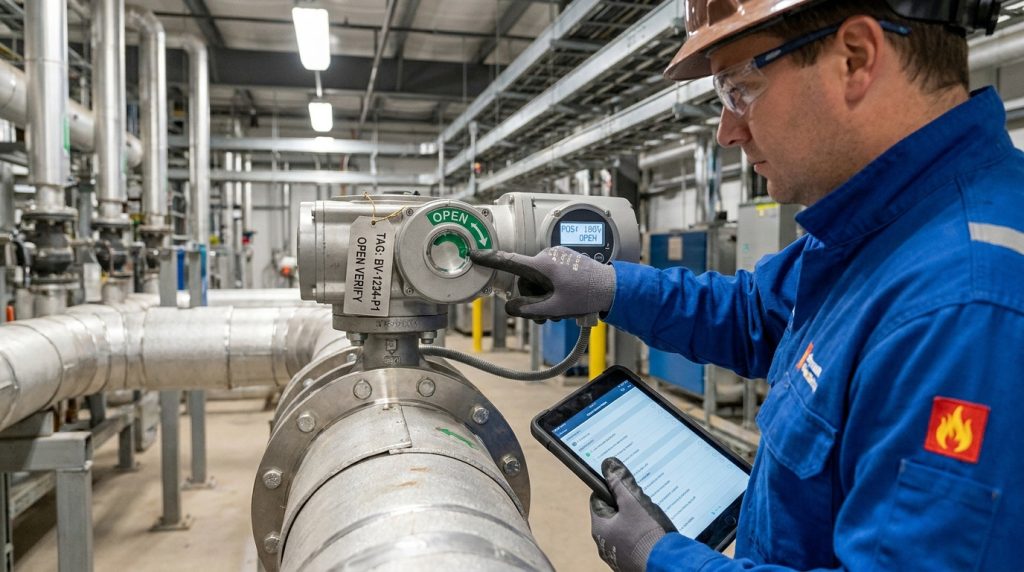
If the valve does not move smoothly, the indicator disagrees with feedback, or the process response does not match the expected open condition, treat the position as uncertain. The next step should be a controlled check of the actuator, coupling, stem, switch setting, or valve data sheet, not repeated force on the operator.
For project documentation, record the confirmed open indication method. A simple note such as “open confirmed by stem pointer and actuator open-limit feedback” is much clearer than “valve open,” especially when the valve will be reviewed later by another operator, inspector, or purchasing team.
Conclusion
This article explained how to identify the butterfly valve open position from the disc, shaft, handle, gear pointer, actuator feedback, and flow behavior. The main judgment is that full open is a mechanical disc position, usually about 90 degrees from closed, while percent open and remote signals must be verified against the actual valve package.
If you are confirming a valve for a new line, replacement project, or actuator package, send the size, medium, pressure, temperature, connection type, actuator type, and required feedback signal through the project contact form so the valve configuration can be reviewed against your operating conditions.
FAQ
Can I tell a butterfly valve is open from the handle direction alone?
Usually yes, but only if the handle is correctly installed. A handle parallel to the pipe often indicates open, but that convention becomes unreliable after maintenance, handle replacement, or actuator changes. Confirm the stem mark, pointer, or valve data sheet if the position matters for safety or operation.
What’s the best way to confirm a butterfly valve remotely?
The best method is to use feedback that reflects actual stem or actuator travel, not only the open command. A control-room “open” request means the system asked the valve to open. Open-limit feedback or position feedback gives a stronger confirmation, especially when it agrees with the local indicator.
How do I know if a butterfly valve is fully open?
The valve is fully open when the disc reaches the open travel stop and the local indicator agrees with the expected open position. For most quarter-turn butterfly valves, that is about 90 degrees from closed. If the stop, pointer, and feedback do not agree, the position should be treated as unconfirmed.
Can I leave a butterfly valve partially open for control?
Yes, but only when the valve and actuator are suitable for throttling. Many butterfly valves can operate at intermediate positions, but percent open is not equal to percent flow. For stable control, check the valve type, Cv curve, actuator sizing, pressure drop, and torque behavior.
What should I check if the valve says open but flow is low?
Start by confirming the local mechanical position. If the disc is fully open, low flow may come from an undersized valve, blocked strainer, closed downstream valve, high pressure drop, actuator miscalibration, or process conditions outside the expected range. Do not assume the butterfly valve is the only cause until the system path is checked.