
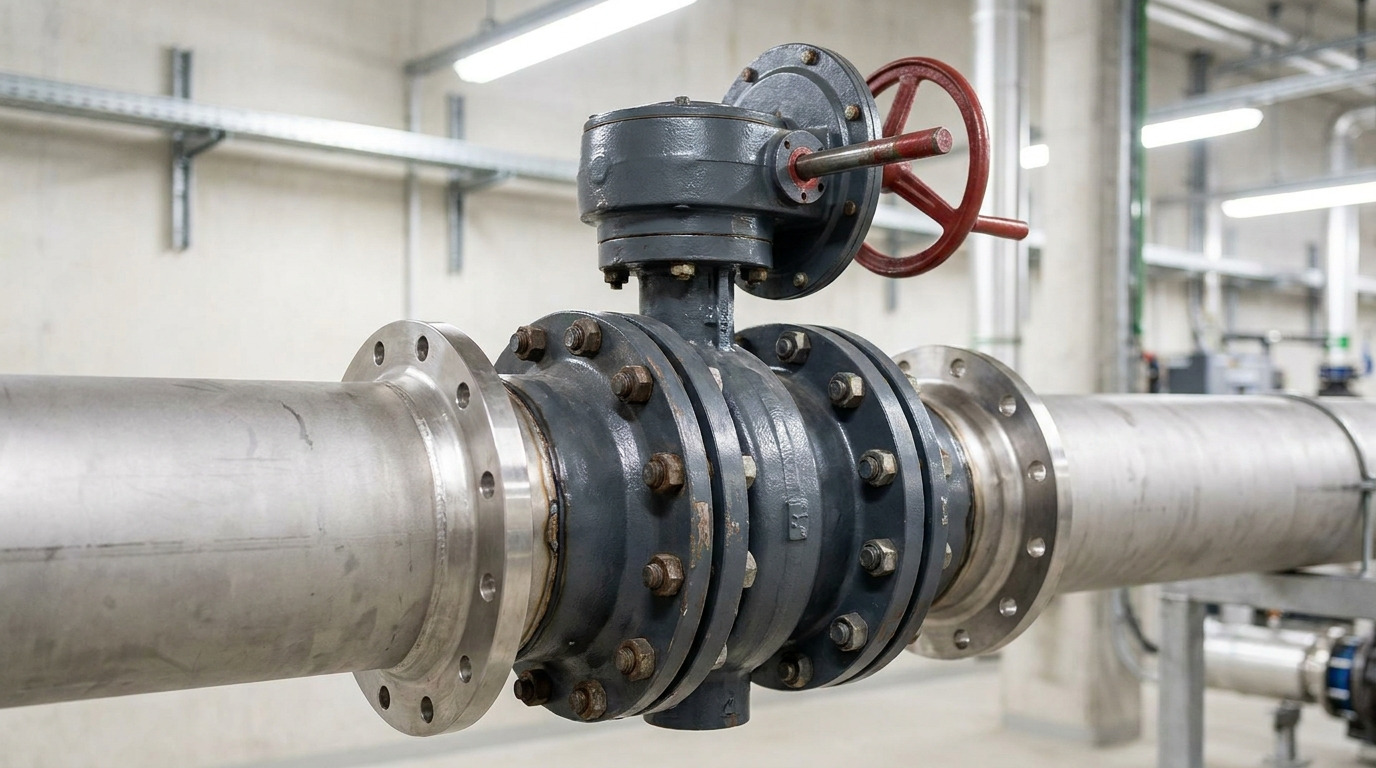
To choose a 14″ butterfly valve, first confirm the line size, flange standard, pressure class, body style, seat material, and operator torque against the actual service conditions. A 14″ butterfly valve is normally treated as DN350/NPS 14, but it is not automatically interchangeable with every valve that carries the same nominal size.
A common replacement problem is simple: the old valve is called “14 inch,” but the new valve has a different face-to-face length, bolt pattern, seat width, or disc clearance. The same checks apply whether you are reviewing a resilient seated butterfly valve for water service or a higher performance offset design for more demanding media.
What Is a 14″ Butterfly Valve?
A 14″ butterfly valve is a quarter-turn valve used to isolate or regulate flow in a DN350/NPS 14 pipeline. The disc rotates about 90 degrees from closed to open, so the valve is compact compared with many gate or globe valves in the same size.
At this size, the main decision is rarely “what is a butterfly valve?” The more useful question is whether the valve body, seat, disc, shaft, flange drilling, and operator match the real piping system.
How Does DN350 Relate to NPS 14?
DN350 and NPS 14 are nominal size references, not a full dimensional specification. For steel pipe, NPS 14 has an outside diameter of 14.000 in, or 355.6 mm, per ASME B36.10M.
That nominal match helps you identify the size family, but it does not confirm flange compatibility. You still need the flange standard, pressure class, gasket style, and valve drawing before ordering.
Why Is Worm Gear Operation Common?
Worm gear operation is common on 14″ valves because the disc and seat contact area create more operating torque than a small hand lever can comfortably handle. A gear operator slows the motion, increases mechanical advantage, and makes manual opening and closing more controlled.
This does not mean every DN350 valve must be manual gear operated. Frequent cycling, remote operation, fail-safe requirements, or control duty may point toward pneumatic or electric actuation instead.
Confirm the Size Before You Choose the Body
Dimensional confirmation is the first serious risk check because a wrong bolt pattern or face-to-face length can make a correct-looking valve unusable. Before you compare price or materials, confirm the pipe OD, flange class, drilling pattern, face-to-face dimension, and disc swing clearance.
The table below helps you separate nominal size from real fit-up details for a 14″ valve.
| Item to Confirm | Typical 14″ / DN350 Reference Point | Why It Matters |
|---|---|---|
| Nominal pipe size | NPS 14 / DN350, with 14.000 in pipe OD for steel pipe per ASME B36.10M | Confirms the size family, not the complete valve fit |
| ASME Class 150 flange drilling | 21.00 in flange OD, 18.75 in bolt circle, 12 bolts, 1 in bolt size, 1-1/8 in bolt holes per ASME B16.5 | Prevents mismatch with Class 300 or PN flanges |
| ASME Class 300 flange drilling | 23.00 in flange OD, 20.25 in bolt circle, 20 bolts, 1-1/8 in bolt size, 1-1/4 in bolt holes per ASME B16.5 | Shows why Class 150 and Class 300 valves are not interchangeable |
| Compact wafer or lug face-to-face | DN350 compact patterns can be around 78 mm or 92 mm, depending on the declared EN 558/API 609 pattern and manufacturer drawing | Prevents spool gap and replacement length errors |
| Gasket and bore clearance | Raised face, flat face, gasket ID, and pipe bore must clear the disc swing | Avoids disc rubbing, high torque, and seat damage |
Use these values for early screening, not as a substitute for the approved valve drawing. If you are replacing an installed valve, measure butterfly valve sizes from the actual line before assuming the old purchase description is complete.
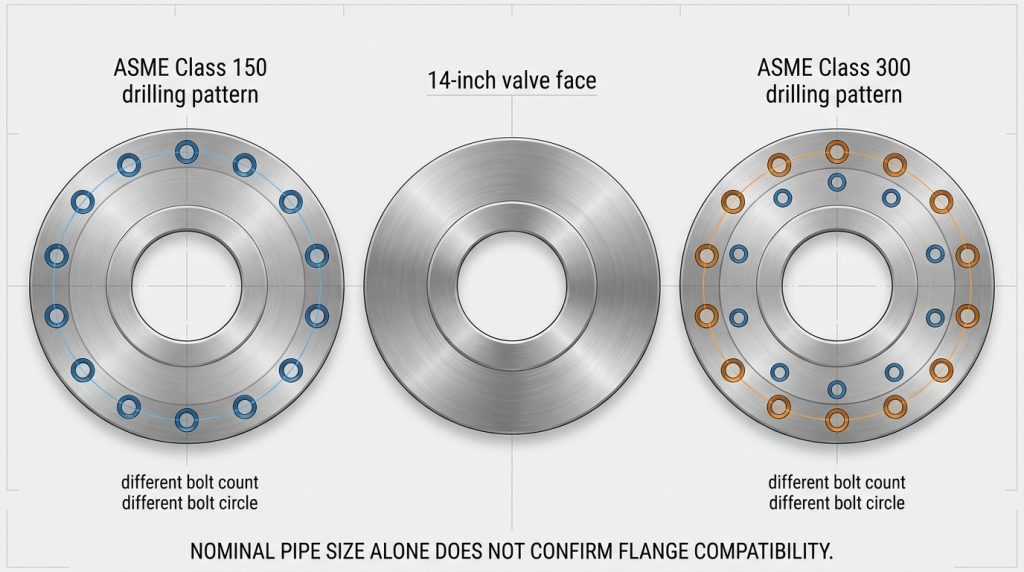
For ASME piping, also check the bolt chart that matches the pressure class. A Class 150 bolt chart is useful only when the mating flanges are truly ASME Class 150; it should not be reused for Class 300 or PN flanges.
Choose Wafer, Lug, or Flanged Body by Duty
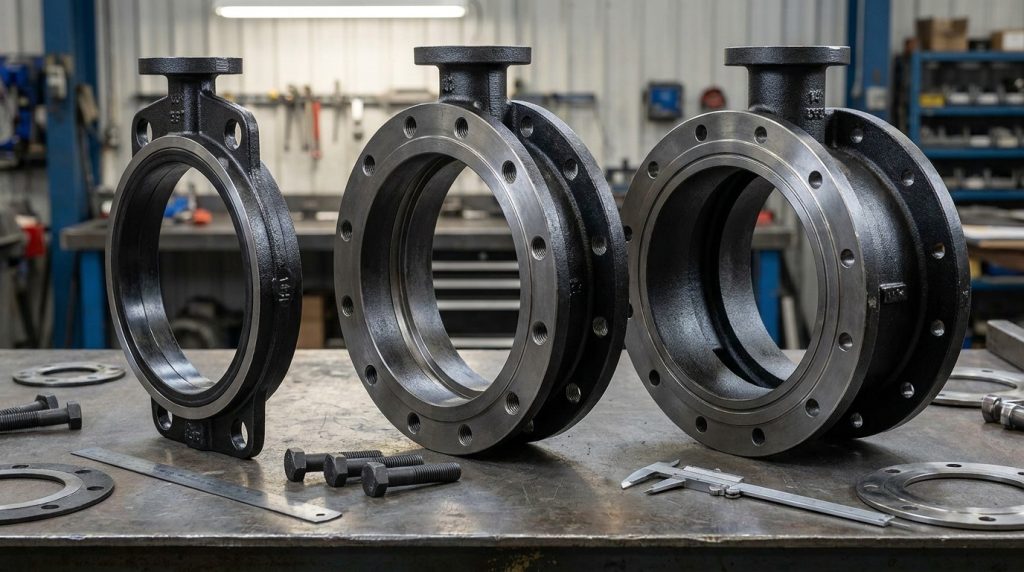
Body style should be selected by piping duty, maintenance needs, and end-of-line requirements, not only by price. A 14″ butterfly valve can be compact, but the wrong body style can create installation and safety problems later.
When Is a Wafer Body Enough?
A wafer body is usually suitable when the valve is clamped between two mating flanges and the line will not require dead-end service. It is compact and economical, especially for water, HVAC, utility, and general industrial lines.
The limitation is that a typical wafer valve depends on the flange pair and through-bolting for installation. If one side of the piping needs to be removed while the valve remains pressurized, you should not assume a wafer body is acceptable.
When Does a Lug Body Make Sense?
A lug body makes sense when the valve may need more positive flange alignment or possible single-side piping removal. Lug valves have threaded or tapped lugs around the body, so each side can be bolted separately.
The important boundary is dead-end pressure rating. Some lug valves are rated for dead-end service only at reduced pressure or only in a specific direction, so you should confirm the valve’s dead-end rating on the datasheet.
When Should You Move to a Flanged Design?
A flanged or double-flanged design is worth considering when pipe loads, frequent removal, larger actuator loads, or higher performance requirements make a thin wafer or lug body less attractive. It is usually heavier and longer, but it can simplify alignment and support in demanding pipework.
For higher temperature, higher pressure, abrasive media, or tighter shutoff requirements, the body style decision may also lead you toward double offset or triple offset butterfly valves. That is a service-condition decision, not just a dimensional upgrade.
Match Materials to Fluid, Temperature, and Pressure
Material selection should start with the fluid and temperature, then move to pressure and cycling frequency. In a 14″ valve, a small compatibility mistake can increase torque, swell the seat, damage the disc edge, or shorten service life.
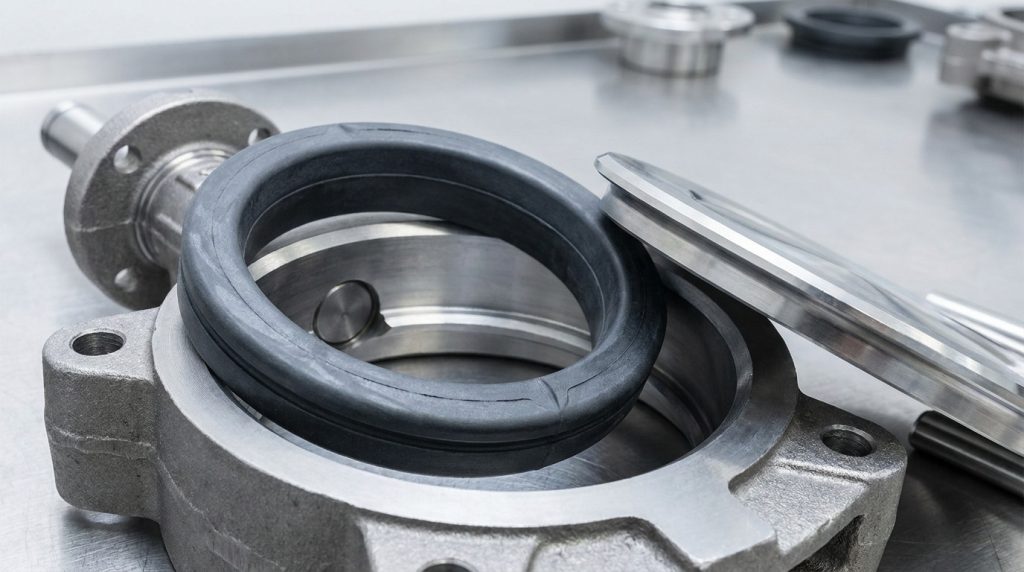
For many resilient seated valves, the seat is the limiting component. Typical published seat screening ranges include EPDM around -29°C to 121°C for many water-compatible compounds, NBR around -18°C to 82°C for many oil-compatible services, and PTFE around -18°C to 200°C for many chemically resistant designs. These are starting ranges only; pressure, compound grade, liner construction, and fluid concentration can reduce the usable limit.
Can Soft Seats Handle the Service?
Soft seats are often the best choice for clean water, treated water, HVAC, air, and many general utility services because they provide tight shutoff with moderate operating torque. They are also common in concentric butterfly valves where the rubber or polymer liner forms the sealing surface.
Soft seats become less suitable when the service includes high temperature, sharp solids, abrasive slurry, steam beyond the seat rating, strong solvents, or frequent throttling near a low opening angle. In those cases, you may need a different seat compound, a lined chemical valve, or an offset metal seated design.
What Disc and Shaft Materials Matter?
The disc sees the flowing media directly, so its material must resist corrosion and erosion. Ductile iron with coating may be suitable for many water lines, while stainless steel or duplex stainless steel may be considered for more corrosive or demanding services.
The shaft matters because it transfers torque from the operator to the disc. If the shaft material is under-specified, the valve may still fit the pipe but perform poorly under high differential pressure or frequent cycling.
Decide Whether a Worm Gear Operator Is Enough
A worm gear operator is usually the practical manual choice for a 14″ butterfly valve, but it must be sized against actual valve torque. Size alone is not enough because torque changes with seat material, pressure differential, fluid condition, cycle frequency, and how long the valve sits in one position.
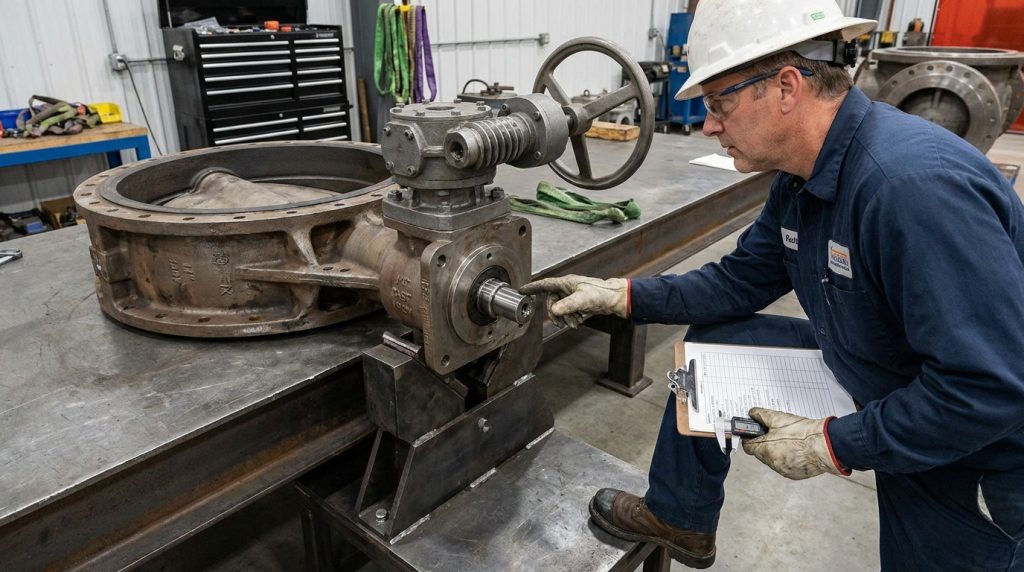
A good gearbox selection gives you enough output torque with a practical handwheel force. If the gearbox is undersized, operators may force the handwheel, damage stops, or fail to fully seat the disc.
How Do You Check Gearbox Sizing?
Start with the valve manufacturer’s break torque, running torque, and seating torque at the stated pressure differential. Then compare those values with the gearbox output torque and service factor.
A useful next step is to review how to size a butterfly valve with gearbox before you approve a manual operator. For DN350 valves, this check is especially important when the line has high differential pressure, elastomer seats, or infrequent operation.
What Raises Operating Torque?
Operating torque rises when the seat grips the disc more tightly, deposits build up around the disc edge, the shaft packing is overtightened, or the valve is installed with poor alignment. High differential pressure across the closed disc also increases the torque needed to break the valve open.
You should also be careful with valves that remain closed for long periods. Elastomer seats can take a compression set, and the first movement after a long static period may require more torque than normal cycling.
Key Takeaway: For a 14″ valve, operator selection should follow verified torque data. Do not choose the gearbox only by nominal size.
Check Flow, Pressure Drop, and Control Limits
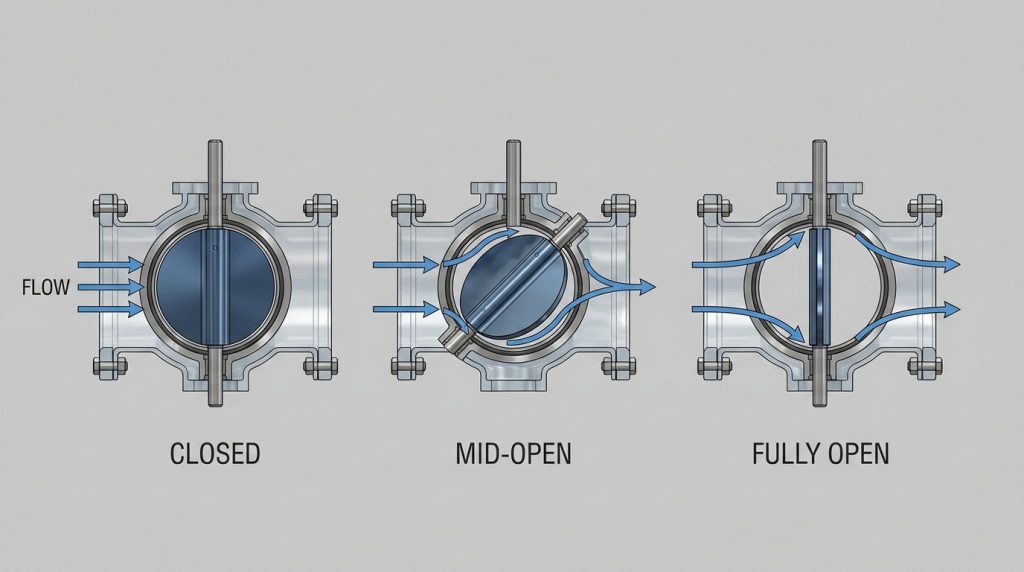
A butterfly valve can throttle flow, but it is not automatically a precision control valve. For a 14″ line, the disc remains in the flow path even when open, so pressure drop, flow noise, cavitation risk, and control stability should be checked when the valve is more than simple isolation.
Butterfly valves are often most stable for throttling in the mid-opening range rather than near fully closed. Near low openings, velocity can rise sharply around the disc edge, which may increase noise, vibration, seat wear, or unstable control.
What Opening Range Is Practical?
For general throttling, many butterfly valves are more usable in a mid-range opening band rather than at very small openings. The exact useful range depends on the valve flow coefficient, disc design, actuator resolution, and system pressure drop.
If you need to compare valve loss against pump capacity or flow demand, use a verified Cv/Kv value from the valve datasheet and calculate butterfly valve pressure drop under the actual flow condition. Do not assume two DN350 valves have the same flow performance just because the nominal size is the same.
When Is Another Valve Type Better?
Another valve type may be better when the process requires fine control at low flow, high pressure drop across the valve, severe cavitation risk, or frequent modulating service. In those cases, a control valve or a different rotary valve design may be more stable.
A butterfly valve remains a strong choice when you need compact installation, quick quarter-turn operation, moderate pressure drop, and cost-effective shutoff in a large line. The decision depends on what the valve must do most often, not only what it can do occasionally.
Specify Testing and Documents Clearly
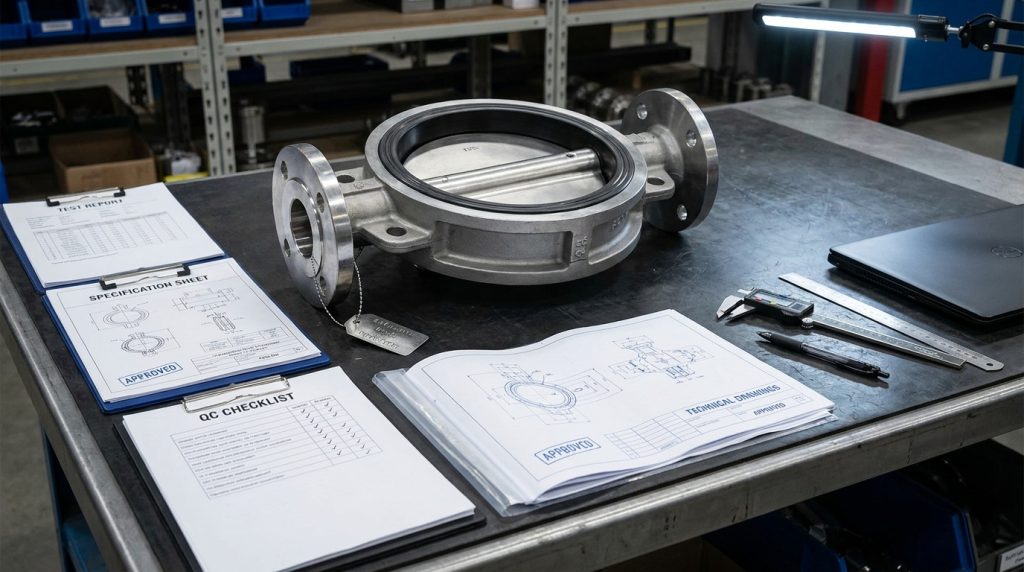
Testing requirements should match the valve design and service risk instead of using vague phrases like “zero leakage” without a standard. For resilient seated butterfly valves, API 598 closure testing is commonly used to define no visible leakage under specified test conditions.
API 609 covers butterfly valve design, materials, face-to-face dimensions, pressure-temperature ratings, inspection, and testing for double-flanged, lug, wafer, and butt-welding-end butterfly valves. MSS SP-67-2022 covers dimensions, design, testing, and marking for butterfly valves, including Type I valves for tight shutoff and Type II valves that permit seat leakage.
For a 14″ butterfly valve inquiry, your specification should normally include:
- Nominal size: 14″ / DN350 / NPS 14
- Flange standard and class: ASME B16.5 Class 150, ASME B16.5 Class 300, EN 1092 PN16, or another confirmed standard
- Body style: wafer, lug, flanged, U-section, double offset, or triple offset
- Body, disc, shaft, and seat materials
- Maximum working pressure and temperature
- Flow media, solids content, and chemical concentration
- Operation: worm gear, pneumatic actuator, electric actuator, or bare shaft
- Test standard and leakage requirement, such as API 598 or EN 12266 where applicable
- Face-to-face standard and final valve drawing requirement
This level of detail helps you compare real equivalents instead of comparing incomplete descriptions. It also reduces the chance of receiving a valve that fits the keyword but not the pipe.
Conclusion
A 14″ butterfly valve should be chosen by confirming DN350/NPS 14 size, flange drilling, face-to-face length, body style, material compatibility, torque, flow behavior, and test requirements. The most common mistakes happen when nominal size is treated as a complete specification, or when pressure class, seat material, and operator torque are left for later.
If you are preparing a replacement order or a new project specification, share the line size, flange standard, media, temperature, pressure, preferred body style, and operator requirement through contact us. Those details make it easier to review whether a 14″ butterfly valve configuration is technically suitable before you move into quotation or drawing confirmation.
FAQ
Can I use a 14″ butterfly valve for throttling?
Yes, but only within a suitable operating range. A butterfly valve can regulate flow, but it may become unstable or noisy at low openings, especially with high pressure drop or high velocity.
What’s the best body style for a 14″ line?
The best body style depends on the duty. Wafer is compact for standard between-flange installation, lug is better when single-side bolting or possible dead-end service matters, and flanged designs are stronger choices for heavier piping or demanding service.
How do I know if DN350 and 14″ are the same?
DN350 and 14″ usually refer to the same nominal valve size, with NPS 14 steel pipe having a 14.000 in outside diameter. You still need the flange standard, pressure class, and valve drawing to confirm actual fit.
Can I replace a lever valve with a worm gear valve?
Yes, if the stem connection, mounting pad, torque rating, and valve stops are compatible. At 14″, worm gear operation is often more practical than a lever because it gives smoother manual control and higher mechanical advantage.
What’s the best seat material for water, oil, or chemicals?
EPDM is often a strong starting point for clean water and many HVAC services, NBR is commonly considered for oil-compatible service, and PTFE is used where broader chemical resistance is needed. The final choice must match fluid concentration, temperature, pressure, and the manufacturer’s seat rating.