
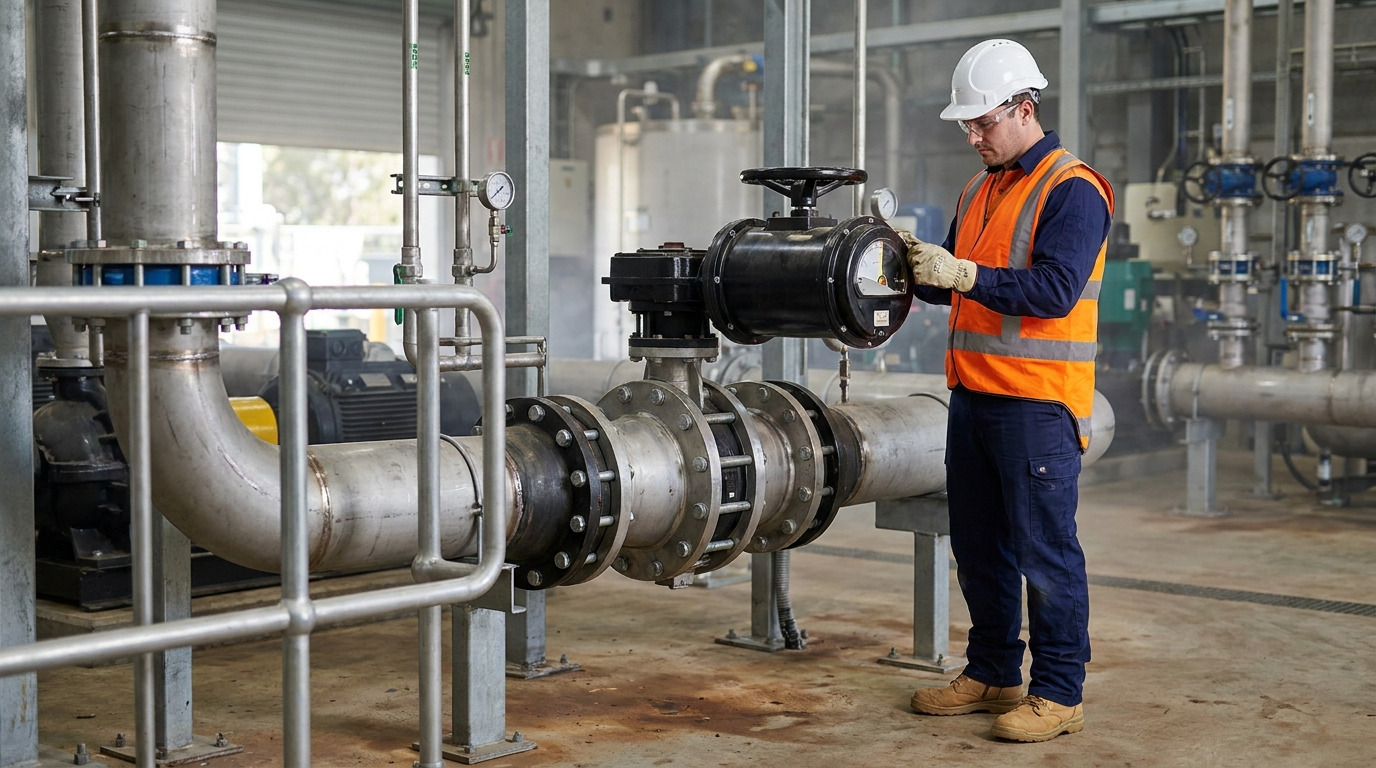
A butterfly valve is a quarter-turn valve that uses a rotating disc to start, stop, or regulate flow in a pipeline. In industrial piping, an industrial butterfly valve is valued because it is compact, fast to operate, and practical for many medium and large pipe sizes where a full-bore valve would be heavier or more expensive.
The short answer is simple, but the useful answer depends on how the disc, seat, body style, pressure rating, and operating method match the service. If you are trying to understand what is butterfly valve, the key is not only its shape; it is the tradeoff between space saving, flow capacity, shutoff expectation, pressure drop, and seat material limits.
What Is a Butterfly Valve in a Piping System
A butterfly valve is a flow-control device installed between pipe flanges or as part of a flanged valve body, with a circular disc mounted on a shaft. When the shaft turns, the disc rotates inside the pipe bore and changes the flow area.
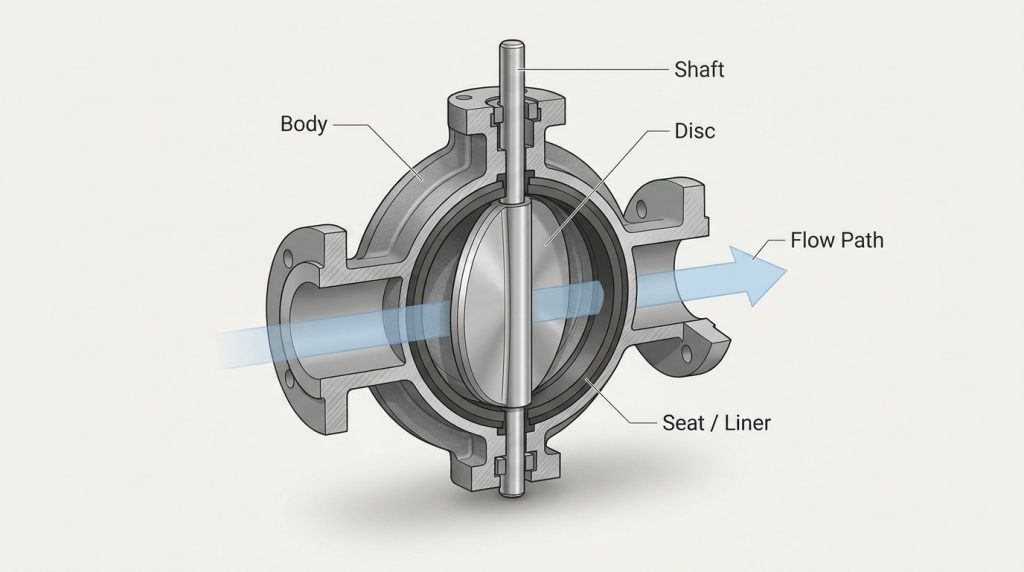
Unlike a gate valve, which lifts a wedge out of the flow path, or a ball valve, which turns a bored sphere, the butterfly valve keeps the disc in the flow stream even when open. That is why it can be thin and lightweight, but also why the open valve still creates some pressure loss.
What Parts Make the Disc Move and Seal?
The main parts are the body, disc, shaft, seat, shaft seal, and operator. The body holds the valve in the pipeline, the disc controls the opening, and the shaft transfers torque from the handle, gearbox, actuator, or hydraulic drive.
The seat is just as important as the disc. In a resilient-seated design, the soft liner or seat provides shutoff and often protects the valve body from the medium. In a high-performance or metal-seated design, the seat geometry and offset disc movement reduce rubbing, improve durability, and support more demanding pressure or temperature conditions.
What Happens in Open, Closed, and Partly Open Positions?
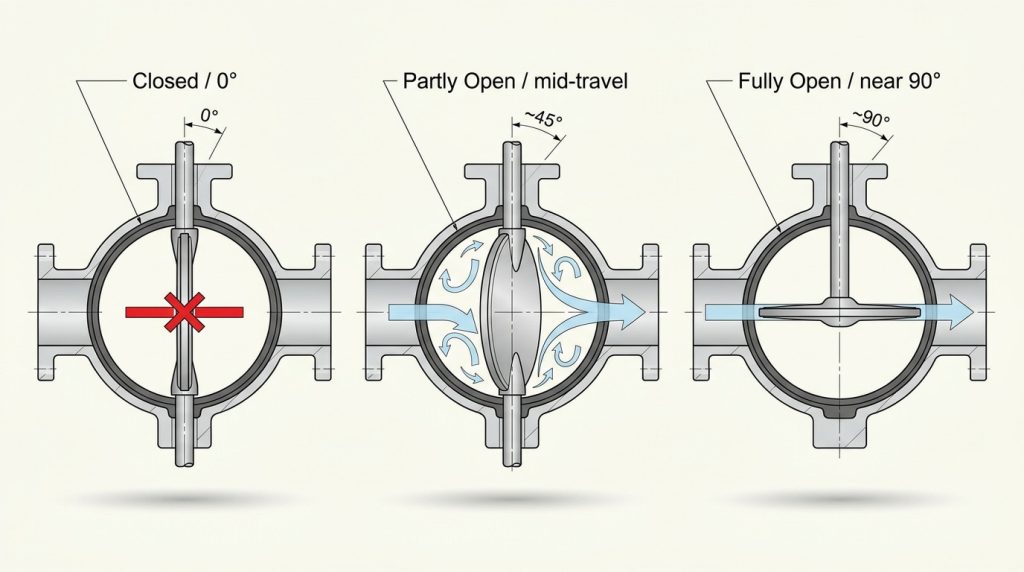
A butterfly valve normally moves through 90 degrees of rotation. At 0 degrees, the disc is across the pipe and the valve is closed; at about 90 degrees, the disc is aligned with the flow and the valve is open.
Partly open positions are used for throttling, but they should not be treated as automatically precise control. The flow does not increase in a perfectly straight line with handle travel, so a small position change can create a large flow change in some ranges.
How Does a Butterfly Valve Control Flow
A butterfly valve controls flow by changing the angle of the disc against the moving fluid. The more the disc turns toward the open position, the larger the available flow area becomes, but the disc still shapes the flow pattern and creates turbulence.
For simple isolation, the valve is either fully open or fully closed. For regulating service, the important question is whether the valve can control the required flow range without vibration, seat damage, cavitation, or unstable actuator movement.
Why Is the Middle Travel More Useful?
The middle travel is usually the most useful range for flow control because very small openings can be unstable and near-full-open positions may provide little additional control. In many practical butterfly valve discussions, the useful throttling band is often treated as roughly the middle portion of travel, such as about 20 to 70 degrees open, but the final range must be checked against the valve flow curve and service conditions.
This is why butterfly valve flow vs percent open matters when the valve is used for control rather than only isolation. You need the Cv curve, pressure drop, media state, and actuator resolution before assuming that a handle position equals a reliable flow rate.
When Does Throttling Become Risky?
Throttling becomes risky when high differential pressure, high velocity, abrasive solids, flashing, or cavitation acts directly on the disc and seat. A concentric rubber-lined valve that works well for water isolation may wear quickly if it is held partly open in a harsh service.
Watch these conditions carefully:
- High pressure drop across a partly open valve
- Slurries or suspended solids striking the disc edge
- Steam, hot gas, or high-temperature service beyond the seat rating
- Control loops that require stable small flow changes
- Dead-end service where one side of the pipeline may be removed
The valve may still be usable, but the design, seat, actuator, and leakage requirement need to be specified more carefully.
Main Butterfly Valve Designs and Where They Fit
The main butterfly valve designs differ by how the disc is centered, how the body connects to the pipeline, and how the seat contacts the disc. These differences decide whether the valve is best for general utility service, higher pressure, higher temperature, tighter shutoff, or automated control.
The table below gives a practical way to read the common design names without turning the article into a full selection guide.
| Design or Body Type | What It Means | Strong Fit | Boundary to Check |
|---|---|---|---|
| Concentric resilient seated | Shaft passes through the disc center; soft seat seals around the disc | Water, wastewater, HVAC, clean utility lines | Seat compatibility, differential pressure, throttling wear |
| Double offset | Disc and shaft geometry reduce seat rubbing during travel | Higher-cycle or higher-pressure service than basic concentric designs | Required leakage class, torque, seat material |
| Triple offset | Adds angular offset to reduce rubbing and support metal seating | High temperature, critical isolation, demanding process lines | Cost, leakage class, torque, installation precision |
| Wafer body | Thin body clamped between two pipe flanges | Compact installations and cost-sensitive lines | Not ideal when downstream piping may be removed |
| Lug body | Threaded or tapped lugs allow bolting from each side | Lines needing easier maintenance or some dead-end arrangements | Dead-end pressure rating must be confirmed |
| Double-flanged body | Valve has integral flanges on both sides | Large sizes, higher stability, easier alignment | Face-to-face dimension and flange standard |
The right design is usually the one that meets the service without overbuilding the valve. A triple-offset metal-seated valve may be excellent in severe service, but it is not automatically better for a chilled-water line where a resilient-seated concentric valve is simpler and more economical.
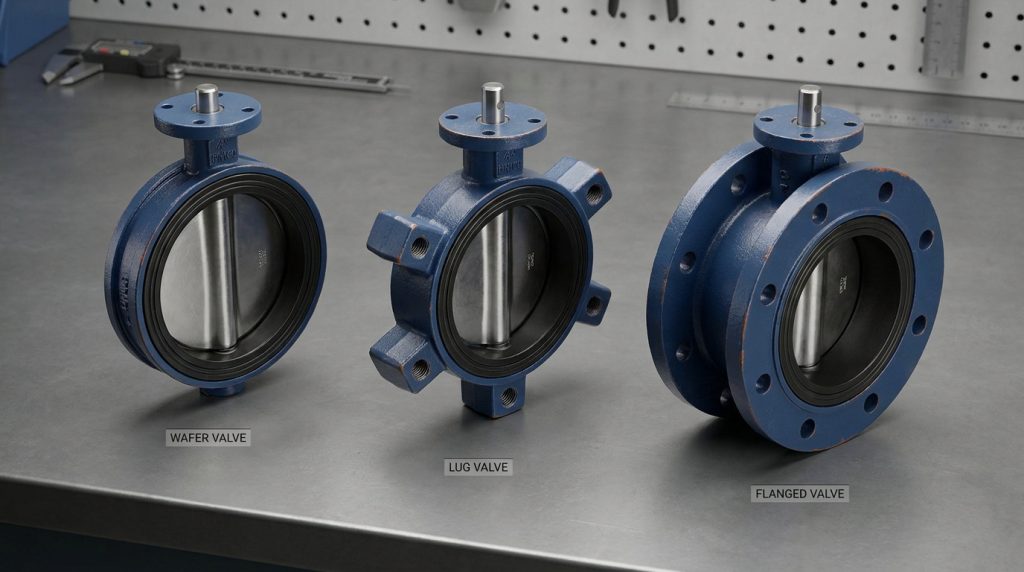
How Do Wafer, Lug, and Flanged Bodies Differ?
Wafer valves are held between pipe flanges by long bolts or studs, so they are compact and economical. They are common when the valve will stay between two connected pipe sections and the system does not require independent bolting on each side.
Lug valves have threaded lugs or inserts that allow each flange side to be bolted separately. This can help when one side of the piping may need to be disconnected, but the allowable dead-end pressure depends on the valve design and manufacturer data sheet.
Double-flanged valves are more rigid and easier to align in larger sizes. They take more space than wafer bodies, but they are often preferred where pipeline loads, size, or handling conditions make alignment more important.
Which Offset Design Matches the Service?
A concentric valve is normally the simplest answer for clean, moderate-temperature utility service. The soft seat provides sealing and keeps the disc centered, but it also means temperature, media compatibility, and seat compression matter.
A double-offset or triple-offset valve is a better discussion when pressure, temperature, cycle frequency, or leakage expectation increases. From a valve manufacturer’s perspective, the offset design should be chosen because the service demands it, not because the name sounds more advanced.
Key takeaway: The phrase “butterfly valve” is not enough for a technical decision. Body style, offset type, seat material, pressure rating, and actuation method define what the valve can safely do.
Where Butterfly Valves Are a Strong Choice
Butterfly valves are a strong choice when you need compact shutoff, fast operation, and reasonable flow capacity in a line where a gate, globe, or full-port ball valve would be heavier, longer, or more costly. They are especially attractive in larger pipe sizes because the thin body and simple rotary motion reduce installation space and operating effort.
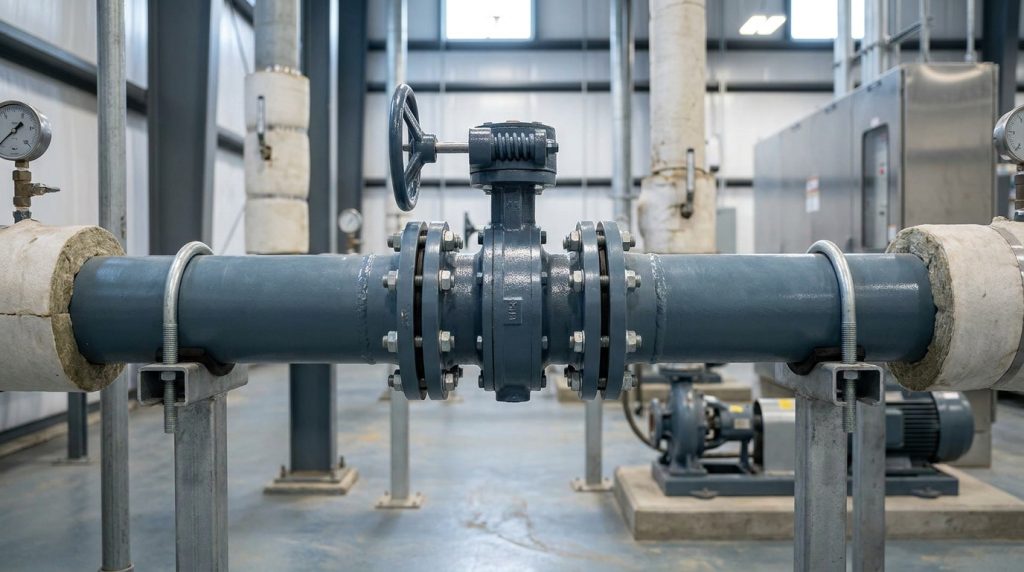
Typical industrial butterfly valve applications include water treatment, wastewater, HVAC and district energy, cooling water, marine systems, utility air, and many general process lines. With the right body, disc, and seat materials, they can also be used in chemical, power, and oil-related services, but the compatibility check becomes more important.
Butterfly valves are usually less suitable when you need very fine throttling at low openings, full unobstructed bore, pigging access, or severe slurry control. They may also be the wrong choice if the seat material cannot handle the medium, temperature, cleaning process, or required shutoff class.
A useful rule is this: use a butterfly valve when compact quarter-turn control fits the duty, but do not use the word “butterfly” as a shortcut for confirming pressure, temperature, media, leakage, and flow behavior.
Limits That Decide Whether It Is the Right Valve
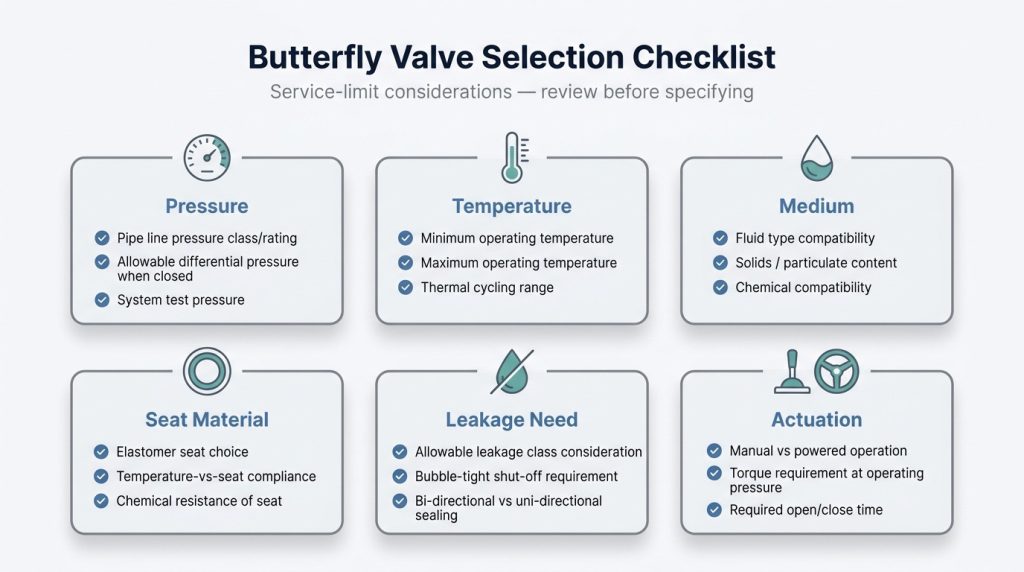
The correct answer to “what is a butterfly valve” changes once pressure, temperature, medium, and shutoff requirement are added. A valve that looks similar from the outside may behave very differently because of its seat, disc edge, shaft seal, and rating basis.
The most common mistake is treating all butterfly valves as if they share the same service envelope. In reality, a rubber-lined utility valve, a PTFE-lined chemical valve, and a metal-seated triple-offset valve belong to different decision paths.
How Do Seat Materials Set Temperature Limits?
Seat material often sets the real service limit before the metal body does. Typical ranges from common valve data sheets may place EPDM around -20°C to 120°C for water-oriented service, NBR around -10°C to 80 or 100°C for many oil-compatible services, PTFE around -20°C to 180 or 200°C depending on valve design, and metal seats above the range of soft seats where the body and trim are suitable.
These values are only typical boundaries, not universal ratings. Actual limits depend on pressure, medium, cycle frequency, seat formulation, liner thickness, disc material, and whether the valve is used for isolation or throttling. For a deeper material-focused check, temperature limits for butterfly valve material should be reviewed against the final data sheet.
Material choice also affects torque. A soft resilient seat may seal well at moderate conditions, but swelling, chemical attack, or heat aging can increase torque and reduce shutoff reliability.
Why Can Pressure Class Be Misread?
Pressure class can be misread because flange class, body rating, cold working pressure, and seat rating are not always the same thing. For example, ASME B16.34-2025 lists ASTM A105 and ASTM A216 WCB Standard Class 150 at 19.6 bar from -29°C to 38°C, but that value is a body material pressure-temperature rating, not a blanket guarantee for every butterfly valve seat or liner.
This matters because many resilient-seated butterfly valves are specified by cold working pressure, while high-performance valves may be pressure-temperature rated by class. If the final valve is soft seated, lined, dead-end capable, or used at elevated temperature, the manufacturer’s pressure-temperature table and product drawing should confirm the actual allowable condition.
Standards and Ratings That Clarify the Specification
Standards help turn the broad term “butterfly valve” into a controlled specification. They do not replace engineering review, but they define what must be checked for design, dimensions, testing, marking, pressure-temperature rating, or actuator mounting.
For industrial projects, the standard named on the datasheet should match the valve type and market requirement. An API 609 butterfly valve may be appropriate for many process and industrial services, while MSS SP-67 or EN 593 may appear in other general-purpose or regional specifications.
| Standard or Rating Item | What It Clarifies | Practical Boundary |
|---|---|---|
| API Std 609, 10th Edition, May 2026 | Butterfly valves with double-flanged, lug, wafer-type, and butt-welding ends | Useful for specifying design and testing basis, but category and seat rating still matter |
| MSS SP-67-2022 | General butterfly valve requirements including dimensions, design, testing, and marking | Covers NPS 1 1/2 through NPS 72 for several common body styles |
| EN 593:2017 | Metallic butterfly valves for general purposes in European-style specifications | Should be read with related EN flange, testing, and pressure equipment requirements |
| ASME B16.34-2025 | Pressure-temperature ratings for valve body materials and classes | Body rating does not automatically equal soft-seat or liner capability |
| ISO 5211 | Part-turn actuator mounting interface | Helps match actuator flange and drive dimensions, but actuator torque must still be sized |
A clean specification normally includes size, pressure class or PN rating, body style, end connection standard, body material, disc material, shaft material, seat material, leakage requirement, operation method, and test standard. For automated valves, add actuator type, supply pressure or voltage, fail position, cycle requirement, control signal, and ISO 5211 mounting interface.
This is where a basic definition becomes useful in real work. Once you know that the butterfly valve is a rotating-disc valve, you can ask the right follow-up questions instead of assuming every disc valve will perform the same way.
Conclusion
A butterfly valve is a compact quarter-turn valve that uses a disc to isolate or regulate flow, and its value comes from fast operation, short face-to-face length, and practical use in many medium and large piping systems. The important details are the ones that decide service suitability: disc design, body style, seat material, pressure-temperature rating, flow behavior, and actuator method.
If you are comparing valve types for a real line, prepare the medium, pressure, temperature, pipe standard, size, body style, seat preference, and actuation need when you contact RUITO Flow. Those details make the discussion more accurate and help narrow the valve configuration without turning a simple butterfly valve question into guesswork.
FAQ
Can I use a butterfly valve for throttling?
Yes, but only within a suitable control range. Butterfly valves can regulate flow, but they are not always as precise as globe valves, especially at very small openings or high pressure drops.
What’s the best butterfly valve type for water service?
A resilient-seated concentric butterfly valve is often the practical starting point. For clean water, wastewater, HVAC, and utility service, it usually gives a good balance of cost, compact size, and shutoff performance.
How do I know if a butterfly valve is fully open?
Check the handle, gearbox indicator, actuator position signal, or stem position marking. In most designs, the disc is fully open at about 90 degrees from the closed position, but the installed indicator should be verified during commissioning.
Can I use a butterfly valve for steam?
Yes, but not every butterfly valve is suitable for steam. Steam service usually requires careful attention to temperature rating, seat material, leakage class, pressure drop, and whether the valve is intended for isolation or control.
What’s the main disadvantage of a butterfly valve?
The main disadvantage is that the disc remains in the flow path. This creates pressure loss and can make throttling less stable than with a dedicated control valve in demanding service.