
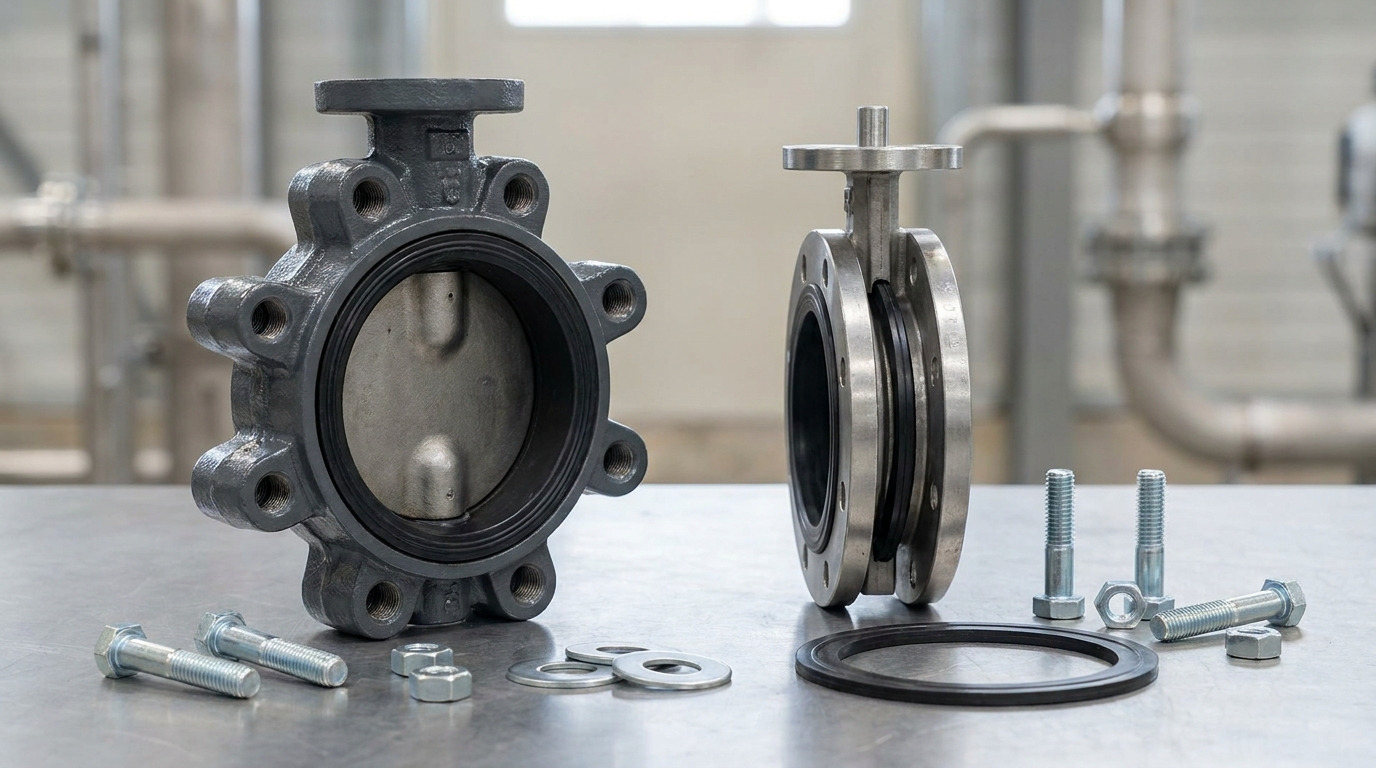
Use a lugged butterfly valve when you need independent bolting, dead-end isolation, or downstream pipe removal; use a wafer butterfly valve when the line stays fully flanged and compact, lower-cost isolation is the priority. The real lugged vs wafer butterfly valve decision is less about which valve is “better” and more about how the body is held between the flanges, how the bolts load the joint, and what happens if one side of the pipe is opened.
For most industrial butterfly valves, the disc, shaft, seat, and actuator may look similar from a distance. The body connection is what changes the installation risk. If you are comparing drawings, checking a replacement valve, or preparing a purchase specification, this guide helps you decide which body style fits the piping situation.
In a typical plant scenario, a maintenance team may want to remove a downstream spool while keeping the upstream side isolated. That is where a wafer valve and a lugged valve stop being interchangeable. The right decision starts with the service condition first, then the flange standard, face-to-face dimension, pressure class, bolting method, and seat material.
Lugged vs Wafer Butterfly Valve Quick Decision
The fastest rule is simple: choose wafer for compact between-flange service, and choose lugged when the valve must remain mechanically supported from one side. This does not mean every lugged valve is automatically suitable for every severe service. It means the lugged body gives you a bolting arrangement that a wafer body cannot provide.
Use the table below as a first-pass decision tool, then confirm the final details against the valve drawing and data sheet.
| Decision point | Wafer butterfly valve | Lugged butterfly valve | What you must verify |
|---|---|---|---|
| Body support | Clamped between two pipe flanges | Bolted to each flange through threaded lugs | Flange standard, bolt pattern, gasket rule |
| Dead-end service | Usually not suitable unless specifically rated | Commonly selected for this duty | Rated dead-end pressure and flow direction |
| Bolting method | Long through-bolts or studs pass across both flanges | Shorter bolts or studs can fasten each side independently | Bolt length, thread engagement, material grade |
| Maintenance isolation | Requires both flanges to stay assembled | May allow downstream piping removal | Lockout procedure and manufacturer rating |
| Space and weight | Usually lighter and more compact | Usually heavier and wider at the lugs | Face-to-face and clearance drawing |
| Cost signal | Lower initial valve body cost | Higher body cost but more isolation flexibility | Total cost of downtime and maintenance access |
| Common mistake | Treating bolt compression as valve retention | Assuming lugs prove pressure rating by themselves | Data sheet, test standard, and pressure class |
The key point is that body style is a mechanical decision before it is a price decision. If the piping will never be opened on one side while the valve remains installed, wafer may be enough. If the valve must act as a removable section boundary, lugged deserves serious attention.
How the Body Connection Changes the Job
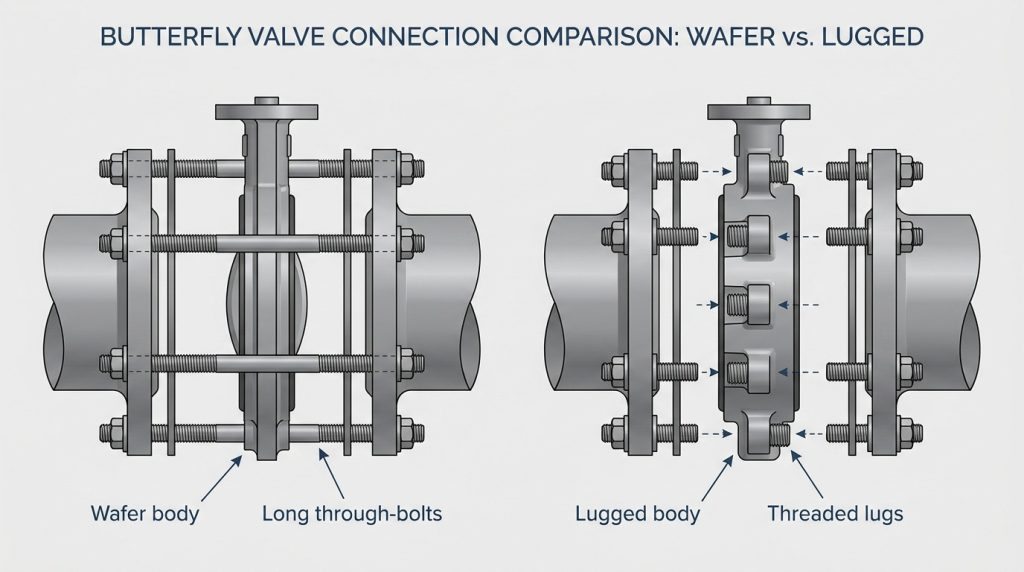
The connection style changes how the valve is centered, retained, and loaded during installation. A wafer valve depends on compression between two flanges, while a lugged valve uses threaded body lugs that create separate bolted joints on each side.
What does a wafer body actually rely on?
A wafer butterfly valve relies on the two mating flanges to clamp the valve body and seat in position. Long bolts or studs pass through the flange holes and pull the flanges together, compressing the valve between them. This makes the design compact, economical, and easy to fit where the pipe remains assembled as a complete joint.
That same advantage creates its main boundary. If one flange is removed, the wafer body no longer has the same mechanical retention. This is why wafer valves are usually best for standard in-line isolation, HVAC, water, and general utility service where both flanges stay in place.
What do threaded lugs change?
Threaded lugs let the valve body be bolted to each flange independently. Instead of one long bolt set clamping the entire sandwich, each side can have its own bolting arrangement. This gives the lugged valve a stronger role in sectional isolation and maintenance planning.
The lugs do not automatically improve the disc, seat, or pressure-temperature capability. A soft-seat lugged valve and a soft-seat wafer valve may share the same basic sealing system. The lugged body changes how the valve is held in the piping, not the laws of seat wear, chemical compatibility, or actuator torque.
Dead-End Service Is the Main Divider
Dead-end service is the clearest reason to choose lugged over wafer. In this condition, the valve may need to hold pressure from one side while the downstream side is open, removed, or not fully flanged.
Can a wafer valve be used at the end of a line?
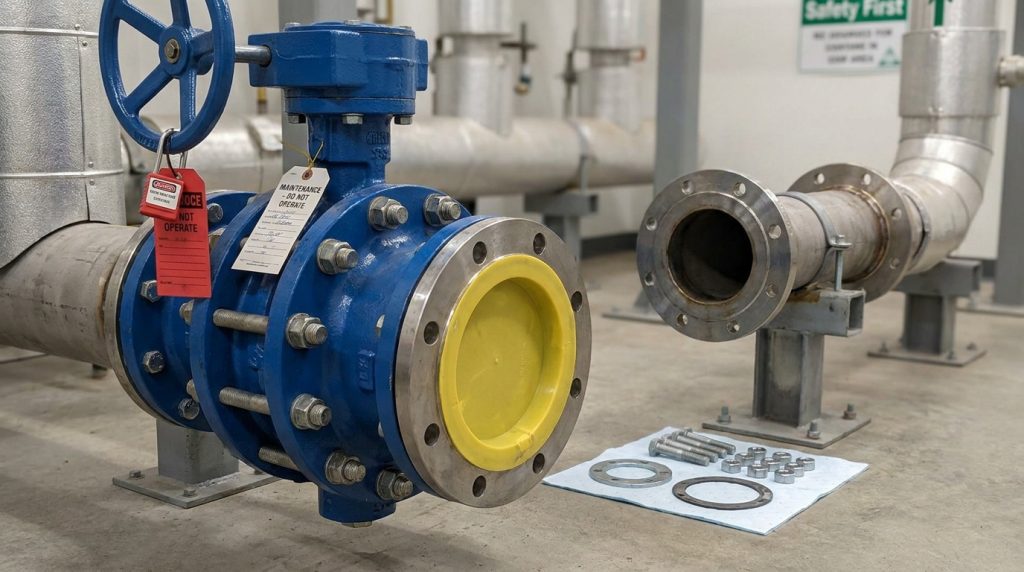
Do not treat a standard wafer valve as a dead-end valve unless the manufacturer explicitly rates it for that service. A wafer body is normally held by the complete flange pair. Once the downstream flange or pipe is removed, the clamping condition changes, and the valve may not be mechanically retained as intended.
This is why a butterfly valve lug style is often specified when maintenance access or one-sided isolation matters. Even then, you should confirm whether the rating applies with a downstream flange installed, with a blind flange, or with the downstream side fully open.
Why lugged does not automatically mean safe?
A lugged body is only safe for dead-end use when the valve is designed, rated, installed, and bolted for that condition. Some valves may have a lower dead-end rating than their normal bidirectional in-line rating. Others may require a specific flow direction, pressure limit, or downstream blind flange.
Before approving lugged dead-end service, check these items:
- Dead-end pressure rating at the actual temperature
- Preferred flow direction, if any
- Body, seat, and disc material compatibility
- Bolt material and thread engagement
- Whether downstream piping may be removed under pressure
- Whether the open side needs a blind flange or safety guard
Key Takeaway: Lugged is the correct body style to investigate for dead-end service, but the data sheet decides the approved limit.
Bolting, Alignment, and Face-to-Face Fit
Many lugged-versus-wafer problems are really bolting and fit-up problems. The valve can be the right type and still leak, bind, or damage the seat if the flange spacing, bolt length, or disc clearance is wrong.
What can go wrong with bolt selection?
A wafer valve often needs through-bolts or studs long enough to span flange, gasket, and valve body thickness. A lugged valve may use shorter cap screws or studs into tapped lugs, and the required length depends on thread depth and gasket stack. If someone orders bolts from a flange chart alone, the bolt pattern may be right while the length is wrong.
This is why an 8 inch butterfly valve bolt size check is useful only when it separates flange drilling from valve body style. ASME B16.5-2025 covers NPS 1/2 through NPS 24 flanges, including Class 150, 300, 400, 600, 900, and 1500 in NPS 1/2 through NPS 24, and Class 2500 in NPS 1/2 through NPS 12. It defines the flange system, but it does not give one universal bolt length for every wafer or lugged butterfly valve.
How do alignment and disc clearance change the answer?
A wafer valve is less forgiving when the installer depends on flange compression to center the body. Uneven tightening can distort the seat, shift the disc, or create leakage across the flange face. A lugged valve can be easier to locate because the lugs follow the bolt circle, but it can still be damaged if flanges are not parallel or if the disc swings into the pipe bore, liner, gasket, or nearby fitting.

Before tightening either style, check that the disc can move freely and that the valve is centered in the pipe. A butterfly valve installed with proper alignment should not be forced into a narrow gap by pulling the flanges together with bolts. That practice can overload the seat before the valve ever enters service.
Standards and Data Sheet Checks That Prevent Misuse
Standards help you ask the right questions, but they do not replace the valve data sheet. For lugged versus wafer selection, the most important standard-related details are body style, flange compatibility, face-to-face dimension, pressure-temperature rating, and test requirement.
Which standards matter for this comparison?
Use standards to define the boundary of the valve, then use the manufacturer drawing to confirm the exact execution. The following standards are commonly relevant when comparing lugged and wafer butterfly valves.
| Standard or specification | What it helps confirm | Useful boundary for this topic |
|---|---|---|
| API STD 609:2026-05 | Butterfly valve construction categories | Tenth Edition, May 2026; covers double-flanged, lug- and wafer-type, and butt-welding ends; API Monogram effective date December 1, 2026 |
| MSS SP-67-2022 | General butterfly valve dimensions, design, testing, and marking | Covers flanged-end, single-flange lug-type, and flangeless wafer-type valves from NPS 1-1/2 through NPS 72 |
| EN 593:2017 | Metallic butterfly valves for isolation, regulation, or control | Covers wafer, lug, flange, and butt-welding piping systems; PN 2.5 to PN 160 and Class 150 to Class 900 |
| ASME B16.5-2025 | Mating flange dimensions and bolting system | Covers NPS 1/2 through NPS 24 flanges and several pressure classes |
| ASME B16.10-2022 | Face-to-face and end-to-end dimensions | Supports installation interchangeability for a given valve type, size, rating, and end connection |
| API 598-2023 | Pressure testing and closure testing | Low-pressure closure test for butterfly valves is 5.5 +/- 1.5 bar, or 80 +/- 20 psig; high-pressure closure is tied to design differential pressure |
This table is not a complete project specification. It shows why a body-style comparison should not stop at “lugged is stronger” or “wafer is cheaper.” Standards define the language; the valve drawing confirms the fit.
What must the datasheet say before approval?
A usable data sheet should state the valve size, pressure class or PN rating, body style, flange standard, face-to-face standard, seat material, disc material, shaft material, actuator type, shutoff direction, test standard, and dead-end rating if applicable. Without those items, you may be comparing product names rather than actual service capability.
When reviewing butterfly valve characteristics, pay special attention to the difference between pressure class and real service pressure at temperature. A Class 150 or PN16 label does not prove chemical compatibility, steam suitability, torque margin, or dead-end approval. Those decisions depend on the full construction and operating case.
When Wafer Is the Better Choice
Wafer is the better choice when the valve is used as a compact, economical, between-flange isolation valve and the piping joint is not expected to be opened on one side under pressure. It is especially attractive in systems where weight, space, and installed cost matter more than sectional maintenance flexibility.
Good wafer applications often share several conditions:
- Both pipe flanges remain installed during normal maintenance
- The valve is mainly used for open-close service or moderate throttling
- The line is low to moderate pressure within the valve rating
- The fluid is compatible with the seat and liner
- The project needs many valves and cost control matters
- There is enough access to align the valve correctly during installation
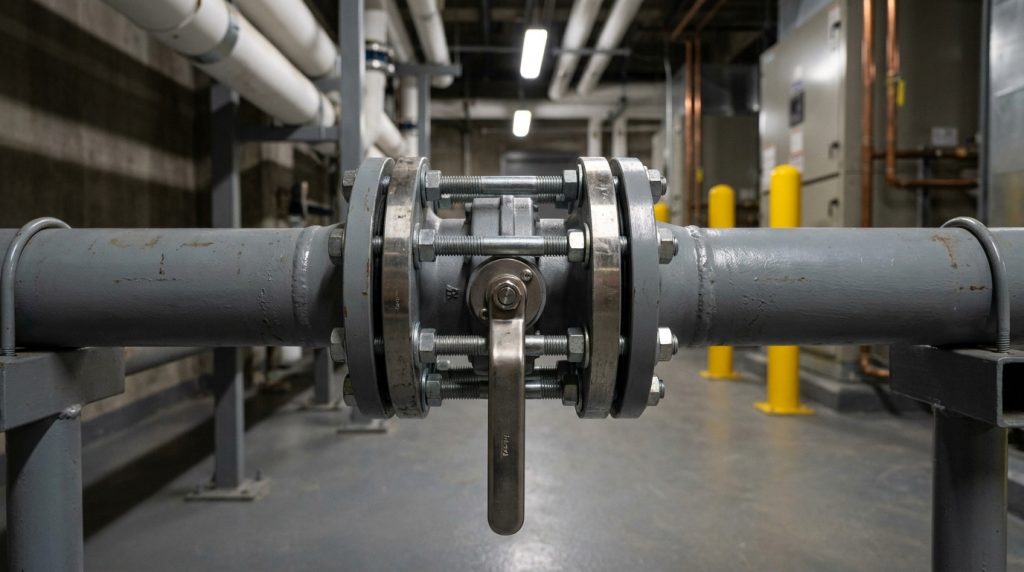
A wafer valve can be the smarter engineering choice when the service is straightforward. Do not upgrade to lugged only because it sounds more robust. If the line does not need one-sided removal, the extra body weight, extra machining, and higher cost may not add useful value.
The caution is that wafer valves are sensitive to installation discipline. Poor flange alignment, incorrect gasket selection, wrong bolt length, or uneven tightening can damage the seat. If the project has many similar valves, the installation procedure should be clear enough that each valve is centered and tightened consistently.
When Lugged Is the Better Choice
Lugged is the better choice when the valve must provide more mechanical independence at the flange joint. It is normally preferred for dead-end service, downstream pipe removal, modular equipment skids, or systems where one section may need to be opened without dismantling the whole line.
A lugged valve is worth specifying when you need:
- Independent bolting to each flange
- Better support for one-sided isolation
- Safer planning for downstream pipe removal
- Clearer maintenance boundaries between pipe sections
- A body style that is easier to identify in a valve schedule
- More controlled fit-up where full bolt-circle engagement helps alignment
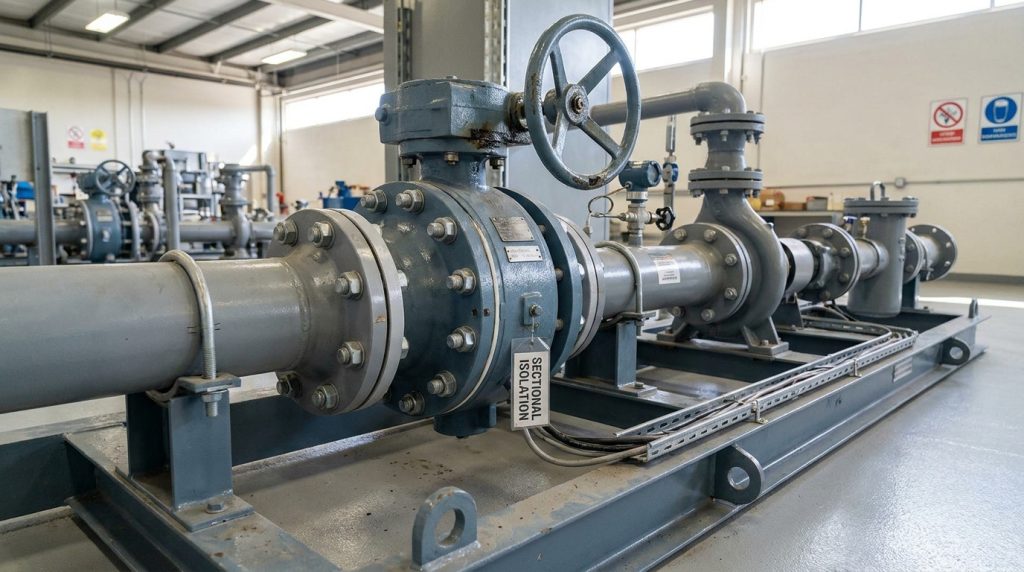
Still, lugged is not a shortcut around proper selection. The seat material must match the fluid and temperature. The body and disc materials must match corrosion and pressure needs. The actuator must be sized from real torque data, not only pipe size. For dead-end duty, the purchase specification should ask for the rated dead-end pressure and the test basis in plain language.
The best decision is often not “lugged or wafer” in isolation. It is “which body style supports the maintenance plan, pressure boundary, flange system, and installation method with the least avoidable risk?”
Conclusion
This article answered the core lugged versus wafer question by focusing on the real decision points: body support, dead-end service, bolting method, alignment risk, standards, and data sheet confirmation. Wafer valves are compact and cost-effective for normal between-flange service, while lugged valves give you independent bolting and better options for sectional isolation when the valve is properly rated.
If you are preparing a project specification, replacement inquiry, or body-style comparison, send the valve size, flange standard, pressure class, media, temperature, seat material, installation position, and dead-end requirement when you contact RUITO for a project review. That information makes the lugged-versus-wafer decision specific enough to discuss without relying on assumptions.
FAQ
Can I replace a wafer butterfly valve with a lugged valve?
Yes, but only after checking the dimensions and bolting details. The replacement must match the pipe size, flange drilling, face-to-face dimension, disc clearance, pressure rating, and seat compatibility. A lugged body may solve a maintenance problem, but it can also require different bolts and installation space.
What is the best choice for dead-end service?
A lugged butterfly valve is usually the correct starting point for dead-end service. The reason is that the threaded lugs can support the valve from one side, while a wafer valve normally depends on compression between two flanges. Final approval still requires the valve’s rated dead-end pressure and installation conditions.
How do I know if wafer is enough for my system?
Wafer is usually enough if the valve stays between two flanges, the line is not opened on one side under pressure, and the service conditions are within the valve rating. You should also confirm that the seat material matches the fluid and temperature. If maintenance requires downstream pipe removal, wafer may not be the right choice.
Can a lugged valve seal better than a wafer valve?
Not automatically. Lugged construction improves the bolting arrangement, but sealing depends on the seat design, disc edge, pressure differential, temperature, media, and test standard. A well-selected wafer valve can seal properly in its intended service, while a poorly specified lugged valve can still leak.
How do I specify lugged or wafer clearly on a datasheet?
State the body style directly and include the flange standard, pressure class or PN rating, face-to-face standard, seat material, disc material, shaft material, test standard, and dead-end requirement if any. For lugged valves, also confirm tapped-lug details, bolt length, and thread engagement. For wafer valves, confirm through-bolt length and centering requirements.