
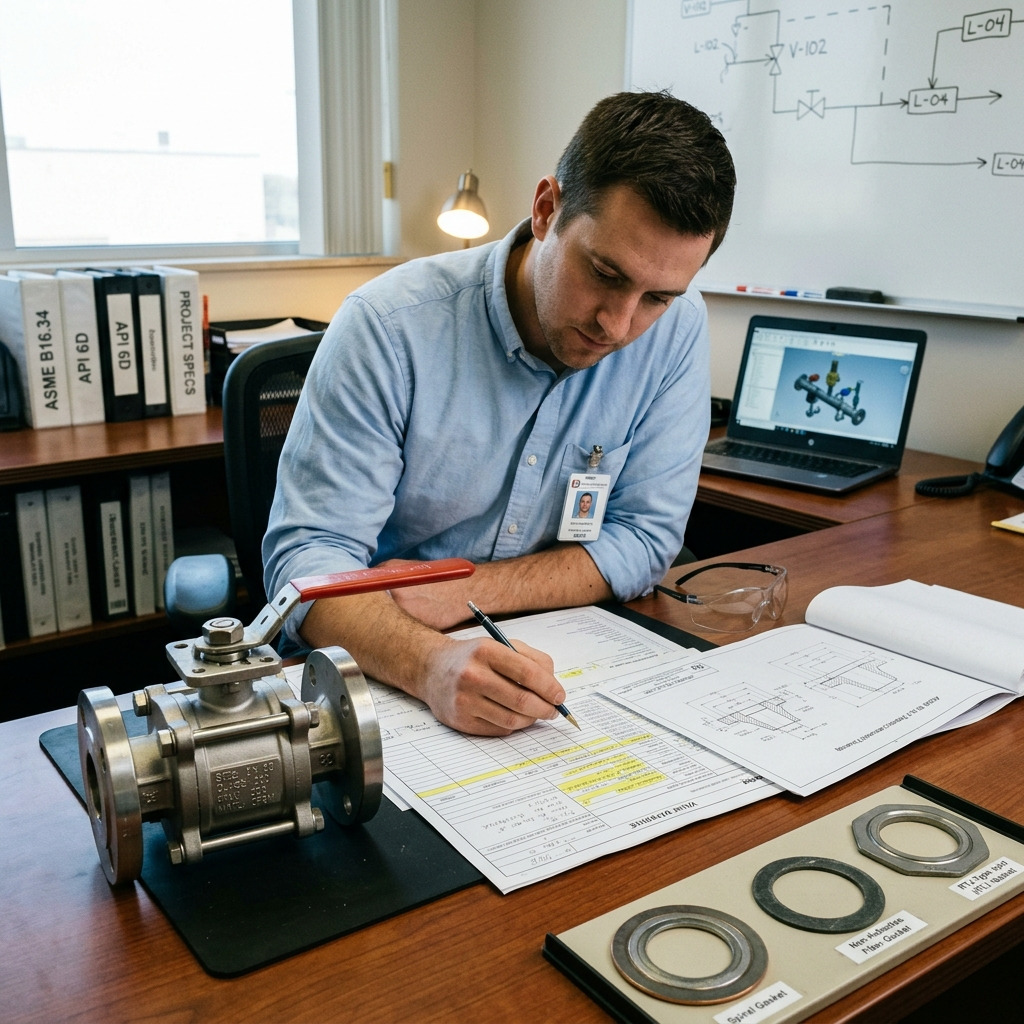
The best flanged ball valve for an industrial line is the one whose flange standard, pressure-temperature rating, bore design, seat material, and test requirements match the actual service conditions. In many projects, the pain is not that a ball valve cannot shut off flow; it is that the purchased valve fits the general description but fails the flange interface, media compatibility, actuator torque, or documentation review.
For engineers and purchasing teams comparing industrial ball valve options, this guide explains how to judge a flanged ball valve as an engineered component rather than a catalog label. The goal is to help you confirm what “best” means for your pipeline, fluid, operating conditions, maintenance plan, and supplier conversation.
What Makes the Best Flanged Ball Valve Fit the Job
A best flanged ball valve is not defined by one universal material or pressure class; it is defined by how well the valve matches the line duty. For industrial service, the first filter should be function: tight isolation, low pressure loss, safe bolted connection, and predictable operation under the specified pressure and temperature range.
A flanged ball valve is usually selected when the pipeline needs a robust bolted end connection, repeatable alignment, and easier removal than welded-end construction. It is often a better fit than a threaded valve in larger industrial piping, higher mechanical load areas, or systems where flange standards are already fixed by the piping specification.
Define the Service Before Comparing Valve Names
The useful question is not “Which valve is best?” but “Best for what service?” A chilled-water loop, a solvent transfer line, a natural gas isolation point, and a slurry line do not stress the valve in the same way.
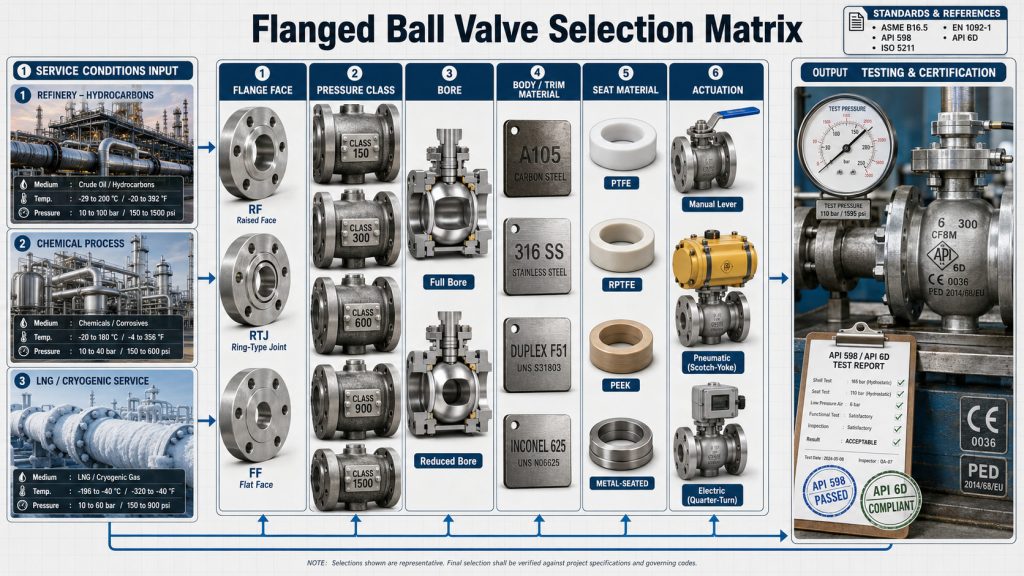
Before comparing suppliers, confirm:
- Fluid or gas composition, including solids, volatility, corrosiveness, and cleaning requirements
- Normal and upset pressure-temperature conditions
- Required end connection standard and flange facing
- Full bore or reduced bore expectation
- Manual, pneumatic, or electric operation
- Test, inspection, documentation, and marking requirements
Avoid Treating Flanged as a Complete Specification
“Flanged” only describes the connection style. It does not confirm body material, pressure class, bore, seat material, stem sealing, fire-safe design, fugitive-emission performance, or testing standard. Two flanged ball valves can look similar from the outside while behaving very differently in torque, sealing, flow loss, and maintenance access.
Start With Flow Function and Bore Design
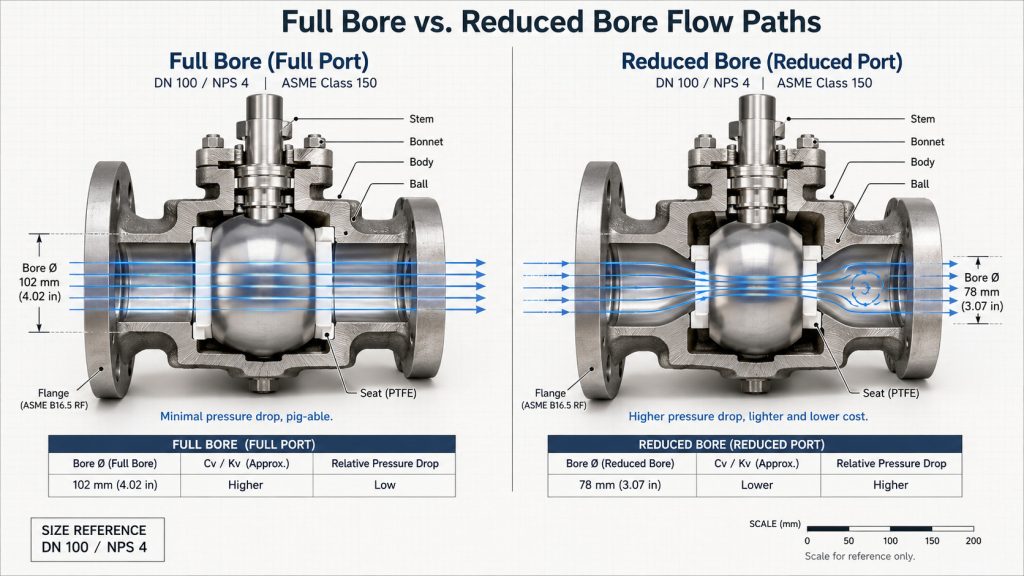
The valve should first be judged by what the line needs it to do: isolate, pass flow with low restriction, or support controlled modulation. Standard flanged ball valves are strongest as on-off isolation valves; if the system needs regular throttling, a characterized control ball design or another control valve type may be more appropriate.
A ball valve opens by rotating a bored ball so the flow path aligns with the pipeline. For readers who need a deeper structure-level explanation, the working principle of how a ball valve works in industrial piping is directly relevant before moving into flanged-end selection.
Full Bore for Flow and Pigging Requirements
A full-bore flanged ball valve keeps the valve opening close to the pipe bore, which can reduce restriction and make it more suitable for pipeline pigging or high-flow isolation duties. This matters in long pipeline sections, transfer lines, and systems where added pressure loss increases pump load or process instability.
Full bore is not automatically required for every project. It usually increases valve size, weight, and cost compared with a reduced-bore design, so it should be specified when the flow, cleaning, or pigging need is real.
Reduced Bore for Cost and Space Control
A reduced-bore design can be suitable where some pressure loss is acceptable and the line does not require pigging. It may help control cost, envelope size, and operating torque, but it should not be chosen blindly in high-flow or erosion-prone service.
If pressure drop is a meaningful design concern, estimate it before ordering. A project that already calculates pump head or system Cv can use ball valve pressure drop using Cv as the next technical check instead of relying only on bore labels.
Match Flanges, Ratings, and Standards
The flange interface must match the piping specification before the valve can be considered suitable. A valve with the right material and seat can still create project trouble if the flange class, drilling pattern, face type, or standard basis does not match the pipeline.
For ASME projects, ASME B16.5 covers pipe flanges and flanged fittings from NPS 1/2 through NPS 24, including pressure class designations 150, 300, 400, 600, 900, and 1500 in NPS 1/2 through NPS 24, plus Class 2500 in NPS 1/2 through NPS 12. That scope is useful when checking whether the valve end connection belongs to the same flange system as the piping.
Use this table to decide which specification details belong in the inquiry or datasheet review.
| Selection area | What to verify | Why it affects the valve decision |
|---|---|---|
| Flange interface | The exact flange standard, size, class, facing, and drilling pattern; for ASME flanges, confirm the applicable B16.5 NPS and class scope | Prevents bolt-hole mismatch, gasket mismatch, and installation rework |
| Valve construction | Whether the valve standard covers pressure-temperature ratings, materials, dimensions, tolerances, NDE, testing, and marking; ASME B16.34 applies to new flanged, threaded, and welding-end valve construction | Keeps the pressure class tied to material and temperature, not just a nameplate class |
| Pipeline duty | For petroleum and natural gas pipeline or piping systems, API Specification 6D defines requirements for ball, check, gate, and plug valves and lists Class 150 through Class 2500 applicability in the cited edition | Helps align valve design, testing, and documentation with pipeline project expectations |
| Pressure testing | ISO 5208:2015 specifies examinations and tests for pressure-boundary integrity, closure tightness, and closure mechanism adequacy for industrial metallic valves | Helps define test language without turning “tight shutoff” into an unsupported promise |
The main takeaway is simple: the valve rating is not separate from the flange and material system. Pressure class, temperature, body material, gasket choice, bolting, and the applicable code or project specification must be read together.
Choose Materials and Seats for the Media
Material and seat selection should be driven by the fluid, not by habit. A good flanged ball valve for clean water service may be the wrong valve for solvent vapor, abrasive slurry, high-temperature thermal oil, or corrosive chemical transfer.
Body material affects corrosion allowance, mechanical strength, and project cost. Seat and seal material affect shutoff behavior, temperature limits, chemical compatibility, torque, and maintenance risk. In chemical service, the next step is often to compare valve materials around the actual process fluid; RUITO’s chemical processing valve applications page is relevant when the media itself is the main selection risk.
Soft Seats for Clean Isolation Duties
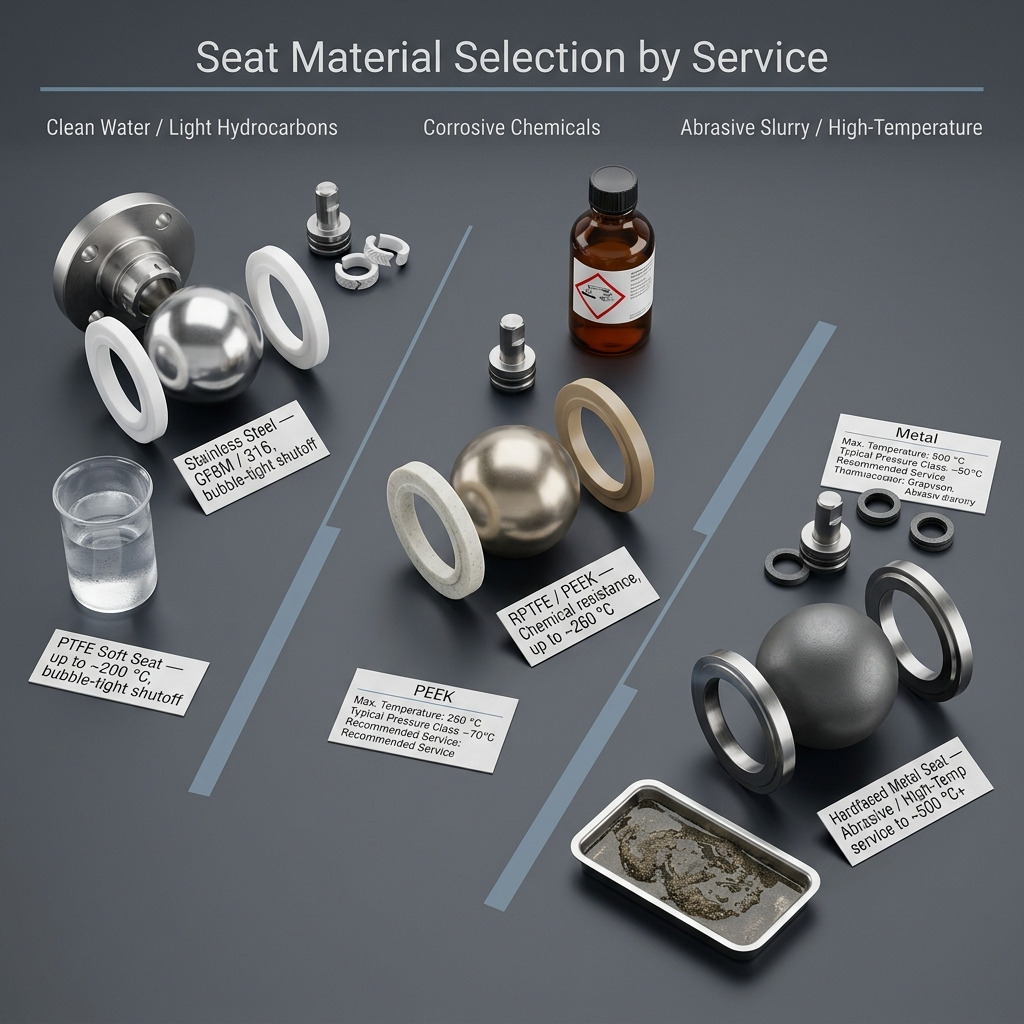
Soft-seated ball valves are widely used where tight closure is needed and the temperature, pressure, and media are compatible with the selected polymer or elastomer. PTFE-based seats are common in many clean-fluid duties, while reinforced or higher-performance materials may be considered when load, temperature, or wear conditions increase.
The risk is overgeneralization. A soft seat that performs well in one chemical or temperature range may swell, creep, wear, or lose sealing load in another. For any project with aggressive media, ask for compatibility confirmation based on the actual fluid concentration, temperature, and cleaning process.
Metal Seats for Heat, Abrasion, or Severe Service
Metal-seated flanged ball valves can be considered where soft seats are limited by temperature, abrasive particles, or service severity. They are not a default upgrade for every project because they can require higher torque, more careful surface finishing, and different leakage expectations under the specified test class.
For abrasive media, the bore design also matters. A reduced bore can increase local velocity, and hard particles may accelerate wear at the seat or ball surface. In this case, media details and flow velocity deserve more attention than a simple “stainless steel valve” description.
Decide Between Floating and Trunnion Designs
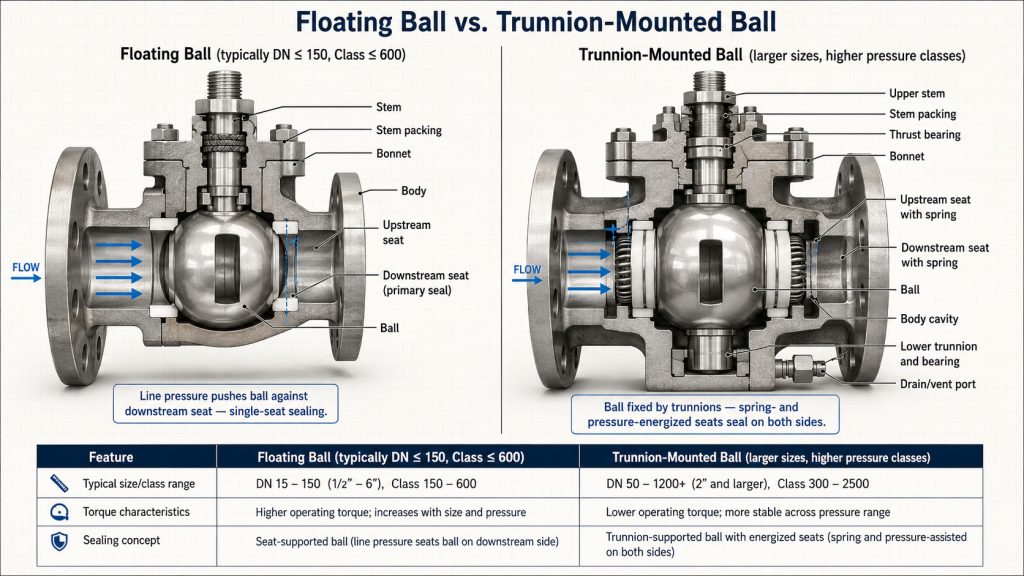
Floating and trunnion-mounted designs change how pressure loads move through the valve. A floating ball relies on line pressure to push the ball against the downstream seat, while a trunnion-mounted ball is mechanically supported and usually selected for larger size, higher pressure, or higher torque duties.
For a deeper design comparison, the article on ball valve trunnion design for pipeline isolation is a logical next step when the project involves large-bore isolation, actuation, or pipeline service.
Floating Ball Valves for Moderate Duties
Floating ball valves are often practical for smaller and moderate service conditions where torque and pressure load remain manageable. They can be compact and cost-effective, especially in clean-fluid isolation duties.
The decision limit is not only size. Media cleanliness, pressure differential, seat material, cycle frequency, and actuation method can all move a project toward a more robust design.
Trunnion Designs for Higher Load Control
Trunnion-mounted ball valves support the ball at fixed points, which can reduce operating torque and improve stability in larger or higher-pressure service. They are common in pipeline isolation, oil and gas systems, and applications where automated operation needs a predictable torque profile.
When specifying actuation, do not size the actuator only from a generic valve type. Ask for torque under the expected pressure differential, seat material, safety factor used by the actuator supplier, and whether the valve will operate normally open, normally closed, or under emergency shutoff logic.
Confirm Testing, Documents, and Quote Details
The final selection step is to translate engineering needs into clear purchase language. A valve that looks acceptable in a catalog may still create risk if the inquiry omits the standard, test, material, flange, actuation, or documentation requirements.
Pressure testing should be stated in the project’s required language. For metallic industrial valves, ISO 5208:2015 is a useful reference because it addresses pressure-boundary integrity and closure tightness, while also noting that product-standard requirements take precedence where they differ.
For volatile or hazardous fluids, external leakage around the stem and body joints can become a separate concern. ISO 15848-1:2015 specifies type-testing procedures for fugitive emissions from stem seals or shaft seals and body joints in isolating and control valves intended for volatile air pollutants and hazardous fluids, but it excludes end connection joints, vacuum applications, corrosion effects, and radiation from that part of the standard.
What to Put in the Inquiry
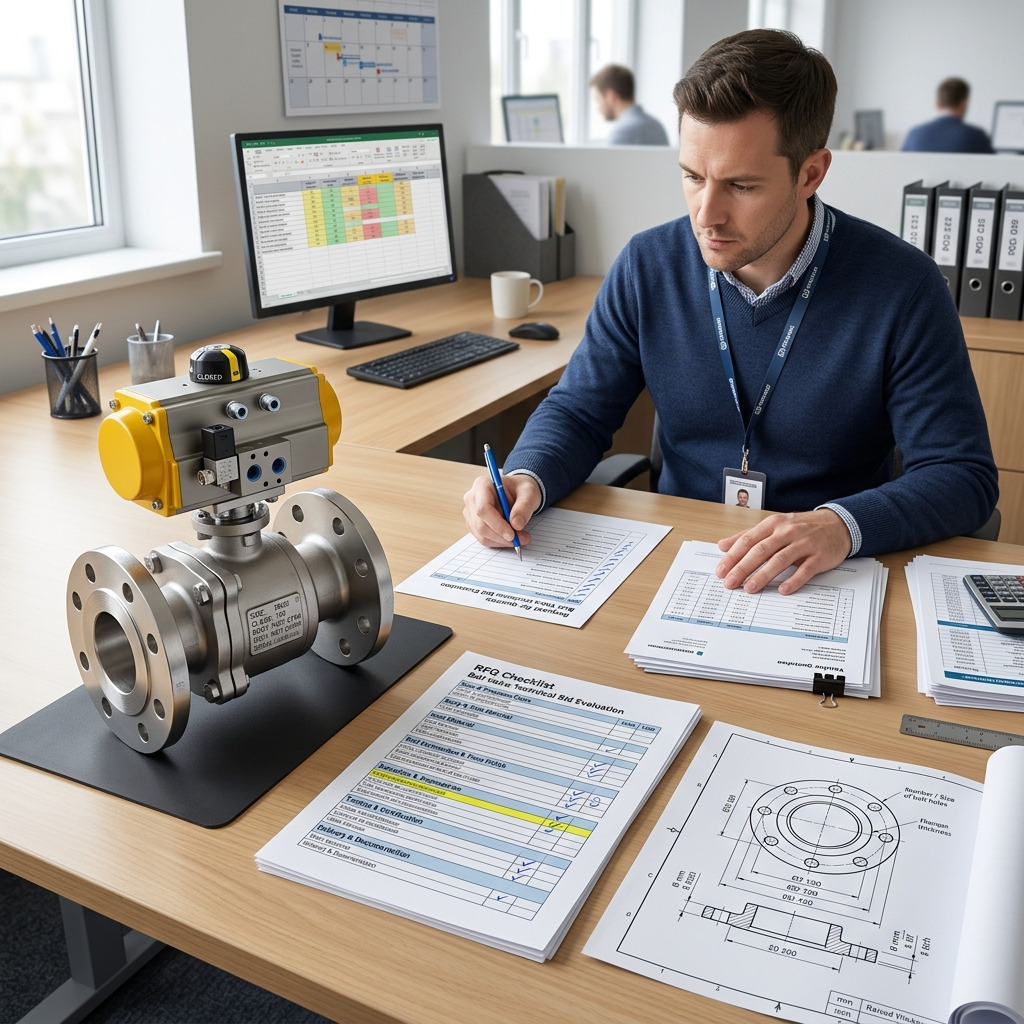
A useful RFQ for a flanged ball valve should include enough information for a manufacturer to check the actual application rather than guess from a product name.
Include:
- Fluid name, concentration, solids content, and cleaning procedure if relevant
- Normal and maximum pressure-temperature conditions
- Pipe size, flange standard, class or PN rating, facing, and gasket type
- Full bore or reduced bore requirement
- Floating or trunnion preference if already defined
- Seat, seal, and body material expectations
- Manual lever, gearbox, pneumatic actuator, or electric actuator
- Required test standard, inspection level, marking, and documentation
- Quantity, project schedule target, and packaging or export requirements
Red Flags Before Purchase
Be cautious if the quotation only says “flanged ball valve” without flange standard, pressure rating basis, material details, bore type, or testing language. Also be careful when a supplier gives a broad performance claim without connecting it to media, temperature, pressure, seat material, and test conditions.
From a valve manufacturer’s perspective, a good selection conversation narrows uncertainty. RUITO can discuss valve type, materials, seat design, bore selection, actuation, and documentation needs based on the operating conditions you provide, without turning a general product term into an unsupported promise.
Conclusion
Choosing the best flanged ball valve means matching the valve to the pipeline rather than chasing a universal label. The strongest selection process starts with service conditions, confirms flange compatibility, checks pressure-temperature limits, selects the right bore and seat design, and then names the testing and documentation requirements clearly.
RUITO’s practical position is that valve selection should be driven by verified interfaces and service conditions before price comparison. If you are reviewing a flanged ball valve for a new project or replacement order, share your media, pressure-temperature conditions, flange standard, bore preference, actuation needs, and drawings through RUITO’s project consultation channel so the discussion can focus on fit, risk, and specification clarity.
FAQ
Is a flanged ball valve better than a threaded ball valve?
It is better when the pipeline needs a stronger bolted connection, easier alignment control, or easier removal from an industrial flange system. Threaded ball valves can still be suitable for smaller or lower-load lines, but flanged ends are usually preferred when the piping specification already depends on flange standards.
Should I choose full bore or reduced bore?
Choose full bore when low restriction, pigging, or flow capacity is important. Reduced bore can be acceptable when the system can tolerate added pressure loss and the project benefits from lower cost, smaller envelope, or lower operating torque.
Can a standard flanged ball valve be used for throttling?
A standard flanged ball valve is usually better for isolation than regular throttling. If the system needs repeatable flow control, ask whether a characterized control ball, V-port ball valve, or another control valve type is more suitable.
What information should I send before asking for a quote?
Send the media, pressure-temperature conditions, pipe size, flange standard, bore requirement, material preference, actuation method, and testing or documentation requirements. These details help the manufacturer review the actual duty instead of quoting from a vague valve name.
What is the biggest mistake when buying a flanged ball valve?
The biggest mistake is treating “flanged ball valve” as a complete specification. The connection type is only one part of the decision; rating basis, materials, seat design, bore, testing, actuation, and documentation all affect whether the valve fits the project.