
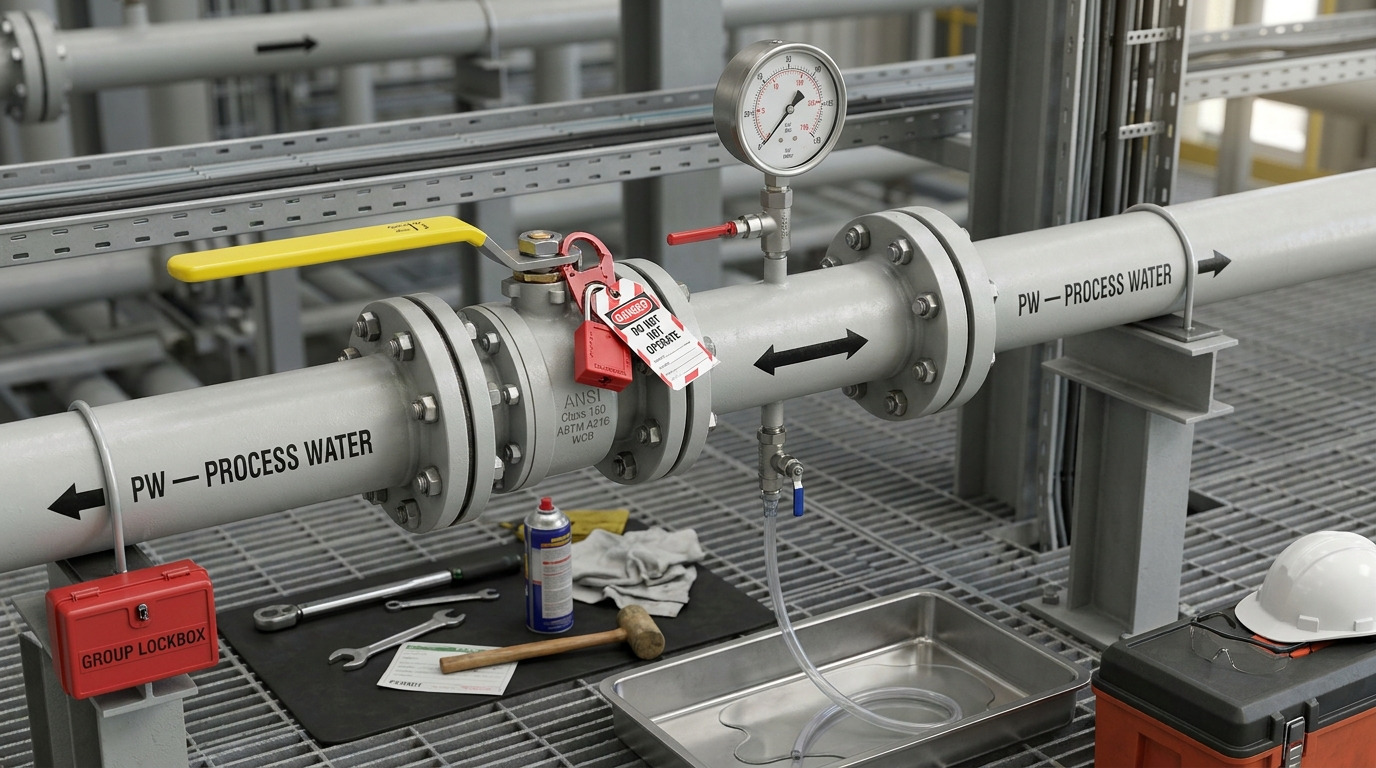
When a ball valve won’t turn, the safest answer is not to force the handle; isolate the line, confirm the valve position, and diagnose the mechanical cause before choosing repair or replacement. In industrial piping, a stuck valve can point to corrosion, debris, seat swelling, stem packing friction, actuator torque mismatch, or damage from past operation.
The typical situation is familiar: an operator tries to close an isolation valve before maintenance, but the handle barely moves or stops halfway. The pressure may still be present, the media may be hazardous, and an improvised extension bar can turn a repairable valve into a damaged valve. This article explains how to judge the problem from a valve construction and specification perspective, especially for project teams comparing manual, flanged, soft-seat, metal-seat, floating, or trunnion industrial ball valves.
Why a Ball Valve Won’t Turn
A ball valve usually stops turning because the torque needed to rotate the ball is higher than the handle, gearbox, or actuator can safely provide. The cause may be inside the valve, around the stem, in the seat area, or in the actuator package.
A manual ball valve is intended to rotate between open and closed positions with a short turning motion. When that motion becomes stiff, the resistance often comes from one of five areas:
- Corrosion on the ball, stem, or body cavity
- Scale, solids, or crystallized media around the ball
- Soft seat swelling, deformation, or thermal damage
- Over-compressed stem packing or stem seal wear
- Undersized, misaligned, or failed actuator components
The search phrase ball valve won’t turn often sounds like a simple operating problem, but the real question is whether the valve is temporarily stiff, mechanically damaged, unsafe to operate, or unsuitable for the service. That distinction matters more than the first attempt to free the handle.
Make the Line Safe Before Applying Force
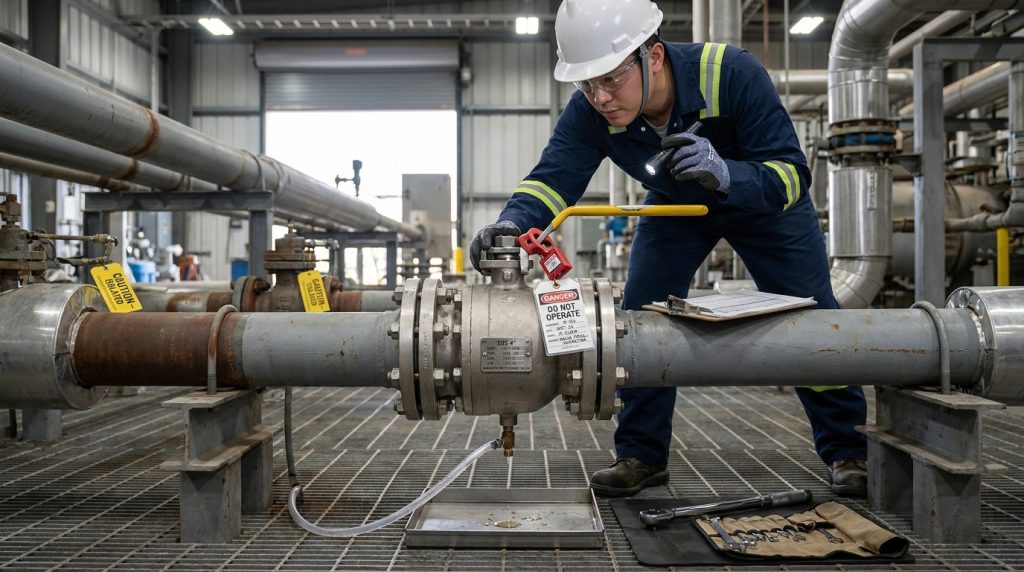
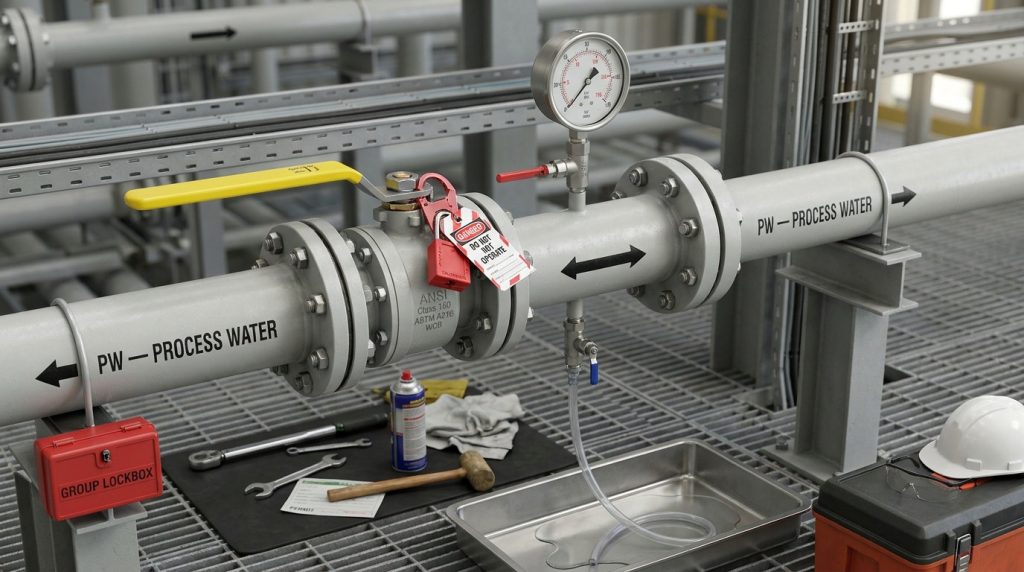
The first step is to control pressure and stored energy before applying more torque. A stuck ball valve can release media, move suddenly, or damage connected equipment if someone treats it like a tight household handle.
In a U.S. general-industry context, 29 CFR 1910.147 covers servicing and maintenance where unexpected start-up or stored energy release could cause injury, and it defines a line valve as an energy-isolating device. Local rules, plant procedures, and the specific media hazard still govern the actual work method.
Check pressure and stored energy first
Confirm upstream and downstream pressure, drain or vent where the system design allows, and verify whether thermal, chemical, pneumatic, hydraulic, or mechanical energy can reaccumulate. A valve that feels stuck under pressure may behave differently after the pressure differential is removed.
If the valve isolates steam, hot oil, compressed gas, chemicals, slurry, or fuel service, treat the symptom as a system safety issue first and a valve issue second. The handle position alone does not prove the bore position if the stem, coupling, or actuator has failed.
Do not defeat the stop or handle
Do not remove the stop plate, extend the handle with a pipe, or force an actuator override until the valve and line condition are understood. Extra leverage can twist the stem, crack the seat, score the ball, or hide the original failure mode.
If the handle has already bent, the stem flats are damaged, or the actuator coupling slips, stop operating the valve. At that point, the problem is no longer just high operating torque.
Diagnose the Mechanical Cause Before Choosing a Fix
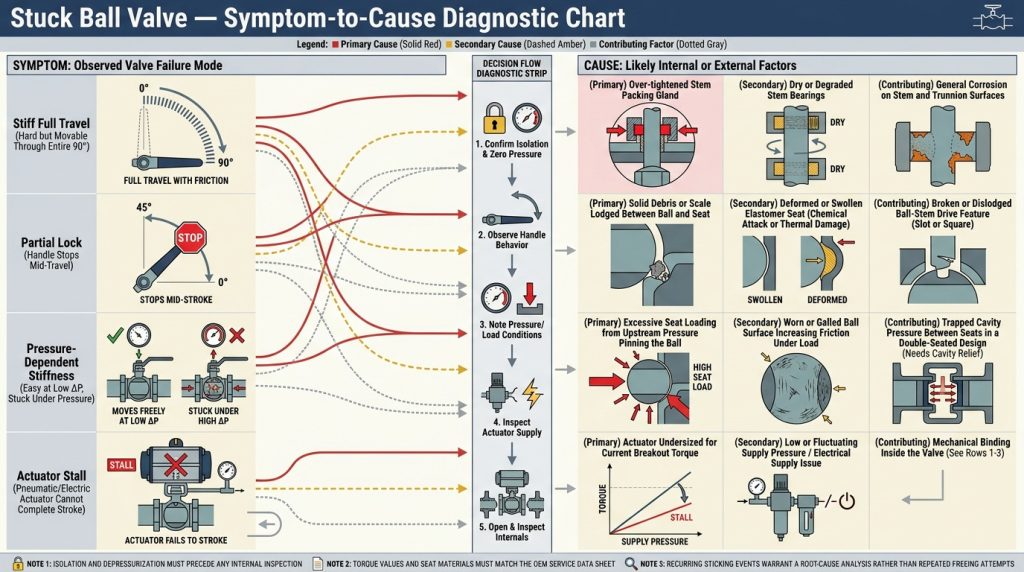
Diagnosis should separate stem friction, seat resistance, internal obstruction, and actuator failure. These causes can feel similar at the handle, but they call for different actions.
Use the table as a first-pass diagnostic filter before deciding whether to lubricate, disassemble, repair, or replace the valve.
| Symptom | Likely cause | Safer next check |
|---|---|---|
| Handle is stiff through the full travel | Stem packing friction, corrosion, or dried lubricant | Check packing area, stem condition, and whether the design allows approved lubrication |
| Handle moves slightly then locks | Debris, scale, ball scoring, or seat deformation | Isolate and inspect service conditions before adding torque |
| Valve turns only after depressurizing | High differential pressure or seat load | Review valve type, pressure class, and whether the actuator or gearbox is sized for the condition |
| Valve is stiff after heat exposure | Soft seat damage or thermal expansion | For PTFE-type seats, material data such as PTFE granular powder ratings may show 260 °C continuous service for the polymer, but the actual valve rating can be lower and must come from the valve datasheet |
| Actuator moves but valve does not | Coupling, bracket, stem, or torque mismatch | Inspect the actuator interface and confirm valve breakaway torque under service conditions |
| Valve was used for throttling | Seat erosion or ball edge damage | Review whether the application needs a control valve or another valve style |
The table does not replace site inspection, but it helps avoid the common mistake of treating every stuck valve as a lubrication problem.
Stem and packing friction
Stem packing can create high turning resistance when it is over-tightened, aged, chemically attacked, or exposed to repeated thermal cycling. In adjustable packing designs, small changes may affect leakage and torque, so adjustment should follow the manufacturer’s instructions rather than field guesswork.
A stem problem may also show up as external leakage, handle wobble, or uneven resistance through the turn. If the stem or packing is already damaged, a quick adjustment may only delay replacement.
Seat swelling corrosion and deposits
Soft seats can grip the ball when they swell, deform, or collect abrasive solids. Metal seats can also seize when corrosion, galling, or hard particles increase friction at the sealing surface.
This is where media details matter. Water scale, polymerizing chemicals, crystallized salts, slurry fines, and corrosion products can all create a valve that feels mechanically locked even when the handle assembly looks normal.
Actuator or gearbox torque mismatch
For automated valves, the problem may sit above the valve. Air pressure, spring return sizing, electric actuator torque settings, limit switch calibration, gearbox condition, coupling alignment, and mounting bracket stiffness can all affect whether the ball rotates.
If the actuator stalls but the valve can be moved safely after isolation, the next question is whether the actuator package was sized for clean new-valve torque or for the real breakaway torque after service exposure. For a deeper actuator-specific path, the same logic applies to a ball valve stuck on an automated actuator.
Match the Fix to the Failure Mode
The right fix depends on whether the valve is dirty, dry, misadjusted, damaged, or wrongly specified. A useful response restores controlled operation without hiding the failure pattern that caused the stiffness.
When lubrication helps
Lubrication may help when the design includes appropriate lubrication points and the issue is stem friction or external operating mechanism friction. It is less likely to solve a damaged seat, scored ball, hard deposits in the bore, or chemical attack.
Lubricant compatibility matters. The lubricant must suit the media, temperature, seat material, elastomers, and cleanliness requirements. If lubrication is being considered, the next step is not simply “add grease”; it is to check whether the valve design and service allow a compatible ball valve lubricant.
When cleaning or repair is more realistic
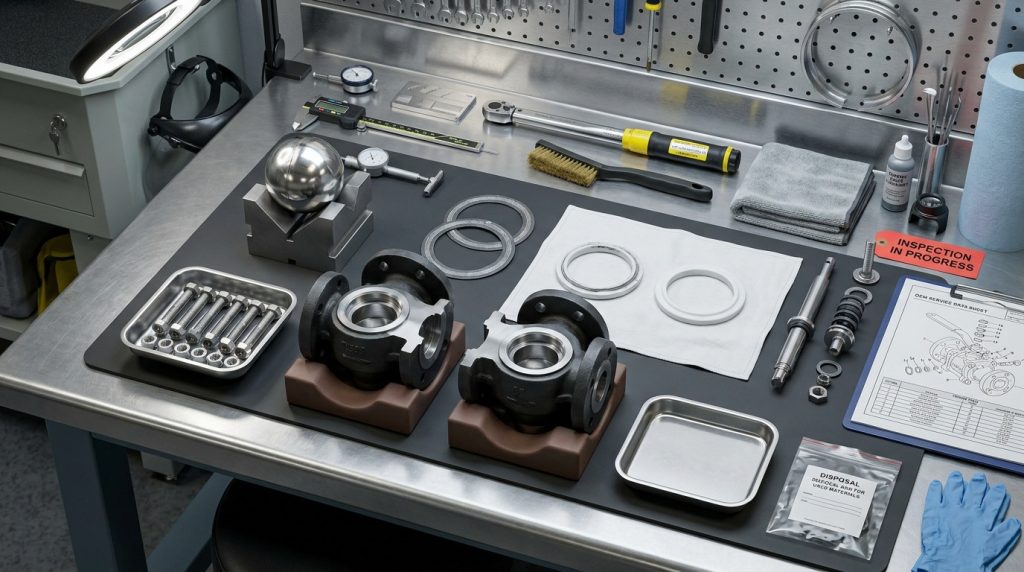
Cleaning may help when the obstruction is external or when the valve can be removed and inspected under controlled conditions. Repair is more realistic for valves with replaceable seats, stem packing, seals, or body gaskets.
One-piece compact valves and many low-cost utility valves may not justify repair. Multi-piece industrial valves may be more repairable, but the parts still need to match the valve series, pressure class, seat material, and service fluid. A useful repair decision starts with ball valve repairability, not with the tool bag.
When operation should stop
Stop operating the valve if the handle bends, the stem twists, external leakage appears, the actuator stalls repeatedly, or the valve does not reach a confirmed open or closed position. These signs suggest that continued force may increase the risk.
A valve that cannot reliably reach its intended position is also a process control problem. In isolation service, uncertainty about open or closed status can affect maintenance planning, pump protection, bypass arrangements, and downstream safety.
Prevent Repeat Seizing Through Specification
Repeat stiffness is often a specification problem, not just a maintenance problem. If the valve keeps sticking, the selected body material, seat material, bore design, actuator margin, or service assumptions may not match the real operating condition.
Media and seat material
Confirm the fluid, concentration, solids content, cleaning chemicals, oxygen exposure, and temperature swings. A seat material that works in clean water may not behave the same way in solvent, slurry, hot oil, steam-adjacent service, or crystallizing chemical duty.
Material data is useful, but it should not be treated as a universal valve rating. A polymer seat, metal seat, elastomer seal, body alloy, and surface coating all interact with pressure and temperature. The valve manufacturer’s pressure-temperature chart and service recommendations should govern the final selection.
Bore design and flow conditions
A full-bore valve can reduce internal restriction and may be useful where pigging, low pressure drop, or solids passage matters. A reduced-bore valve may be acceptable in utility service, but higher local velocity can become a concern in abrasive or dirty media.
If the valve is being specified for flanged industrial piping, confirm flange standard, pressure class, face-to-face requirements, bore style, seat type, and maintenance access together. A stuck replacement valve is easier to prevent during flanged ball valve selection than after installation.
Actuation margin and mounting
For actuated valves, size the actuator for service conditions, not only catalog new-valve torque. Breakaway torque can increase after long static periods, temperature cycling, dirty media, or pressure differential.
Confirm mounting interface, coupling fit, actuator safety factor, fail position, air supply or power limits, manual override method, and limit switch feedback. A strong actuator on a misaligned bracket can still create poor motion, stem stress, and unreliable position indication.

Know When Replacement Is Safer Than Reuse
Replacement is safer when the valve’s internal condition, service compatibility, or position reliability can no longer be trusted. A valve that has seized once may return to service after inspection, but a valve that seizes repeatedly is telling you that the duty or design needs review.
Replacement clues for project teams
Consider replacement instead of reuse when you find:
- Stem deformation, broken handle parts, or damaged stops
- Seat fragments, deep ball scoring, or severe corrosion
- Stiffness caused by incompatible media or temperature exposure
- Unreliable actuator travel or repeated torque alarms
- Leakage after the valve is freed
- Missing data on pressure rating, materials, or test standard
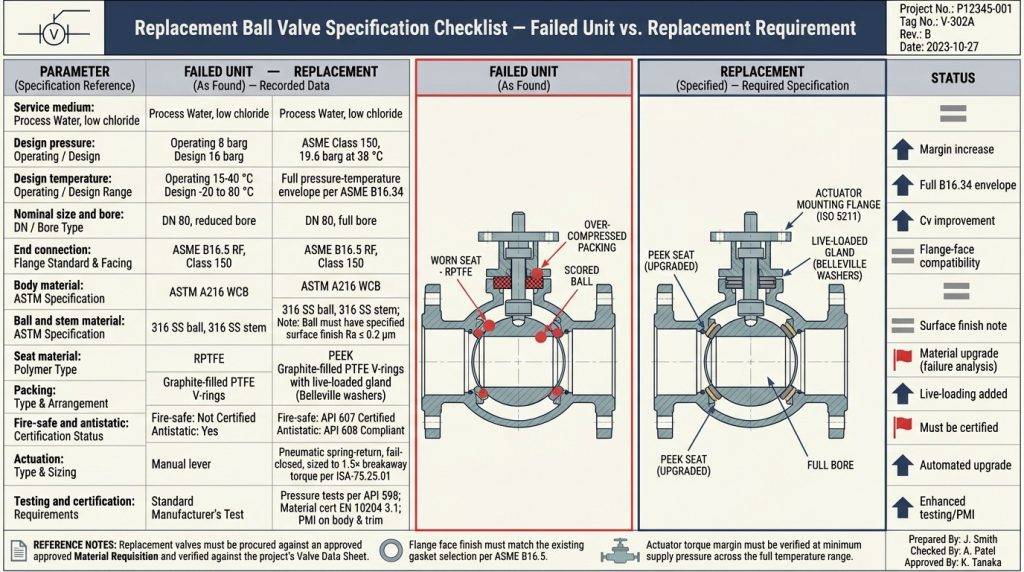
For new valve specification, ASME B16.34 2025 applies to new flanged, threaded, and welding-end valves and covers pressure-temperature ratings, dimensions, tolerances, materials, nondestructive examination requirements, testing, and marking. That scope is a useful reminder: replacement is not only about matching pipe size. It is about matching the pressure boundary, materials, connection, seat design, and testing expectations.
What to confirm before buying a replacement
Prepare the service information before requesting a replacement valve. At minimum, confirm the media, pressure, temperature, pipe size, end connection, pressure class, body material, seat material, bore style, manual or actuated operation, normal valve position, cycling frequency, and any project testing or documentation requirements.
If the original valve failed from corrosion, deposits, heat, slurry, or actuator undersizing, do not replace it by size alone. A same-size valve with the same unsuitable seat or torque margin can repeat the same failure.
Conclusion
A stuck ball valve should be treated as a diagnosis problem before it becomes a force problem. The main task is to make the line safe, identify whether resistance comes from the stem, seat, ball, deposits, pressure differential, or actuator, and decide whether lubrication, repair, cleaning, or replacement is the more reliable path.
RUITO’s position is practical: a valve that turns correctly over time depends on suitable materials, seat design, operating torque, testing expectations, and clear project communication, not last-minute force at the handle. If you are reviewing a stuck valve for replacement, material change, actuator sizing, or specification confirmation, you can send the operating conditions and project requirements to RUITO for discussion.
FAQ
Can I use more force if a ball valve is stuck?
No, adding force should not be the first response. Extra leverage can damage the stem, seats, ball, handle, gearbox, or actuator coupling, and it may create a safety risk if pressure or hazardous media is still present.
Why does a ball valve get hard to turn after sitting unused?
A long static period can allow corrosion, scale, dried residue, or seat adhesion to increase breakaway torque. The risk is higher when the media contains solids, crystallizes, attacks the seat material, or leaves deposits in the body cavity.
Is lubricant enough when a ball valve won’t turn?
Sometimes, but only when the stiffness comes from a lubricated stem or operating mechanism and the lubricant is compatible with the valve and media. Lubricant will not correct a swollen seat, scored ball, heavy deposits, wrong material selection, or undersized actuator.
Should I repair or replace a stuck ball valve?
Repair may make sense when the valve is designed for serviceable parts and the pressure boundary is still trustworthy. Replacement is usually more appropriate when the stem is damaged, seats are degraded, corrosion is severe, or the original valve specification does not match the service.
What information helps specify a replacement valve?
Send the media, pressure, temperature, pipe size, connection type, pressure class, body and seat material, bore style, operating method, failure symptom, and any testing or documentation requirements. Those details help separate a simple like-for-like replacement from a needed material, seat, or actuator change.