
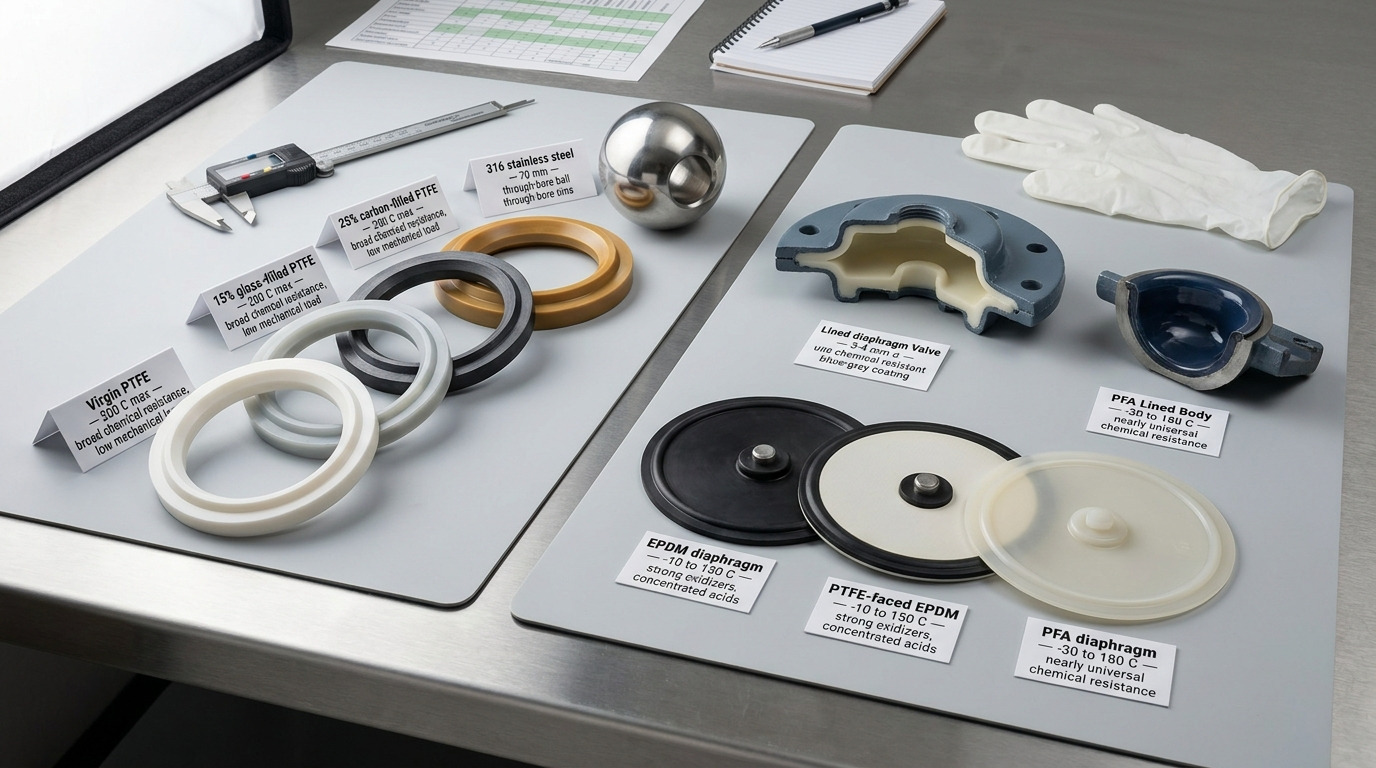
For a diaphragm valve vs ball valve decision, choose the valve by media cleanliness, pressure drop, corrosion risk, temperature, and maintenance access, not by valve name alone. A ball valve is usually the stronger starting point for quick on/off isolation in clean liquid or gas lines, while a diaphragm valve often makes more sense when the fluid is corrosive, abrasive, viscous, sanitary, or needs separation from stem and bonnet components.
In real process lines, the painful mistake is assuming both valves solve the same problem because both can stop flow. If a clean utility line needs compact quarter-turn shutoff, an industrial ball valve may be the practical baseline. If the medium attacks metal seats, carries solids, or must avoid trapped product zones, the comparison changes quickly.
This guide compares the two valve types from an engineering and procurement perspective: how they seal, where they fit, what data to confirm, and which risks to check before specifying one for a project.
Diaphragm Valve vs Ball Valve Selection Factors
The quickest answer is this: use a ball valve when low restriction and fast isolation matter most, and consider a diaphragm valve when media compatibility, cleanability, or isolation of working parts matters more. The table below is a practical first screen, not a substitute for manufacturer ratings.
| Selection factor | Diaphragm valve | Ball valve | What to confirm |
|---|---|---|---|
| Closing element | Flexible diaphragm seals against a weir or seat; MSS SP-88-2021 defines this type as using a resilient diaphragm with equal sealing capability in either flow direction | Rotating ball with a bore turns through 90 degrees; ball valve technical guidance describes floating and trunnion designs from 1/4 in. through 60 in. and larger | Valve type, body style, seal design, and flow direction |
| Main advantage | Media is isolated from stem and bonnet working parts | Compact, fast, low-resistance isolation when fully open | Whether the line needs isolation, throttling, or both |
| Pressure drop | Usually higher than a full-port ball valve, especially in weir designs | Full-port designs can reduce pressure loss; reduced-port designs need Cv review | Published Cv or Kv at the required opening |
| Dirty or solid-bearing media | Can suit abrasive or viscous duties when the body pattern and diaphragm material are correct; one published industrial diaphragm-valve data sheet lists weir designs up to 15% solids and straight-through designs up to 100% solids for that product family | Soft seats can be scratched by hard particles; metal-seated or special designs may be needed | Solids percentage, particle hardness, velocity, and cleaning method |
| Temperature limit | Governed by diaphragm and lining material | Governed by seat, seal, body, and fire-safe design; PTFE-type resilient seats are noted around 450°F or 232°C depending on exact material | Actual material grade and manufacturer rating |
| Maintenance focus | Diaphragm wear, compressor travel, bonnet integrity, lining condition | Seat wear, stem packing, torque rise, body-joint sealing | Spare parts access and whether the valve must stay in line |
The main takeaway is not that one valve is universally better. The right choice is the one whose sealing material, body design, pressure class, and maintenance path match the service conditions.
How Each Valve Seals and Controls Flow
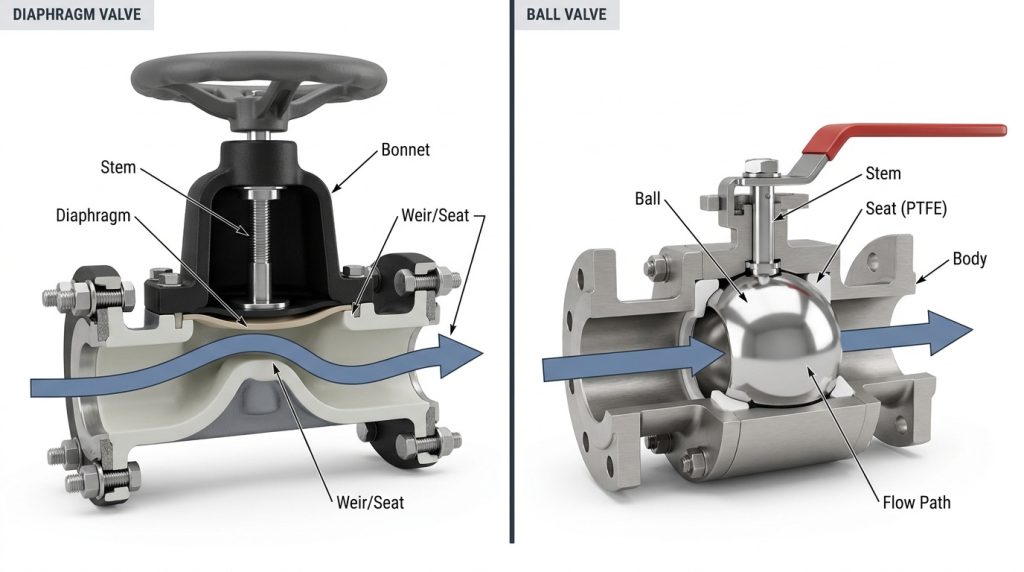
A diaphragm valve seals by pressing a flexible diaphragm into a weir or seat, while a ball valve seals by rotating a bored sphere between seats. That difference drives most of the selection trade-offs.
Diaphragm Valve Sealing Path
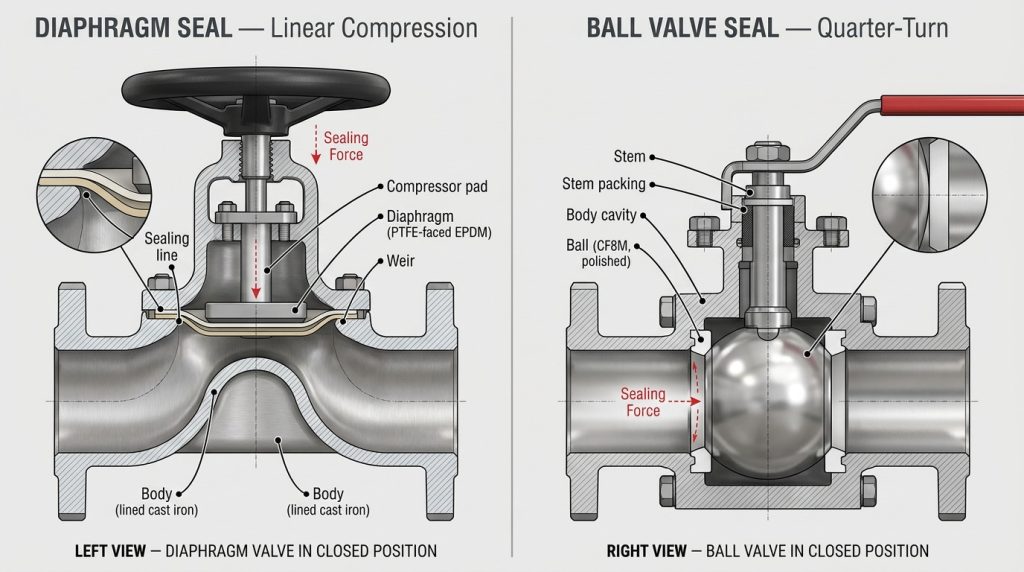
In a diaphragm valve, the line media contacts the body lining and diaphragm, not the stem threads or bonnet working parts. This is why diaphragm valves are common in corrosive chemical service, slurry handling, and hygienic process lines where trapped product or stem leakage risk needs careful control.
A weir-type diaphragm valve gives better throttling behavior than many simple on/off valves, but the raised weir also increases flow resistance. A straight-through diaphragm design can reduce restriction and handle heavier solids, but it may need more actuator force and careful diaphragm selection.
Ball Valve Flow Path
A ball valve opens when the ball bore aligns with the pipe and closes when the solid side of the ball blocks the line. Full-port ball valves are especially useful where the line should stay close to pipe bore, while reduced-port designs can be acceptable when pressure drop is still within the system allowance.
Floating ball valves are generally used in smaller and lower-pressure services; trunnion designs support larger and higher-pressure applications. Published valve-industry guidance notes floating ball valves are manufactured up to 24 in., with the practical range often much lower, while trunnion pipeline ball valves are used in diameters up to 60 in. and pressures up to Class 600.
Media Compatibility and Cleanability Drive the Choice
Media compatibility often decides the valve before pressure rating does. If the fluid corrodes trim materials, embeds particles into soft seats, or must be cleaned without trapped pockets, a diaphragm valve may offer a cleaner risk profile.
Corrosive and Abrasive Fluids
For acids, alkalis, solvents, slurry, and wastewater streams, the question is not just “Can the valve close?” It is whether the wetted body, lining, diaphragm, ball, seat, stem seal, and packing can survive the actual concentration, temperature, and solids profile.
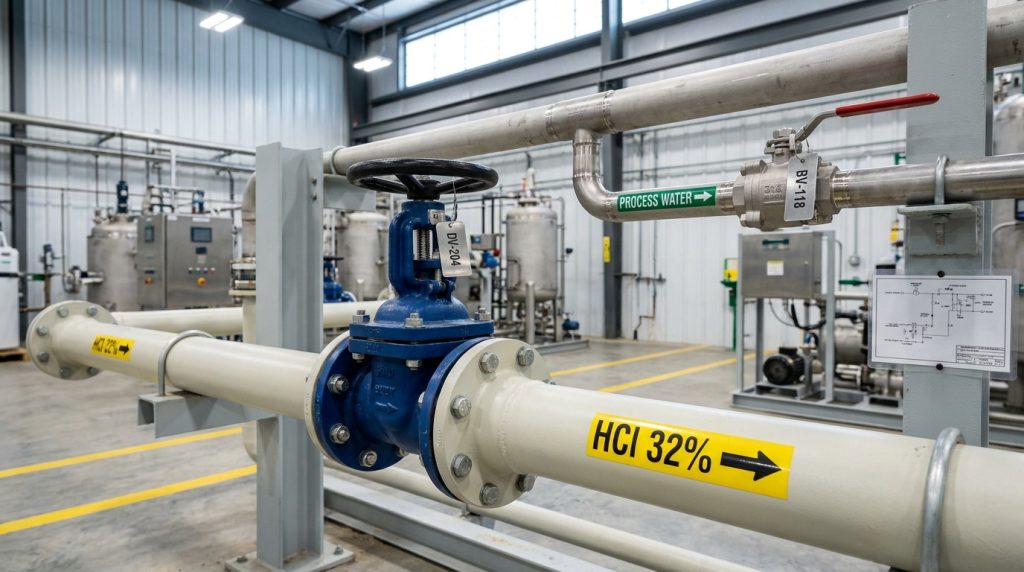
In chemical processing lines, diaphragm valves are often considered when the process needs lining compatibility and isolation of the operating mechanism from the media. Ball valves can still be appropriate, especially with compatible stainless steel, alloy, lined, or metal-seated designs, but hard particles and crystallizing fluids can damage seats or raise operating torque.
Sanitary and Hygienic Service
For food, beverage, pharmaceutical, and high-purity duties, cleanability and dead-leg control matter as much as shutoff. The 3-A standards list includes 3A 54-02 for Diaphragm-Type Valves and 3A 68-01 for Ball-Type Valves for Milk and Milk Products, which shows that both valve types can appear in sanitary contexts when designed and certified for that service.
The deciding details are surface finish, drainability, elastomer compatibility, cleaning temperature, connection type, and whether the valve body geometry creates product hold-up. A standard industrial ball valve should not be assumed sanitary just because it is stainless steel.
Pressure Drop, Throttling, and Flow Control
A ball valve usually wins for low pressure drop when fully open, but a diaphragm valve may be easier to justify for moderate throttling in corrosive or particle-bearing fluids. Neither should be treated as a precision control valve unless the design, actuator, and sizing data support that duty.
For liquid systems, pressure drop should be checked with published Cv or Kv values rather than assumed from the valve category. If the line depends on pump head or stable flow, calculate ball valve pressure drop using Cv and compare it with the diaphragm valve data at the required operating position.
Ball valves can throttle in some services, but standard round-port designs may create poor control at small openings and can expose the seat edge to high-velocity wear. V-port ball valves are a separate control-oriented design and should not be confused with ordinary isolation ball valves.
Diaphragm valves can provide more progressive closure because the diaphragm travel changes the flow area gradually. The trade-off is that diaphragm movement, weir geometry, and elastomer behavior must be compatible with cycling frequency and pressure differential.
Pressure, Temperature, and Material Limits
Pressure and temperature limits come from the actual valve construction, not the label “diaphragm” or “ball.” Body material, pressure class, lining, diaphragm compound, seat material, stem seal, and end connection all shape the safe operating envelope.
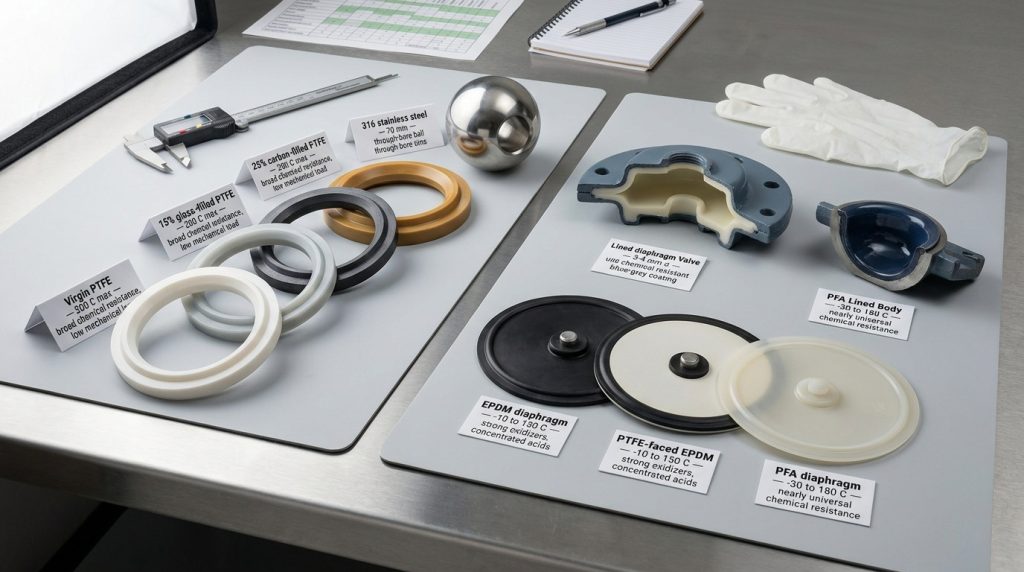
Soft-seated ball valves need special attention because the seat material is often the limiting part. PTFE-based seats can provide strong chemical resistance and low friction, but PTFE ball valve seat behavior should be reviewed against pressure, temperature, thermal cycling, and media cleanliness instead of treated as one fixed rating.
Diaphragm valves face a similar material limit. Elastomeric and fluoropolymer diaphragms behave differently under temperature, vacuum, chemical exposure, and repeated flexing. If a diaphragm valve is lined, the lining must also be checked for permeation, swelling, abrasion, and bonding risk.
For high-temperature steam, thermal oil, high-pressure gas, or fire-risk service, a standard diaphragm valve may be unsuitable, while a metal-seated or fire-tested ball valve may be considered if the manufacturer’s rating and applicable test standard match the duty. For corrosive low-to-moderate pressure liquids, the opposite may be true.
Maintenance and Lifecycle Risk
Maintenance risk is different for each valve type: diaphragm valves concentrate wear in the diaphragm, while ball valves concentrate risk around seats, stem packing, and operating torque. The better option depends on whether the plant values in-line diaphragm replacement, low operating torque, compact installation, or long isolation intervals.
A diaphragm is a planned wear part. That can be useful when the process fluid is aggressive because the replacement task is predictable, but it also means the diaphragm material and cycling conditions must be selected carefully.
A ball valve may need less frequent attention in clean isolation service. However, if solids scratch the seats or deposits build around the ball cavity, the valve can become stiff, leak internally, or fail to close fully. In maintainable ball valve designs, the three-piece versus two-piece ball valve decision can matter almost as much as the choice between ball and diaphragm.
Actuation also affects lifecycle cost. A ball valve typically uses quarter-turn actuation, while many diaphragm valves require linear motion. Before automation, confirm torque or thrust, fail position, cycle frequency, air supply or motor sizing, and whether position feedback is needed.
Specification and Testing Checks Before Purchasing
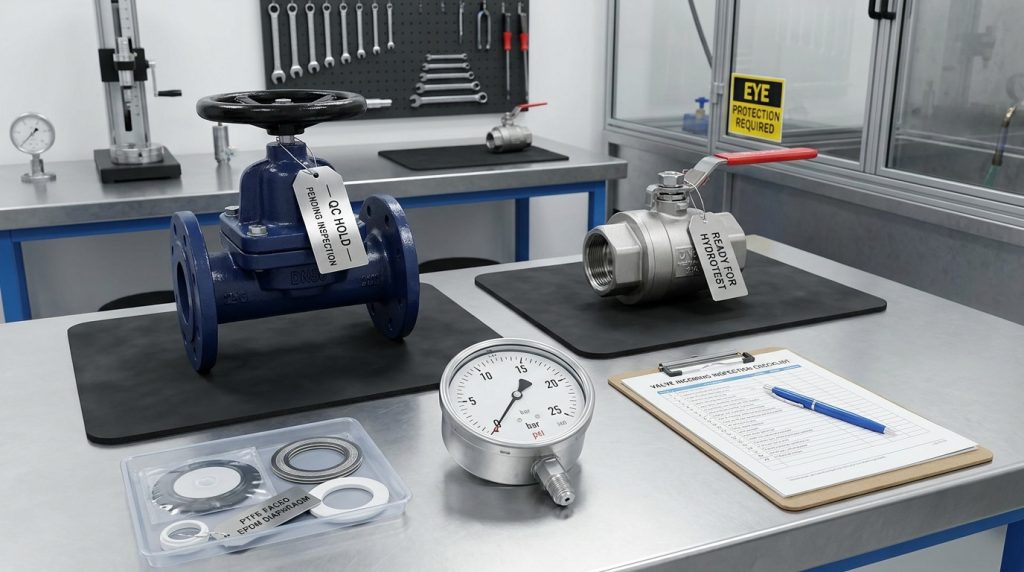
Before purchasing either valve, define the service conditions and the acceptance standard clearly. Vague requests such as “chemical valve,” “tight shutoff,” or “zero leakage” create risk because test method, leakage class, material, and pressure rating may not be the same across suppliers.
A useful specification should include:
- Medium name, concentration, solids content, viscosity, and cleaning chemicals
- Operating and design pressure, temperature, and expected cycling frequency
- Valve size, end connection, face-to-face requirement, and flow direction
- Body, lining, diaphragm, seat, seal, and stem material expectations
- Isolation or control duty, including required Cv or Kv if flow matters
- Manual, pneumatic, or electric operation and fail-position requirement
- Required inspection and pressure test standard, such as API 598, ISO 5208, or EN 12266-1
- Documentation expectations that are actually needed for the project
Testing language deserves extra care. EN 12266-1 is a 2012 CEN standard for pressure tests, procedures, and acceptance criteria for production testing of metallic industrial valves, while API 598 and ISO 5208 are commonly referenced in other markets and specifications. The selected standard should match the valve type, material, region, and project contract.
Different standards can also produce different test pressures. A valve-testing technical article notes that a Class 150 carbon steel valve may be shell tested at 31 bar under API/ASME logic, while a stainless steel equivalent may be 29 bar; under EN/DIN logic, PN10 and PN40 examples are 15 bar and 60 bar respectively. That is why the purchase order should name the standard instead of relying on a generic phrase such as “standard factory test.”
Which Valve Fits Common Process Services
For clean water, compressed air, fuel, and general utility isolation, a ball valve is often the simpler choice if its pressure class, seat material, and end connection match the system. It is compact, fast to operate, and efficient when fully open.
For corrosive liquids, chemical dosing, viscous fluids, and some slurry services, a diaphragm valve may reduce contact between the media and mechanical working parts. The decision still depends on lining, diaphragm compound, solids behavior, and operating pressure.
For hygienic service, either valve type may be possible, but diaphragm valves are often favored where drainability, cleanability, and product hold-up are strict concerns. Ball valves can be used in sanitary designs, but ordinary industrial ball valves should not be substituted into hygienic service without confirming the standard, seal design, and cleaning method.
For throttling, a diaphragm valve may be more forgiving than a standard round-port ball valve in difficult fluids. If control precision is critical, compare a control diaphragm valve, V-port ball valve, globe valve, or dedicated control valve using actual flow data and actuator requirements.
Conclusion
The diaphragm valve vs ball valve choice is mainly a question of service conditions. Ball valves usually fit clean, fast, low-resistance isolation; diaphragm valves often fit corrosive, dirty, viscous, or hygienic duties where media isolation and material compatibility matter more.
RUITO’s position is that valve selection should begin with the actual medium, pressure, temperature, connection, and maintenance plan, not with a shortcut valve label. If you are comparing valve types for a process line, you can share the operating conditions, drawing, and material expectations through RUITO’s contact page so the discussion starts from the real specification rather than a generic product name.
FAQ
Is a diaphragm valve better than a ball valve for chemicals?
Often, yes, but only when the diaphragm and lining materials match the chemical. Diaphragm valves can isolate the bonnet working parts from corrosive media, while ball valves may still be suitable if the body, seat, and stem seals are compatible with the chemical and temperature.
Can a ball valve be used for throttling?
A standard ball valve can sometimes throttle, but it is usually selected for on/off isolation. For repeated throttling, check whether the design is a V-port or control-style ball valve and confirm Cv, seat wear risk, actuator resolution, and pressure-drop limits.
Which valve is easier to clean in sanitary service?
A sanitary diaphragm valve is often easier to justify where drainability and low product retention are priorities. A sanitary ball valve can also be used when its design and certification match the process, but a general industrial ball valve should not be assumed suitable for hygienic duty.
Which valve is better for slurry?
A diaphragm valve can be better for some abrasive or viscous slurry lines, especially in straight-through designs, but it is not automatic. Particle size, solids percentage, velocity, pressure, lining material, and cleaning method must be checked before selecting either valve.
What project details are needed before choosing?
Send the medium, concentration, solids content, pressure, temperature, pipe size, end connection, flow rate, operating frequency, cleaning method, and required test standard. Those details determine whether the safer route is a diaphragm valve, a ball valve, or another valve type entirely.