
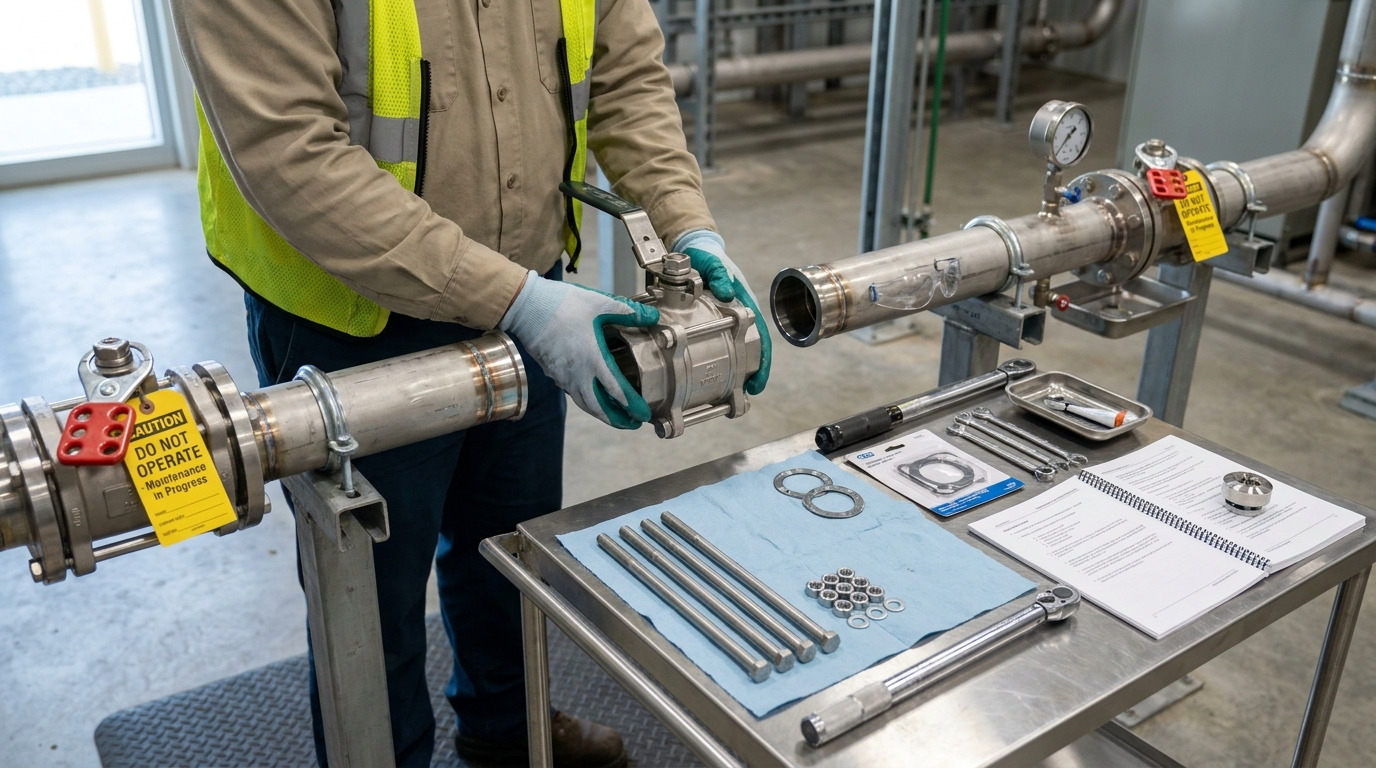
When comparing a 3 piece ball valve vs 2 piece design, the main difference is not how the ball opens and closes; it is how easily the valve body can be accessed after installation. A 2-piece valve is usually chosen for compact, lower-maintenance isolation duties, while a 3-piece valve is usually worth considering when cleaning, seat replacement, welded ends, or repeated maintenance matter.
In a typical plant, skid, or utility line, the pain starts when two valves share the same size, material, and pressure class but create very different maintenance and replacement costs later. This article explains the construction difference, where each design fits, and which specifications to confirm before requesting industrial ball valves for a project.
What the body pieces actually change
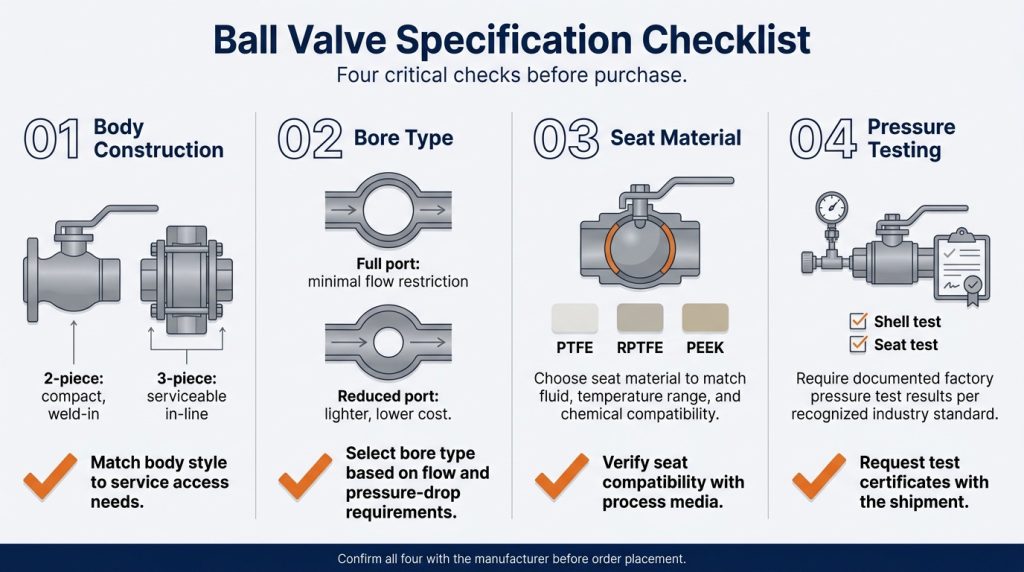
The body construction changes access, sealing interfaces, assembly method, and maintenance strategy. It does not replace the need to confirm material, pressure-temperature rating, bore type, seat material, end connection, and test requirements.
Two-piece construction
A 2-piece ball valve typically has a main body and one body end or adapter that closes the pressure-containing assembly. It is compact, common, and suitable for many isolation services where the valve is expected to operate reliably but not be opened frequently for internal maintenance.
Many 2-piece valves are replaced rather than rebuilt, especially in smaller threaded or utility applications. Some split-body designs can be serviced, but that depends on the manufacturer’s design, spare parts availability, and whether the valve can be safely removed from the line.
Three-piece construction
A 3-piece ball valve has a center body section between two end connectors. After the line is isolated and depressurized, the center section can often be removed while the end connectors remain attached to the piping, provided there is enough clearance and the manufacturer’s procedure allows it.
This construction is useful where seats, seals, balls, or stems may need inspection or replacement. Before treating any valve as maintainable, the plant team should confirm whether the procedure allows ball valve disassembly without damaging sealing surfaces or disturbing nearby pipework.
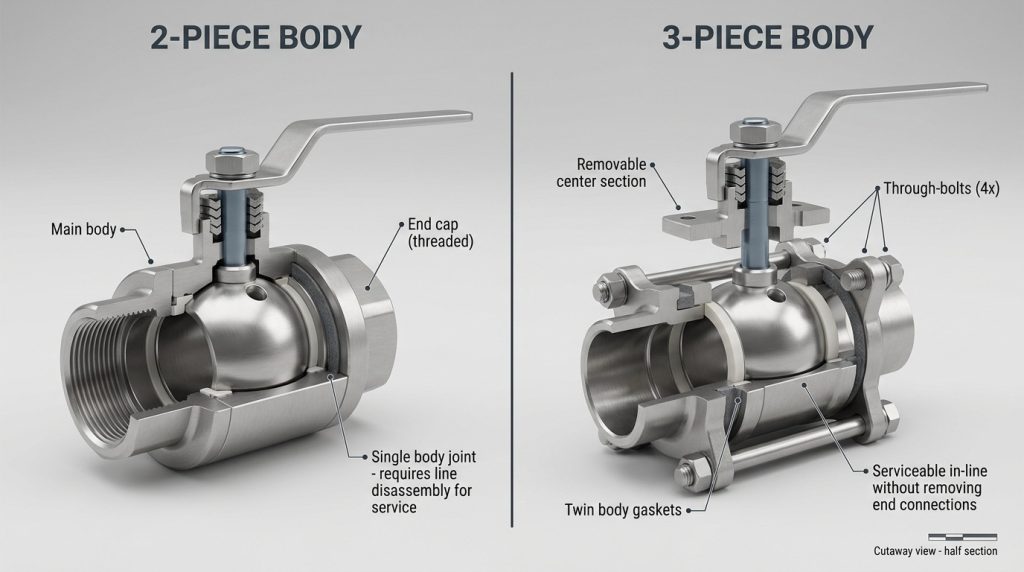
3 Piece Ball Valve vs 2 Piece Comparison Table
The fastest way to compare 3 piece ball valve vs 2 piece selection is to separate body access from the rest of the specification. The body style matters, but it should be judged together with the line conditions and required standard.
| Decision point | 2-piece ball valve | 3-piece ball valve | What to confirm |
|---|---|---|---|
| Body access | Usually more compact, with limited internal access after installation | Center body can often be removed for internal inspection after safe isolation | Whether the design is intended for field service and whether spare parts are available |
| Maintenance fit | Better for lines with low maintenance frequency | Better for lines needing cleaning, seat changes, or repeated inspection | Whether maintenance savings justify higher initial cost |
| End connection | Common in threaded, socket-welded, and flanged designs | Common in threaded, socket-welded, butt-welded, and flanged designs | For metal ball valves, ISO 17292:2015 covers threaded and socket-welded ends from DN 8 to DN 50 and flanged or butt-welded ends from DN 15 to DN 600 |
| Pressure and temperature | Depends on material, class, seat, and standard, not only body pieces | Same principle; 3-piece construction does not automatically increase rating | Match the valve standard, class or PN rating, material group, and seat rating |
| Cost logic | Lower initial cost in many general services | Higher initial cost can make sense when maintenance access reduces shutdown work | Compare purchase cost with expected cleaning, replacement, and downtime risk |
The practical conclusion is simple: choose the body style around maintenance access first, then verify the pressure boundary and sealing details separately.
When a 2-piece ball valve makes more sense
A 2-piece ball valve makes more sense when the line needs reliable shutoff, the media is reasonably clean, and the project does not require frequent internal maintenance. In these conditions, compact construction and simpler procurement can matter more than rebuild access.
Lower maintenance isolation service
For water, air, inert gas, clean utility lines, and many general industrial fluids, a 2-piece valve can be a sensible option when material and seat compatibility are correct. The valve still needs proper pressure class, bore selection, and connection compatibility, but the user may not gain much from paying for a body that is easier to disassemble.
This is especially true where the valve is small, accessible, and economical to replace during scheduled maintenance. If the line is difficult to isolate or the media is hazardous, the decision should be reviewed more carefully.
Compact layouts and cost control
A 2-piece design can help when space is limited around equipment, skids, packaged systems, or branch lines. It can also reduce unnecessary specification complexity when the valve is not expected to be opened internally.
The risk is under-specifying the valve because it looks like a simple commodity item. The body split, machining accuracy, ball finish, stem sealing, and pressure test plan still belong in the same conversation as the ball valve manufacturing process, because two valves with the same body style can perform differently if internal surfaces and assembly controls are not comparable.
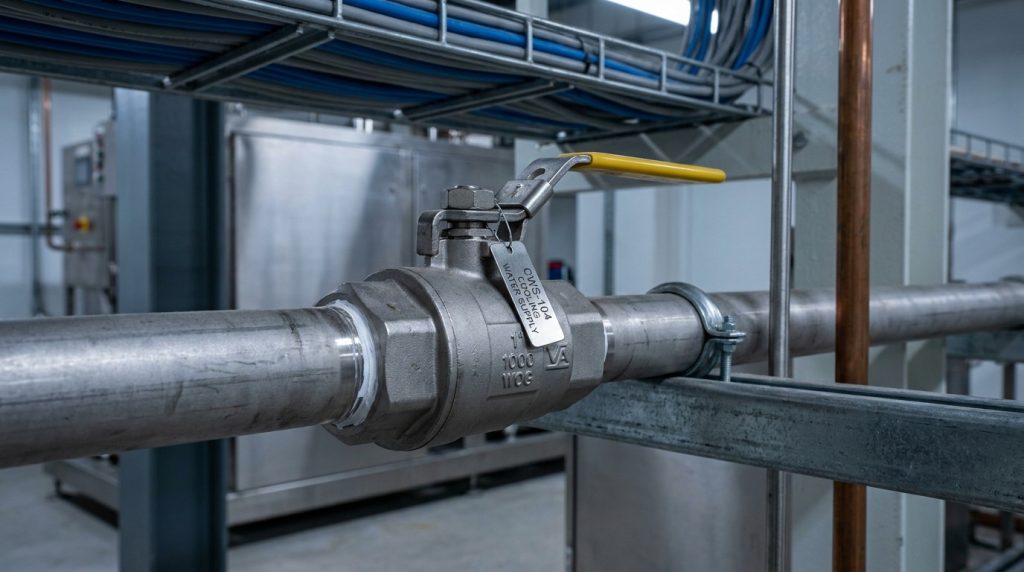
When a 3-piece ball valve earns its higher cost
A 3-piece ball valve earns its higher cost when maintenance access has real value. It is not automatically the better valve, but it can be the more practical choice when removing the entire valve would disturb welded ends, alignment, insulation, actuator mounting, or nearby equipment.
Frequent cleaning and seat replacement
Food, chemical, process utility, and high-cycle isolation duties may require more frequent inspection than ordinary utility service. In these cases, the ability to reach seats, seals, and the ball can reduce the work needed to evaluate wear or contamination.
For soft-seated service, the polymer seat choice deserves its own check. A ball valve PTFE seat can be suitable in many clean-fluid applications, but seat material should be matched to the actual media, temperature, pressure differential, cycle frequency, and cleaning method.
Welded ends and line disturbance
Three-piece construction is often considered when welded ends are preferred but the user still wants body access. The advantage is not that the valve can be opened while the line is live; the system still needs proper isolation, depressurization, draining, and safety control.
The value is that the pipe-end connectors may remain in place during planned maintenance. That can help preserve alignment and reduce the need to cut out a welded valve body when the center section is the part that needs inspection.
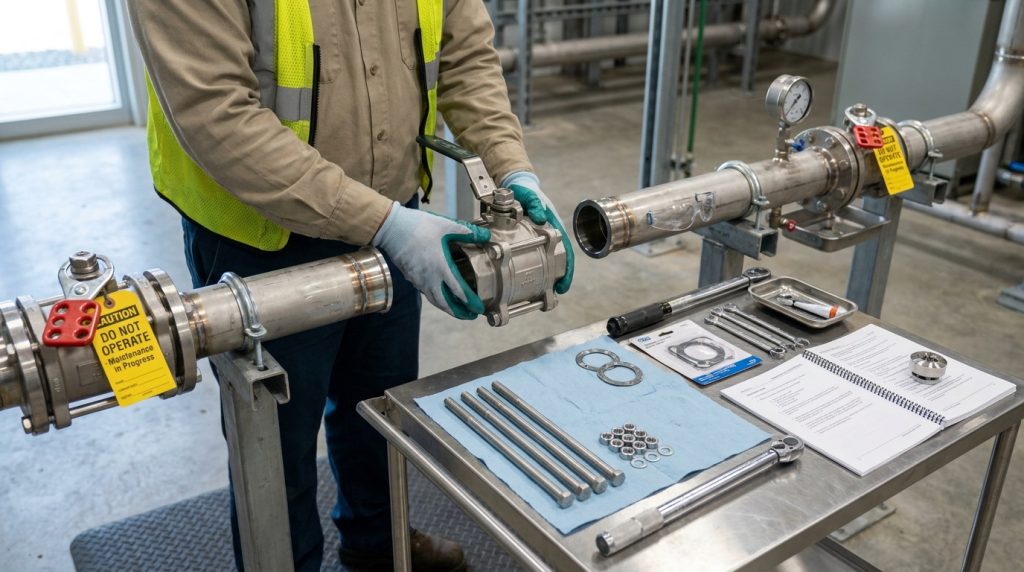
Specifications that matter more than piece count
Piece count should never be used as a shortcut for engineering suitability. A well-specified 2-piece valve can be more suitable than a poorly specified 3-piece valve, and the reverse can also be true.
Bore design and pressure drop
Full bore, reduced bore, and double reduced bore affect flow restriction, pigging possibility, pressure drop, and cost. ISO 17292:2015 explicitly includes body seat openings designated as full bore, reduced bore, and double reduced bore for covered metal ball valves.
If the line requires pigging or low pressure loss, the bore type should be stated clearly in the RFQ. If some pressure loss is acceptable, a reduced bore valve may be reasonable, but that decision should be made against the system flow requirement rather than assumed from the body style.
Seat and seal material
Seat material is often more important than whether the valve body has two or three pieces. Soft seats can provide tight shutoff in many clean services, while metal seats may be considered for higher temperature, abrasive, or erosive duties, depending on the valve design and manufacturer ratings.
Do not copy a seat material from another line unless the media, temperature, pressure differential, cycle frequency, and cleaning conditions are similar. A 3-piece body can make seat access easier, but it does not protect the wrong seat material from chemical attack, thermal deformation, or abrasive wear.
Standards and pressure testing
Standards help define the valve’s pressure boundary, dimensions, marking, and testing expectations. ASME B16.34 applies to new construction and covers pressure-temperature ratings, dimensions, tolerances, materials, nondestructive examination requirements, testing, and marking for applicable flanged, threaded, welding-end, wafer, or flangeless valves.
For pressure testing, ISO 5208:2015 defines test fluid temperature as greater than 5 °C and not more than 40 °C, requires pressure measuring equipment accuracy of ±5% of required test pressure, and limits chloride content to 100 ppm when water is used for pressure testing austenitic stainless steel shell components. These details matter because a valve can have the right body style but still be unsuitable if testing and material conditions are not aligned with the purchase specification.
Application patterns that change the decision
Applications with the same nominal size can require different body styles. The right decision comes from the maintenance pattern, fluid condition, connection type, and shutdown tolerance.
Clean utilities and general isolation
For clean water, air, nitrogen, and non-aggressive utility service, a 2-piece valve is often practical when the valve is accessible and replacement is acceptable during scheduled maintenance. The key checks are material, pressure-temperature rating, bore type, and seat compatibility.
A 3-piece valve may still be selected if the plant standardizes on serviceable valves or wants easier access for inspection. That choice should be justified by maintenance practice rather than by assuming more body pieces automatically mean better performance.
Process lines with recurring maintenance
Chemical skids, dosing systems, cleaning circuits, and other process lines may favor 3-piece valves when internal cleaning or inspection is expected. The removable center section can help maintenance teams reach wear parts without disturbing pipe-end alignment.
For flanged process piping, the body style decision should sit alongside the same checks used for a flanged ball valve: flange standard, pressure-temperature rating, gasket interface, face-to-face constraints, and actuator clearance.
High temperature or abrasive media
High temperature, slurry, powder, crystallizing media, or abrasive service should not be decided by body pieces alone. Seat design, ball coating or hardening, stem sealing, cavity relief, cleaning method, and operating torque may dominate the selection.
A 3-piece valve may make inspection easier, but it does not make a soft seat suitable for a duty outside its rating. For these services, ask for the manufacturer’s stated material compatibility and pressure-temperature limits for the exact valve design.
How to confirm the right valve before purchase
The safest purchase decision is to turn the comparison into a short specification review. Instead of asking only for a 2-piece or 3-piece valve, define the service conditions that make one construction valuable.
Data to put in the RFQ
A clear RFQ should include enough information for the manufacturer to judge body style, seat material, and connection design together. At minimum, include:
- Fluid or gas name and concentration where relevant
- Normal and maximum operating pressure
- Normal and maximum operating temperature
- Required size, bore type, and end connection
- Body, ball, stem, seat, and seal material preferences
- Manual, pneumatic, or electric actuation requirement
- Cycle frequency and cleaning or maintenance expectation
- Applicable standard, pressure class, PN rating, and test requirement
- Whether welded ends, in-line service access, or spare parts matter
This information prevents a common mistake: selecting a 3-piece valve for maintainability while leaving the seat material, test requirement, or end connection unclear.
Supplier questions that expose risk
Before approving the valve, ask whether the quoted design is actually intended for internal service, which spare parts are available, and whether the body bolts, seats, seals, and stem packing can be replaced under the manufacturer’s procedure.
Also ask which standard the valve is designed and tested against, whether pressure-temperature ratings are based on the body material and seat limits, and whether the valve is suitable for the stated media. These questions are more useful than asking for the lowest price on a body style alone.
Conclusion
A 2-piece ball valve is usually the practical choice for compact, lower-maintenance isolation service, while a 3-piece ball valve becomes more attractive when cleaning, seat replacement, welded ends, or planned internal inspection are part of the real operating life. The body style is important, but it should be confirmed together with bore type, seat material, end connection, pressure-temperature rating, and testing requirements.
RUITO’s position is that valve body construction should reduce real specification and maintenance risk, not just make a datasheet look heavier. If you are comparing 3 piece ball valve vs 2 piece options for an industrial line, you can share your media, pressure, temperature, end connection, maintenance expectation, and project drawings with RUITO’s valve team for a project-specific discussion.
FAQ
Is a 3-piece ball valve better than a 2-piece ball valve?
Not automatically. A 3-piece valve is usually better for maintenance access, while a 2-piece valve can be more practical for compact, lower-maintenance isolation service.
Can a 3-piece ball valve be repaired in the pipeline?
It can often be serviced more easily after safe isolation, depressurization, and draining, but it should not be treated as live-line repair. The manufacturer’s procedure, installation clearance, end connection, and spare parts availability must be confirmed.
Does a 2-piece ball valve have lower pressure rating?
No, not simply because it has two body pieces. Pressure rating depends on the valve design, material, class or PN rating, seat limits, temperature, and applicable standard.
Which valve is better for welded pipe connections?
A 3-piece valve is often preferred when welded ends are used and future access to the center body is important. The benefit is reduced disturbance to pipe-end connections during planned maintenance, not permission to service a pressurized line.
What should buyers check before choosing either design?
Check the media, pressure, temperature, bore type, end connection, seat material, operating cycle, maintenance plan, applicable standard, and test requirement. Those details usually decide the correct valve more reliably than body construction alone.