
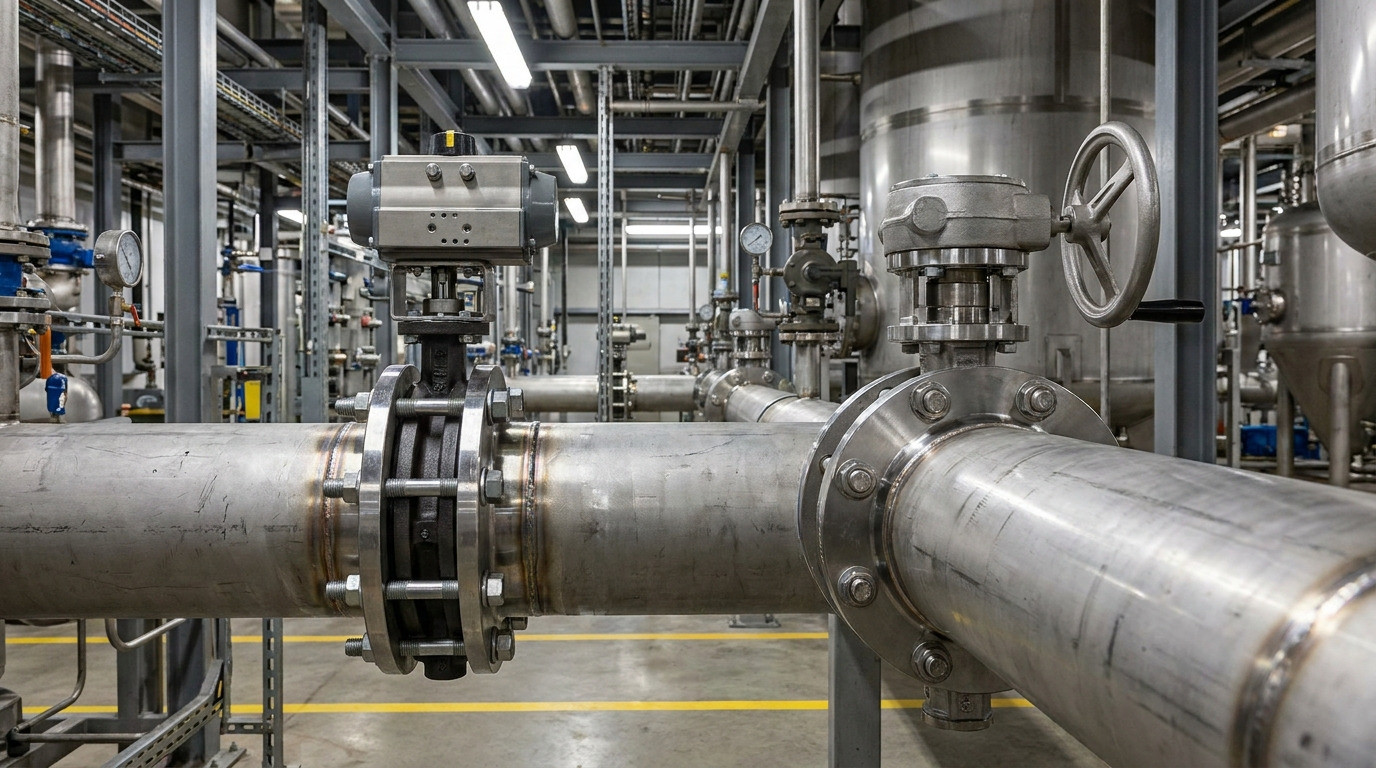
The main difference between these two valves lies in their body design and installation method, dictating whether you can disconnect one side of the piping while under pressure. Picture this: you are running a high-demand processing line when a sudden leak occurs, threatening hours of costly downtime. The inability to isolate sections of your pipework forces a complete system shutdown, draining your resources and patience. By choosing the right wafer vs lug style butterfly valve, you solve this problem instantly by matching the correct valve body to your isolation requirements.
What is a wafer vs lug style butterfly valve?
A wafer vs lug style butterfly valve refers to the two primary flanged connections used for quarter-turn rotary fluid control devices. The wafer style fits snugly between two pipe flanges using long bolts that span the entire valve body. In contrast, the lug type features threaded metallic inserts on its exterior to securely anchor each flange independently.
Both designs utilize a central disc to regulate flow efficiently. You will find them essential in commercial plumbing, food processing, and chemical handling. Their streamlined profiles save valuable space in tight pipeline assemblies.
What are the core features?
Now let’s move on: understanding the physical traits of these valves prevents installation errors. The fundamental characteristics include:
- Wafer body: lighter weight, unthreaded holes, relies on flange clamping.
- Lug body: heavier construction, tapped lugs, allows independent bolting.
- Shared traits: quarter-turn operation, resilient seats, low pressure drop.
Using these parameters, you can quickly identify the appropriate hardware for your facility. Incorrect identification often leads to mismatched flange ratings and compromised pipeline integrity.
Which design suits your needs?
Your operational goals dictate which structural design offers the most benefit. The wafer type excels in permanent, continuous flow lines where maintenance happens rarely.
Key Takeaway: Identifying the physical attributes of your valve ensures you purchase the exact component needed for your maintenance strategy.
| Feature | Wafer Valve | Lug Valve |
|---|---|---|
| Bolt Type | Long through-bolts | Short cap screws |
| Weight | Lighter | Heavier |
| Cost | Economical | Premium |
The data highlights that while lug valves cost more, their threaded inserts provide greater structural versatility.
How does a wafer vs lug style butterfly valve operate?
A wafer vs lug style butterfly valve operates by rotating a central disc ninety degrees to fully open or close the fluid pathway. When the actuator turns the stem, the disc aligns parallel to the flow to allow maximum throughput. Turning it perpendicular forces the disc against the resilient seat, creating a bubble-tight seal.
This quarter-turn mechanism ensures rapid response times during emergency shutoffs. You rely on this straightforward operation to maintain precise flow regulation across varying media types.
How does the mechanism work?
You might be wondering: how does such a simple disc stop high-pressure fluid? The magic lies in the sealing geometry. Consider these operational mechanics:
- The actuator delivers high torque to the central stem.
- The stem rotates the disc against the rubber or Teflon seat.
- The interference fit between disc and seat guarantees zero leakage.
This reliable sealing makes them ideal for both automated and manual control setups. You save energy and time because the valve requires minimal effort to cycle.
What limits their performance?
Despite their efficiency, excessive fluid velocity can cause cavitation or noise inside the pipe. You must size the valve correctly to prevent premature wear on the rubber seat.
Key Takeaway: Mastering the quarter-turn operation of these valves empowers you to optimize flow control and extend the lifespan of your pipeline components.
| Operation Metric | Open State | Closed State |
|---|---|---|
| Disc Position | Parallel | Perpendicular |
| Flow Resistance | Minimal | Total |
| Wear Rate | Low | High at seating |
This operational summary shows that the highest mechanical stress occurs exactly at the moment of closure.
Why choose a wafer vs lug style butterfly valve?
You choose a wafer vs lug style butterfly valve based on whether your system demands dead-end service or maximum cost-efficiency. The lug version allows you to remove downstream piping without draining the upstream fluid, which is crucial for continuous operations. The wafer version offers a highly economical, space-saving solution for standard pipeline integration.
Your project budget and maintenance frequency play massive roles in this selection. Picking the correct unit minimizes long-term operational headaches and keeps your facility running smoothly.
When is isolation necessary?
What’s the real story? Dead-end service changes everything. If your technicians regularly clean or replace downstream filters, isolation becomes critical.
- Lug valves handle dead-end pressure safely.
- They prevent total system drainage during repairs.
- They protect workers from unexpected fluid surges.
Without this capability, every minor repair requires a complete plant shutdown. You lose thousands of dollars in lost production time just to clean a simple strainer.
How does cost factor in?
If you run extensive piping networks without the need for selective isolation, the wafer configuration saves substantial capital. Its simplified body uses less metal, dropping the initial purchase price.
Key Takeaway: Selecting the right valve type based on isolation needs directly reduces your facility’s maintenance downtime and operational costs.
| Selection Factor | Wafer Recommendation | Lug Recommendation |
|---|---|---|
| Dead-End Service | Not advised | Highly advised |
| Budget Constraints | Primary choice | Secondary choice |
| Maintenance Frequency | Low | High |
The comparison clearly indicates that your maintenance schedule should dictate the initial valve investment.
What are the costs of a wafer vs lug style butterfly valve?
The costs of a wafer vs lug style butterfly valve differ primarily due to the amount of raw material required and the machining complexity. Wafer valves are universally cheaper because they lack threaded inserts and require less casting metal. Lug valves demand premium pricing due to the precise tapping of each individual lug and heavier body mass.
You must also consider the hidden installation costs associated with bolting requirements. Long studs for wafer units are sometimes cheaper, but the labor to align them perfectly can increase installation time.
What drives the price difference?
This is where it gets interesting: the upfront price tag only tells half the story. You must evaluate the total cost of ownership over the valve’s lifespan.
- Wafer bodies require less metal, dropping material costs.
- Lug bodies need precise machining, increasing manufacturing time.
- Replacement labor heavily favors the lug design during repairs.
Choosing a cheaper wafer valve for a high-maintenance area actually costs you more over ten years. You end up paying for extended downtime rather than just the hardware.
How to balance the budget?
You can strategically mix both styles across your facility to optimize the budget. Use expensive lug units near pumps and filters, while deploying economical wafer units on long, uninterrupted pipe runs.
Key Takeaway: Analyzing the long-term maintenance labor costs prevents you from making poor purchasing decisions based solely on the initial sticker price.
| Cost Component | Wafer Impact | Lug Impact |
|---|---|---|
| Initial Purchase | Low | High |
| Installation Fasteners | Moderate (Long studs) | Moderate (Cap screws) |
| Future Labor Costs | High (Full shutdown) | Low (Partial shutdown) |
This financial breakdown proves that paying more upfront for a lug valve often yields better long-term savings.
How to install a wafer vs lug style butterfly valve?
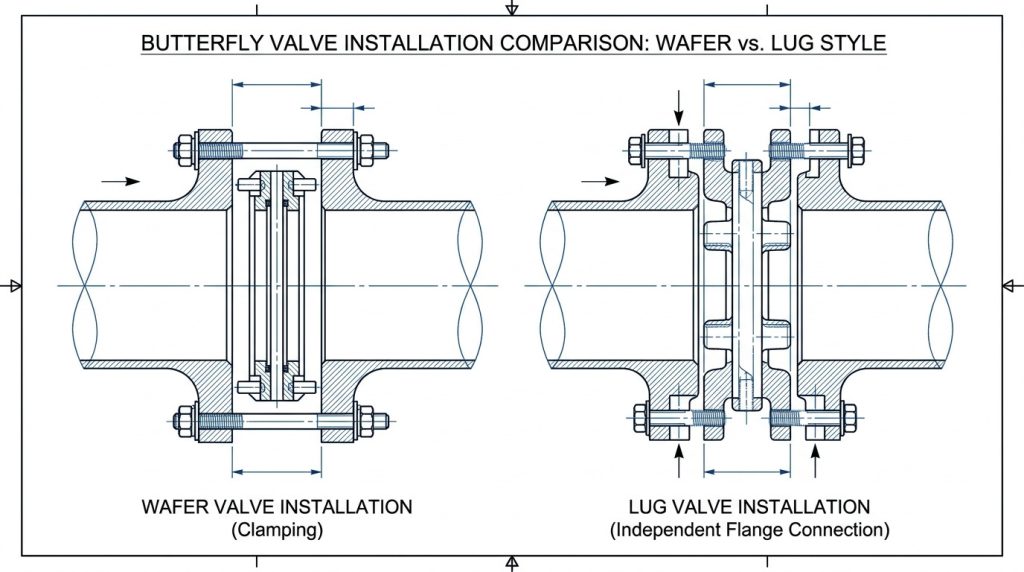
To install a wafer vs lug style butterfly valve, you carefully align the component between two properly spaced pipe flanges before tightening the fasteners in a star pattern. For a wafer unit, you slide long bolts completely through both flanges, capturing the valve in the middle. For a lug unit, you thread shorter cap screws directly into the tapped holes on the valve body from both sides.
Proper alignment prevents the disc from striking the pipe interior when opening. You must ensure the pipe flanges are parallel and free of debris to guarantee a bubble-tight exterior seal.
What are the installation steps?
Here is the kicker: improper bolting sequences cause 80% of all flange leaks. You must follow strict mechanical procedures.
- Inspect the elastomer seat for shipping damage.
- Open the valve disc slightly before tightening bolts.
- Use a torque wrench in a crisscross star pattern.
Never use standard flange gaskets with resilient-seated butterfly valves. The molded rubber seat acts as its own sealing face, and adding an extra gasket will destroy the seal.
How to avoid alignment issues?
You must adequately support the pipework before sliding the valve into place. If the pipes sag, they pinch the rubber seat unevenly, leading to premature wear and catastrophic leaks.
Key Takeaway: Executing a flawless, torque-controlled installation process ensures your valve performs flawlessly and prevents dangerous environmental leaks.
| Installation Step | Wafer Requirement | Lug Requirement |
|---|---|---|
| Bolt Insertion | Through both flanges | Threaded into body |
| Pipe Support | Critical | Critical |
| Alignment Difficulty | High | Medium |
The installation requirements demonstrate that wafer valves demand slightly more skill to align correctly during bolting.
When to use a wafer vs lug style butterfly valve?
You should use a wafer vs lug style butterfly valve based on the specific mechanical requirements of the piping sector, particularly regarding downstream maintenance. Deploy lug valves at the end of pipes or near sensitive equipment like pumps that require frequent calibration. Utilize wafer valves in general utility lines, cooling water loops, and air distribution systems where selective isolation is unnecessary.
Your engineering team must map out the entire process flow to identify critical isolation zones. Getting this wrong results in severe operational bottlenecks during routine facility upgrades.
Where do wafer valves excel?
Truth be told: you cannot beat the wafer configuration for basic utility applications. They thrive in environments where cost and weight are paramount.
- HVAC water circulation systems.
- Compressed air distribution networks.
- Large-diameter agricultural irrigation setups.
Their slim profile allows you to squeeze them into densely packed mechanical rooms. You save premium floor space without sacrificing flow control capabilities.
Where are lug valves mandatory?
You absolutely need lug variants in chemical processing and sanitary food lines where partial system dismantling happens daily. They provide the mechanical safety required to protect maintenance crews.
Key Takeaway: Mapping your facility’s maintenance zones allows you to deploy the correct valve type, ensuring maximum safety and workflow efficiency.
| Application Type | Recommended Style | Primary Benefit |
|---|---|---|
| End of Line Service | Lug | Safe isolation |
| General Utilities | Wafer | Cost savings |
| Tight Spaces | Wafer | Compact profile |
This application guide illustrates how matching the valve to the specific environment optimizes your entire fluid network.
What are the pressures for wafer vs lug style butterfly valve?
The pressure ratings for a wafer vs lug style butterfly valve generally range from 150 PSI to 300 PSI depending on the body material and seat design. Both styles easily handle standard municipal water pressures and low-pressure steam applications. However, when a lug valve is used in dead-end service without a downstream flange, its pressure rating typically drops to compensate for the lack of opposing structural support.
You must verify the manufacturer’s specific dead-end pressure limits before installation. Exceeding these limits causes the rubber seat to blow out, resulting in massive fluid loss and safety hazards.
How does pressure affect performance?
Ready for the good part? Understanding pressure dynamics prevents catastrophic equipment failure. The system pressure interacts heavily with the valve’s structural integrity.
- High velocity increases seat wear exponentially.
- Pressure spikes can deform the central stem.
- Dead-end service places all stress on one set of threads.
You must install pressure relief mechanisms if your line experiences severe water hammer. The sudden shockwaves will easily shatter the internal disc or strip the lug threads.
How to read pressure ratings?
Always check the valve’s identification tag for the cold working pressure (CWP) limits. You cannot assume a Class 150 lug valve handles 285 PSI in dead-end service just because it fits the flange.
Key Takeaway: Strict adherence to manufacturer pressure ratings, especially during dead-end service, prevents dangerous blowouts and ensures long-term operational safety.
| Pressure Metric | Standard Service | Dead-End Service |
|---|---|---|
| Wafer Rating | Up to 300 PSI | Not applicable |
| Lug Rating | Up to 300 PSI | Often reduced (e.g., 150 PSI) |
| Water Hammer Risk | High | High |
This pressure breakdown highlights that dead-end applications significantly reduce the safe operating threshold of the hardware.
How to maintain a wafer vs lug style butterfly valve?
To maintain a wafer vs lug style butterfly valve, you must conduct routine visual inspections for exterior leaks and actuate the disc periodically to prevent the seat from sticking. You should lubricate the actuator stem and check the torque on the flange bolts every six months. For lug valves, carefully inspect the threaded inserts for signs of galvanic corrosion if exposed to harsh environments.
Preventative maintenance keeps the torque requirements low and protects the automated actuators from burning out. You extend the asset’s life by addressing minor seating issues before they become major pipeline ruptures.
What are daily maintenance tasks?
Pay attention to this: neglecting simple maintenance destroys even the best valves. You need a solid routine to keep things flowing.
- Cycle the valve fully open and closed monthly.
- Inspect the stem packing for moisture.
- Verify pneumatic actuator air pressure is stable.
Leaving a valve in the exact same position for years causes the rubber to vulcanize to the metal disc. When you finally try to close it during an emergency, the seat tears apart.
How do you handle seat wear?
Once a valve begins passing fluid in the closed position, the internal seat has failed. You must schedule downtime to remove the valve and replace the elastomeric liner.
Key Takeaway: Implementing a proactive cycling and inspection schedule prevents the valve components from seizing, guaranteeing reliability during critical shutoffs.
| Maintenance Task | Frequency | Action Required |
|---|---|---|
| Disc Cycling | Monthly | Open and close fully |
| Bolt Torque Check | Bi-annually | Retighten to spec |
| Seat Inspection | Annually | Check for internal leaks |
This maintenance schedule demonstrates that consistent, minor interventions drastically reduce the probability of total valve failure.
What are safety rules for wafer vs lug style butterfly valve?
The safety rules for a wafer vs lug style butterfly valve dictate that you must completely depressurize and drain the pipeline before loosening any flange bolts. If you are using a lug valve for dead-end service, you must verify that the upstream pressure does not exceed the manufacturer’s de-rated dead-end specifications. You should also ensure that lockout-tagout (LOTO) procedures are strictly followed on automated pneumatic or electric actuators.
Ignoring these protocols leads to severe chemical burns, mechanical injuries, or facility flooding. Your maintenance crew’s safety relies entirely on understanding how stored energy interacts with these specific valve designs.
What are the critical hazards?
Make no mistake: pressurized fluids act like loaded springs. You must mitigate the risks before picking up a wrench.
- Never remove a wafer valve without draining both pipe sides.
- Always lock out the air supply to pneumatic actuators.
- Never stand directly in front of a dead-end lug valve under pressure.
If you mistakenly remove the wrong bolts on a wafer valve, the entire unit can violently eject from the pipeline. You must provide extensive training on the structural differences to all new technicians.
How to secure the perimeter?
Before servicing, isolate the immediate area and wear appropriate personal protective equipment (PPE). You must treat every closed valve as if it is barely holding back a catastrophic wave of fluid.
Key Takeaway: Enforcing strict depressurization and lockout-tagout protocols protects your personnel from the life-threatening release of trapped pipeline energy.
| Safety Protocol | Wafer Valve Hazard | Lug Valve Hazard |
|---|---|---|
| Depressurization | Required on both sides | Required on upstream side |
| Lockout-Tagout | Mandatory for automated | Mandatory for automated |
| Bolt Removal Risk | Very High (ejection) | High (thread failure) |
This safety analysis underlines the extreme danger of unbolting flanged components without proper pressure verification.
How to replace a wafer vs lug style butterfly valve?
To replace a wafer vs lug style butterfly valve, you first isolate the fluid flow, depressurize the line, and carefully loosen the flange fasteners to extract the old unit. For a wafer valve, you remove the long studs and physically spread the pipe flanges apart to slide the valve out. For a lug valve, you unthread the cap screws from both sides, allowing the valve to drop free without needing to spread the heavy pipe runs.
You must then thoroughly clean the flange faces before inserting the new valve. Never force the new valve into a tight gap, as this will tear the new elastomer seat instantly.
What is the removal process?
Look at it this way: removing old hardware is often harder than installing new parts. You need patience and the right tools.
- Use flange spreaders to create safe clearance.
- Support the valve’s weight with a hoist before pulling the last bolt.
- Scrape away any rust or debris from the pipe flanges.
If you scratch the metal pipe flange during cleaning, the new valve will never seal properly. You must use soft wire brushes rather than harsh abrasive grinders.
How to commission the new valve?
After bolting the new unit in place, slowly introduce fluid back into the line to check for exterior leaks. You should actuate the valve several times under low pressure to seat the disc properly.
Key Takeaway: Utilizing proper extraction tools and flange preparation techniques guarantees that your replacement valve will seal perfectly and perform optimally from day one.
| Replacement Step | Wafer Complexity | Lug Complexity |
|---|---|---|
| Flange Spreading | Required (Often difficult) | Not required |
| Weight Support | Needed upon bolt removal | Needed upon bolt removal |
| Face Cleaning | Critical | Critical |
This replacement comparison shows that lug valves offer a vastly superior and safer extraction process in rigid piping systems.
Elevating Your Industrial Fluid Control Strategy
Optimizing your pipeline infrastructure starts with understanding the subtle, yet impactful, differences between valve body designs. This guide resolved the confusion surrounding isolation capabilities, maintenance labor, and pressure constraints associated with these critical components. We provide engineered solutions tailored to your unique flow conditions, ensuring maximum uptime and safety.
By integrating reliable hardware into your facility, you establish a resilient foundation for long-term operational excellence. We remain committed to advancing fluid dynamic efficiency for industries worldwide. When you are ready to upgrade your system, reach out and contact us today to engineer a flawless control solution.
FAQ
Q1: Can I use a wafer style valve for dead-end service?
No, you cannot. Wafer valves rely on the clamping force of two opposing flanges to hold them securely in place, making them dangerous and prone to blowout if one flange is removed under pressure.
Q2: What’s the best way to clean the valve seat?
The best way is to utilize your system’s Clean-In-Place (CIP) protocols. By flushing the line with approved cleaning agents while cycling the disc, you maintain sanitary conditions without dismantling the hardware.
Q3: How do I know if my valve seat is worn out?
You will notice fluid leaking past the closed valve or pressure dropping in the isolated line. This internal passing indicates the elastomer seat has eroded or vulcanized, requiring immediate replacement.
Q4: Can I automate both lug and wafer style valves?
Yes, they both accept automation easily. The standard ISO 5211 top flange found on both styles allows you to mount pneumatic, electric, or hydraulic actuators for remote flow control.
Q5: What’s the best material for high-temperature applications?
Metal-seated valves are required for extreme heat. While standard rubber seats melt at high temperatures, specialized stainless steel or high-performance alloy seats can withstand harsh thermal conditions.