
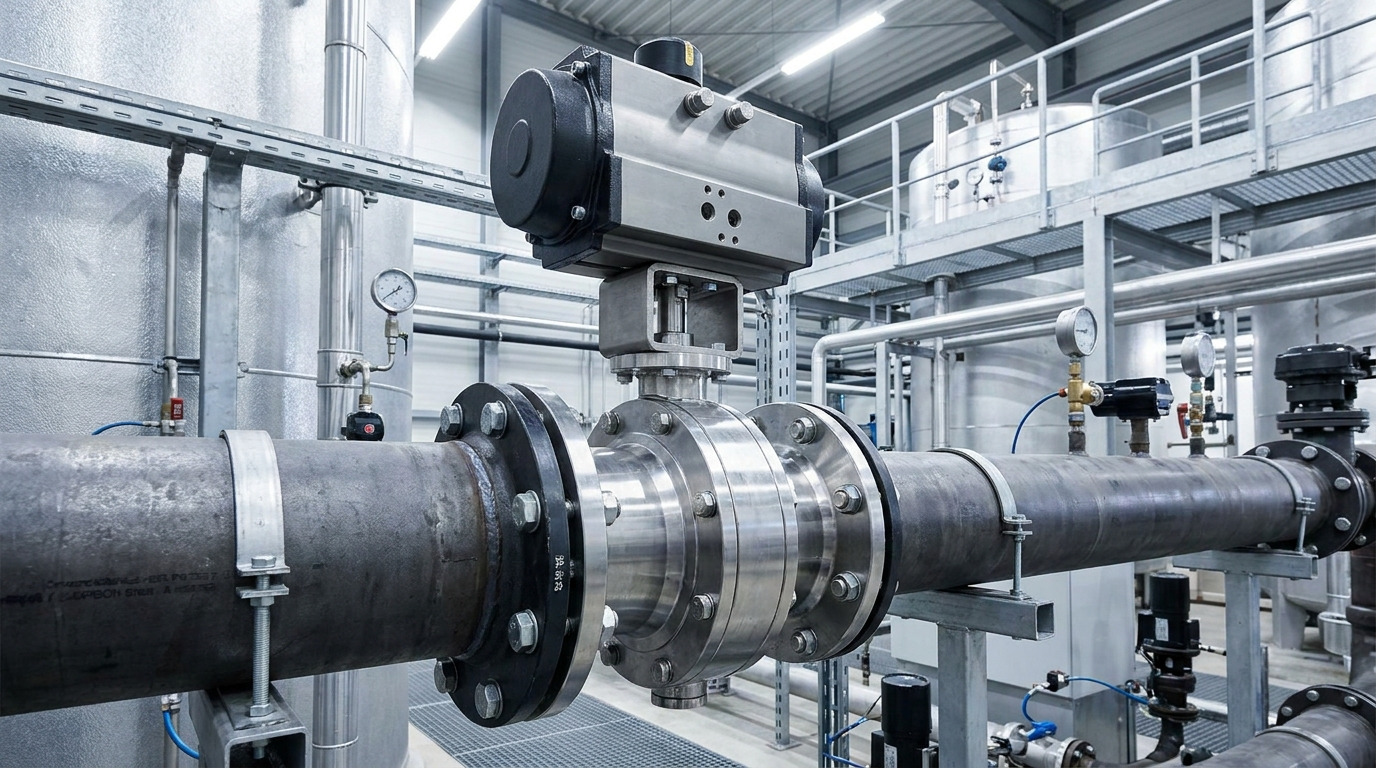
A high-performance butterfly valve is an offset, pressure-temperature-rated design for demanding service, while the “butterfly valve” in this comparison usually means a concentric, resilient-seated valve for moderate duty. That is the practical answer to the high performance butterfly valve vs butterfly valve question, but it is only the first selection gate.
Two valves with the same nominal size can have different seat ratings, shutoff directions, torque requirements, and installation limits. Choose by the complete operating envelope and required evidence—not by the product name alone.
High Performance vs Standard Butterfly Valve at a Glance
The main differences are seat contact, rating basis, available seat systems, and the severity of service each design can handle.
| Comparison point | Standard concentric butterfly valve | High-performance butterfly valve |
|---|---|---|
| Typical geometry | Shaft and disc centered in the bore | Usually double-offset, with the shaft displaced from the disc and pipe centerlines |
| Seat action | Disc rubs and compresses the resilient seat during travel | Disc cams away from the seat soon after opening and returns near closure |
| Common seat systems | EPDM, NBR, FKM, or another elastomer | PTFE/RPTFE, elastomer-backed systems, fire-safe seats, or metal seats, depending on design |
| Practical service | Clean, compatible media at moderate pressure and temperature | Higher pressure-temperature duty, frequent operation, aggressive media, or more demanding shutoff |
| Rating check | Often manufacturer-rated cold working pressure | Commonly pressure-temperature rated; body and seat limits may differ |
| Typical cost logic | Lower initial cost when the service fits the liner | Higher initial cost justified by the required envelope or duty |
| Main selection risk | Seat wear, swelling, hardening, or excessive torque outside the material limit | Assuming the valve name guarantees a seat rating, leakage level, or severe-service capability |
The important conclusion is not that one valve is universally better. A standard resilient-seated valve is often the better engineering choice for clean water or HVAC duty that remains comfortably inside its rating. An HPBV earns its place when the service conditions or operating duty exceed that simpler design’s safe margin.
What Does “High Performance” Actually Mean?
In industrial specifications, “high performance” usually describes a double-offset butterfly valve with an engineered seat system and a defined pressure-temperature rating. It does not simply mean “premium,” and it should not be treated as a complete specification.
The two offsets change how the disc approaches the seat. One moves the shaft behind the disc sealing plane; the other moves it away from the pipe centerline. This geometry creates a camming action, so the disc separates from the seat earlier during opening. Less sliding contact can reduce seat wear and operating torque, especially when the valve cycles often.
API terminology also shows why names need interpretation. An API 609 overview distinguishes Category A valves, which are usually concentric and manufacturer-rated for cold working pressure, from Category B pressure-temperature-rated valves with an offset seat. It also notes that a Category B seat rating may be lower than its body rating. Category A and B are therefore useful specification categories, but they are not marketing synonyms for “standard” and “high performance.” Apply the edition required by your project and state the category in the RFQ.
A triple-offset butterfly valve is another step, not an automatic synonym for HPBV. Its third geometric offset creates a conical sealing path that allows a metal or laminated seal to engage with minimal rubbing. Consider that family when temperature, abrasion, fire-safe duty, or a specified metal-seat leakage requirement exceeds the capability of a double-offset soft-seated design.
How the Two Sealing Mechanisms Behave
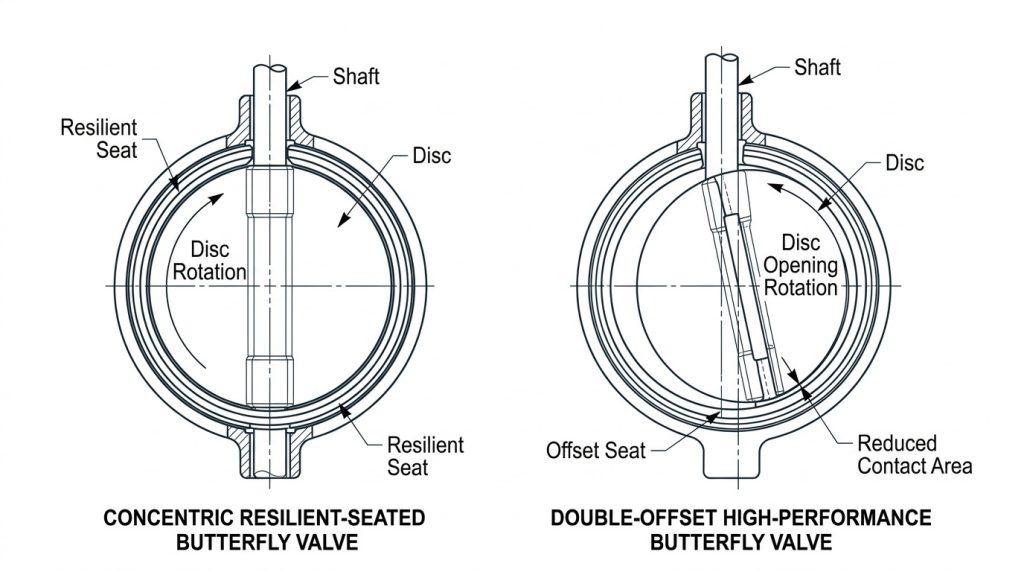
A concentric valve depends on controlled interference between the disc and a resilient liner, while a double-offset valve uses geometry to reduce contact during most of the stroke.
Concentric resilient-seated design
In a concentric valve, the shaft passes through the disc center and the disc rotates through the liner. The resilient seat can provide tight shutoff with clean, compatible media, and the liner may isolate the body from the process. This makes the design economical for water distribution, HVAC circuits, air, and general utility isolation.
The same interference that creates the seal also produces friction. If temperature hardens the seat, the medium swells it, solids lodge at the disc edge, or differential pressure is higher than expected, seating and unseating torque can rise. Repeated rubbing can then shorten seat life.
Double-offset high-performance design
In a double-offset design, the disc lifts away from the seat shortly after rotation begins. Contact is concentrated near the closed position, which reduces continuous rubbing. The design can support a broader selection of body, trim, packing, and seat systems for more demanding duties.
That advantage remains conditional. A PTFE-based seat still has chemical, creep, pressure, and temperature limits. A metal-seated version may tolerate heat better but must meet the leakage acceptance stated for the project. Geometry does not replace material compatibility or a verified rating.
Compare the Complete Pressure-Temperature Envelope
The correct valve is the complete assembly whose lowest applicable rating covers the maximum differential pressure at every operating and design temperature.
Do not compare a standard valve’s liner limit with an HPBV body class and assume the higher number wins. Check the body, disc, shaft, seat or seal ring, packing, bearings, fasteners, and actuator interface as one system. Include startup, shutdown, cleaning, steam-out, ambient extremes, and credible upset conditions—not only the normal process point.
Seat screening should start with the medium, then temperature, pressure differential, and cycling frequency. EPDM can suit many water duties but not oils and many hydrocarbons. NBR can suit some oil and air services but is not universal. PTFE offers broad chemical resistance, yet its allowable pressure can fall as temperature rises. Metal seats tolerate heat and abrasion better, but leakage criteria must be confirmed rather than assumed. A focused review of butterfly valve material temperature limits helps identify the questions to resolve before a final data-sheet check.
RUITO’s published industrial butterfly valve range covers DN25 to DN3000 and PN10 to PN25, with an overall listed temperature span of -40°C to +550°C depending on material and configuration. Available body materials include ductile iron, cast iron, carbon steel, stainless steel, and duplex; seat options include EPDM, NBR, PTFE, FKM, and metal-to-metal designs. Those are portfolio boundaries, not a claim that every configuration covers the full range. The approved data sheet must define the envelope for the valve you order.
Choose by Duty, Not by Industry Label
Choose the simplest construction that passes every service gate; do not specify an HPBV merely because the line is in a chemical plant or a standard valve merely because the medium is water.
Choose a concentric resilient-seated valve when the medium is clean and compatible, pressure and temperature stay comfortably inside the seat rating, the required shutoff is proven for the stated direction, and operating frequency does not create unacceptable wear. This is often the cost-effective answer for cooling water, treated water, HVAC, and moderate utility service.
Move to a high-performance double-offset valve when higher pressure-temperature load, frequent cycling, aggressive media, adjustable packing, or a more demanding shutoff requirement makes the concentric seat interaction a risk. Then select the actual seat system; “HPBV” alone does not tell you whether the valve uses RPTFE, an elastomer-backed seat, a fire-safe construction, or metal seating.
Move beyond the binary comparison when the duty requires metal-seat severe service, very fine low-flow control, high pressure-drop throttling, slurry handling, pigging, or full-bore flow. A triple-offset butterfly valve, specialized control valve, ball valve, or another valve family may fit better. If the valve will modulate, use butterfly valve flow characteristics to check Cv or Kv by opening angle at minimum, normal, and maximum flow.
Confirm Installation and Actuator Constraints
Body style, pipe geometry, and actuator duty can disqualify an otherwise suitable valve family.
For a replacement, verify face-to-face length, flange standard and class, pipe inside diameter, gasket contact, bolt clearance, and disc swing clearance. A wafer valve is compact, but it does not automatically support dead-end service. A lug valve can isolate one side only when its body, lugs, bolting, seat retention, pressure direction, and published dead-end rating allow it. State whether upstream pressure remains while downstream piping is removed.
Size the actuator for the valve’s seating, unseating, running, and dynamic torque at the maximum credible differential pressure and relevant temperature. Then apply the project’s required margin using the minimum available air pressure or worst electrical supply, not the nominal utility value. Specify fail-open, fail-closed, or fail-in-place action; cycle frequency; stroke time; position feedback; and any manual override.
For throttling, also check disc angle, flow torque, actuator resolution, backlash, and how deposits or temperature change seat friction. A larger actuator cannot correct an oversized valve that operates near the unstable end of its travel.
Define Shutoff as a Testable Requirement
“Zero leakage” becomes useful only when the test medium, pressure, direction, duration, and acceptance rate are defined.
Separate shell integrity from closure tightness. ISO 5208:2015, confirmed current in 2025, covers examinations and tests for pressure-boundary integrity, closure tightness, and structural adequacy of the closure mechanism. The product standard and project specification still control when their requirements differ.
On the valve data sheet or purchase order, state whether shutoff is unidirectional or bidirectional, which side receives pressure, the required leakage rate, and whether the condition is normal isolation or dead-end service. For control duty, define allowable leakage separately from rangeability and positioning accuracy.
Evidence should match the risk. RUITO’s published butterfly-valve quality process lists an EN 10204 3.1 mill test certificate, dimensional inspection report, torque test log, hydrostatic test chart, leakage certificate, and pre-shipment release records. Request the documents that apply to your order, link them to the valve or batch identification, and define any witness or hold points before production.
Put These Inputs in the RFQ
A complete RFQ lets the supplier select and price the construction without guessing about the duty.
Include:
- Medium, concentration, solids, contaminants, and cleaning or flushing fluids.
- Normal and design pressure, plus maximum differential pressure across the closed disc.
- Normal, minimum, maximum, and upset temperatures, including thermal cycling.
- Nominal size, pipe schedule or inside diameter, flange standard, pressure class, and required face-to-face dimension.
- Valve function: isolation, throttling, modulating control, emergency shutdown, or maintenance isolation.
- Flow and shutoff direction, bidirectional requirement, and any dead-end duty.
- Seat or leakage requirement with test standard, medium, pressure, duration, and acceptance rate.
- Minimum, normal, and maximum flow with inlet and outlet pressure when the valve throttles.
- Operating frequency, actuator type, fail position, available utility, stroke time, and feedback requirements.
- Required body, disc, shaft, seat, packing, coating, fire-safe, emissions, or corrosion-control features.
- Design and test standards, material certificates, inspection records, drawings, witness points, and tagging requirements.
If your project invokes API 609, add its required category and body style rather than writing only “API 609 butterfly valve.” This API 609 butterfly valve specification checklist explains the interface and service details that need to accompany the standard reference.
Choose the Simplest Design That Clears Every Gate
The high-performance-versus-standard decision should follow the service envelope, seat compatibility, shutoff test, installation interface, flow duty, and actuator requirement. A concentric resilient-seated valve is not an inferior choice when it has adequate margin. An HPBV is not a universal upgrade when its seat, rating, or test conditions remain undefined.
Send the completed operating data and required documentation with your inquiry. RUITO can review the design conditions, identify the appropriate valve family, and return a configuration for technical approval. For a project-specific review or quotation, contact the RUITO engineering team.
FAQ
Is every double-offset butterfly valve a high-performance valve?
Not automatically. Double-offset geometry is a common feature of HPBVs, but the valve still needs a defined pressure-temperature rating, seat system, material set, shutoff capability, and applicable design standard. Confirm those items on the data sheet.
Does a high-performance butterfly valve always seal better?
No. Sealing performance depends on seat design, pressure direction, differential pressure, temperature, test medium, and the stated leakage criterion. Compare test results under the required conditions rather than relying on the product label.
Can a high-performance butterfly valve be used for throttling?
Yes, if it is sized for the control duty. Confirm Cv or Kv by opening angle, available pressure drop, operating range, actuator resolution, dynamic torque, noise, and cavitation risk. A line-size valve may be unsuitable even when its pressure-temperature rating is adequate.
Is a triple-offset butterfly valve the same as an HPBV?
Usually not in a precise specification. HPBV commonly refers to a double-offset design, while triple-offset describes a separate conical sealing geometry often used with metal or laminated seals for severe service. State the required geometry and seat construction instead of assuming the names are interchangeable.