
The primary types of butterfly valves include concentric, double offset, triple offset, wafer, lug, and flanged designs, each engineered for specific pressure, temperature, and installation requirements. Imagine managing a high-flow industrial pipeline where an unexpected valve seal blowout halts your entire production line, racking up thousands of dollars in unplanned downtime. This common operational headache stems from using the wrong valve geometry for demanding process conditions. By sourcing the correct types of butterfly valve, you can prevent leakage, reduce maintenance cycles, and ensure long-term system integrity.
What are the main types of butterfly valve?
The main types of butterfly valve are categorized by their physical configuration, body mounting style, and actuation method to meet different fluid-control demands. These categories help engineers specify the exact mechanical design required for their system.
Why design differences matter for your project
When you select a valve, the mechanical design dictates how it behaves under continuous line pressure. Choosing incorrectly can cause localized stress, seat erosion, or even catastrophic failure.
Let’s look closer:
- Design variations prevent system compatibility mismatches.
- The right structure directly impacts your overall maintenance costs.
Which construction standards should you check?
You must verify that your valves conform to global standards such as API 609, DIN, or EN 593. These guidelines establish standard face-to-face dimensions and pressure testing rules.
Key Takeaway: Adhering to unified manufacturing codes guarantees seamless mechanical installation and simplifies international parts sourcing.
| Standard Category | Relevant Specification | Target Pressure/Size |
|---|---|---|
| API 609 | Offset & Concentric | Up to Class 600 / Large Bore |
| EN 593 | European Industrial | PN10 to PN40 / DN50-DN1200 |
This comparison guide helps you align your engineering drawings with international manufacturing specifications.
How do concentric types of butterfly valve work?
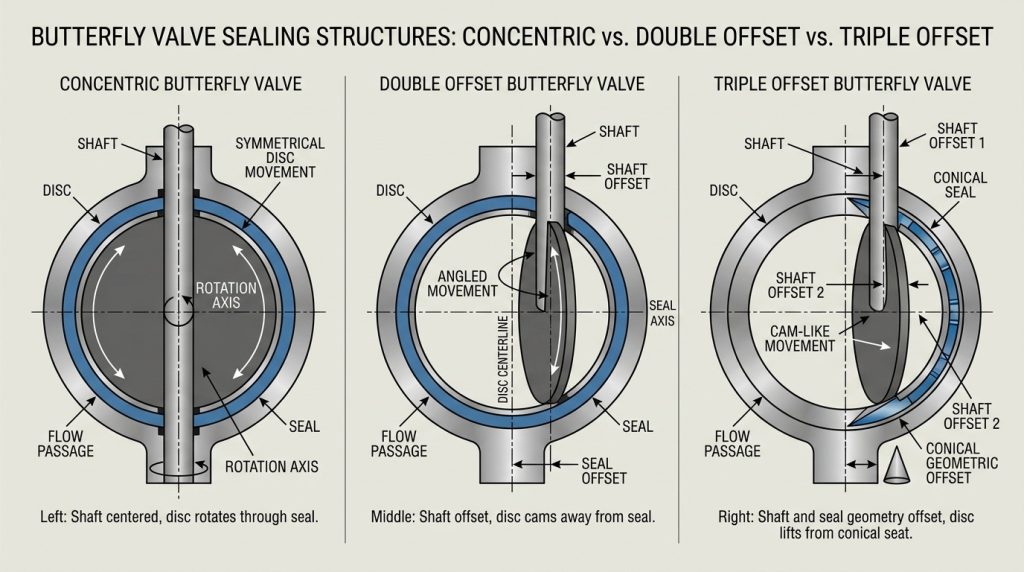
Concentric types of butterfly valve work by rotating a centered disc directly into a resilient elastomeric seat to create a bubble-tight seal. In this symmetrical design, the shaft passes straight through the centerline of the disc and the pipe bore. This layout is highly economical for low-pressure utilities.
The role of the resilient seat
The soft elastomer liner completely isolates the valve body from the processed fluid, preventing internal corrosion. As you turn the disc, it compresses the rubber to block flow.
Think about this:
- EPDM seats handle standard water and HVAC networks.
- NBR seats resist hydrocarbon-heavy process lines.
Are there pressure and temperature limits?
Because the disc maintains constant contact with the seat, these valves are limited by the thermal limits of the rubber. You should avoid concentric models in high-temperature steam lines.
Key Takeaway: Choosing resilient elastomer liners for low-temperature applications provides cost-effective, zero-leakage performance.
| Seat Material | Temperature Envelope | Primary Utility |
|---|---|---|
| EPDM | -10°C to +120°C | Potable Water, HVAC |
| NBR | -10°C to +80°C | Oils, Diesel, Hydrocarbons |
This material matrix guides you in selecting the correct soft liner for your specific system chemistry.
Why choose double offset types of butterfly valve?
You should choose double offset types of butterfly valve because their dual-eccentric shaft design significantly reduces seat friction and operational wear during cycling. By displacing the stem from the sealing plane and the pipe centerline, the disc cams away from the seat quickly. This dynamic extends the lifespan of your high-performance lines.
How the dual-eccentricity works
The double offset design uses two distinct shaft displacements to lift the disc out of the seat within the first few degrees of rotation. This motion reduces localized friction.
Let’s face it:
- First offset shifts the shaft behind the sealing plane.
- Second offset shifts the shaft slightly to one side of the center.
Why this reduces your actuation torque
Since the disc does not rub continuously against the seat, the valve requires far less force to open and close. This allows you to spec smaller, less expensive actuators.
Key Takeaway: Investing in double offset designs minimizes seat wear and reduces actuation costs across medium-pressure pipeline grids.
| Design Geometry | Friction Window | Primary Advantage |
|---|---|---|
| Concentric | Full 90° rotation | Low initial cost |
| Double Offset | Only 1° to 3° of rotation | Low torque, longer seat life |
This geometry breakdown demonstrates why upgrading to double offset reduces long-term operational expenditures.
When should you use triple offset types of butterfly valve?
You should use triple offset types of butterfly valve when your application requires a metal-to-metal, zero-leakage seal under high-pressure and extreme-temperature conditions. This design adds a third geometric offset by sloping the seat cone axis. This adjustment allows the disc to seal with zero sliding friction.
The mechanics of the third offset
The third offset slopes the sealing surfaces to create a right-angled cone profile. This ensures the disc only contacts the seat at the final point of closure.
In other words:
- Eliminates sliding friction and subsequent wear.
- Ensures a true torque-seated mechanical seal.
Handling extreme temperature and steam
Using premium materials like stainless steel and exotic alloys, these valves operate reliably in high-pressure steam and oil refining. You can trust them to remain fire-safe in hazardous zones.
Key Takeaway: Utilizing triple offset valves eliminates costly process leaks and guarantees absolute fire safety in critical industrial plants.
| Offset Class | Temperature Limit | Seal Style |
|---|---|---|
| Double Offset | Up to 200°C | Polymer (PTFE) |
| Triple Offset | Up to 538°C+ | Metal-to-Metal |
This technical comparison shows why extreme thermal systems demand the robust engineering of a triple offset valve.
How do wafer types of butterfly valve compare to lug types?
Wafer types of butterfly valve are designed to slide between pipe flanges, whereas lug types feature threaded metal lugs that bolt directly to the pipeline flanges for independent support. While wafer designs are highly compact and lightweight, they require a full system shutdown to service. Choosing between them depends on your pipeline maintenance strategy.
The compact wafer design advantage
Wafer valves use long bolts that pass through both flanges to squeeze the valve body in place. This makes them highly economical for tight skid installations.
But wait, there’s more:
- Lowest face-to-face dimension on the market.
- Minimizes structural pipe weight loads.
Why lug valves excel in isolation
Lug valves allow you to disconnect piping on one side of the system while keeping the other side pressurized. This layout is vital for pump discharge headers.
Key Takeaway: Selecting the optimal body mounting style simplifies pipeline modifications and saves days of planned facility maintenance.
| Mounting Style | End-of-Line Service | Installation Cost |
|---|---|---|
| Wafer | Not Recommended | Very Low |
| Lug | Fully Supported | Moderate |
This quick-reference mounting guide ensures you choose the correct body style for your system’s maintenance plan.
What are the advantages of flanged types of butterfly valve?
The primary advantages of flanged types of butterfly valve are their exceptional structural rigidity and superior sealing integrity in large-diameter, high-stress piping systems. These valves feature integral flanges that bolt directly to matching pipeline connections. This robust design makes them ideal for heavy water infrastructure.
Structural stability under heavy loads
The double-flanged body resists pipe bending and soil movement in buried services. You can rely on this stability to prevent joint leakage in long pipe runs.
Let’s look closer:
- Integral flanges distribute piping stress evenly.
- Thick walls resist external physical impacts.
Scalability for municipal water networks
For large-diameter pipelines exceeding DN1200, flanged bodies are the safest option. They conform perfectly to DIN and EN standards for high-capacity municipal projects.
Key Takeaway: Implementing double-flanged valves prevents line deflection and secures structural integrity in extreme large-bore systems.
| Connection Type | Structural Rigidity | Best Size Range |
|---|---|---|
| Wafer / Lug | Moderate | DN50 to DN600 |
| Double-Flanged | Extremely High | DN600 to DN3000 |
Use this size and strength guide to safeguard your heavy municipal and industrial pipeline connections.
How do seat materials affect types of butterfly valve?
Seat materials directly determine the temperature envelope, chemical compatibility, and sealing capability of all types of butterfly valve. Selecting the wrong seat material can lead to rapid swelling, chemical degradation, or high operating torque. Engineers must match the seat options to their specific process chemistry.
Elastomers for municipal applications
EPDM and NBR seats provide excellent, bubble-tight sealing for water distribution and general utilities. You will benefit from low operating torque and long wear cycles.
Think about it:
- EPDM excels in warm water and dilute chemicals.
- NBR resists mineral oils and industrial fuels.
Polymers and metals for aggressive chemicals
PTFE and metal-to-metal seats handle highly corrosive acids and extreme temperatures. These options prevent seal blowouts in harsh process environments.
Key Takeaway: Matching seat materials to process chemistry blocks internal corrosion and eliminates unexpected seal blowouts.
| Seat Type | Temperature Range | Media Compatibility |
|---|---|---|
| EPDM / NBR | -10°C to +120°C | Water, Glycols, Hydrocarbons |
| PTFE / Metal | -20°C to +538°C | Corrosive Acids, High-Temp Steam |
This material selection guide serves as a technical checklist for your chemical and thermal compatibility reviews.
Why are actuation types of butterfly valve critical?
Actuation types of butterfly valve are critical because they determine how quickly, safely, and accurately you can control fluid flow within your process loop. Whether manually operated or fully automated, the actuation system must match the valve’s torque requirements. Failing to size this properly can cause incomplete closure or actuator damage.
Manual versus gear operators
Hand levers provide quick 90-degree on-off action for small valves. For larger lines, multi-turn gearboxes reduce operational torque and prevent water hammer.
Here is the truth:
- Levers offer instant visual open/closed status.
- Gearboxes use mechanical advantage for large lines.
Choosing between pneumatic and electric
Pneumatic actuators offer rapid cycle speeds and built-in safety failsafes. Electric actuators deliver precise modulating control and clean integration with SCADA systems.
Key Takeaway: Selecting custom actuation systems guarantees remote line safety and ensures precise system flow control.
| Actuation Method | Cycle Speed | Primary Advantage |
|---|---|---|
| Pneumatic | 1 to 3 Seconds | High speed, spring-return failsafe |
| Electric | 10 to 30 Seconds | Highly accurate flow modulation |
Use this operational breakdown to align your valve automation with the plant’s control system.
What applications suit high-pressure types of butterfly valve?
Applications that suit high-pressure types of butterfly valve include petrochemical refining, power generation, and deep-sea marine systems where process pressures exceed standard class limits. In these environments, concentric valves are inadequate, requiring robust double or triple offset designs. Specifying these high-performance options prevents pipeline blowouts.
Steam and power plant systems
High-temperature steam demands metal-seated triple offset valves that can handle sudden thermal shifts. You will maintain zero leakage and protect downstream turbines.
But wait, there’s more:
- Resists high-velocity steam erosion.
- Maintains structural integrity under extreme heat.
Offshore oil and gas platforms
Marine environments require valves made from corrosion-resistant alloys like duplex stainless steel. You need robust sealing to withstand aggressive saltwater systems.
Key Takeaway: Sourcing high-performance valves for demanding settings prevents catastrophic system pressure failures.
| Application Sector | Typical Pressure | Recommended Offset |
|---|---|---|
| Water Mains | PN10 to PN16 | Concentric / Double Offset |
| Steam & Refining | Class 300 / 600 | Triple Offset (Metal Seat) |
This pressure mapping table guides your engineering team to select the safest valve for extreme processing lines.
How do you maintain different types of butterfly valve?
You maintain different types of butterfly valve by conducting routine visual inspections, cycling the disc periodically, and replacing worn seats and stem packings before leaks occur. Simple maintenance-free designs still require scheduled operational checks to verify their integrity. Proper maintenance protects your system from unexpected shutdowns.
Best practices for routine inspection
You should inspect the valve body, associated bolts, and wiring every six months. Cycling the valve regularly prevents scale buildup and seat hardening.
In other words:
- Check for stem packing leaks early.
- Lubricate external actuator gears and linkages.
Replacing worn seals and components
Most resilient seats can be replaced in the field by removing the stem and disc. Metal-seated offsets may require factory calibration to maintain zero leakage.
Key Takeaway: Adhering to a standardized preventive maintenance schedule minimizes system failure risks and multiplies asset longevity.
| Maintenance Task | Recommended Interval | Expected Outcome |
|---|---|---|
| Visual Inspection | Every 6 Months | Identifies early body or joint leaks |
| Operational Cycle | Every 6 Months | Prevents internal scaling and sticking |
Follow this proactive maintenance plan to ensure reliable fluid control and maximize system uptime.
Secure Your Piping System Integrity with the Right Valve
Matching the ideal valve geometry to your process parameters prevents catastrophic leaks and eliminates costly downtime. Ruito Flow is dedicated to solving these critical interface and scheduling risks for global EPCs and OEMs. Our precision-engineered solutions are ISO 9001, CE, and WRAS certified, ensuring 99.5% quality reliability. If you are ready to eliminate pipeline failures and optimize your fluid control systems, contact us to discuss your technical specifications. Ruito Flow: Precision-engineered valve solutions for global industries, keeping systems safe and operational.
Frequently Asked Questions about Butterfly Valves
Can I use wafer-style butterfly valves for end-of-line isolation service?
No, it is not recommended. Wafer-style valves must be clamped between two piping flanges to retain their structural hold, so removing downstream piping will cause the valve to fail. Use full lug-style valves for secure dead-end isolation services.
What’s the best seat material for handling highly aggressive chemicals?
PTFE is the most reliable choice. This polymer is chemically inert, resisting corrosive acids, bases, and organic solvents at moderate temperatures. For extreme heat coupled with acids, choose a metal-seated triple offset configuration.
How do I know if I need a double offset or a triple offset valve?
You need a triple offset valve if your system experiences extreme pressures or temperatures above 200°C. Double offset valves work excellently in standard high-performance applications, but triple offset designs are required to achieve friction-free, metal-to-metal bubble-tight sealing.
Can I replace a gate valve with a butterfly valve to save space?
Yes, you can. Butterfly valves are significantly narrower, lighter, and require less physical support compared to bulky gate valves. This upgrade simplifies pipe design and lowers structural installation costs.
How do I prevent water hammer when operating manual butterfly valves?
You should install a manual gearbox instead of a simple hand lever. The multi-turn gearbox slows down the operational closure speed, preventing the sudden deceleration of fluid that causes dangerous hydraulic shock.