
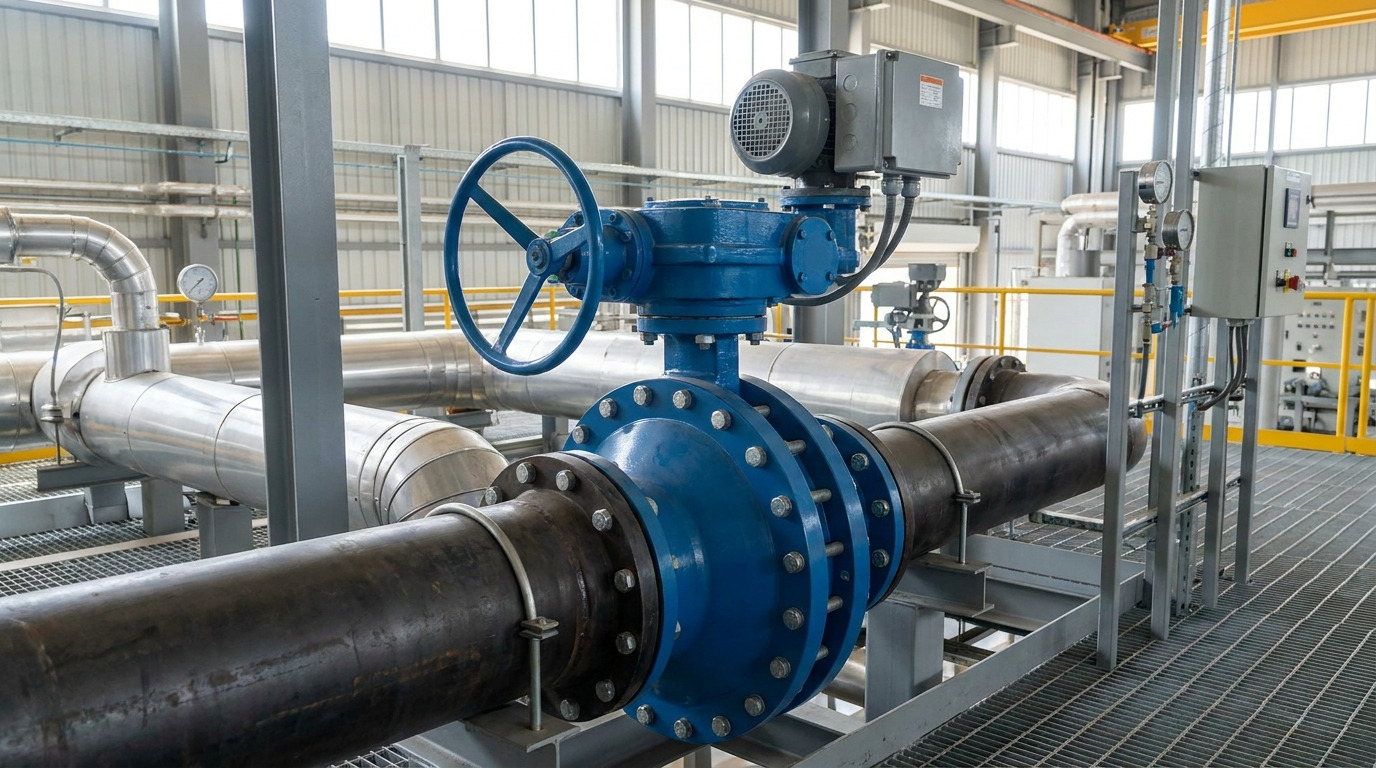
The main types of butterfly valve are classified by disc geometry, body connection, seat construction, and actuation; a complete valve description combines one choice from each group. This distinction matters because terms such as wafer, triple-offset, metal-seated, and pneumatic do not describe competing valves. They describe different parts of the same valve.
A typical specification problem starts when a buyer requests “a lug butterfly valve” or “a high-performance butterfly valve” without defining the media, pressure, temperature, shutoff duty, or maintenance plan. Several valves may match the name while only one matches the service. RUITO’s industrial butterfly valve range illustrates this variety with wafer, lug, and flanged bodies; resilient, PTFE, and metal seats; multiple materials; and sizes from DN25 to DN3000 at PN10 to PN25. Those are portfolio limits, not one rating that applies to every configuration.
This guide separates the classification axes, explains the common options, and shows how to turn them into a specification that engineering and procurement can verify.
Butterfly Valve Types Use Four Classification Axes
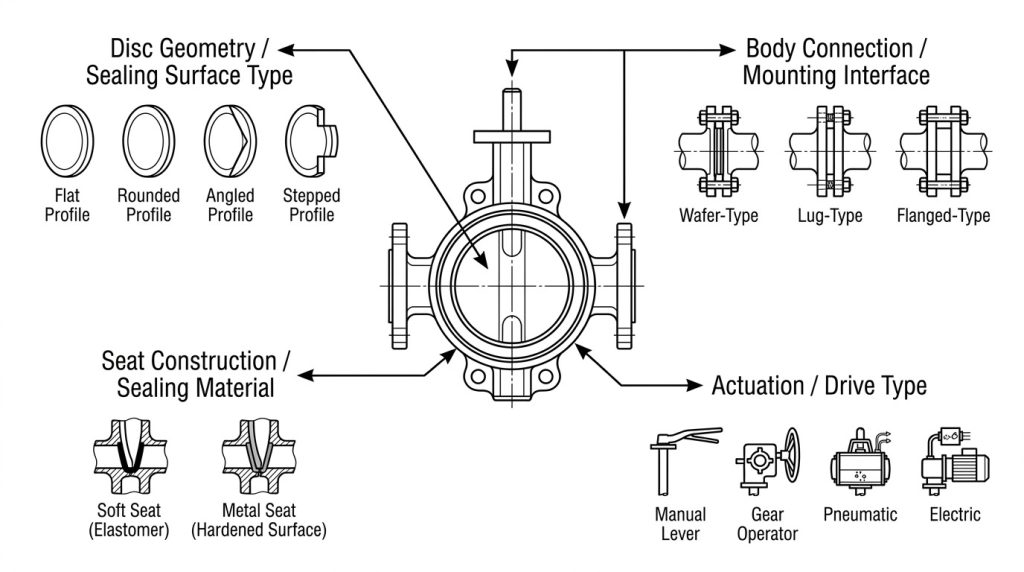
Butterfly valve types make sense when you classify the valve on four separate axes instead of treating every label as a stand-alone design. Disc geometry controls how the disc meets the seat, the body style controls how the valve connects to the pipe, the seat and materials define the service envelope, and the operator determines how the valve moves.
| Classification axis | Common options | What it primarily determines |
|---|---|---|
| Disc geometry | Concentric, single-offset, double-offset, triple-offset | Seat contact, wear, torque, and sealing behavior |
| Body connection | Wafer, lug, flanged, welded | Pipe attachment, support, removal, and maintenance boundary |
| Seat construction | Elastomer, PTFE-based, laminated, metal | Media compatibility, temperature capability, leakage behavior, and torque |
| Actuation | Lever, gearbox, pneumatic, electric, hydraulic | Operating speed, control method, fail action, and available torque |
A valve can therefore be a lug, concentric, EPDM-seated, gear-operated butterfly valve. Changing the gearbox to a pneumatic actuator does not change its body or offset type. Likewise, a wafer valve can be concentric or offset, depending on the product design.
This four-axis model prevents the first common mistake: comparing unlike labels as if you must choose only one.
Disc Geometry Controls Seat Contact and Wear
Disc geometry separates general-service concentric valves from offset designs that reduce rubbing and support more demanding sealing systems. It is usually the most important starting point after you define the service conditions.
Concentric and Single-Offset Designs
In a concentric, or zero-offset, valve, the shaft passes through the center of the disc and pipe bore. The disc remains in contact with the resilient seat during much of its travel. The design is compact, economical, and well suited to compatible water, air, HVAC, and general utility service within the published seat and body ratings.
A single-offset valve moves the shaft away from the sealing plane to reduce part of that contact. It exists, but it is less common because double-offset geometry usually provides a more useful reduction in seat rubbing.
Double-Offset Designs
A double-offset valve shifts the shaft behind the disc sealing plane and away from the pipe centerline. This creates a cam action: the disc moves away from the seat soon after opening and returns near the end of closing. Less sliding contact can reduce wear and operating torque.
Double-offset valves are often called high-performance butterfly valves, but the label alone does not prove a pressure-temperature rating or leakage level. Use the actual body rating, seat rating, media compatibility, and test requirement. Our standard versus high-performance butterfly valve comparison explains why the seat limit can be lower than the body limit.
Triple-Offset Designs
A triple-offset valve adds an angular, conical relationship between the disc seal and body seat. The geometry allows the sealing surfaces to separate during travel and engage at final closure with minimal sliding. This supports torque-seated metal sealing for hotter, higher-pressure, abrasive, or otherwise demanding service.
Triple-offset does not automatically mean zero leakage, bidirectional sealing, or suitability for every severe fluid. Confirm the permitted flow direction, leakage test, pressure-temperature curve, material set, and required operating torque.
Body Connections Set the Maintenance Boundary
Wafer, lug, and flanged butterfly valves differ mainly in how they attach to the piping and what happens when one side of the line is removed. The body style must match the flange standard, mechanical support, space, and maintenance plan.
| Body style | How it is installed | Best starting point | Critical verification |
|---|---|---|---|
| Wafer | Clamped between two pipe flanges, usually with through-bolts | Compact, economical in-line service | Flange alignment, disc clearance, and no assumption of dead-end capability |
| Lug | Separate bolts engage body lugs from each side | Systems needing one-side disassembly or a defined isolation boundary | Manufacturer-rated dead-end pressure, direction, and bolt engagement |
| Double-flanged | Integral valve flanges bolt to the pipe flanges | Larger sizes, permanent installation, or stronger pipe support | Flange drilling, face-to-face dimension, weight, and support |
A lug body is not automatically safe for full rated pressure with downstream piping removed. Dead-end service can be derated or limited to one pressure direction, so the data sheet must state the allowable condition. A wafer valve should not be selected for that duty unless its manufacturer explicitly rates the exact design for it.
Body style also affects fit. Confirm flange standard and class, face-to-face dimension, bolt pattern, gasket practice, and the clearance needed for the disc to rotate inside the adjoining pipe. For a broader check of these variables, see the butterfly valve characteristics used in selection.
Seat Construction Defines the Real Service Envelope
The seat often sets the practical temperature, chemical, cycling, and leakage limit even when the body can withstand more severe conditions. Select it against the fluid at its actual concentration and maximum temperature, not from a generic material name.
Elastomer seats such as EPDM, NBR, and FKM can provide tight shutoff and low operating torque in compatible service. Their limits differ sharply: a material that performs well in water may swell, harden, or lose strength in hydrocarbons, oxidizing chemicals, or elevated temperature.
PTFE-based seats extend chemical and temperature capability for many applications, but they are not universal. Creep, deformation, filler choice, pressure, temperature, and cycling all affect sealing. Metal and laminated seats can suit higher temperature, abrasion, or fire-related requirements, although they may need more torque and a defined allowable leakage rate.
Do not specify “soft seat” or “metal seat” alone. State the seat material, fluid and concentration, normal and maximum temperature, differential pressure, required leakage criterion, and test direction.
Actuation Must Match Torque, Speed, and Fail Action
Actuation type determines how the valve operates, but it does not change the underlying disc, body, or seat classification. Choose the operator only after the valve construction and maximum differential pressure are known.
A lever suits smaller, low-torque valves that need simple local operation. A gearbox reduces hand effort and provides controlled travel for larger valves or higher seating torque. Pneumatic actuators suit rapid cycling and can be configured for a defined fail position; electric actuators suit remote operation where electrical power and position control are available. Hydraulic actuators are considered when high torque or a particular hydraulic control arrangement is required.
For automation, confirm seating, unseating, running, and dynamic torque at the worst operating condition. Then define operating time, duty cycle, fail-open or fail-closed action, power or air supply, enclosure or hazardous-area requirement, and position feedback.
If the valve will modulate rather than only isolate, actuator selection is not enough. Review Cv by disc angle, available pressure drop, normal operating position, and control stability. The guide to butterfly valve flow characteristics covers that separate sizing task.
Build the Complete Valve Specification in Six Steps
The reliable way to choose a butterfly valve is to move from process duty to construction, then verify the selected combination against product data. This sequence prevents a familiar error: choosing a type first and trying to force the service conditions to fit it.
- Define the duty. State whether the valve will isolate, throttle, control, provide emergency shutoff, or remain in place during one-side pipe removal. Add the required flow direction and fail position.
- Record the service envelope. Provide the fluid, solids content or chemical concentration, minimum and maximum temperature, normal and design pressure, maximum differential pressure, line size, and operating frequency.
- Select geometry and seat together. Start with concentric resilient seating for compatible moderate service. Move toward double-offset construction when seat wear, cycling, pressure-temperature load, or shutoff duty becomes more demanding. Review triple-offset metal seating when the service exceeds soft-seat capability.
- Choose the body for the piping plan. Match wafer, lug, or flanged construction to flange standard, installation space, support, isolation boundary, and future removal sequence.
- Size the valve and operator. Isolation duty may accept line size after pressure-loss and velocity checks. Throttling duty requires Cv or Kv data across the intended opening range. Size the actuator from the manufacturer’s torque data, not pipe size alone.
- Verify the evidence before release. Check the pressure-temperature curve, seat rating, material list, face-to-face and flange dimensions, disc clearance, flow coefficient, torque basis, leakage test, and inspection documents. Resolve every exception on the approved data sheet or drawing.
A clear RFQ description should follow this pattern:
size + pressure class + disc geometry + body style + body/disc/shaft/seat materials + duty + media + temperature + differential pressure + leakage requirement + actuator + flange/face-to-face/test requirements
This line is more useful than a short label because it gives the supplier enough information to confirm suitability and gives the project team an auditable acceptance basis.
Turn the Type Name Into a Reliable Specification
The right butterfly valve is not selected from one list of names. It is built from compatible choices for disc geometry, body connection, seat and materials, and actuation, then checked against the real pressure, temperature, media, duty, and maintenance boundary.
If you are preparing an RFQ, send the complete service envelope and required documents through our project contact page. RUITO can review the configuration against the requested duty before the valve, actuator, and connection details are released for order.
FAQ
What Are the Three Main Butterfly Valve Types?
The three main types by disc geometry are concentric, double-offset, and triple-offset butterfly valves. Single-offset designs also exist but are less common. This answer covers only geometry; the same valves can also be classified by body, seat, and actuation.
Is Wafer, Lug, or Flanged the Same as Concentric or Offset?
No. Wafer, lug, and flanged describe the body connection, while concentric, double-offset, and triple-offset describe disc and seat geometry. A complete specification may combine either kind of connection with an available geometry.
Which Butterfly Valve Type Is Best?
No type is best for every service. Concentric resilient-seated valves are often the economical choice for compatible moderate-duty systems, while offset and metal-seated designs become useful as pressure-temperature load, cycling, abrasion, or shutoff requirements increase.
Can Every Butterfly Valve Be Used for Throttling?
No. A butterfly valve can throttle only when its design, sizing, Cv curve, pressure drop, actuator, and service conditions support stable operation. A valve selected only for line-size isolation may be oversized or unsuitable for continuous modulation.