
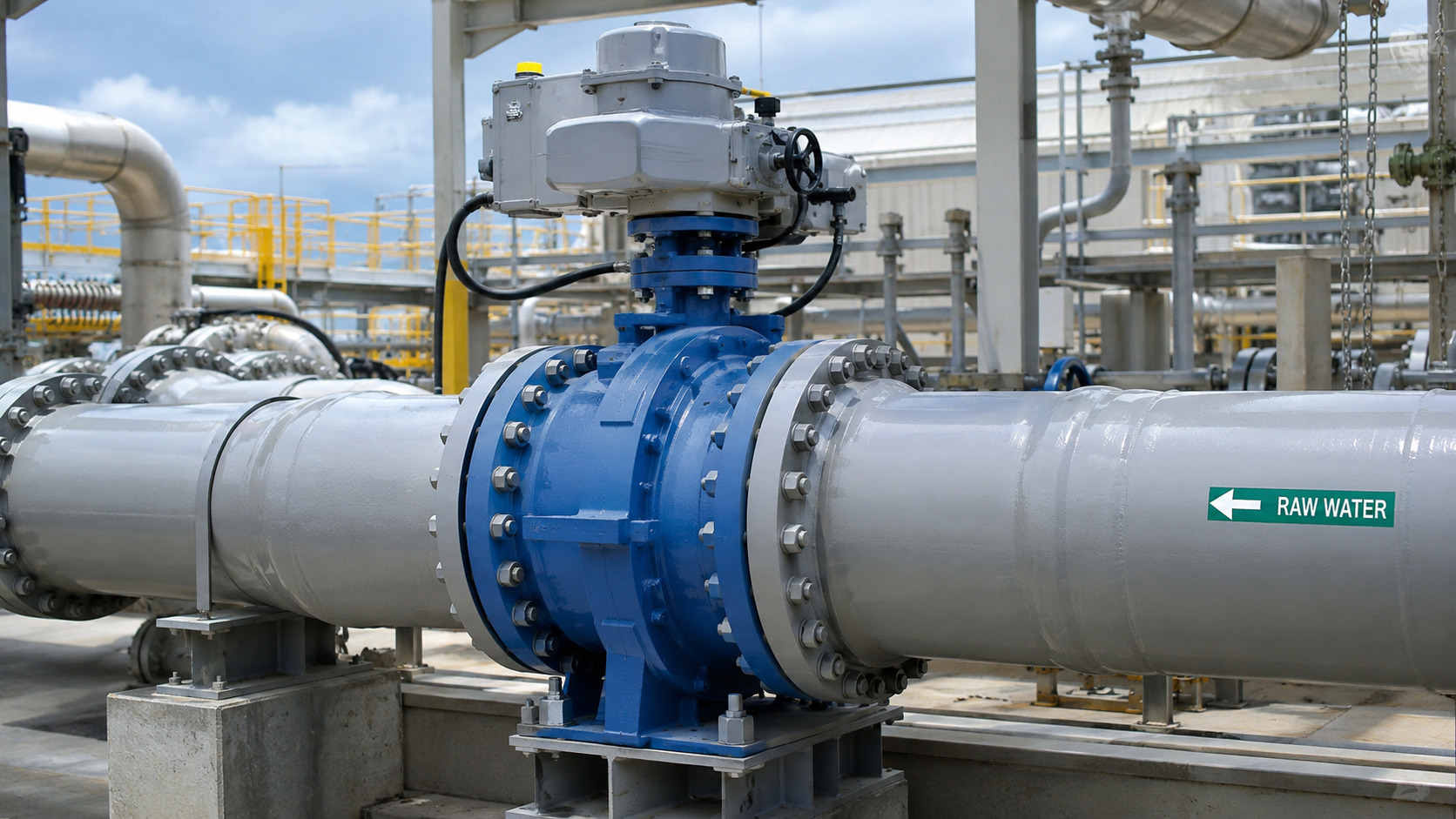
Butterfly valves are used to isolate, start, stop, and—when correctly sized—regulate the flow of liquids or gases in pipelines. They are especially useful when the line is large, installation space is limited, or fast quarter-turn operation is required. The important qualification is that “butterfly valve uses” describes several different duties; a valve that works well for clean-water isolation may be unsuitable for severe throttling, abrasive sludge, or a piggable line.
This guide connects each common use to the service conditions and construction that make it practical.
What a Butterfly Valve Actually Does
A butterfly valve controls a pipeline with a disc that rotates on a shaft through a quarter turn. At the closed position, the disc covers the flow passage and seals against the seat. At the open position, the disc aligns with the flow, although it remains inside the bore.
This simple arrangement gives the valve three possible roles:
- Isolation: Keep the valve fully open or fully closed to separate equipment or a section of pipe.
- Flow control: Position the disc between open and closed to change flow, provided the valve has been sized for the required control range.
- Diversion or sequencing: Use an actuated valve as part of a process sequence, backwash cycle, bypass, or equipment changeover.
The body, disc, shaft, seat, bearings, and operator form one assembly. Changing any of them can alter torque, leakage, corrosion resistance, and control behavior.
Common Butterfly Valve Uses by System Duty
The most suitable butterfly valve uses combine high flow with compact installation in a service that does not require an unobstructed bore.
The table below separates the application name from the actual job the valve must perform.
| System or process | Typical valve duty | Conditions to confirm |
|---|---|---|
| Municipal water distribution | Main-line isolation, reservoir or zone separation | Water quality, pressure class, buried-service operator, potable-water approvals |
| Water and wastewater treatment | Intake isolation, filter sequencing, backwash, treated-water discharge | Solids content, cycle frequency, coating, seat compatibility, shutoff requirement |
| HVAC and district energy | Chilled-water or condenser-water isolation and modulation | Glycol content, temperature range, design flow, available pressure drop, actuator signal |
| Cooling-water and utility lines | Equipment isolation, bypass, general flow adjustment | Corrosion allowance, water chemistry, velocity, cycling frequency |
| Chemical processing | Tank, pump, heat-exchanger, or line isolation | Exact chemical and concentration, temperature, disc and seat compatibility, external leakage limit |
| Air and gas service | Shutoff, damper-like control, automated sequencing | Leakage class, gas compatibility, pressure differential, actuator fail position, hazardous-area requirements |
| Fire-protection water | Supervised isolation | Applicable system approval, tamper monitoring, normal position, inspection access |
In water treatment, the valve type should change as the media changes. RUITO’s water and wastewater valve application overview places butterfly valves in large-flow isolation and some modulating duties, but calls for full-bore designs in high-solids sludge service. The lesson is useful beyond water plants: select for the media at the valve, not for the name of the facility.
Why Engineers Select Butterfly Valves
Engineers select butterfly valves for their short face-to-face dimension, relatively low weight, quick operation, and scalable actuation. These benefits become more valuable as pipe diameter increases.
A 90-degree disc movement also makes electric, pneumatic, or hydraulic automation straightforward. The operator must still be sized for maximum differential pressure, seat friction, fluid forces, operating frequency, and the required fail position. “Quarter turn” describes travel; it does not prove that the actuator has enough torque to close the valve under the worst operating condition.
Wafer bodies fit between flanges with through-bolts, lug bodies provide threaded attachment points, and double-flanged bodies provide a more rigid connection. They are not interchangeable where one side of the line may be removed or pressurized independently.
Match the Construction to the Intended Use
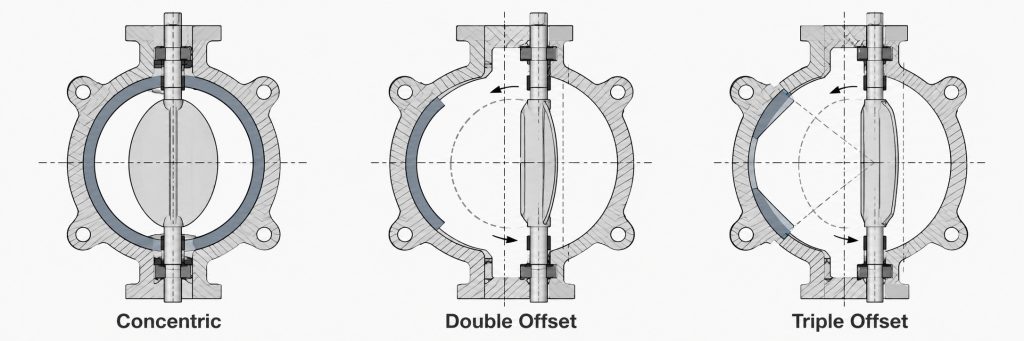
The construction must match the pressure, temperature, media, and shutoff duty; the word “butterfly” alone is not a specification. A practical first screen is to choose among concentric, double-offset, and triple-offset designs.
Concentric resilient-seated valves
Concentric valves center the shaft in the disc and use an elastomeric seat. They suit clean water, HVAC, and general utility isolation. Confirm seat compatibility, and do not assume a general-purpose design can sustain high differential-pressure throttling.
Double-offset valves
Double-offset geometry moves the shaft away from the seat and pipe centerlines, so the disc cams away during opening and reduces sliding contact. It suits services needing lower seat wear or greater pressure-temperature capability.
Triple-offset valves
Triple-offset valves add conical seating and normally use a metal seat. They suit higher-temperature or severe services requiring controlled contact and defined leakage performance. Still confirm the rating, materials, test basis, and flow direction.
RUITO’s published industrial butterfly valve range covers DN25 to DN3000 and PN10 to PN25, with a stated overall temperature span of -40°C to +550°C that depends on material and construction. Listed options include ductile iron, carbon steel, stainless steel, duplex, EPDM, NBR, PTFE, FKM, and metal seating. Those figures describe the portfolio, not one universal configuration, so use the selected valve’s data sheet for the final limits.
Can a Butterfly Valve Regulate Flow?
A butterfly valve can regulate flow when its Cv or Kv curve, available pressure drop, actuator, and usable travel range match the process. It should not be selected for control merely because the disc can stop at an intermediate angle.
For control, define minimum, normal, and maximum flow; upstream and downstream pressure; fluid density, viscosity, temperature, and vapor pressure; and the required shutoff. Then compare the required capacity with Cv or Kv by disc angle. A full-open coefficient alone does not prove smooth control at normal load.
High pressure recovery also matters. ISA’s control-valve guidance explains that butterfly valves can create a pronounced internal pressure dip and that cavitation or choking depends on fluid properties, flow, pressures, temperature, piping, and valve construction. Noise, vibration, unstable control, and pitted surfaces are warning signs that the duty needs a new sizing review or a different valve style.
For a practical sizing workflow, review the butterfly valve flow characteristics instead of treating percent open as percent flow. If normal operation sits near an end of travel, the valve may pass the design flow yet provide poor control authority.
When a Butterfly Valve Is the Wrong Choice
A butterfly valve is the wrong choice when the disc in the bore conflicts with cleaning, solids handling, control, or pressure-loss requirements. Check these exclusions before comparing prices:
- The line must be pigged or swabbed. The disc and shaft obstruct the bore.
- The media contains dense, stringy, settling, or abrasive solids. Material can pack around the disc and seat; a full-bore or slurry-specific valve may be safer.
- The process needs precise low-flow control across a wide range. A characterized control valve may provide better installed gain and cavitation resistance.
- The available pressure drop is severe. A high-recovery rotary valve can expose the disc, seat, and downstream pipe to damaging cavitation or noise.
- Very low permanent pressure loss is essential. Even fully open, the disc remains in the flow path.
- The body cannot provide the required function. Do not assume a wafer valve is rated for dead-end service or seals equally in both directions.
- The shutoff, fire-safe, sanitary, emissions, or approval requirement is undefined. “Tight shutoff” is not a test criterion; specify the leakage class and test standard.
If an exclusion applies, compare the duty against gate, ball, globe, plug, knife-gate, or purpose-built control valves. This valve-type selection comparison provides a useful next check without changing the core question: which geometry fits the service?
Turn the Intended Use Into a Verifiable Specification
A verifiable specification converts the intended use into operating data, construction requirements, and acceptance evidence. Send at least the following information with an inquiry or data-sheet request:
- Fluid name, composition, concentration, solids content, and any cleaning media.
- Minimum, normal, and maximum temperature.
- Working and design pressure, plus maximum differential pressure at shutoff.
- Minimum, normal, and maximum flow, and allowable pressure drop if the valve controls flow.
- Pipe size, flange drilling, face-to-face requirement, and body style.
- Body, disc, shaft, and seat material requirements; verify the elastomer against the exact media rather than relying on a generic label. A focused butterfly valve seal selection review can help identify the data needed.
- Manual or automated operation, power or air supply, control signal, cycle frequency, fail position, and position feedback.
- Required leakage performance, design standard, pressure-test standard, material certificates, coating documentation, and witness or inspection requirements.
Standards must match the use. The current AWWA standards list separates C504 rubber-seated valves, C516 valves of 78 inches and larger, and C519 high-performance waterworks valves from 3 to 60 inches. Writing only “AWWA butterfly valve” leaves the acceptance basis unclear.
Before approval, compare the quotation, drawing, data sheet, Cv or Kv curve, torque basis, pressure-temperature rating, and test plan against the same operating conditions. This final cross-check catches a common procurement error: a valve that matches nominal size and pressure class but not the real duty.
Choose by Duty, Not by Industry Label
Butterfly valves perform best in large-flow isolation and suitable modulating services where compact size, low weight, and fast operation matter. Their practical limits come from the disc in the bore, the chosen seat and offset geometry, the available pressure drop, and the quality of the sizing and acceptance data.
If you are evaluating a real project, send the fluid, flow, pressure, temperature, connection, leakage, and actuation requirements through the RUITO engineering contact page. We can review the proposed use against a specific construction and identify which drawings, curves, material records, and test documents should be confirmed before ordering.
FAQ
Can a butterfly valve be installed in either flow direction?
Some are bidirectional, but not every design has the same shutoff rating both ways. Check the marked direction, preferred pressure side, torque data, and leakage test basis.
Is a butterfly valve suitable for dead-end service?
Only when the body, bolting, and rating explicitly allow it at the required differential pressure. Never treat a standard wafer valve as one-sided isolation without written confirmation.
What data is needed to size a butterfly valve actuator?
Actuator sizing needs the valve design, maximum differential pressure, fluid, temperature, seat, operating time, cycle frequency, safety factor, and fail position. Use torque data for the selected configuration.
Can butterfly valves be used for gas service?
Yes, when the pressure rating, seals, leakage class, actuator, and hazardous-area requirements fit. Define whether the duty needs isolation, modulation, fire-safe construction, or emissions control.