
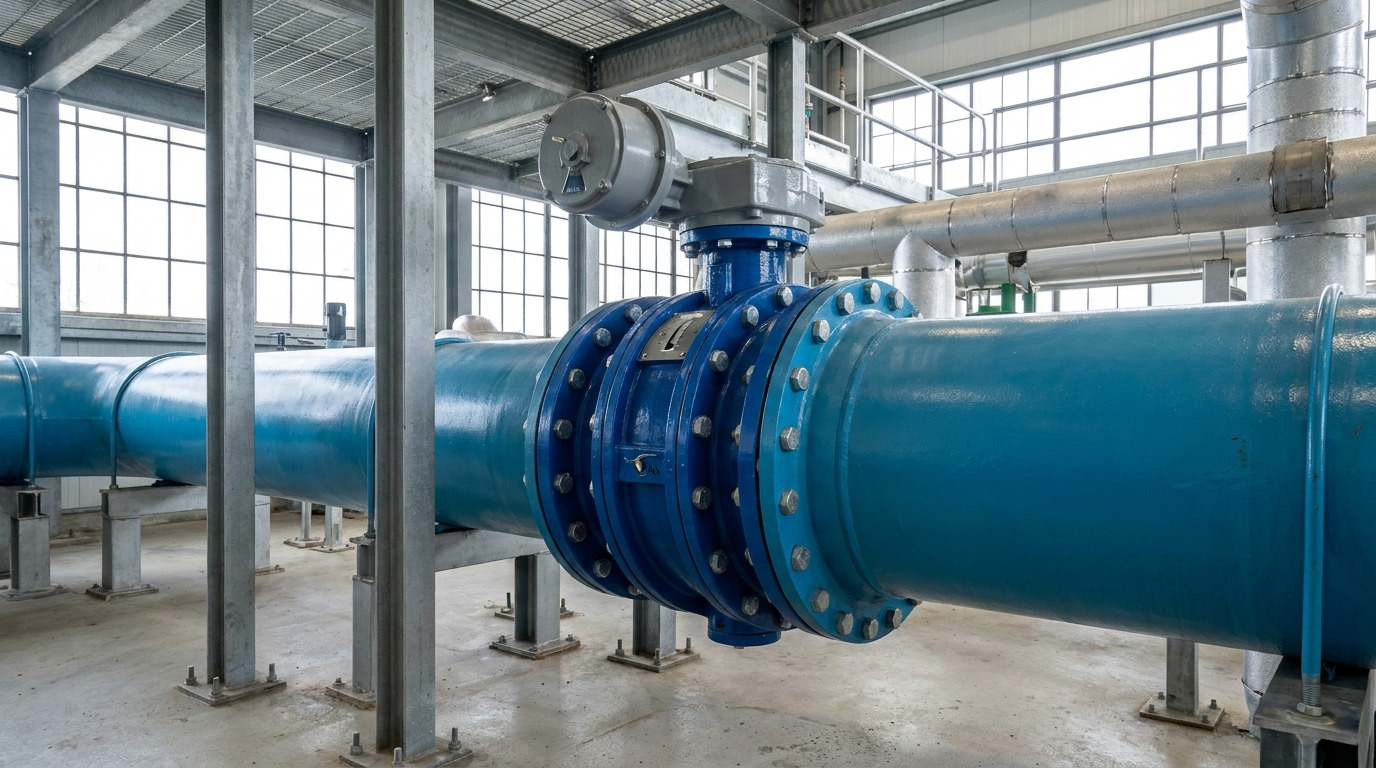
An AWWA C504 butterfly valve is a rubber-seated, quarter-turn valve designed for waterworks service. Selecting one can become difficult when pressure class, seat chemistry, flange dimensions, actuator torque, and project documentation come from different specifications. A mismatched valve may leak, wear prematurely, or delay site acceptance.
A properly specified AWWA C504 butterfly valve resolves those risks through defined design, material, testing, and performance requirements. This guide shows you how such valves work and how to select a dependable configuration for your project.
What Is an AWWA C504 Butterfly Valve?
An AWWA C504 butterfly valve is a resilient-seated valve built around requirements published by the American Water Works Association. Its rotating disc opens, restricts, or stops flow through a 90-degree movement.
What separates this valve from a generic design?
Here’s the practical difference: a generic butterfly valve may meet a manufacturer’s internal specification without satisfying waterworks project requirements. C504 addresses areas that buyers need documented, including:
- Body and end configuration
- Shaft and disc construction
- Resilient seating system
- Actuator performance
- Production testing
These requirements give you a common purchasing basis across bids.
What value does C504 provide during procurement?
Why does that matter? C504 helps engineers compare valves using shared technical criteria rather than price or nominal diameter alone.
| Procurement Area | C504-Based Requirement | Buyer Benefit |
|---|---|---|
| Design | Defined mechanical criteria | Clear bid comparison |
| Testing | Documented acceptance checks | Lower inspection risk |
| Actuation | Operating requirements | Safer torque selection |
This comparison shows why a standard designation must connect with actual project data.
Key Takeaway: C504 gives you a structured basis for evaluating a rubber-seated waterworks valve.
Where Is an AWWA C504 Butterfly Valve Used?
An AWWA C504 butterfly valve is used mainly in raw water, potable water, wastewater, and reclaimed-water systems. Typical locations include treatment plants, pumping stations, reservoirs, transmission mains, and distribution networks.
Which operating scenarios suit this valve?
Here’s where it fits: water utilities often need compact isolation equipment for large pipe diameters. Common duties include:
- Pump discharge isolation
- Reservoir inlet control
- Filter gallery service
- Buried transmission mains
- Treatment-process piping
You should still confirm water chemistry, temperature, solids content, and operating frequency.
When might another valve design work better?
Here’s the catch: C504 should not be treated as a universal choice for steam, aggressive chemicals, gas, or abrasive slurry.
| Service Condition | General Suitability | Required Review |
|---|---|---|
| Clean water | Strong | Seat and coating |
| Wastewater | Project-dependent | Solids and velocity |
| High-temperature steam | Poor | Metal-seat alternative |
This service screen quickly identifies applications needing extra engineering review.
Key Takeaway: Use C504 for compatible water service after checking every operating condition.
Which Sizes Does an AWWA C504 Butterfly Valve Cover?
An AWWA C504 butterfly valve generally covers rubber-seated waterworks valves from 3 through 72 inches, or 75 through 1,800 millimeters. C504-23 remains listed by AWWA as its current published edition for this valve category.
Which service boundaries should you verify?
What belongs on your checklist? Published scope information associates C504 with water having a pH range of 6–12 and temperatures from 33°F through 125°F. Confirm these items before requesting a quotation:
- Nominal valve size
- Working and differential pressure
- Water temperature
- Fluid velocity
- Installation orientation
Project specifications may impose tighter boundaries than C504.
Why can nominal size be misleading?
Now for the practical part: matching pipe diameter does not automatically confirm hydraulic or dimensional suitability.
| Parameter | What It Describes | Verification Source |
|---|---|---|
| Nominal size | Pipeline designation | Piping schedule |
| Face-to-face | Installed body length | Approved drawing |
| Flange drilling | Bolt pattern | Project flange standard |
This distinction prevents a correctly sized valve from arriving with an incompatible connection.
Key Takeaway: Confirm size, pressure, velocity, and dimensions as one coordinated data set.
Which Materials Suit an AWWA C504 Butterfly Valve?
An AWWA C504 butterfly valve requires materials matched with water chemistry, temperature, coating conditions, and expected service life. Ductile iron bodies, stainless-steel shafts, coated discs, and elastomer seats form a common waterworks configuration.
How should you select seat material?
Here’s the deciding factor: fluid compatibility matters more than habit. Review:
- EPDM for many potable-water duties
- NBR where compatible oils may occur
- Natural rubber for selected abrasion duties
- Special compounds for disinfectant exposure
Potable-water projects may also require recognized sanitary approvals for wetted components.
What should you check beyond body material?
Look beneath the surface: disc coating, shaft grade, fasteners, and seat-retaining parts can govern service life.
| Component | Common Option | Main Selection Issue |
|---|---|---|
| Body | Ductile iron | Pressure and coating |
| Shaft | Stainless steel | Strength and corrosion |
| Seat | EPDM or NBR | Media compatibility |
This material map helps expose weak components hidden behind a suitable body specification.
Key Takeaway: Review every wetted and load-bearing component rather than naming only a body material.
How Does an AWWA C504 Butterfly Valve Seal?
An AWWA C504 butterfly valve seals through controlled contact between a resilient seat and its mating surface. Closing movement compresses that elastomer enough to stop flow without creating excessive operating torque.
What affects shutoff performance?
This is where details count: dependable shutoff comes from several interacting features. You should review:
- Seat location and retention method
- Mating-surface finish
- Disc and shaft alignment
- Differential-pressure direction
- Elastomer condition
A “zero leakage” claim has little value without defined test pressure, medium, duration, and acceptance criteria.
Why does seat compression need control?
Here’s the balance: insufficient compression may permit leakage while excessive compression raises torque and accelerates wear.
| Seat Condition | Likely Result | Corrective Focus |
|---|---|---|
| Too little contact | Seat leakage | Alignment and dimensions |
| Correct contact | Stable shutoff | Verified assembly |
| Excess contact | High torque | Seat and disc geometry |
This pattern links sealing symptoms with likely mechanical causes.
Key Takeaway: Specify measurable leakage criteria and verify seat contact during testing.
How Should You Size an AWWA C504 Butterfly Valve?
An AWWA C504 butterfly valve should be sized using flow rate, available pressure drop, velocity, and operating duty rather than pipe diameter alone. Line-size selection may suit isolation service yet perform poorly when used for regular throttling.
Which sizing data should you provide?
Here’s what engineers need: accurate sizing starts with real operating points. Supply:
- Minimum, normal, and maximum flow
- Upstream and downstream pressure
- Water temperature and density
- Pipe diameter and schedule
- Isolation or throttling duty
These values support Cv review and reveal unsuitable operating angles.
How does sizing affect actuation?
The connection is direct: valve size, differential pressure, velocity, and seat friction all influence required torque. A detailed actuator torque review should use manufacturer data plus a suitable application margin.
| Sizing Error | Operating Effect | Project Risk |
|---|---|---|
| Oversized valve | Sensitive low-angle control | Unstable flow |
| Undersized valve | High velocity and loss | Noise or wear |
| Correct sizing | Usable operating range | Predictable control |
This table shows why hydraulic sizing and actuator sizing belong in one review.
Key Takeaway: Share real flow cases so your valve works across its full operating envelope.
Which Body Design Fits an AWWA C504 Butterfly Valve?
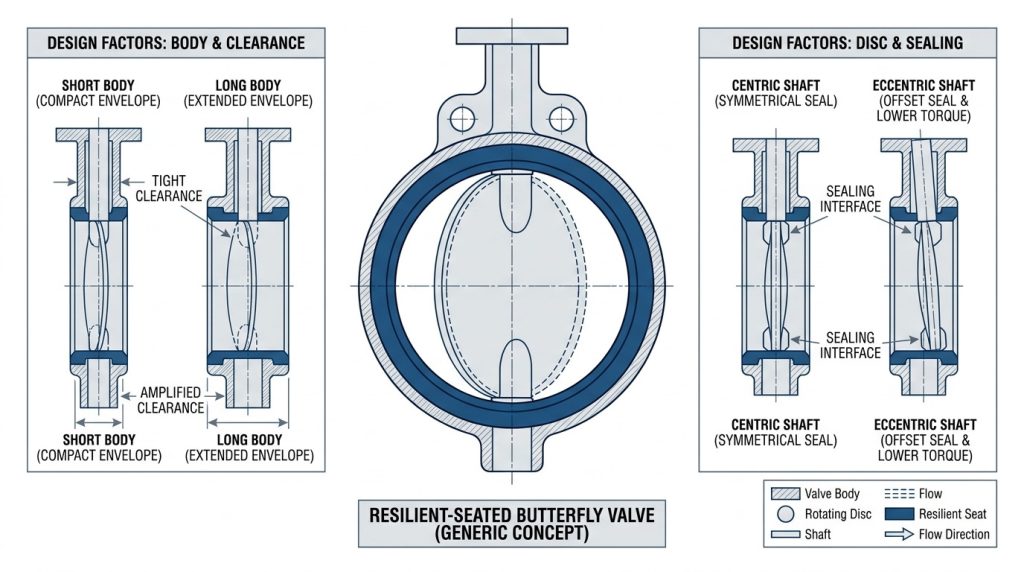
An AWWA C504 butterfly valve may use configurations suited to installation access, pipe layout, pressure duty, and maintenance plans. Flanged bodies are widely associated with waterworks service while project requirements govern final construction.
How do concentric and eccentric designs differ?
Here’s the mechanical distinction: a concentric design keeps its shaft near the disc centerline while an eccentric arrangement offsets moving parts. Compare:
- Seat contact throughout disc travel
- Opening and closing torque
- Wear near shutoff
- Repair access
- Bidirectional pressure needs
An eccentric design can reduce rubbing during movement when correctly engineered.
Which body details affect installation?
What can derail field work? face-to-face length, flange drilling, actuator orientation, and disc clearance often create fit problems.
| Design Detail | Site Check | Risk if Missed |
|---|---|---|
| Face-to-face | Available pipe gap | Rework |
| Disc swing | Internal clearance | Disc damage |
| Flange pattern | Bolt alignment | Installation delay |
This fit review should occur before drawings receive approval.
Key Takeaway: Select body geometry through dimensional and mechanical checks rather than product naming alone.
How Should an AWWA C504 Butterfly Valve Be Actuated?
An AWWA C504 butterfly valve should use an actuator sized for seating, unseating, running, and dynamic torque under specified differential pressure. Manual gear operators suit many isolation points while electric, pneumatic, or hydraulic units support remote operation.
Which actuator type matches your project?
Here’s a quick filter: choose actuation around available utilities and control needs. Common options include:
- Gearbox for local manual isolation
- Electric actuator for remote plant control
- Pneumatic actuator for fast cycling
- Hydraulic actuator for high-output duties
- Buried operator with extension stem
You should also define fail position, cycle rate, enclosure rating, and feedback signals.
Why should torque margin remain controlled?
More torque is not always safer: an oversized actuator can damage shafts, seats, keys, or gear components.
| Torque Element | What It Represents | Design Response |
|---|---|---|
| Seating torque | Final shutoff load | Confirm seat limit |
| Dynamic torque | Flow-induced load | Check velocity |
| Safety margin | Application allowance | Apply stated basis |
This torque breakdown helps you challenge vague actuator selections.
Key Takeaway: Match actuator output with every operating load and protected component limit.
How Do You Specify an AWWA C504 Butterfly Valve?
An AWWA C504 butterfly valve should be specified with edition, size, pressure, service conditions, materials, connections, actuation, testing, coatings, and documentation. Writing only “C504 valve” leaves several commercial and technical decisions unresolved.
What belongs in your purchase specification?
Here’s a workable structure: record each requirement in a valve data sheet. Include:
- Applicable standard and edition
- Water type, pH, and temperature
- Pressure and flow conditions
- Body, disc, shaft, and seat materials
- Coating and sanitary approval
- Actuator and control requirements
Add drawing approval and document-submittal dates to your procurement schedule.
Which documents should accompany each order?
Documentation closes the gap: certificates and test reports connect supplied hardware with approved requirements.
| Document | Review Purpose | Typical Timing |
|---|---|---|
| General arrangement | Dimensional approval | Before production |
| Material records | Traceability | Before shipment |
| Test report | Performance evidence | Before release |
This document set supports faster inspection and cleaner project handover.
Key Takeaway: A complete data sheet reduces assumptions across engineering, manufacturing, and site teams.
How Do You Inspect an AWWA C504 Butterfly Valve?
An AWWA C504 butterfly valve should be inspected against approved drawings, purchase specifications, material records, coatings, operation, and pressure-test results. Inspection depth should reflect project risk, quantity, and service conditions.
Which checks belong in an inspection plan?
Here’s a sensible sequence: combine document review with physical verification. Common hold points cover:
- Material identification
- Dimensions and flange drilling
- Coating condition and thickness
- Assembly and travel
- Shell and seat testing
- Marking and packaging
Witness requirements should be agreed before production begins.
What should happen before shipment?
This is your last control point: resolve deviations and verify that released documents match valve identification.
| Release Item | Acceptance Basis | Evidence |
|---|---|---|
| Pressure test | Approved procedure | Signed report |
| Visual condition | Project specification | Inspection record |
| Identification | Purchase order | Nameplate check |
This release gate keeps unresolved issues from moving toward site.
Key Takeaway: Tie every inspection activity to a written acceptance criterion and retained record.
Are You Ready to Specify the Right Waterworks Valve?
You now have a practical framework covering C504 scope, applications, materials, sealing, sizing, body design, actuation, procurement, and inspection. A precise specification protects your schedule while giving suppliers a clear basis for engineering and testing.
Share your operating data and project requirements when you contact us today. We can support valve selection, technical review, drawings, material coordination, and manufacturing documentation. Our position is simple: dependable water infrastructure starts with valves engineered around real service conditions.
What Do Buyers Ask About AWWA C504 Valves?
Can I use an AWWA C504 valve for potable water?
Yes, when its materials and coatings suit potable-water service. Confirm required sanitary approvals, water chemistry, temperature, and local regulatory requirements before ordering.
What’s the best seat material for treated water?
EPDM often provides a practical choice for treated water. Your final selection should reflect disinfectant concentration, temperature, pressure, and approval requirements.
How do I know if my valve actuator is large enough?
Compare actuator output against seating, unseating, running, and dynamic torque across specified pressure conditions. Apply a documented margin without exceeding valve-component limits.
Can I use this valve for throttling service?
Yes, within a suitable operating range supported by hydraulic data. Confirm Cv, pressure drop, velocity, cavitation risk, and expected disc angle at each flow case.
How do I know if a supplier meets C504 requirements?
Request an itemized compliance statement, approved drawings, material records, coating data, and pressure-test reports. Review any exceptions before production approval.