
Select an API 609 butterfly valve by treating API 609 as a design-and-rating framework, then proving that the offered valve fits your medium, pressure, temperature, piping, shutoff, and operating duty. The standard creates a common technical basis, but the label alone does not tell you whether a particular seat will survive your fluid, whether the disc will clear the pipe, or whether the actuator can close against maximum differential pressure.
A typical RFQ lists only size, pressure class, and “API 609.” Suppliers can then quote different categories, body styles, seats, test conditions, and actuator assumptions. The prices may look comparable even though the valves are not. The practical solution is to define the service first and require evidence for every compliance claim.
RUITO’s published industrial butterfly valve range covers DN25 to DN3000, PN10 to PN25, and material-dependent temperatures from -40°C to +550°C, with wafer, lug, and flanged configurations. Those figures describe a portfolio containing multiple designs and material sets; they are not a single valve’s operating envelope. Your approved data sheet must state the limits of the exact configuration offered.
What API 609 Establishes and What It Leaves Open
API 609 establishes requirements for covered butterfly-valve configurations, but it does not complete the application specification for you. Its scope includes double-flanged, lug, wafer, and butt-welding-end designs, together with requirements concerning design, materials, dimensions, ratings, inspection, testing, and marking.
Edition control matters in 2026. API’s 10th Edition update states that the new edition was published in May 2026 and becomes effective on December 1, 2026. During this transition, write the required edition in the RFQ, purchase order, approved drawing, and inspection plan. Do not assume that “latest edition” means the same thing to the owner, EPC, supplier, and inspector.
API 609 does not automatically select a seat material, establish suitability for your chemical concentration, prove fire-safe performance, size an actuator, or approve a valve for dead-end service. It also does not make every valve carrying the same nominal class interchangeable. Those decisions remain tied to the offered design and your project conditions.
Category A and Category B Use Different Rating Logic
The useful first distinction is the rating basis: Category A uses a manufacturer-rated cold working pressure, while Category B uses an ASME Class pressure-temperature basis. Construction often follows that split, but you should not choose the category from a shorthand such as “water equals A” or “process fluid equals B.”
Use this comparison to decide what must appear in the quotation.
| Decision point | Category A | Category B |
|---|---|---|
| Rating basis | Manufacturer-rated CWP | ASME Class pressure-temperature rating |
| Common construction | Usually concentric and resilient-seated | Commonly double-offset or triple-offset; seat design varies |
| Typical selection driver | Moderate-temperature utility duty within published seat and CWP limits | Class-rated process duty, higher differential pressure, temperature, cycling, or demanding shutoff |
| Evidence to request | CWP, seat limit, medium compatibility, size, and drilling pattern | Body rating, seat rating, pressure-temperature table, differential-pressure limit, and shutoff direction |
| Main purchasing risk | Treating ambient CWP as a high-temperature rating | Assuming the seat can seal at every condition allowed by the body class |
The decisive point is that body rating and seat rating are not necessarily identical. A class-rated body may remain structurally acceptable at a condition where the selected seat cannot provide the required shutoff. If you are deciding whether process severity justifies an offset design, use the high-performance butterfly valve comparison as the next review, then confirm the actual supplier curves and limits.
Build the Specification From the Service Envelope
A reliable specification starts with the service envelope, not with the valve catalog. The supplier needs enough data to determine category, materials, geometry, sealing system, and actuation without filling gaps with assumptions.
Capture operating and design conditions separately
Provide the following as a minimum:
- Medium, composition or concentration, solids content, and any cleaning fluid
- Minimum, normal, and maximum operating pressure and temperature
- Design pressure and design temperature
- Maximum differential pressure in the closed, opening, and throttling conditions
- Line size, pipe schedule or bore, flange standard, facing, and gasket type
- Required function: isolation, emergency shutoff, throttling, or modulating control
- Flow direction, shutoff direction, bidirectional requirement, and leakage acceptance
- Cycle frequency, actuator power source, fail position, and required closing time
- Outdoor, buried, marine, hazardous-area, or other environmental conditions
Separate operating values from design values because they answer different questions. Normal conditions affect control behavior and wear, while design extremes affect pressure containment, material limits, and actuator sizing.
Apply the lowest verified limit
The usable rating of an API 609 butterfly valve is the lowest verified limit among the body, seat, shaft seal, end connection, and actuator torque. Check each element at the same temperature, differential pressure, flow direction, and operating state. A body pressure class, a generic seat temperature range, or a full-open torque value cannot substitute for that combined check.
This rule also prevents a common material mistake. “Stainless steel body” does not prove that the disc, shaft, seat, packing, bearings, or fasteners are compatible with the medium. Review the complete bill of materials and identify every wetted or pressure-retaining component.
Check Body Style, Flange Fit, and Disc Clearance
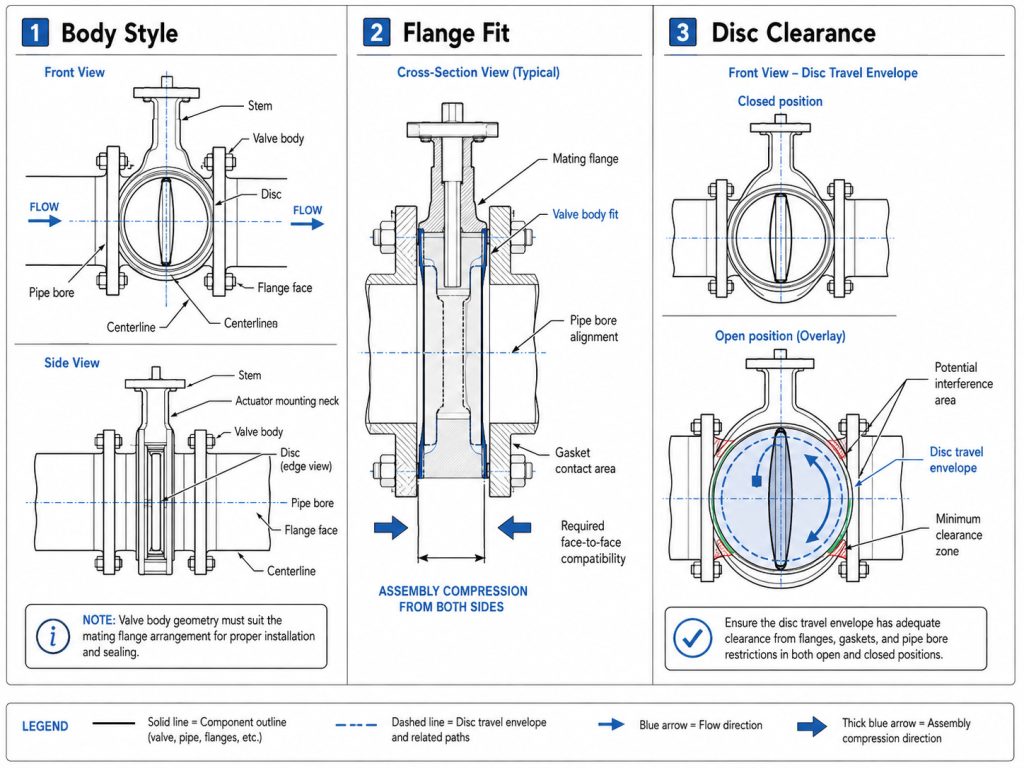
Body style determines how the valve is installed, supported, removed, and loaded, so it must be verified independently of size and class. A nominal match can still fail at site because of face-to-face length, flange drilling, gasket interference, or disc contact with the pipe bore.
This table connects each configuration with the installation evidence you need.
| Body style | Practical use | Mandatory fit check |
|---|---|---|
| Wafer | Compact installation between two flanges | Flange standard, through-bolt arrangement, centering, gasket contact, and disc swing |
| Lug | Independent bolting on both sides; may support one-sided isolation when specifically rated | Lug thread, bolt engagement, pressure direction, allowable dead-end pressure, and downstream-removal condition |
| Double-flanged | Larger sizes, heavier piping duty, or permanent flanged installation | Long or short pattern, face-to-face length, flange series, bore, support, and actuator envelope |
| Butt-welding end | Welded process piping where the project specifically permits this construction | End preparation, material and weld compatibility, heat-treatment requirements, and maintenance strategy |
The most important point is that a lug body is not automatically approved for full-pressure dead-end service. Require the allowable dead-end pressure, direction, bolting arrangement, and operating restriction on the data sheet. For a broader installation review, see the butterfly valve characteristics checklist.
For wafer and lug valves, also compare the proposed valve drawing with the actual flange bore, pipe inside diameter, liner thickness, and gasket. The disc projects beyond the body during travel. If that swept envelope is not checked, the valve may assemble correctly but bind or damage its sealing edge on the first operation.
Separate Shutoff, Fire Safety, and Control Duty
Shutoff performance, fire-safe qualification, and throttling capability are separate requirements; one claim does not prove the other two. Put each required result and its acceptance basis in the project documents.
Define the shutoff test
State the test standard, test medium, shell and closure pressures, permitted leakage, pressure direction, and whether the closure test is unidirectional or bidirectional. API 609 is the butterfly-valve standard, while API 598 is a separate valve inspection and testing standard; the current editions and publication dates are listed in API’s standards plan. If the project requires API 598, say so rather than asking for a valve “tested as standard.”
Specify fire-safe qualification separately
API 609 compliance does not by itself prove fire-safe performance. If fire exposure is part of the hazard basis, identify the applicable fire-test standard, valve configuration, size and class coverage, seat design, and certificate or report required for acceptance. Confirm that the qualification covers the offered valve instead of accepting a certificate for a different family.
Treat throttling as a sizing task
An API 609 valve can be used for control only when its flow characteristic, operating angle, pressure drop, cavitation or noise risk, and actuator resolution suit the system. Request Cv or Kv by opening angle, not only the full-open value. The butterfly valve flow-characteristics method explains how to test minimum, normal, and maximum flow against the usable travel range.
Turn Compliance Claims Into Supplier Evidence
A compliance statement becomes useful only when a document lets engineering, procurement, and inspection verify it. Build the submittal register at RFQ stage so missing evidence is visible before commercial approval.
Use this evidence matrix when comparing offers.
| Supplier claim | Evidence to request | What to verify |
|---|---|---|
| API 609 compliance | Data sheet, general arrangement drawing, nameplate or marking proposal | Edition, category, body style, size, class or CWP, and exact offered model |
| Pressure-temperature capability | Body and seat rating tables | Offered materials, temperature, differential pressure, and any derating |
| Material compatibility | Bill of materials and material certificates | Grade, heat or batch traceability, wetted parts, and specified special requirements |
| Dimensional fit | Approved drawing and dimensional schedule | Face-to-face, flange standard and series, bore, disc swing, bolting, and actuator clearance |
| Shutoff performance | Inspection and test plan plus signed test report | Test standard, medium, pressure, duration, direction, and leakage acceptance |
| Actuator adequacy | Valve torque basis and actuator data sheet | Seating, unseating, dynamic torque, safety factor, air or power condition, and fail mode |
| Special qualification | Applicable certificate and scope page | Standard edition, test specimen, valve family, size and class range, and exclusions |
The value of this matrix is comparability. Two offers should not be treated as technically equal until their documents prove the same duty and acceptance criteria.
For RUITO projects, our published process provides technical data sheets and dimensional drawings for review, applies hydrostatic testing and inspection during production, and supplies test certificates and manuals with shipment. Project-specific requirements still belong in the purchase order and inspection plan; the documents must identify the actual valves delivered.
Run Two Gates Before Purchase Approval
Purchase approval should pass two independent gates: standard compliance and application suitability. Passing only one creates either a noncompliant valve or a compliant valve that fails in service.
Gate 1 checks the stated standard
Confirm the API 609 edition, Category A or B, body style, rating basis, dimensions, materials, marking, and required inspection or testing. Record every exception and deviation in the supplier’s offer. Silence is not approval.
Gate 2 checks the real duty
Confirm media compatibility, pressure-temperature envelope, differential pressure, shutoff direction, dead-end requirement, disc clearance, flow range, torque, cycle duty, environment, and document package. Reject or clarify any offer that relies on a generic catalog range rather than the selected model’s data.
A clear RFQ should therefore include the service data, API 609 edition and category if specified, size, rating, body style, flange or weld details, complete materials, seat and leakage requirement, flow direction, actuator duty, quantity, inspection level, and deliverable documents. Ask suppliers to list deviations in a separate schedule. That single instruction prevents hidden substitutions from being buried in a quotation.
Specify the Valve, Not Just the Standard
API 609 gives you a disciplined basis for butterfly-valve design, rating, dimensions, inspection, and testing, but reliable selection comes from connecting that basis to the actual service. Decide the category from rating logic, apply the lowest component limit, prove piping fit, separate shutoff from fire and control claims, and approve the offer only when its documents close both review gates.
If you are preparing an RFQ or comparing technical offers, send your valve specification to our engineering team. RUITO can review the service conditions, configuration, materials, actuation, test requirements, and submittal list before quotation.
FAQ
Can an API 609 butterfly valve be used for steam?
Yes, but only when the category, body and trim materials, seat system, packing, pressure-temperature rating, leakage requirement, and actuator torque are valid for the stated steam conditions. A resilient-seated utility valve and a metal-seated offset valve can both be described under API 609 while having very different steam limits.
Do I need API 598 in addition to API 609?
Specify API 598 when the project requires its inspection and pressure-test basis. API 609 defines the butterfly-valve product requirements, while API 598 can provide a separate acceptance basis for shell and closure testing. The RFQ should state the required editions, test direction, medium, pressure, and leakage criteria.
Does a lug valve automatically qualify for dead-end service?
No. Lug construction makes independent flange bolting possible, but allowable dead-end pressure depends on the valve design, seat retention, lugs, fasteners, flow direction, temperature, and manufacturer rating. Require the exact one-sided pressure condition on the approved data sheet.