
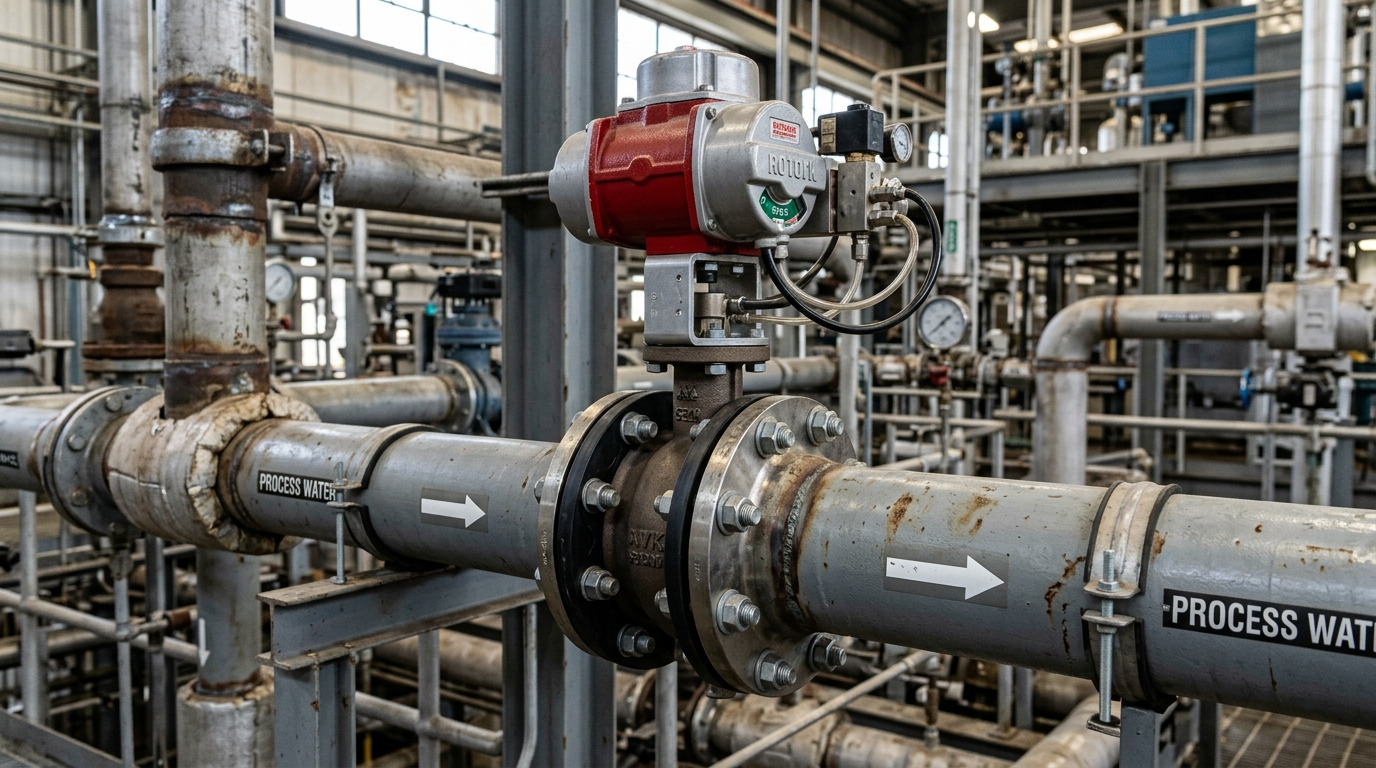
A rubber lined butterfly valve is a strong choice when you need compact, tight shutoff in a medium that is compatible with the elastomer, but it is only reliable when the liner, disc, pressure-temperature envelope, operating duty, and flange interface are specified together. Selecting by the words “rubber lined” alone can leave the actual wetted construction, chemical compatibility, and test basis undefined.
This matters in water, wastewater, HVAC, and general process lines where a resilient seal is attractive, yet a wrong compound or installation detail can cause swelling, hardening, disc binding, or flange leakage. Start with the service conditions, then compare them with an actual cross-section, material list, and test plan. RUITO’s industrial butterfly valve range provides wafer, lug, and flanged configurations with several body, disc, and sealing options for this type of review.
What the Rubber Lining Actually Does
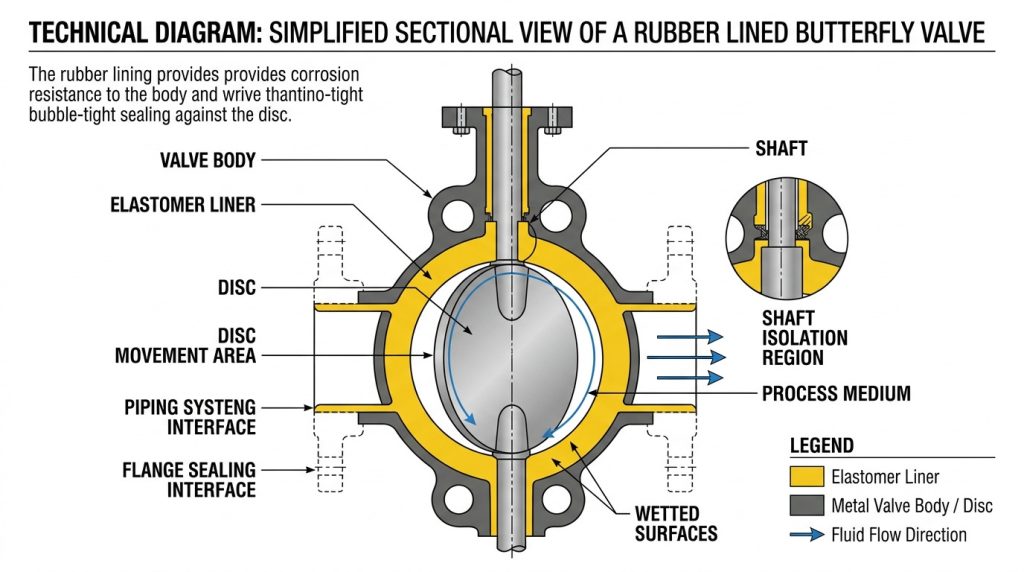
The rubber lining normally isolates the valve body from the process medium and forms the resilient sealing surface against the disc. In a concentric design, the shaft and disc share the same centerline, and the disc compresses the elastomer as it turns through approximately 90 degrees from open to closed.
The product name does not define the complete construction. Depending on the design, “rubber lined” may describe a replaceable sleeve that also seals against the pipe flanges, a bonded body liner, or a valve with both a lined body and an encapsulated disc. The disc edge, shaft penetrations, bushings, and liner retention method can still determine whether the valve survives the service.
Before approving a valve, confirm these details on the drawing and material list:
- Whether the liner is bonded or replaceable
- Whether the liner extends over the flange-contact faces
- The disc’s exposed material or encapsulation
- How the shaft is isolated from the medium
- Whether the seat is rated for bidirectional or dead-end shutoff
- Which component must be replaced if the sealing surface is damaged
This construction check prevents a common mistake: assuming that the valve body, disc, and shaft are all protected merely because the body is described as lined.
Where This Valve Fits—and Where It Does Not
A rubber lined butterfly valve fits compatible, moderate-temperature services where compact isolation, low operating torque, and tight resilient sealing matter. Typical candidates include clean or treated water, cooling water, HVAC circuits, selected wastewater duties, and certain dilute chemical solutions.
The medium name is only the first screening step. Within water and wastewater valve applications, clean water, raw water, sewage, chemical dosing, and sludge impose very different demands. Suspended grit can cut the seat edge, fibrous solids can obstruct closure, and chemicals used for cleaning or dosing can attack an otherwise suitable liner.
Use the following service pattern as an early go/no-go check.
| Service condition | Initial decision | What must be verified |
|---|---|---|
| Clean water or HVAC water | Usually a good candidate | Water chemistry, temperature, pressure, cycling, approvals |
| Wastewater with limited soft solids | Possible with the right design | Particle size, concentration, settling, velocity, disc clearance |
| Oil, fuel, or hydrocarbon service | Compound-dependent | Swelling resistance of the exact elastomer formulation |
| Dilute acid or alkali | Compound-dependent | Chemical identity, concentration, temperature, cleaning exposure |
| Abrasive or crystallizing slurry | High review priority | Solids hardness, velocity, deposition, seat-edge wear |
| Steam or sustained high temperature | Usually choose another seat system | Full pressure-temperature rating and thermal cycling |
| Fire-safe or severe high-pressure duty | Usually not a standard resilient-seat application | Required standard, leakage class, body and seat rating |
Rubber can resist abrasion in some applications, but “abrasion resistant” is not a universal approval for slurry. Particle hardness, shape, concentration, velocity, disc position, and cycle frequency determine whether the liner protects the valve or becomes the first wear component.
Select the Liner by Media, Not by Color
The liner should be selected from compound-specific compatibility data for the actual fluid, concentration, temperature, and cleaning method. Generic elastomer names are useful for screening, but compounding, curing, hardness, and reinforcement can change performance.
This table provides a starting point, not a final material approval.
| Elastomer | Common starting point | Recheck or reject when |
|---|---|---|
| EPDM | Water, HVAC water, weather-exposed aqueous service, some dilute chemicals | Oils, fuels, hydrocarbons, or incompatible cleaning agents are present |
| NBR | Oils, fuels, compressed air, and some water duties | Ozone, weathering, polar solvents, or incompatible chemicals dominate |
| FKM | Many hydrocarbon and higher-temperature chemical duties | Hot water, steam, amines, or other incompatible media are present |
| Natural rubber | Selected abrasive water or slurry duties | Oil exposure, oxidation, or temperature exceeds the compound limit |
| CR (neoprene) | Water, weathering, and selected mild chemical service | Strong chemicals or temperatures exceed published limits |
Do not approve the liner independently of the other wetted parts. A compatible EPDM liner does not correct an incompatible exposed disc, unprotected shaft area, coating defect, or unsuitable bushing. Ask for one wetted-material schedule that identifies every component exposed during normal operation, partial opening, and shutdown.
Match Pressure, Temperature, and Duty Together
The valve body rating does not by itself prove that the rubber seat can seal at every pressure and temperature within that body class. The liner often becomes the practical limit, and its capacity may change with temperature, differential pressure, vacuum, flow direction, and operating frequency.
When you compare butterfly valve characteristics, record normal and design conditions separately. At minimum, check:
- Minimum, normal, and maximum process temperature
- Startup, shutdown, cleaning, and short-duration temperature excursions
- Normal line pressure, design pressure, surge pressure, and full shutoff differential
- Vacuum conditions and reverse pressure, if applicable
- Unidirectional, bidirectional, or dead-end isolation
- Cycle frequency and the longest expected idle period
A valve that passes a room-temperature water test may still be unsuitable for a hot chemical line or a cold outdoor startup. Ask for the manufacturer’s pressure-temperature rating for the selected liner and valve design, not a generic temperature limit copied from an elastomer chart.
Check Flow and Actuation Before Calling It a Control Valve
A rubber lined butterfly valve can provide on-off isolation and coarse throttling, but it should not be treated as a precision control valve without flow and torque data. The disc remains in the flow path, and small angle changes can create large, nonlinear changes in capacity.
For throttling service, review butterfly valve flow characteristics at the expected operating points. Request Cv or Kv by opening angle rather than only a full-open value, then check pressure drop, velocity, noise, cavitation risk, and the time the valve will spend near closed position. High local velocity at the disc and seat can accelerate liner wear even when the fully open line velocity appears acceptable.
Actuator selection must use the valve manufacturer’s torque data at the maximum differential pressure. Include seating and unseating torque, bearing friction, media effects, cycle frequency, safety margin, fail position, available air or power supply, and required closing time. Choosing an actuator from nominal pipe size alone can produce a valve that opens during a bench test but stalls under operating load.
Verify the Flange Interface Before Installation
The flange interface must match the liner design because some extended resilient liners provide the flange seal and may not accept separate gaskets. Adding an unapproved gasket can alter compression, push elastomer into the bore, restrict disc travel, or create an external leak path.
Use the approved valve drawing and installation instructions to decide whether a separate gasket is required. The butterfly valve gasket selection guide explains how resilient wafer and lug designs differ from double-flanged and metal-seated arrangements.
Before bolting the valve into the line:
- Confirm the flange standard, facing, inside diameter, and bolt pattern.
- Check that the disc can rotate without contacting the pipe, liner, or gasket.
- Clean and align the flange faces without using the valve bolts to pull misaligned piping together.
- Center the valve, open the disc slightly as instructed, and tighten bolts in a controlled cross pattern.
- Recheck disc movement and actuator travel before pressure testing.
More bolt torque is not a remedy for poor alignment or the wrong sealing arrangement. Excess compression can distort a wafer body, damage the liner, increase operating torque, and make the original leak worse.
Turn “Tight Shutoff” Into an Inspectable Specification
“Tight shutoff” becomes useful only when the purchase specification defines how the result will be tested and documented. State the test standard and edition, test medium, pressure, duration, flow direction, allowable leakage, and whether the purchaser or a third party must witness the test.
ISO 5208:2015 covers tests used to establish pressure-boundary integrity and verify closure tightness, while noting that it is applied with the relevant valve product standard. That distinction matters: a shell test, a seat test, and an operating test prove different things.
For a project order, request an evidence package appropriate to the risk. RUITO can supply agreed documentation such as drawings, material certificates, dimensional inspection records, shell and seat test reports, tagging, and traceability records. The documents should identify the actual valve or batch and match the approved materials, pressure rating, and test scope; a generic certificate is not a substitute.
RFQ Checklist for Rubber Lined Butterfly Valves
A useful RFQ defines the service envelope and acceptance evidence, even if every parameter is not yet finalized. Send what you know and mark unresolved items for engineering review.
- Fluid name, composition, concentration, pH if relevant, and cleaning chemicals
- Solids type, hardness, particle size, concentration, and tendency to settle or crystallize
- Minimum, normal, maximum, startup, shutdown, and cleaning temperatures
- Working pressure, design pressure, maximum differential pressure, surge, and vacuum
- Pipe size, design flow range, and required Cv or Kv data for throttling
- Isolation, throttling, or modulating duty and expected cycles
- Unidirectional, bidirectional, or dead-end shutoff requirement
- Wafer, lug, or double-flanged body style and required face-to-face dimension
- Mating flange standard, facing, bore, and pipe inside diameter
- Liner compound, bonded or replaceable construction, and flange-sealing arrangement
- Body, disc, shaft, bushing, and all other wetted materials
- Manual, pneumatic, or electric operation; fail position; power supply; and closing time
- Design and test standards, leakage acceptance, witness points, and document package
- Quantity, delivery schedule, packing, tagging, and certification requirements
If the liner compound is still open, do not guess. Provide the media and full operating envelope so the manufacturer can propose a compound and state the limits that must appear on the approved data sheet.
Make the Final Choice From the Service Envelope
A reliable rubber lined butterfly valve selection connects five items: actual lined construction, complete wetted-material compatibility, pressure-temperature limits, flow and torque requirements, and verifiable shutoff testing. If any one of these remains undefined, the product name is carrying more certainty than the specification.
RUITO can review a complete data sheet or start with the information you already have, such as media, temperature, pressure, size range, duty, or an existing leakage problem. Share your current requirements through the RUITO contact page for a configuration review or quotation.
FAQ
Does the rubber lining protect the disc and shaft?
Not necessarily. Some valves line only the body and seat area, while others use an encapsulated disc or additional shaft isolation. Confirm every wetted component on the cross-sectional drawing and material schedule.
Can a rubber lined butterfly valve handle slurry?
It can handle some slurry services, but suitability depends on particle hardness, size, concentration, velocity, settling behavior, and valve cycling. Abrasive or crystallizing solids can damage the liner and disc edge, so the application needs a specific wear review.
Is a bonded liner better than a replaceable liner?
Neither construction is universally better. A bonded liner can provide stable retention, while a replaceable liner may simplify maintenance; the better choice depends on pressure, vacuum, chemical exposure, dimensional control, and the planned replacement method.
Does a rubber lined butterfly valve seal in both directions?
Only if the design is rated and tested for bidirectional shutoff. State the pressure direction, differential pressure, and any dead-end requirement in the RFQ, then require the test record to match that condition.